Ursula’s war…

Over the last few days I’ve been reading Ursula Bloom’s memoir of her life as a young woman during the first world war.

It’s not history, it’s very much a personal memoir, but on another level it is an important resource describing how people in Britain on the Home Front felt about the war and a developing sense of cynicism about its progress.

Much of British World War One history focuses on generals, the hell of the Western Front, and very little on how people at home in Britain felt.

Bloom’s memoir helps correct that.

A clergyman’s daughter, living with her slowly dying mother, first in St Albans and then in Walton on the Naze in Essex, Bloom was a member of the genteel poor of the Edwardian era, living on a small fixed income which she supplemented by playing piano to accompany silent films in the cinema, she started the war full of the Edwardian certainties of Britain’s position in the world.

But when the army didn’t perform as well as expected, not to mention the navy, doubts began to creep in as to how well the war was actually going. Even the Daily Mail, Bloom’s newspaper of choice, couldn’t manage to maintain an upbeat tone, especially when Field Postcards ceased to be a novelty and often brought news of a loved one being wounded and in a field hospital.

Bloom habitually refers to the new post-1914 volunteer army as ‘Fred Karno’s Army’ that replaced the British Expeditionary Force due to its disorganisation and the way it consisted of half trained squaddies commanded by officers straight out of public school – Fred Karno was a well known slapstick comedian of the time who had a touring troupe.

Bloom also describes the impact of inflation on the genteel precariat on fixed incomes – things that were affordable became unaffordable, and, coupled with increases in income tax, began to hollow out the bottom end of Edwardian middle class.

Households could no longer afford maids and cooks, and the Aunt Mildreds, who had formerly managed quite well on small fixed incomes found it increasingly hard to manage.

Rationing in a sense was their salvation, as they had to live on a poorer meaner diet than before, and shortages of meat and potatoes, among other things, helped disguise that they simply couldn’t afford meat every day.

Other things stand out. Living on the Essex coast, Bloom would sit, in the blackout, watching the Zeppelin raids on the Thames estuary.

(As an aside I tried researching some of these raids using Welsh Newspapers Online. It’s quite clear from the reports that the British authorities heavily censored the reports of zeppelin raids, where they occurred and what damage there had been, perhaps for fear of spreading panic among the civilian population, or simply trying to curb war weariness.
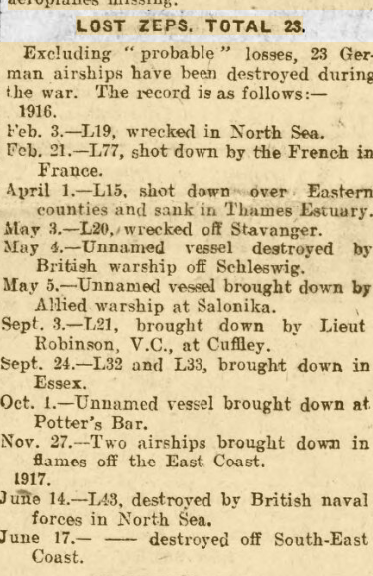
On the other hand, perhaps because the Zeppelin raids worried the population so much, they were keen to publicise successes

As in the shooting down of L15, which Bloom witnessed. The Royal Flying Corps officer responsible for shooting down L15 was in fact from New Zealand, something the British papers seem not to mention, although it was headline news in New Zealand.)

As I say, an interesting resource, and a valuable counterweight to the ‘big men’ style of much of military history, especially where World One is concerned.
Posted in Uncategorized | Tagged , , , | Leave a comment

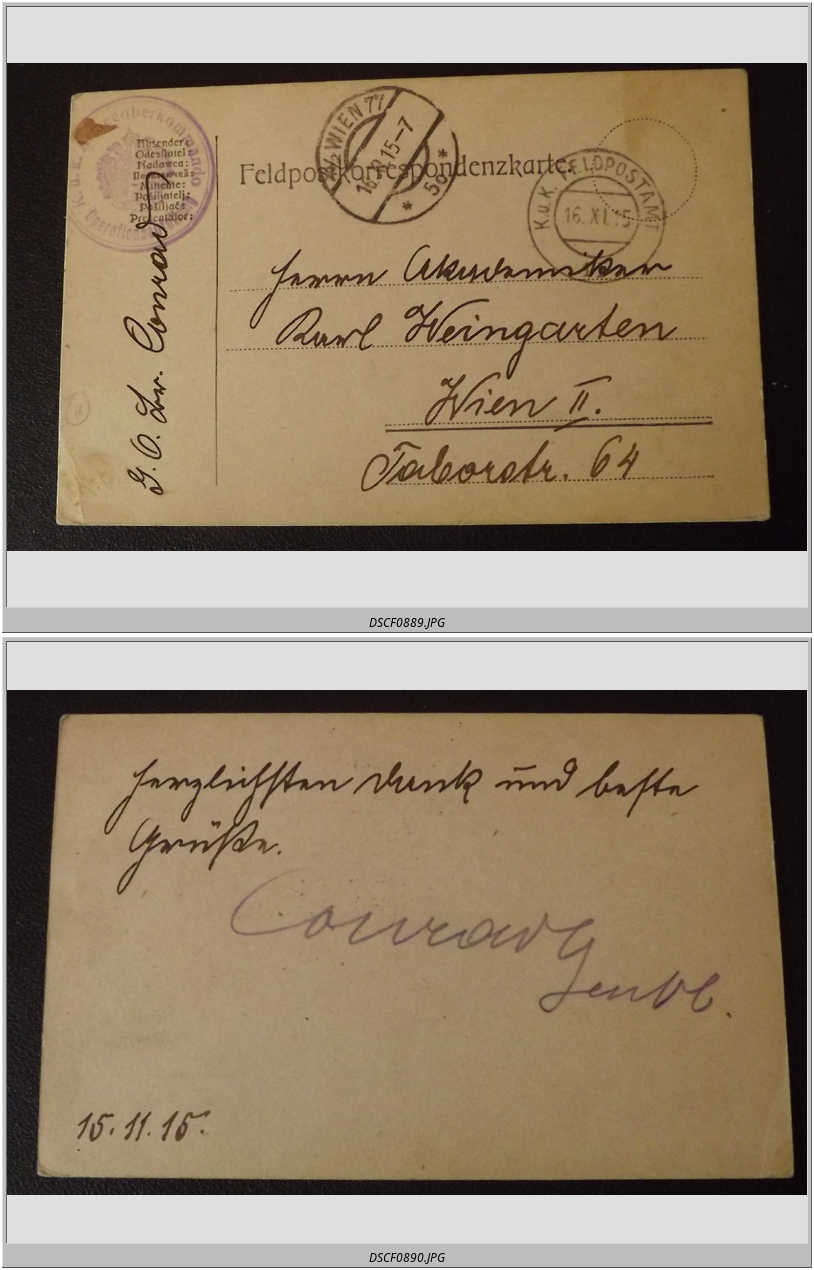
Austro Hungarian Field Postcard 1915

I’ve acquired an AustroHungarian field postcard for my little collection of world war one ephemera

Compared to British examples it’s quite simple.

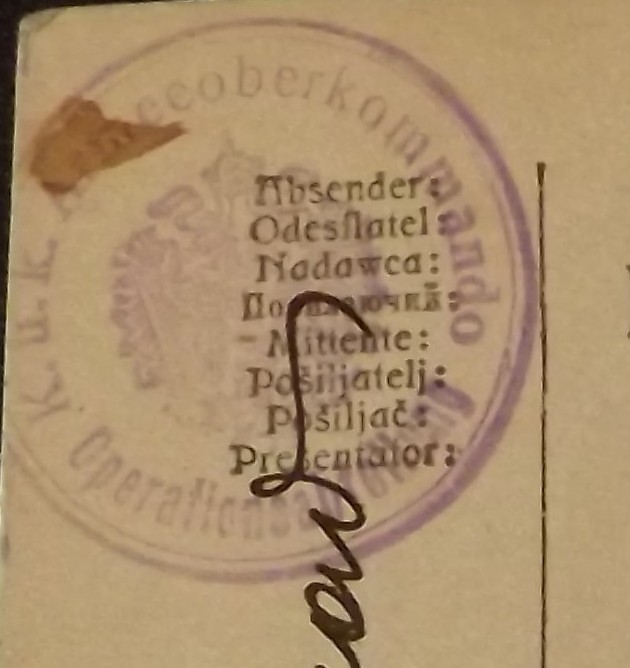
On the front of the card there’s a section on the left – helpfully labelled in the principal languages of the empire – for the sender to write their name and a return address

In this example there’s only a name, the unit name and address is given in the official purple stamp, in other examples I’ve seen there might be a line like ‘Feldpost 306‘ to give the number of the appropriate field post office.

Unlike British examples the rear of the card is blank for a simple message – no restrictive list of pre printed messages or warnings that the card will be destroyed if a personal message is added, as on the British ones.

The card is labelled Feldkorrezpondenzkarte – Field correspondence card- and that’s exactly what it is, a means for soldiers at the front to send short messages home for free.

Here the message is quite short and accompanied by a scrawl in pencil in a different had, presumably by the censor.

If you want to know more about German and AustroHungarian field postcards I’ve come across an informative blogpost with some good example images

Posted in Uncategorized | Leave a comment

The Stepaniak code…

Recently, I’ve been rereading Death of a Schoolboy by Hans Koning.

Long out of print it’s a novel about Gavrilo Princip, the assassin of Franz Ferdinand and paints a compelling portrait of alienation and radicalisation. It’s also one of the books that sparked my interest in the last days of the Austro Hungarian Empire.

After the assassination of Franz Ferdinand, the heir to the Austro Hungarian throne, Princip and his co conspirators are arrested, beaten up and put in solitary confinement, where they find they can communicate with each other using the ‘Stepaniak Code’ by tapping on the heating pipe.

Given that I’ve been researching Sergei Stepaniak, Constance Garnett and the Friends of Russian Freedom, there is no way that this would not pique my interest.

The code probably has other names, but in Sergei Stepaniak’s book Underground Russia describing the Narondnaya Volya (People’s Will) group of anti tsarist terrorists in the 1880s he mentions the use of the code.

The code is breathtakingly simple and made up of a set of long and short taps, and has the merit that, while clumsier than morse code, there’s no appreciable learning curve, and providing you know how the code works it’s easy enough to make yourself a crib.

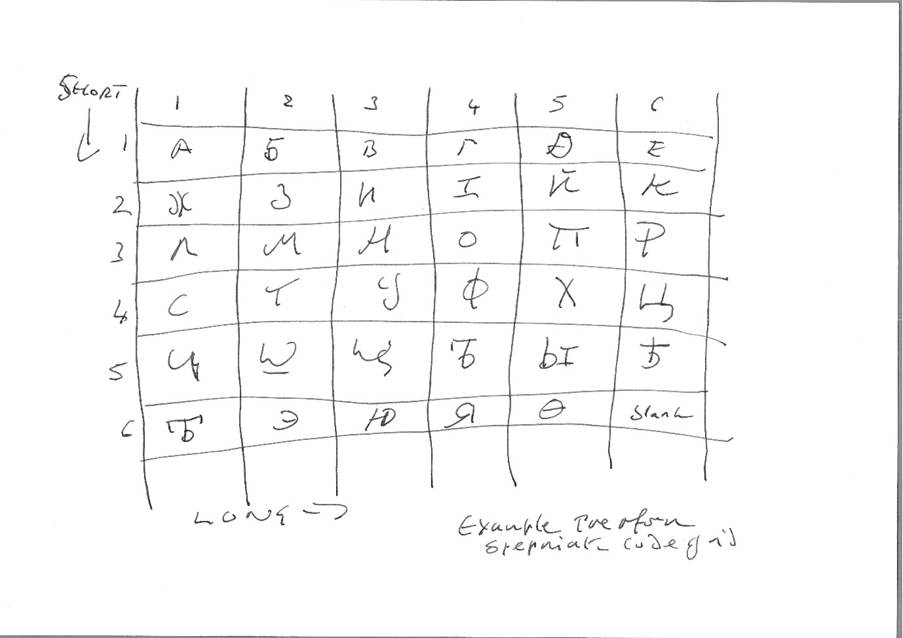
The pre-revolutionary Russian alphabet consisted of thirty five characters. Drawn on a 6×6 grid you get something like this

Position 36 is left blank, and each letter is represented by a sequence of long and short taps, for example Б is one short and two long and Ф is four short and four long.

Clumsy, but like texting in 1990s before even T9 predictive text was a thing, and you had to tap through the character options on the keypad, it was possible to get quite quick at it.

And it’s not just a Cyrillic thing. It’s easy enough to adapt to other languages and scripts.

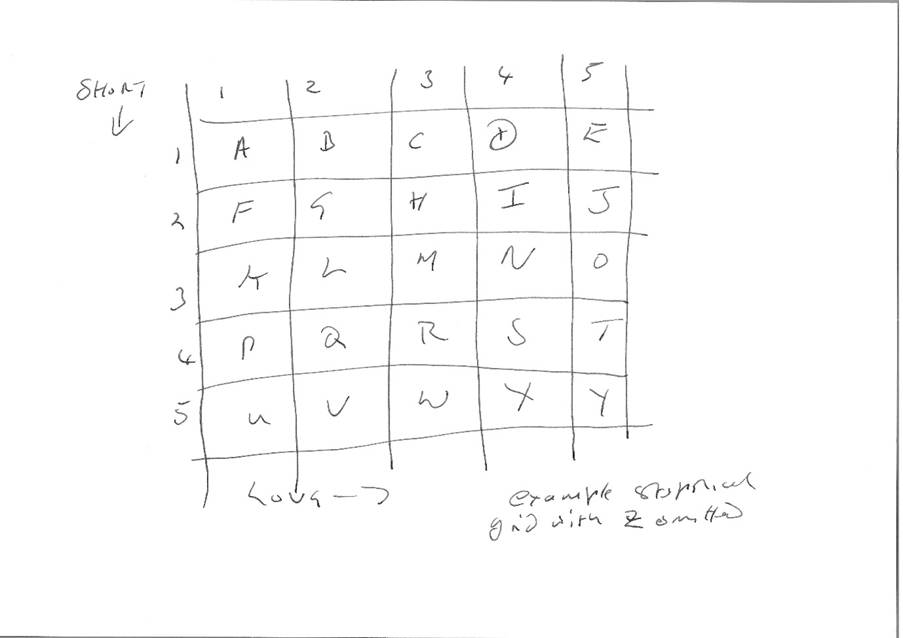
For example, if you decided that you didn’t need to use the letter Z, you could make a 5×5 crib like this for English

If you were using another language, let’s say German or Swedish that uses extra accented characters you might add an extra row to accommodate them.

But the point remains, the code itself is breathtakingly simple, so simple that one can make one’s own crib on a scrap of paper, all you need know is the size of the grid and whether long taps signify a horizontal or vertical position on the grid…

Posted in Uncategorized | Tagged , , , | Leave a comment

Stalin in London

Earlier this year I read ‘Young Stalin‘ by Simon Sebag-Montefiore – the book was published nearly twenty years ago but is still an interesting read. (The book is still in print and second hand copies are available online for a few dollars.)

Police mugshot following his arrest in 1908

To an extent the book humanises the monster and shows Stalin to be a more complex individual than the standard caricature – Stalin apparently liked to grow flowers in his garden and to read novels, besides having a string of lovers as a young man.

Not quite what you expect of a man who sent millions to their deaths, at times almost on a whim.

Stalin was not well travelled – unlike some of the other revolutionaries he simply did not have the money or connections to exile himself abroad, although he did live for a time in Vienna, and spent a few weeks in London in the run up and during the 1907 RSDLP congress.

The rest of his time he was either on the run, in prison, or sentenced to internal exile, at one time to a remote indigenous community in the Arctic.

Stalin’s command of English was poor – he may have understood more than he let on, but he certainly was not fluent, and relied on interpreters later in life.

There’s a comment in Sebag-Montefiore’s book that in London, Stalin would often attend Anglican high church services, ostensibly to improve his English by listening to the priest’s homily.

But the question is, why Anglican services, and not some preachy wordy methodist or protestant church?

And I think the answer is simple, and again humanises the monster.

Stalin was alone, with little money and could barely speak English. Maybe he did go to Anglican services to improve his English, but perhaps also as he’d nearly become a priest after several years in the Orthodox seminary in Tblisi, he also missed the colour and spectacle of an Orthodox mass, and settled for the smells and bells of Anglicanism to soothe his homesickness and loneliness, while surrounded by the damp greyness of London.

Strange to think of a strange bearded man standing at the back of a very middle class English event – one wonders what the very middle class church goers of suburban London would have thought if they realised that that strange man would one day be the leader of the Soviet Union…

Posted in Uncategorized | Tagged , , | Leave a comment

Snow on their boots

I’ve been working up at the Athenaeum for one morning a week cataloguing their historic book collection, and last Friday I catalogued some books written by Ursula Bloom.

There seemed to be rather a lot of books by Ms Bloom, she was obviously very popular with the users of the Athenaeum in the 1950s, so out of curiosity, I typed her name into wikipedia, and found a rather more interesting story than I imagined – I’d sort of envisaged her as a 1950s equivalent to Jilly Cooper but with less sex but just as many straining jodhpurs and heaving bosoms.

And that doesn’t seem to be an unfair characterisation of much of her work, but as often happens, if you scratch beneath the surface, you find a much more interesting person.

At the start of world war one she was working as a cinema pianist – her parents had separated and she was living in genteel poverty along with her mother in St Albans. (A cinema pianist was the person who played the musical accompaniment to silent movies – in itself quite interesting as it shows the sort of jobs open to middle class young women, and probably not quite what her piano teacher had envisaged)

She later wrote an autobiography describing life on the home front in world war one, rationing, zeppelin raids and the general atmosphere of paranoia and suspicion.

In her description of the start of world war one, she mentions the rumour that there were secret trains ferrying Russian reinforcements to support the British Expeditionary Force at Mons, where things were not going terribly well for the British – pushed back by the German army after an initial advance into Belgium, the British army attempted to stop the German advance at Mons.

They didn’t. They both suffered and inflicted heavy casualties, but the British army did slow the German advance enough to allow the bulk of the British Expeditionary Force to withdraw towards the French border.

The first Battle of Mons is also significant in that it was the first time in seventy years that a British army had fought anything other than a colonial war.

While the wars in South Africa had shown that there were deficiencies in British tactics in dealing with what were essentially guerilla forces, it was not until Mons that there was any real inkling that things might be different this time around and it might not be the glorious adventure that war was sometimes portrayed as in the popular literature of the time.

In the wake of the near disaster at Mons, there were widespread rumours that Russian reinforcements had been sent all the way from Siberia by way of Archangel in the north of Russia, and then by ship to the north of Scotland, bypassing neutral Norway. They had apparently been seen with snow still in the fur of their hats, and numbered up to ten thousand men.

The authorities were sufficiently worried to try to downplay the story, planting articles in the newspapers that what people had seen were Gaelic speaking soldiers from Ross-shire in Scotland – it might even have been more or less true, but looking at the newspapers of the time there was clearly a widespread belief that Russian reinforcements had come to the aid of British forces in Belgium.

It is almost certainly a case of mistaken identity – I doubt if the inhabitants of the south of England at the end of the Edwardian era, were familiar with the sound of spoken Gaelic, but what is interesting is that people quite clearly wanted to believe that the near disaster at Mons would turn out all right, and given that the newspapers of the time were trumpeting Russian successes in the east, particularly against Austria-Hungary, it’s perhaps natural that the Russians would be seen as potential saviours of what Kaiser Wilhelm allegedly described as ‘a contemptible little army‘.

Posted in Uncategorized | Tagged , | 1 Comment

Edwardian paranoia

The Edwardian era was an unsettling time for Britain.

Queen Victoria had died, and with her the certainties of the late Victorian era. People were unsure of what, exactly, was Britain’s place in the world, and if there would be a war.

And you see this reflected in the popular fiction of the time. One trope was ‘invasion fiction’, such as Erskine Childers’ Riddle in the Sands, a variant on espionage fiction where some dastardly foreign power, usually Germany (after all Britain was locked in a naval arms race with Germany, as expensive and deadly as the later Soviet US arms race), was going to mount a sneaky invasion and overwhelm an incompetent and bumbling British government, and square jawed chaps would have to take it on themselves to do something about it.

And in the Edwardian era Britain, fearing attack, made alliances.

First with France, despite lingering suspicions dating back to the Napoleonic era, not to mention some more recent colonial disputes, but at least they could agree that Germany was a threat to them both.

Britain’s other ally was Imperial Russia, the third member of the triple entente.

Russia was a nasty repressive autocratic state.

People disappeared, people were sent in exile to Siberia, but yet there was money to be made as the Russian economy was beginning to boom, new factories, a new middle class, railways to be built, and so on.

At the same time there were all these escapees from Russia. Some were poor Jews fleeing persecution, some were equally poor political dissidents choosing life in the East End of London over internal exile, or worse a labour camp somewhere in the trackless wastes of Siberia.

Tolerated, Edwardian Britain was quite liberal in allowing dissidents and exiles in, something that was recognised by at least some of the exile groups, including the RSDLP, the forerunner of the Bolsheviks. The RSDLP, who were appreciative of being able to hold their congresses in exile with minimal interference by the authorities actually went out of their way to avoid being involved in any violent activity in Britain.

After all, they might need somewhere to escape to if the revolution didn’t play out the way they expected.

And the Okhrana, the Tsar’s secret police, were in England as well, sometimes co-operating with the British police, sometimes carrying out what the KGB later called мокрые делы – wet jobs – assassinations, and sometimes, especially after Sidney Street and the Houndsditch murders, with the connivance of the authorities.

There were of course other sorts of dissidents, ones like Sergei Stepniak, who was a gentleman, who spoke nicely about literature and art, quite unlike these strange slightly frightening men with strong accents and and their talk of violence and revolution, and who attracted groups of supporters such as the Friends of Russian Freedom. (While its helpful to think of the various factions within the dissident community as separate groupings there was a continuum – Fanny Stepniak, Sergei Stepniak’s widow helped organise Lenin’s 1907 RSDLP congress in London.)

And some of these supporters helped the dissidents by smuggling banned books and pamphlets into Russia.

Constance Garnett did so, and was so frightened by the experience she dumped all the material she was smuggling and escaped back to Britain as quickly as possible.

Russia was a frightening place where frightening, violent, things happened.

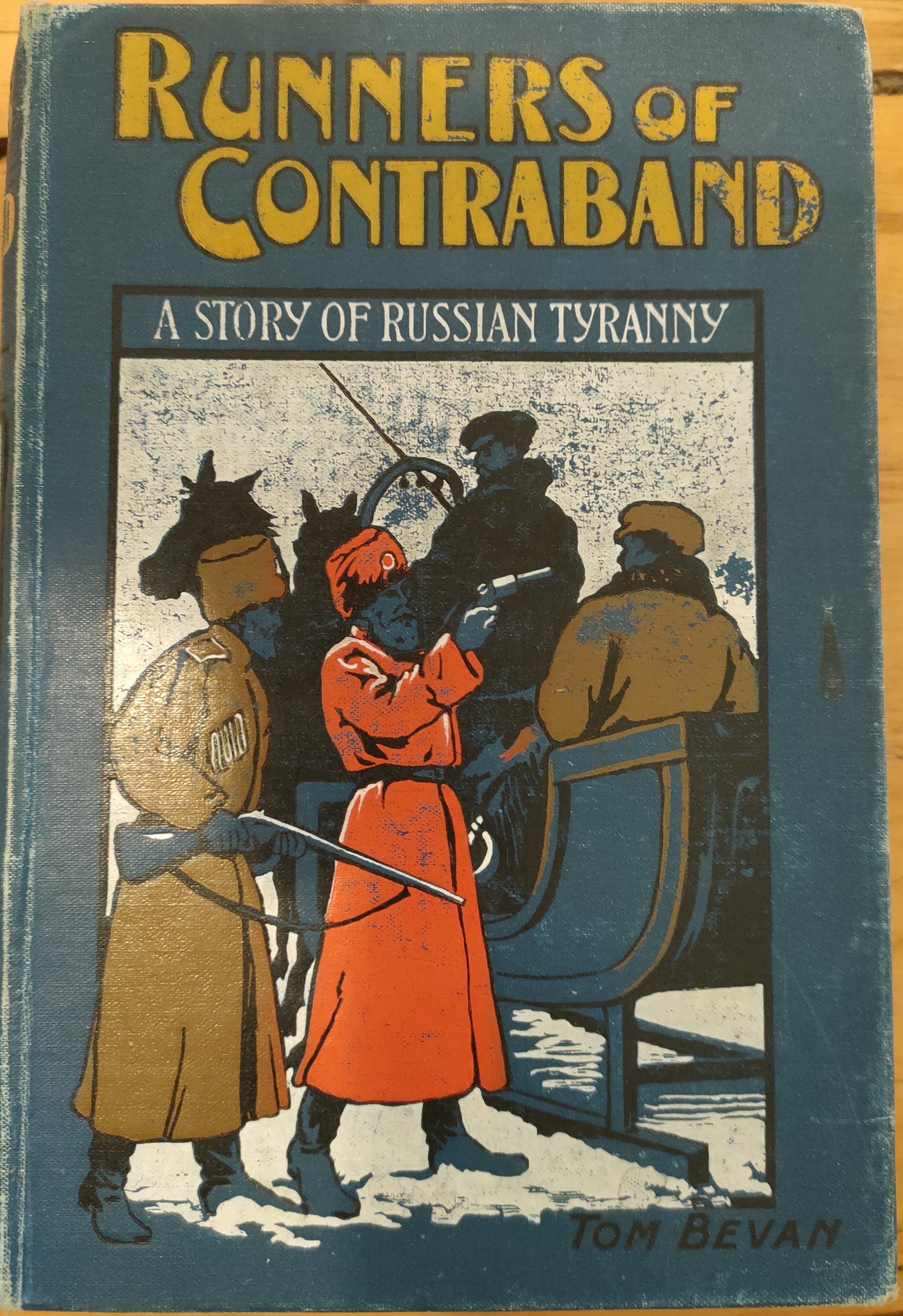
And this was reflected in the espionage fiction of the time. Hence novels like Tom Bevan’s Runners of Contraband, a tale of smuggling forbidden books and other material into Russia.

It’s probably not great fiction, but just as during the cold war bookshops always had a shelf or two of espionage fiction, it’s a symptom of how Russia was viewed by the Edwardians…

Posted in Uncategorized | Tagged , , , | Leave a comment

Romanian army buttons from world war one

Over ten years ago, before we moved to Beechworth, I became fascinated by the provenance of the old Krupp 75 mm gun outside the RSL.

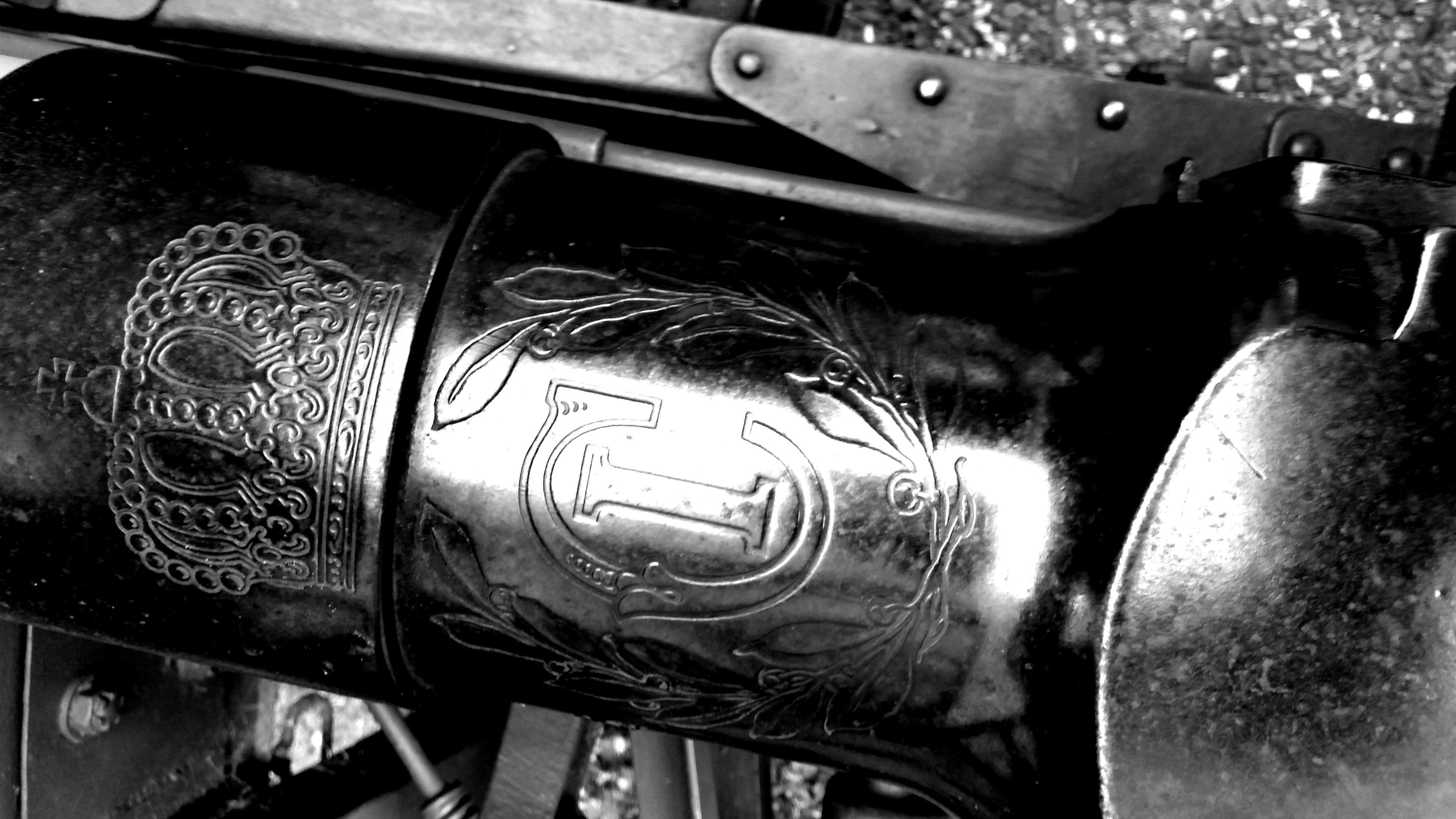
It didn’t have an Ottoman cipher, or a German or Austro Hungarian crest but instead the cipher of Carol I of Romania

The defining characteristic is the crown, a representation of the Steel crown of Romania.

The question is of course, how did a 75mm gun made by Krupp in 1905 for Romania end up Beechworth as a war trophy, as after all, Romania was on the side of the Entente in World War I.

The story is both simple and complex, so we’ll go for the simple version, but even that requires a recap on the history of the Balkans prior to World War One.

After participating in the Balkan wars that led to the Ottoman presence in Europe being reduced to a rump around Edirne, Romania initially stayed neutral in the First World War, unlike Bulgaria which sided with the Central Powers and Serbia, who sided with the Entente.

Bulgaria had been unhappy with the division of Ottoman territory between itself and Serbia as a result of the first Balkan war, and had then fought Serbia in the second Balkan war in the hope of gaining more of what is now Northern Macedonia.

Bulgarian participation in the First World war was really an attempt to ensure that if Austria Hungary defeated Serbia, it would be able to claim more of Macedonia.

And this is where the story gets tricky. Bear with me, people have written PhD theses on this, but we also need to discuss the Eastern Front and the Russian army in World War I.

There’s a view that during the First World War the Imperial Russian army simply wasn’t very good, and that Russia was too underdeveloped to produce the sheer amount of ammunition required by the army, and that eventually the rank and file got pissed off and went home to spread revolution and anarchy.

That’s not actually true.

It’s true that in the north against the German forces the Russian army was unsuccessful, but against Austria Hungary it was a different story, advancing to the edge of the Carpathians, and occupying Austro Hungarian cities such as Lemberg (now Lviv in the west of the Ukraine).

It’s also the case that in the early stages of the war all sides found they had underestimated the amount of ammunition required and had problems with supply. While the Gallipoli landings are sometimes presented as an attempt to seize the Dardanelles and Constantinople, to allow the resupply of the Russian army via Odessa (now Odesa), in truth, it was just as much about allowing Russian wheat exports via the Black Sea to help feed Britain and France.

By the time of the Brusilov offensive in 1916 the Russian army had all the military supplies they needed and it looked very much like they were about to break the Austro Hungarian army, so much so that Germany panicked and diverted scarce troops from the Western front to the Carpathian front to stiffen the Austro Hungarian forces.

At the same time Romania saw this as an opportunity to reclaim Transylvania from Austria Hungary and sided with the Entente and attempted to seize Transylvania from the Hungarians.

With Bulgarian attacks in the south and German forces advancing through Transylvania, the war didn’t go Romania’s way, and not even the Kerensky offensive of 1917 when post February Revolution Russia managed to assemble an army and push back against the combined German and Austro Hungarian forces, saved them and they were forced to sue for peace.

The Krupp gun, along with others, were seized by the occupying German forces, and passed to the Ottomans who had previously bought a lot of the same artillery piece from Germany, and was captured by Australia forces somewhere in what was then Palestine.

Quite a story.

It’s not the only Romanian gun on display in Australia – there are a few others, along with some Ottoman Krupp 75mm guns including the one nearby on the war memorial in Chiltern.

But there’s always been something that puzzled me. Romanian coins from the period used a different crown

Romania 1905 5 Bani

And then I came across an online antique dealer in Bulgaria who had some Romanian uniform buttons from the period of the Balkan wars and World War I. I checked out the dealer on line and they appeared to have a good reputation.

The buttons came with a partial provenance, suggesting that they were legitimately acquired – I’m guessing from a metal detectorist or field walker.

And there they were – any gilding has long gone and the buttons look to have been cleaned – and again the Romanian Steel crown is used, and not the other crown which was used on coins of the period suggesting that the Steel Crown was used as the Romanian army logo. If I was more anally retentive than I am I would search for other examples of its use by the Romanian military, but I’m happy with the army buttons as confirmation. (Just to confuse matters, some German regiments used buttons in a very similar design with the Prussian crown – it would be possible to go slightly mad comparing images on ebay and etsy)

So, there we have it, the crown used on the Krupp cannon is the same as that used on Romanian army uniforms of the period and something that to me, at least, closes the mystery of the provenance of the Beechworth gun and the crown used in the cipher…

Posted in Uncategorized | Tagged , | Leave a comment

Technology and me in 2025

Most years I do a post recording how my personal use of technology over the year.

Looking back at last year’s post, I can see there’s been a few changes but perhaps not as many as you might expect.

The major event affecting my use of technology was not the end of Windows 10, but my finally coming to the end of my documentation projects for the National Trust. My guerilla cataloguing exercise for the Athenaeum doesn’t require so much in the way of equipment – a laptop, a camera, and a scratchpad seems to cover it, along with the beanbags and some of bits a pieces out of my work kit.

Almost, I have occasionally documented artefacts up at the Athenaeum, most recently some nineteenth century tools leant to us as part of an exhibition, and when doing so I’ve reused the tweaked methodology I used down at Lake View.

I’m still using my old Windows 10 Thinkpad for the cataloguing exercise – after all, all I need is a browser but I’m mindful of the fact that technology creep may break things I’ve already configured a refurbished Windows 11 Acer Travelmate ready to use as a substitute cataloguing machine.

The only reason I havn’t changed over is that I like the slightly larger screen on the Thinkpad, but I should probably bite the bullet and change.

Talking of larger screens I had a win, successfully installing Ubuntu on J’s old iMac which has given me a big screen device for looking at images, which, coupled with the recycled workbench I put together mid year, has made the whole business of transcriptions and the like much easier than before.

And while I’m talking about installing linux on things, I successfully installed linux on an old Chromebook I’d picked up cheaply with the intention of using it as a distraction free writing machine.

My initial purchase of the Chromebook wasn’t one of my better decisions, I managed to pick a model that was too far out of updates to be truly useful, so nothing ventured, nothing gained I had a go at installing linux on it and have ended up with a robust little writing machine that’s proved incredibly useful with its excellent battery life.

The original distraction free machine continues to live on as a second documentation machine – it’s battery life isn’t quite as good as the Chromebook, but having rather more in the way of storage adding extra software when required is not a problem, unlike the Chromebook which is pretty tight for free space.

At the same time I installed linux on my old AMD Ryzen based laptop – I’d originally planned on using Bunsen Labs Linux on it, but the screen had an annoying flicker. Changing to Ubuntu was better but not perfect, but after some digging I located some Lenovo drivers for Ubuntu and that fixed the problem.

The machine now sits happily on my recycled workbench.

Somehow, I seem to have ended up with rather more linux machines than is totally sane, and it’s probably time for a cull, especially given that I’ll doubtless be moving my remaining Windows 10 machines to linux sometime in 2026.

On the other hand they all have their uses, as I found when I discovered that the old laptop I’d put in the studio before we turned into a shared workspace still had a working CD drive allowing me to recover data from an old CD for J.

As for the rest, I’m still using the Lenovo Ideapad I bought back in 2022, principally as a machine to take away with me on an overnight trip. Battery life is still good, and the ability to use it in tablet mode saves having to take an extra device with me. The only problem is the lack of ports, and if there’s going to be any photography involved I either take the HP laptop I bought for our 2024 Tasmania trip or a linux based laptop.

Much to my regret, I have ditched my old pandemic era Huawei tablet – even though the hardware was still reliable it was too far out of software updates to support the current versions of the applications I use.

I still have a soft spot for Android tablets though and replaced it with one from Honor that works well and does the job

At the same time I ditched the dogfood tablet. Basically after nearly five years of use it was too old, too slow, but had done its job and done it well. At the time being I’m using the little Lenovo M8 I bought last year as an e-reader among other things and that’s working out well.

So, as regards hardware it’s been a year of incremental change, as I expect next year will be, with more linux and fewer machines (possibly).

I did make some changes to my use of social media despite having sworn off it a couple of years ago.

I rejoined Facebook because a lot of local history societies use it as a means for communication, and there was material out there I wanted to take a look at. In the month or so I’ve been back on Facebook it’s been useful, even though I’m still mostly lurking.

At the same time I joined pixelfed as a way of sharing photos that wasn’t Instagram, and that’s also working out well.

So there we have it. No dramatic changes, a few successes, and perhaps a bit more linux than last year …

Posted in Uncategorized | Tagged , , , , | Leave a comment

The disappearance of the long s from handwriting

The long s (ſ) and its disappearance from handwriting is a bit of a mystery to me.

Printers had more or less abandoned its use at the beginning of the nineteenth century, although it continued to continued to be used in the Sydney Gazette as late as 1814.

However, by 1816 it was gone, and the typography followed modern usage.

Handwriting was a different matter though.

When my great^n grandfather was born in 1814, the parish clerk recording the event used a long s. Jane Austen also used a long s on occasions in her writing, so we could plausibly argue that when people wrote letters and official documents, they used the long s.

It would be entirely natural to find that people who had learned to write using the long s would continue to do out of habit long after printers had dropped its use, especially if they were frequent correspondents.

So when did the handwritten long s drop out of use?

Short answer is I don’t know. I’d say probably around 1830, and certainly there’s some evidence to support the idea that it was much less commonly used by then.

Fanny Owen, when she wrote to Charles Darwin in 1831 before his departure on the Beagle, appears not to have used it, nor did Florence Nightingale or Madeleine Smith.

Fanny Owen is the most interesting example – Florence Nightingale and Madeleine Smith were born in 1820 and 1835 respectively, which would have meant that by the time they were learning to write, the long s had dropped out of use in printed books, but Fanny Mostyn Owen was born in 1806, which suggests that she would have learned to write in the early 1810’s, at a time when the long s was still in use, but may no longer have been taught in books of penmanship.

And this leads me to an interesting little puzzle – I was looking at a Facebook page from the East Yorkshire archives that included a recipe for mouthwash tentatively dated to some time around 1890

and there, in the second line is the word glass written as glaſs.

Obviously the dating could be wrong and the document could have been written well before 1890, and the person writing it could have learned to write using the long s even though by the time the document was written it was no longer in common usage.

And while I’m prepare to stick to 1830 (±5) for when it dropped out of common usage, there’s evidence that the handwritten long s was still in use in 1842

suggesting that some people were still using the long s in correspondence in the 1840’s, although the author could conceivably have been old enough to have learned to write using the long s.

Likewise in the course of researching this blog post I looked at one of Wilkie Collins’ letters from 1860, and towards the bottom of the letter there is the phrase Miss Halcombe’s Dream which looks to have been written Miſs Halcombe’s Dream

Wilkie Collins was born in 1825, meaning that he would be of an age where one would have expected him to have learned to write without using the long s.

It could of course simply be a slip of the pen, or it could genuinely be a long s. One example does not a usage make.

I think I might have found myself a little problem to worry out …

Posted in Uncategorized | Tagged , | Leave a comment

An unused Queen Victoria letter card

I’ve picked up rather a nice example of an unused UK Queen Victoria letter card – which we can date to somewhere between 1892 when they were first introduced to sometime shortly after 1901 when she died and the existing stock had run down.

Quite like the very formal Victorian warning on the back about how additional postage must be attached if it was being sent to an overseas address …

Posted in Uncategorized | Leave a comment