
J, my partner in crime, is an accomplished artist.
While she does do the occasional landscape, what she really likes doing is drawing people and doing portraits.
And like everything, while innate talent helps, you have to practise, one of the exercises is life drawing, which is essentially the exercise of drawing naked people in a variety of poses to see how the body moves and changes.
And it’s not just drawing the young and lithe, the old and wobbly are just as important as subjects, perhaps more so, as being less taut their bodies change more with posture.
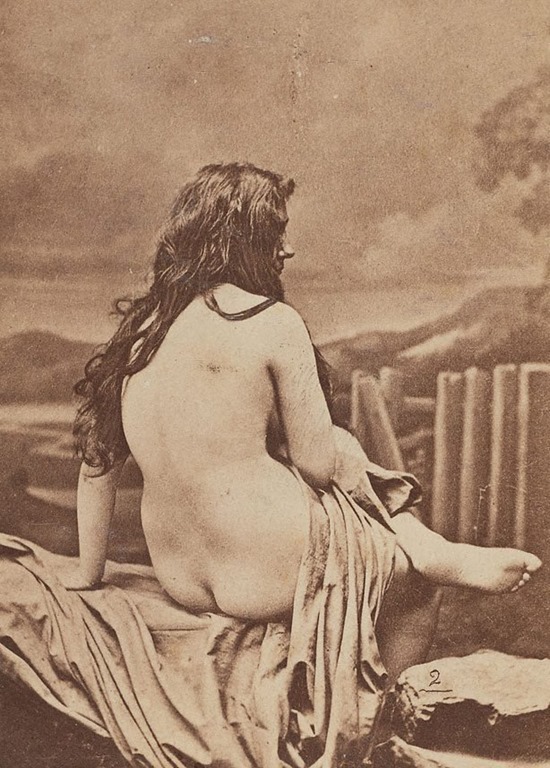
For example in this nineteenth century photograph from the Art Gallery of New South Wales, you can see how the subject’s body fat caused the body to be more solid and block like
Despite the fact we live in a rural area, there’s actually quite a healthy life drawing scene with groups of local artists clubbing together to hire a room and a model for a couple of hours.
All good.
Of course, during the pandemic this all stopped.
And J, like other artists, turned to the web for inspiration. There are a number of websites that host collections of images for use by people practising life drawing.
The images on these are not sexy or erotic, basically they are pictures of naked people of a variety of ages, ethnicities and genders, in a variety of poses.
This actually isn’t new or innovative.
Artists have used nude photographs of models ever since they became available, as in the work of Gaudenzio Marconi, a photographer working in Paris in the 1860 and 70s, who we knew took photographs for various artists working in Paris at the time, including Auguste Rodin.
Some of Marconi’s photographs are quite arresting as in this one of a female model posing as angel
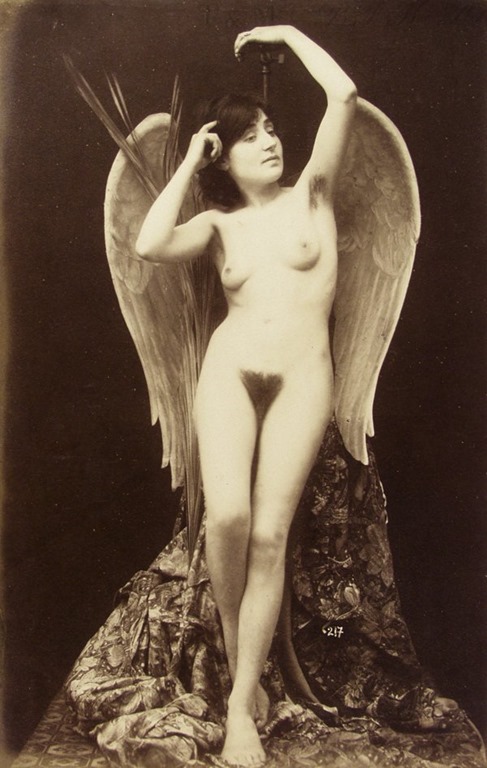
I did try to find who commissioned this image, without any success, nor could I find who the model was, but using Google Lens to do a reverse image search, I did find an image on a Catalan auction site which seems to feature the same model in a less successful pose, perhaps suggesting that the artist was trying to find an image that worked.
I’m equally unsure why the image was commissioned – I’m guessing that it was for some devotional art or a funerary monument rather than a Christmas card.
Marconi was not just a studio photographer. He was in Paris during the siege and the Commune and photographed some of the victims of both.
Back to the present day.
After the pandemic faded away, life drawing with real live humans became possible again and some of the life drawing websites shut down because they weren’t making any money, but slightly disturbingly, one of the websites that shut down said it was closing because the company hosting the site had deemed the content obscene and wished to terminate the hosting agreement.
The other thing that artists started doing was building up little collections of images such as those by Marconi, Muybridge and others, and putting them on photosharing sites.
Increasingly, they are being asked to remove these images as they are ‘not nice’.
Site owners, of course have a perfect right to change the rules as what they will and will not host.
However many of these site are run by American businesses, and there are some very strange things happening in America at the moment with the Christian right increasing in influence.
I don’t understand the ins and outs of American politics, and I’m very much of the view ‘their country, their rules’.
However, because American content hosting and sharing sites are so dominant we are at risk of importing their restrictions by default, and I think that’s something that needs discussion …


 stuff 'n other stuff