
As you might know, as well as my gig at the Athenaeum, I’m back with the National Trust, this time cataloguing the contents of Lake View House.
Like a lot of historic properties, it has been ‘dressed’ ie artefacts from the period have been added to the display to give an impression of how the house would have looked when it was lived in in the late 1800s.
One of the items I catalogued yesterday was a rather attractive metal container with a hasp closure for a padlock.
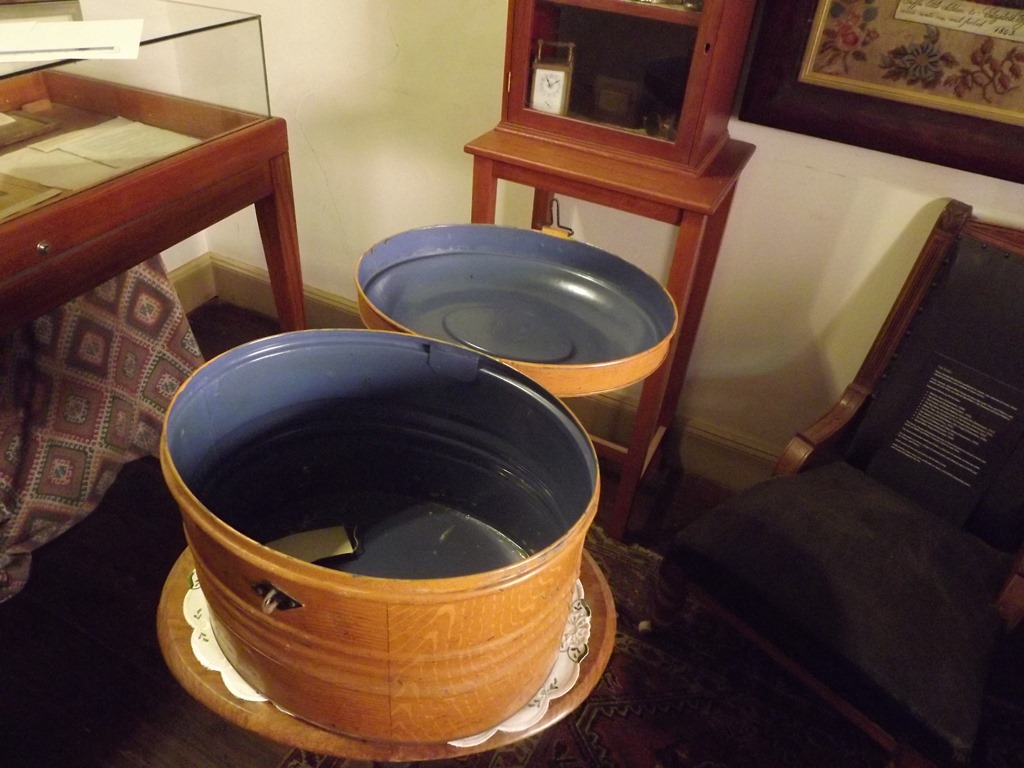
On the outside it’s painted to look as if it was made of wood, and the inside was painted a rather attractive blue colour.
Obviously the item was designed for transporting something safely, what I was not sure at first, but probably a hat box to safely transport one of these over the top late Victorian or Edwardian ladies hats.
Certainly a trawl of the web brings up a number of similar items categorised as late Victorian tin hat boxes on antiques trading sites. Admittedly mostly sites from the UK where antiques are more of a thing than Australia, but at the end of the Victorian era it was still the case that most consumer goods were imported from the UK than manufactured locally, so we can safely say it was a hat box.
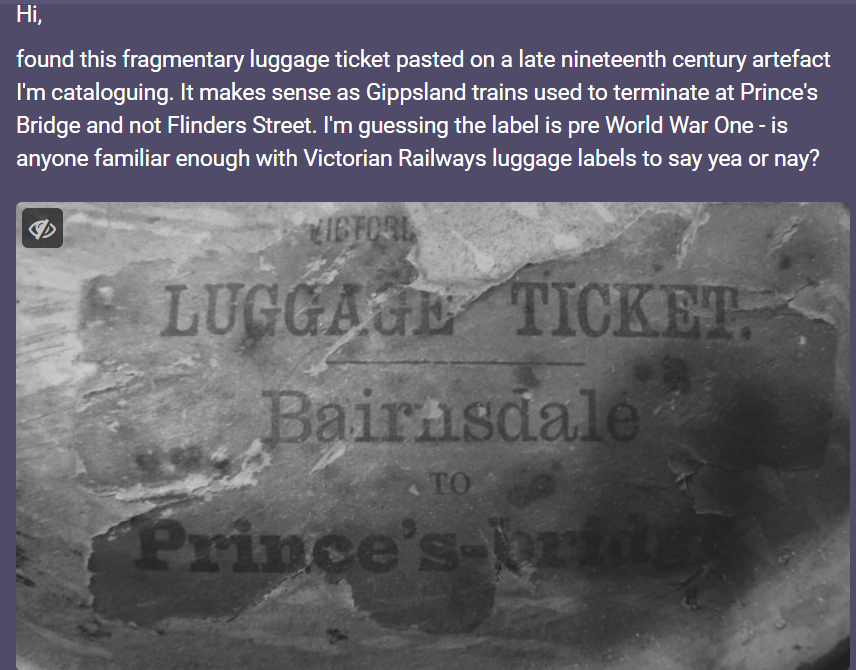
On the lid is pasted a fragmentary Victorian Railways luggage ticket – basically the equivalent of an airline checked baggage tag – from Bairnsdale to Prince’s Bridge station.
Prince’s Bridge station, was a now closed railway station in Melbourne, adjacent to, but separate from Flinders Street station.
Crucially, it was where trains on the Gippsland line used to terminate (trains on the Gippsland line now terminate at Southern Cross, as do all other V/line country services).
So, we can say that someone, and we don’t know when, checked the box on a train from Bairnsdale to Melbourne.
As to when, well my first thought was that one of the train nerds on Mastodon might know when that particular design of luggage ticket was used
Nothing doing. Well I guess that luggage tickets are a bit too esoteric, so I turned to online auction sites where collectors buy and sell old railway tickets.
Again nothing.
So this morning I played with some editing software to sharpen the image and see if there was a ghost of some ink or pencil addition to the label

Basically nothing.
Now the train line didn’t reach Bairnsdale to 1888, which means that the label cannot be any earlier than then.
But how late could it be?
Stylistically, no later than the 1920s, the give away being the destination station name Prince’s-bridge.
If you look at late nineteenth century and early twentieth century newspapers you will see that sometimes street names are given with a hyphen – so Lonsdale-street instead of the more modern Lonsdale Street. Not everyone followed this convention at the time, but enough people did for the use of a hyphen in a street name to be a widely recognised usage.
And obviously Victorian Railways did in regards to Prince’s Bridge station which is given as Prince’s-bridge.
So it’s a reasonable guess that the label was printed sometime after 1888 and before 1920, by which time you might expect that the design might have become a little more modern.
Except, no. When I was working on the contents of Dow’s pharmacy, I came to realise that some of the letterpress labels that you might think on grounds of typeface and design to belong to the late Victorian period were being used as late as the 1940’s – obviously the wholesalers had had batches of the labels printed in the 1890s, and kept using them until they ran out, where they printed some more using a more modern typeface.
And so it may be with the luggage tickets. Victorian railways probably printed a batch when the line opened in 1888, but probably didn’t reprint them until stocks ran low, so it’s possible that they might have been using stocks of an older design later than 1920.
How much later is an open question, but given that big hats went out of fashion with World War One, we can probably say the label was stuck on the box sometime in the late Victorian or Edwardian era.
That is unless eccentric Aunt Mildred was still wearing a hat dating from the time of Edward VII in the 1930s …


 stuff 'n other stuff