
While train travel undoubtedly revolutionised life for Victorians, it did, especially in the days of non corridor trains, expose women to the risk of being sexually assaulted.
The most prominent case that I’ve come across is that of Kate Dickinson, who was assaulted by Colonel Valentine Baker, which is unusual in that she went to court and prosecuted him for assault.
Most women preferred to keep quiet due to the risk of having their reputations dragged through the courts and snide insinuations made by lawyers about what today we would call their sex lives.
And in an assymentric society such as Victorian Britain, rich powerful men who could afford lawyers would always would always win in a case brought by a woman of lower social status.
However, I’ve just come across the case of Fanny Elizabeth Bull, a young governess, who was subject to an attempted rape in 1885 on a local train in London.
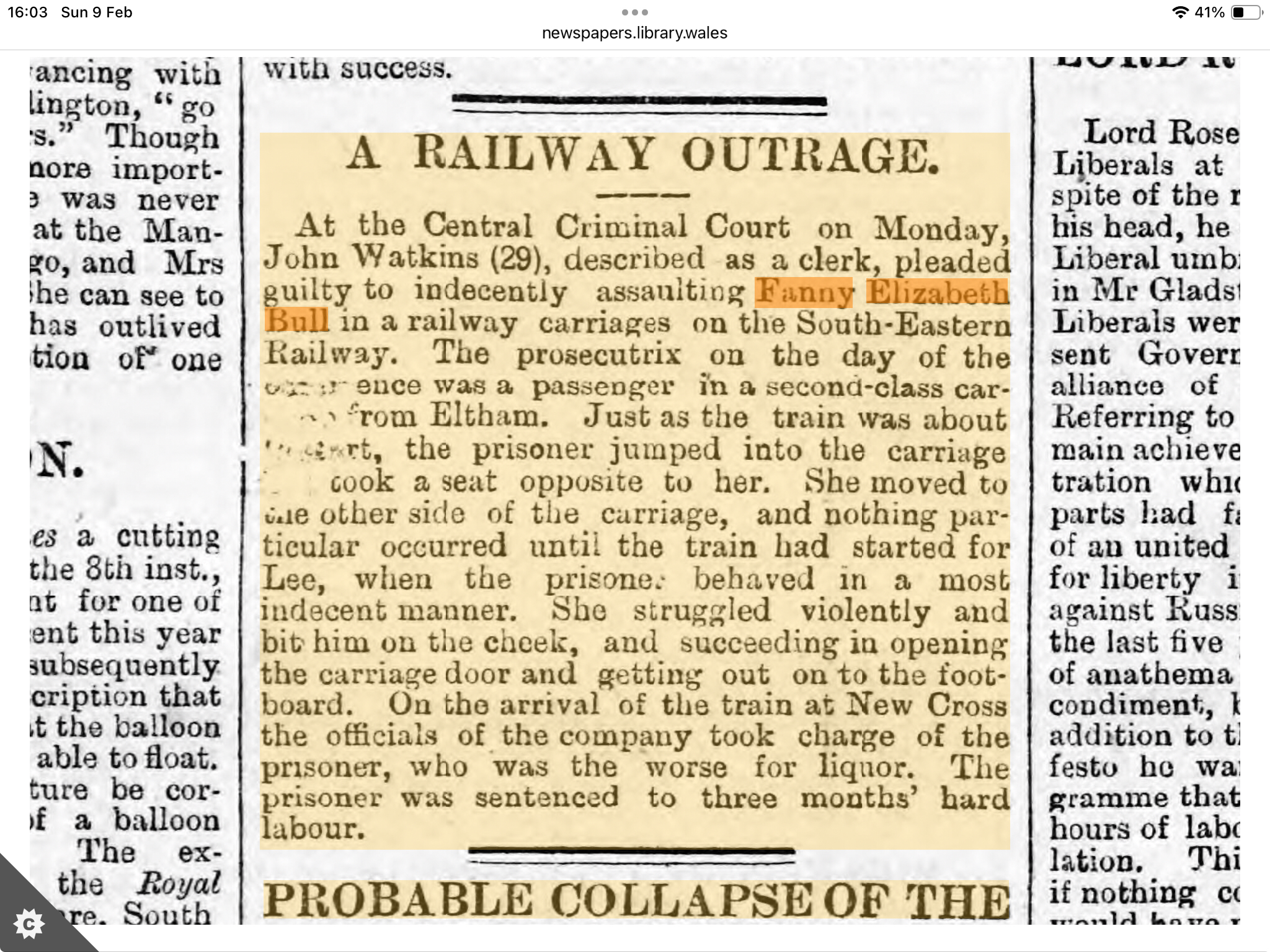
Fanny fought back, bit her assailant on the cheek, and as in other cases opened the door on the moving train and at some risk to herself, stepped out on the running board to attract attention.
There are two interesting things about the case – Fanny is decribed as a governess, which while she might be badly paid was seen as a respectable occupation for a young woman – it is notable that some newspaper reports are headlined ‘Assault on a Lady’, a governess having higher social standing than a clerk.
The other interesting thing is that in the longer accounts of the court case, such as in this one from the Sunday Times, we see an attempt at the initial hearing to persuade Miss Bull to take the case further, despite her fears of damage to her reputation should she appear in the Central Criminal cour in London
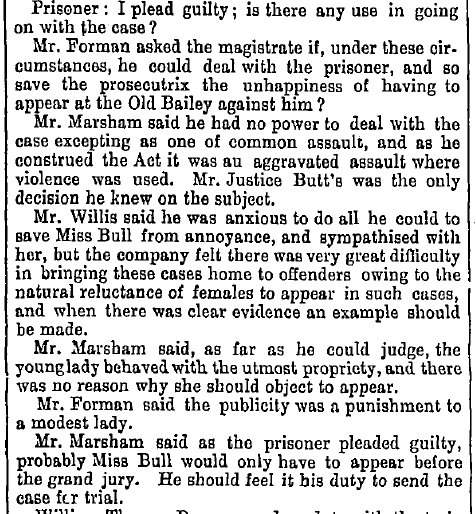
which neatly demonstrates the reluctance of young women to risk damage to their reputations and perhaps marriage prospects, by appearing in court in a sexual assault cases, with the consequence that such cases were not prosecuted with the full rigour of the law.
It also shows that, as in the case of the Lauriston assault, the judges and lawyers were well aware of the problem and tried where possible to work round the problem and reassure the victim that she had done nothing to damage her reputation…
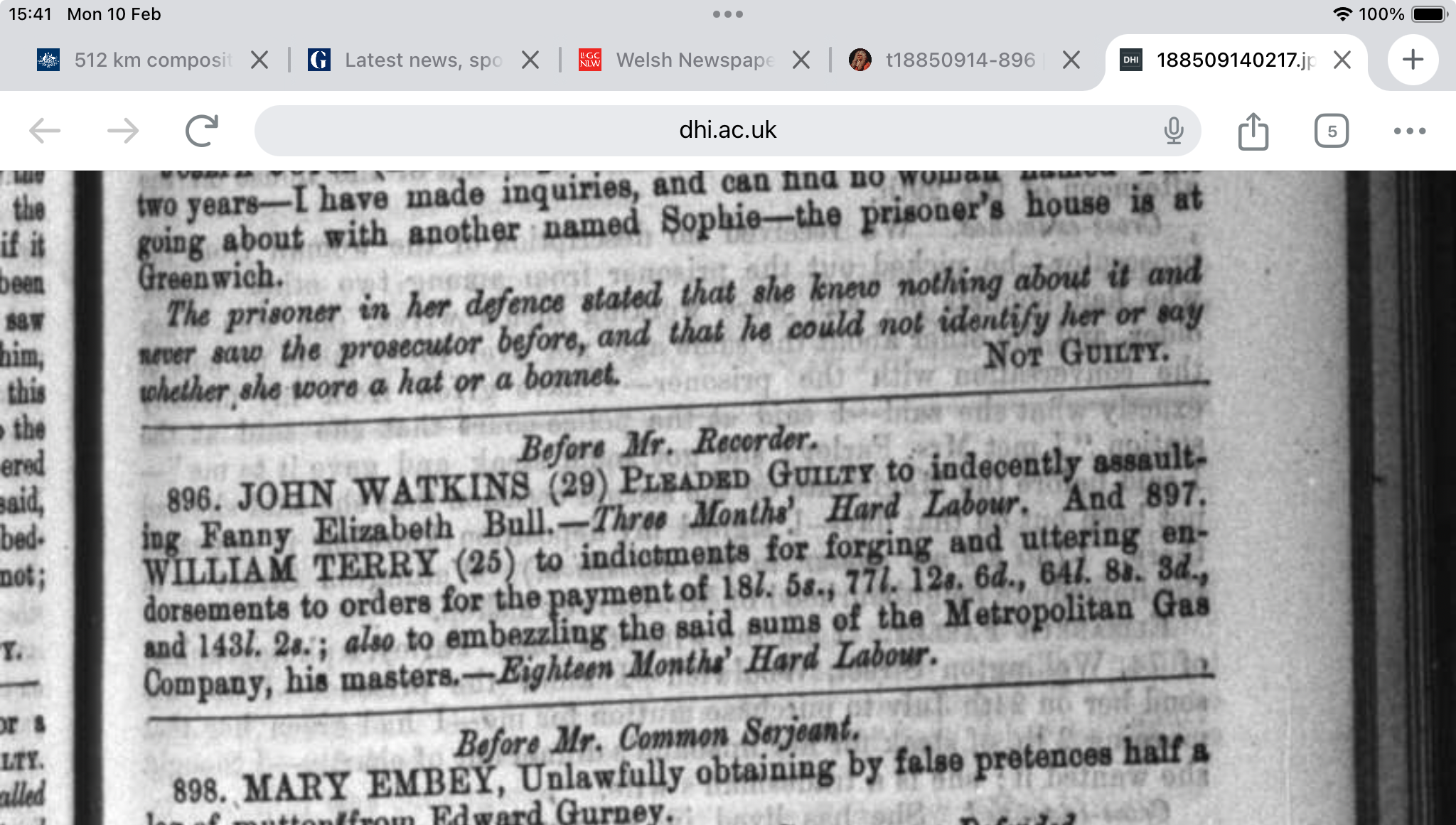
In this case, the lawyers were obviously successful in persuading her to go to trial in a higher court and Miss Bull’s assailant was tried in September 1885 at the Central Criminal Court (aka the Old Bailey) where he was sentenced to three months hard labour


 stuff 'n other stuff
Pingback: Amy Faulkner | stuff 'n other stuff
Pingback: Ladies only compartments | stuff 'n other stuff
Pingback: Spending a little more time with Katherine Scragg | stuff 'n other stuff