
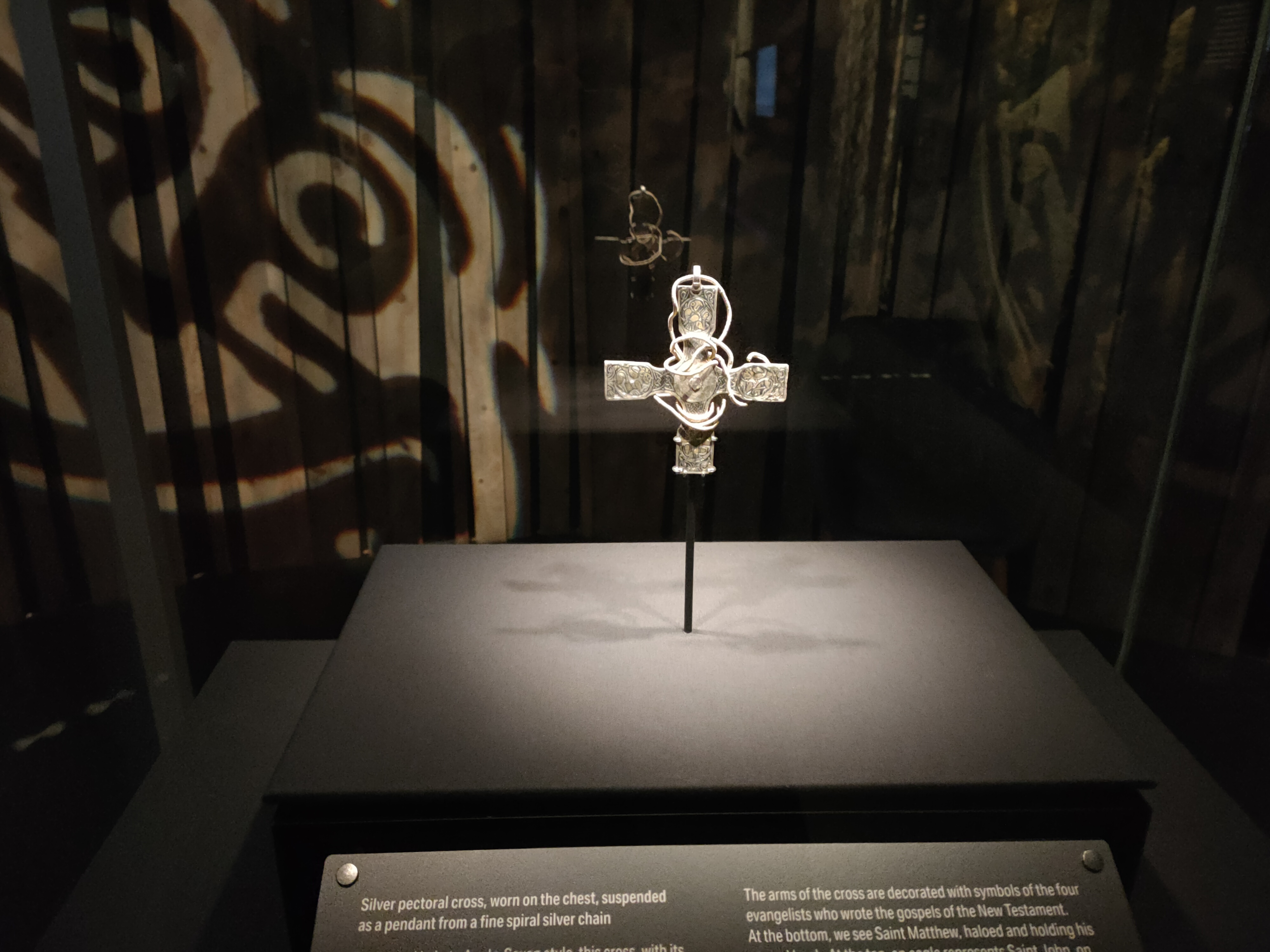
By pure chance, we were in Adelaide at the same time of as the Galloway Hoard exhibition at the South Australian Museum.
The Galloway Hoard is a collection of hack silver and other pillaged objects that probably came from the early Christian communities in south west Scotland – remember that Whithorn had been the site of an ecclesiastical settlement since the mid 400s CE and has been the site of a major archaeological investigation in the late 1980s.
There is an assumption that the hoard represents objects in some way connected with these communities, and it’s assumed that due to the presence of hacksilver they had been pillaged rather than hidden from pillagers.
The exhibition is quite small but contains the pectoral cross, some disc brooches and some of the hacksilver. Some of the rock crystal artefacts and a vessel that was found wrapped in textile are not original but in fact 3D printed replicas, perhaps because the originals were deemed too fragile to travel from Scotland.
It was the first time I had come across the use of 3D printing in exhibitions this way, and while a valuable technique to provide access to fragile objects, I felt that the mention of 3D printing and where it had been used in the exhibition should have been more prominent.
When we visited on a Friday lunchtime the exhibition was not too busy, apart from a school group, which gave us time to look properly at the items, unlike the scrum at the Dead Egyptians exhibition in Melbourne last year.
There are also some quite good an informative videos on the conservation of the hoard which are well worth sitting and watching.
At a bit over twenty dollars the exhibition is at the cheap end of the ticket costs for travelling exhibitions, my only complain being the use of TicketTek to manage online bookings when there are other providers known for better data security and lower fees.
While we were at the museum we popped next door to see the Renaissance Art exhibition, which was quite interesting and included some sixteenth century paintings I had not seen before, including one of Edward VI, and a rather nice one of the tax collectors office by Pieter Breughel the Younger that almost borders of caricature, but more importantly gives an insight into the business processes of early modern administration.
If you want to see the exhibition, be aware it closes on the 13th of April. The exhibition is free to visit.


 stuff 'n other stuff

Pingback: An autumn road trip … | stuff 'n other stuff