
Recently, I’ve been rereading Death of a Schoolboy by Hans Koning.
Long out of print it’s a novel about Gavrilo Princip, the assassin of Franz Ferdinand and paints a compelling portrait of alienation and radicalisation. It’s also one of the books that sparked my interest in the last days of the Austro Hungarian Empire.
After the assassination of Franz Ferdinand, the heir to the Austro Hungarian throne, Princip and his co conspirators are arrested, beaten up and put in solitary confinement, where they find they can communicate with each other using the ‘Stepaniak Code’ by tapping on the heating pipe.
Given that I’ve been researching Sergei Stepaniak, Constance Garnett and the Friends of Russian Freedom, there is no way that this would not pique my interest.
The code probably has other names, but in Sergei Stepaniak’s book Underground Russia describing the Narondnaya Volya (People’s Will) group of anti tsarist terrorists in the 1880s he mentions the use of the code.
The code is breathtakingly simple and made up of a set of long and short taps, and has the merit that, while clumsier than morse code, there’s no appreciable learning curve, and providing you know how the code works it’s easy enough to make yourself a crib.
The pre-revolutionary Russian alphabet consisted of thirty five characters. Drawn on a 6×6 grid you get something like this
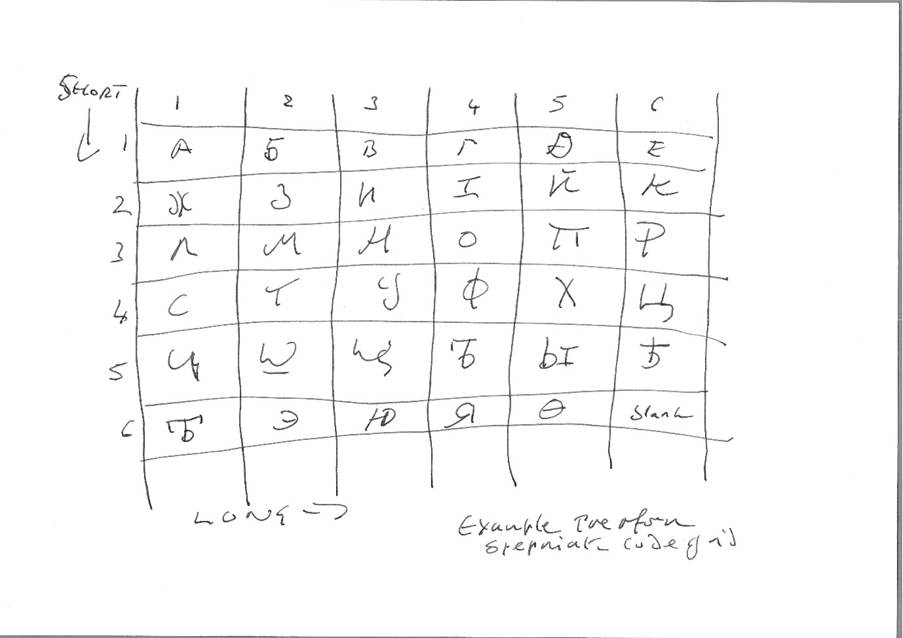
Position 36 is left blank, and each letter is represented by a sequence of long and short taps, for example Б is one short and two long and Ф is four short and four long.
Clumsy, but like texting in 1990s before even T9 predictive text was a thing, and you had to tap through the character options on the keypad, it was possible to get quite quick at it.
And it’s not just a Cyrillic thing. It’s easy enough to adapt to other languages and scripts.
For example, if you decided that you didn’t need to use the letter Z, you could make a 5×5 crib like this for English
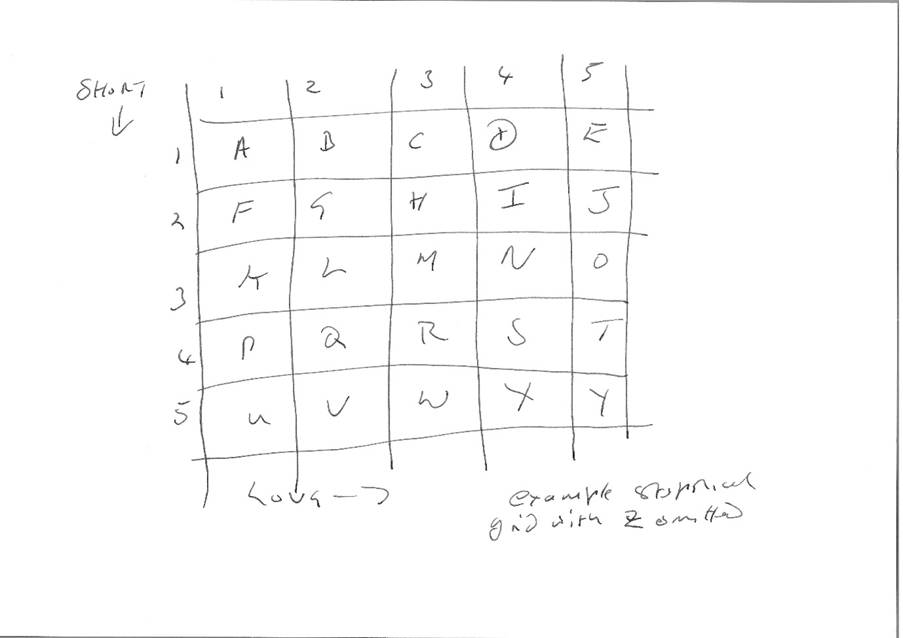
If you were using another language, let’s say German or Swedish that uses extra accented characters you might add an extra row to accommodate them.
But the point remains, the code itself is breathtakingly simple, so simple that one can make one’s own crib on a scrap of paper, all you need know is the size of the grid and whether long taps signify a horizontal or vertical position on the grid…


 stuff 'n other stuff
.jpg)