
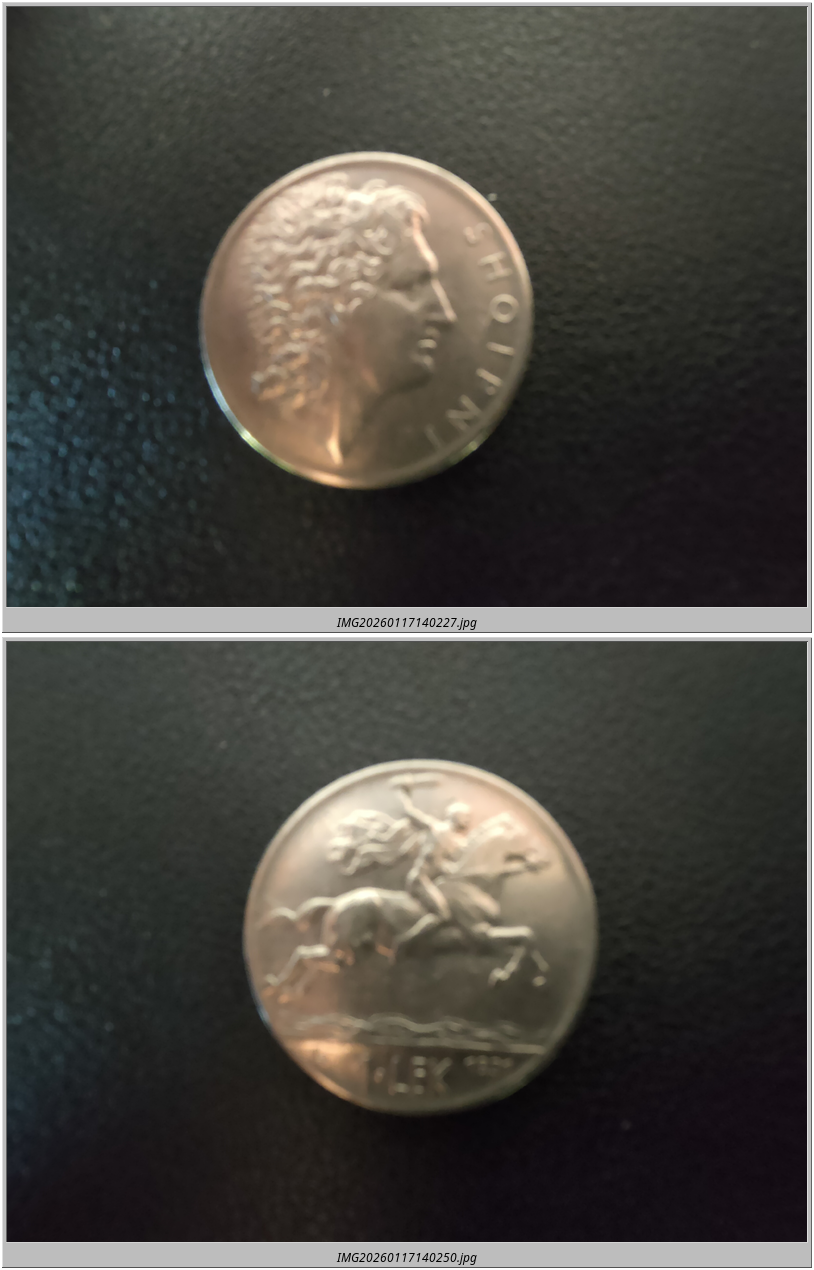
An Albanian 1 Lek coin from 1931.
Albania, in the early part of the twentieth century, had a complex, and at times farcical history.
Emerging from the ruins of the Ottoman Empire after the Balkan wars, at first the European powers attempted to impose a German princeling as king – after all such a move had worked reasonably well in both Bulgaria and Romania a generation earlier.
Needless to say, this time it didn’t.
The would be King of Albania was deposed before he’d ever properly been installed and a republic declared. Kaiser Wilhelm of Germany, shrewder than he is often portrayed as being, said it would probably have been better if an Ottoman prince had been installed.
In the midst of this chaos at the start of world war one, Otto Witte, an Austrian acrobat and fantasist claimed he had been mistaken by one Albanian faction for a nephew of the Ottoman sultan and had been invited to be king.
The story is almost certainly baloney, even if the police in Berlin during the Weimar republic allowed Witte to style himself ex-king of Albania on his id card.
As it was, for a few years it didn’t matter. During world war one the Albanian polity was occupied first by retreating Serb forces, who did not treat the local population well, followed by both Austria-Hungary and Bulgaria occupying the north and east of the country, not to mention other parts of Albania being occupied by Greece, France and Italy, but eventually, at the end of the first world war, Albania finally became a republic in more than name.
Power struggles within the government eventually resulted in the president, Ahmed Zogu, declaring himself Zog I and king of Albania in 1928. During Zog’s reign, Albania increasingly came under the influence of Mussolini’s Italy and was eventually invaded by Italy and made an Italian protectorate at the beginning of the second world war.
Not surprisingly, Zog needed a founding myth for Albania, given that it was little more than a loose confederation of feuding clans, and fastened on Alexander the Great and his Illyrian grandmother, Eurydice, as a better sounding story, and comfortably in the past, than any event in the more recent history of Albania.
Hence the coins of his period have Alexander, modelled after a classical period Greek coin of Alexander the great on the obverse and Alexander charging on his horse Bucephalus on the reverse, the design echoing Italian coins of the period in harking back to a heroic classical past

as in these Italian 50 centesimi of the period – Mussolini’s fascist era coin on the left with the Roman eagle, and the 1920’s version, showing a pride of four lions, celebrating equality, aeqvitas, as in the French ideal of Liberté Egalité Fraternité, on the right.
In Albania the coinage was replaced during the Italian occupation by coins bearing an effigy of Victor Emmanuel III of Italy on the obverse and fascist iconography and the Albanian eagle on the reverse.


 stuff 'n other stuff
Pingback: The man who might have been king… | stuff 'n other stuff