Wiping your bottom in bygone times

Let’s be honest here – almost everyone is secretly fascinated by the question as how people wiped their bottoms in times past, and the recent world wide burst of pandemic inspired panic buying of toilet paper has inspired lots of articles along the lines of this one from Country Life in the UK.

These articles all cover some fairly standard material – the Roman sponge stick, Gayetty’s invention of toilet paper in the mid 1800’s, and how people were originally resistant to the idea of spending good money to wipe your bum, when cheap disposable printed material was readily available.

gayetty

Gayetty claimed (falsely) that printers ink gave you haemorrhoids and that using his medicated paper lubricated with aloe would avoid the problem.

Most people ignored him and continued to use newspapers and the like – the invention of cheap wood pulp based paper by Charles Fenerty in the mid nineteenth century led to a vast expansion of paper production and cheap printed material, meaning that most people had easy access to scrap paper to use in the toilet.

And of course the toilet would have most likely been a cess pit or bucket type arrangement than a flushing toilet – as in this example in an officer’s house on Norfolk Island

IMG_0219

Prior to then most paper was relatively expensive rag based paper (which is why the paper in pre-1860 books and documents is less prone to decay and brittleness and lasts better than many post 1860 papers), and too expensive to be used for such a mundane purpose as cleaning one’s bottom.

Stories from the English Civil War and elsewhere about soldiers profaning prayerbooks and psalters by ripping them up and using them as toilet paper are most likely propaganda from one side or the other – in a religious age the idea of someone using the Book of Common Prayer for such a practice would have seemed sacriligeous in the extreme.

I’ve no doubt that it may have happened – I’m sure that most people would have simply used what was to hand and prayerbooks might have been it – but on the whole most people would have used leaves or bits of rag and moss, and perhaps occasionally bits of scrap paper, but on the whole there wasn’t that much paper around.

The elite might have had access to paper, and scholars might have repurposed used bits of scrap paper, but on the whole most people would simply have used scrap material or leaves.

I suspect, but have no proof, that is one was to compare rural seventeenth and eighteenth century cesspits between those in towns and those in the country one would find more use of scrap material in urban contexts and of organic material such as leaves in rural contexts.

Given the stiffness of most early rag papers, paper in the seventeenth century might not  have been as effective as you might hope and  like Izal and other early hard toilet papers – more suited to scraping than wiping.

Izal of course, horrible hard paper as it was, had the advantage over newsprint that it did not block drains, so it and other similar products gradually took over as people moved from having pit toilets to flushing toilets, even if they were still outside in the back yard and was still in common use until the 1960s and beyond.

Forestry Commission toilets in Scotland well into the seventies used to have this Izal look alike that was printed Government Property – Now wash your hands, and public toilets in England retained Izal style paper for a long time – basically it was thought that it was so unpleasant to use that no one would steal it.

So what we see is a union of two technologies – woodpulp paper to make paper cheap enough to be treated as a disposable product, and flush toilets which required the use of something that could be flushed down the drain without causing a blockage …


Posted in Uncategorized | Leave a comment

PTSD in the Crimean War ?

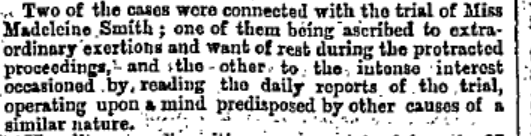
I’ve been looking at the fallout from the Madeleine Smith trial and had come across this summary of the annual report of the Royal Edinburgh Asylum from the Scotsman of 24 February 1858:

Annotation 2020-03-01 105359

which is interesting – unfortunately the reports don’t give the gender of the afflicted individuals, so I can’t say if the first person mentioned was a member of the legal profession (presumably male) who was stressed by the (for 1857) extremely salacious nature of the trial and depositions and suffered from stress akin to facebook content moderators dealing with confronting content.

However there was another interesting part of the report. Unfortunately it’s spread over two columns

Annotation 2020-03-01 105630

Annotation 2020-03-01 105151b

which sounds rather as if there was a recognition that not only could serious injuries to the head result in changes in behaviour, but also that the stress of combat could result in mental disturbance.

It would be interesting to look into this further, but while the records are available, they have not yet been digitised, and are inconveniently on the other side of the planet …

[update]

I was sufficiently intrigued by this to do a little more digging.

The topic has been under researched, but it looks as if a number of Crimean War soldiers we diagnosed as having an irritable heart – perhaps the same as was later described as Da Costa Syndrome during the American Civil War.

Other than a paper researching the occurrence of suicide in Crimean war veterans, I’ve been unable to find other substantial research into the effects of traumatic stress on Crimean war soldiers, although I did find a paper detailing a case of stress related chronic fatiguein a single Chelsea pensioner after service both in Crimea and the 1857 Indian rebellion…


Posted in Uncategorized | 2 Comments

Another Moncur bad boy

I probably need to get out more, but a few days ago, I ran my surname through querypic, looking to see if there were any reports relating to George or Thomas Moncur.

I didn’t turn up anything relating to them but I did turn up this notice about an absconding Moncur in 1828:

Annotation 2020-02-23 153653

As a notice it’s quite informative – it tells us that John Moncur, who was transported on the Minstrel – which sailed and arrived in 1825, and that when he absconded from the road gang he was 21 years old, making him seventeen or eighteen when he arrived in 1825.

Well our old friend the Scots Magazine with its record of court proceedings helps tie this down:

Annotation 2020-02-23 154847

but as you can see, it’s one of these cases where digitisation went a little askew.

A bit of hunting showed that there was also a report of court proceedings in the Scotsman, but the Scotsman digital archive wants to charge you eight quid for two days access, which I thought was a little excessive for a couple of column inches.

Fortunately the Scotsman is included in the State Library’s Proquest subscription, so after a few minutes scratching about to find my login details I had my report:

Annotation 2020-02-23 161215

The Scotsman described him as fifteen or sixteen, assume he was sixteen when convicted in December 1824, he could plausibly be seventeen when he arrived in August 1825.

Given that a lot of poorer classes – labourers, farmworkers etc, – in the Georgian era were a bit vague about their age and date of birth, it’s quite possible that he didn’t know his birthday and was judged to be sixteen.

So, he should have been easy to find. But he isn’t. No John Moncur shows up in the convict register.

It’s another good old transcription error – he’s listed as John Mancor

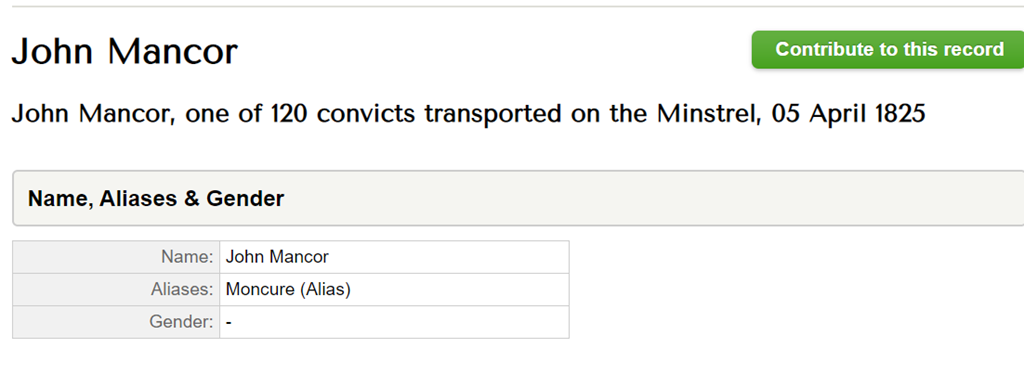
Annotation 2020-02-23 163610

on the convict records website, albeit with Moncure being given as an alias.

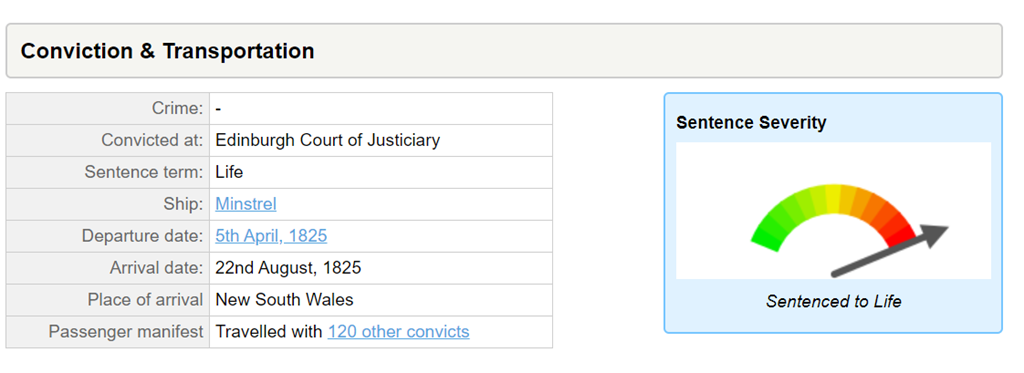
His conviction record ties in with the report in the Scotsman

Annotation 2020-02-23 163651

so we can be reasonably certain it’s him.

Unfortunately I can’t trace him beyond 1828 – none of the newspapers report him (as Moncur, Mancor, or Moncure) as being recaptured – it’s possible he’s in the convict records somewhere, but I havn’t looked very hard.

There’s a takeaway to this – be aware of aliases, different spellings and just plain old transcription errors, especially when searching old records …

Posted in Uncategorized | 1 Comment

Chinese Herbalist advertising in 1924

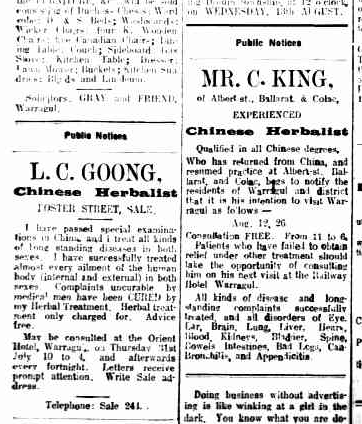
Came across this little curiousity in the West Gippsland times of 1924:

chinese herbalists in 1924

two Chinese herbalists (they probably couldn’t call themselves apothecaries) advertising to the white anglo population in rural Victoria.

And of course the obvious question is how much use was made of Chinese medicine as opposed to western medicine in the 1920’s ?

This is quite an interesting question because in the nineteenth century, the reliance of western pharmacy on herbal based cures was marked, and many of the common patent medicines sold were essentially packaged versions of traditional herbal cures.

A little digging suggests that in the 1870’s some Chines practitioners in Ballarat sought to have their Chinese qualifications recognised, but the was rejected by the Medical Board at the time meaning they had to describe themselves as herbalists.

There’s also some evidence that this refusal was as a result of racism and a failure of the western practitioners to recognise that Chinese practitioners had undertaken a rigorous course of study.

However, most people couldn’t afford doctors.

They would often buy a preparation, or a patent medicine, based on a recommendation by the pharmacist as still happens in some countries today.

And having seen Chinese miners go to a Chinese herbalist when they were sick (distrust goes both ways) they seem to have been happy to try Chinese medicine if all else failed.

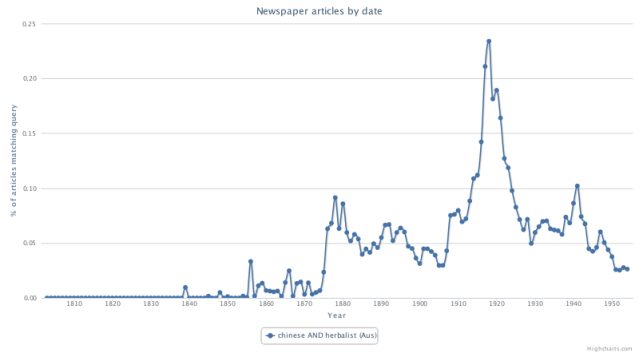
And the adoption of Chinese medicine seems a reasonably widespread phenomenon in late nineteenth and early twentieth century Australia – a search of the digitised newspaper collection on Trove turns up over a hundred thousand references.

Using querypic shows a sustianed interest over our period with a peak in the second decade of the twentieth century:

chart (1)

perhaps as a result of a reduced availability of western preparations during the first world war …

Posted in Uncategorized | Leave a comment

And some were bad boys …

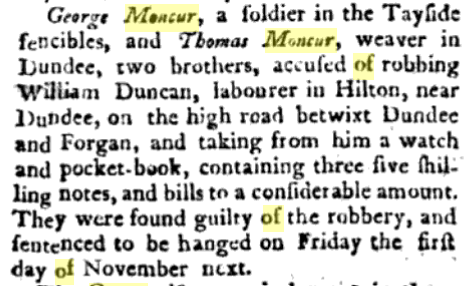
While I was looking for eighteenth century Moncurs I came across George and Thomas Moncur, who were convicted in 1799 at the Perth Court of Justicary in September 1799 and transported to Australia on board the Glatton arriving in 1803.

This is unusual in two ways – firstly, relatively few Scottish convicts were transported to Australia, and secondly, people brought before the Court of Justicary were guilty of doing seriously bad things – murder, rape, sedition, counterfeiting, violent robbery and the like.

Now, in 1798, there were various demonstrations in Scotland inspired by the rebellion of the United Irishmen, as well as other radical demonstrations following on from the failed insurrection in 1797, so at first I wondered if there was any connection, given that the Justiciary court was reserved for serious crimes.

Well as always the truth was rather more mundane. George and Thomas were thugs and tried for robbery with violence, as in this account from the Scots Magazine of 1799:

moncur bad boys

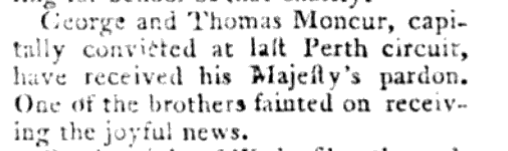
However, they didn’t hang for their crime – again from the Scots Magazine:

bad boys pardoned

The fact that one of them fainted somehow makes them more real …

Posted in Uncategorized | 1 Comment

A final turn around family history (for now)

I’ve been doing a little more digging around the whole family history thing, and I reckon that I’m probably correct in my supposition that most of the people with the Moncur surname adopted it due to their association with the area around Inchture.

I need to do some proper searching of the eighteenth century records to be sure but looking at the rough geographical spread of references to people named Moncur that seems a reasonable supposition.

I still need to sort out my line of descent from before 1814 and I suspect that will involve me signing up to Ancestry or MyHeritage to leverage off other information held there.

And now a confession – I actually don’t think my family history is remarkable or especially interesting – it’s quite clear that a lot of them shovelled shit in one way or another for a living.

What is potentially rather more interesting is the impact of the land tenure system on the movement of people after the mid 1750’s – essentially before 1750 the land was worked semi communally on the run rig system  by groups of related people.

When this changed to individual farms being worked on fixed tenancies with the farmworkers being hired for a six monthly contract this had an impact on where people lived.

Younger men, especially if they were skilled as ploughmen, would move between farms, and young women would likewise move between farms as maids of all work – something that a number of writers have blamed for a higher than average rate of births out of wedlock – put a group of young men and women together on an isolated farm and the inevitable happened.

This seems to have been a genuine phenomenon, rather than an expression of a Victorian moral panic about the the feckless poor breeding irresponsibly.

So, as a winter project I though I would trace my family back two or three generations more, say to the 1750’s or thereabouts and then trace the various siblings back to sometime around 1900 to see what jobs they did and where they lived, a sort of family microhistory if you like.

Personally I’ve always been more interested in social history and how people loved and lived

IMG_0218

as in this picture of a gentleman’s privy from No 10 Quality Row in Kingston on Norfolk Island, than the doings of the great and the good …

Posted in Uncategorized | 1 Comment

Well maybe we did have a castle after all

This is a sort of retraction, but only a partial of retraction.

The whole Moncur Castle/Moncur placename thing has been gnawing away at me and I’ve been doing some more digging, and it turns out there was an aristocratic Moncur family in medieval Scotland who held land round about Inchture, but the line died out, and the land passed to the Kinnairds, who are probably the people who built the house known as Moncur castle, and which appears on one of the Pont maps of Renaissance Scotland as Montcurr castle.

So given the family died out, how did people end up with the Moncur surname?

There’s basically four ways this could have happened.

The most likely is that the name was adopted by one or more tenant farmers or other followers of the  Moncur lords – this would probably have happened sometime in the late fifteenth or early mid sixteenth century – ordinary people didn’t really do surnames in the Scots speaking areas before then (Surnames in the Gaelic speaking areas have a different history).

The implication of this is that not all Moncurs are related but that some of us at least were originally agricultural workers on lands held by the Moncur family. Given that there seems to be cluster in the eighteenth century of records, grave stones and so on in the Longforgan and Forfar areas that seems fairly tenable as an argument.

The other obvious suggestion is that the while the title to the Moncur lands may have expired, other quasi aristocratic Moncurs – the sons of younger sons etc, may have meant that the name lived on.

Given that some of the early Moncurs seem to have been ministers of religion or people of some education it’s possible that they had access to family wealth, however diminished, to fund their education, that seems a  plausible alternative.

The other two explanations are less likely. One is that the name has a Huguenot origin.

Having watched time and again the hotel clerks behind the reception desk in France take my passport, say Bonjour, Monsieur Montcour, and proceed to type my name that way, despite having my passport open in front of them, you can’t but believe in a French origin of the surname.

But Huguenot it is not.

Given that the Forfar area being known for linen waving from the eighteenth century onwards, and the well known Huguenot connection with the weaving industry, it at first might seem to be a tenable argument that the name was Huguenot in origin. (While the Spitalfields Huguenots in London were primarily silk weavers, there was a Huguenot community in Ireland associated with the linen industry, and some of them later moved to Scotland to work in the developing Scots linen industry.)

However, we can discount the suggestion of a Huguenot origin to the name. The various Huguenot societies maintain detailed lists of surnames they consider Huguenot in origin and their variants and Montcour/Moncoeur/Moncur is not on the list.

Incidentally, there is some evidence of an extended family of Huguenot weavers from Picardy being encouraged to settle in the Forfar area, but they had classic Huguenot names.

The fourth alternative is that the name is of Flemish origin – there was a fairly large Flemish settlement in the Dundee area in medieval times – and  despite the name sounding more Walloon than Flemish, it could be argued that the name came via Flemish settlement – except that recent research at St Andrews into the Flemish settlement does not identify the Moncur name as being associated with Flemish settlement.

So, the simplest answer is that one or more people living or working in the Moncur area adopted the name of the area as their surname when it became practical requirement.

Certainly the work I’ve done tracing my family line back seems to suggest a heritage of agricultural workers rather than that of the gentry.


Posted in Uncategorized | 4 Comments

Cinnak

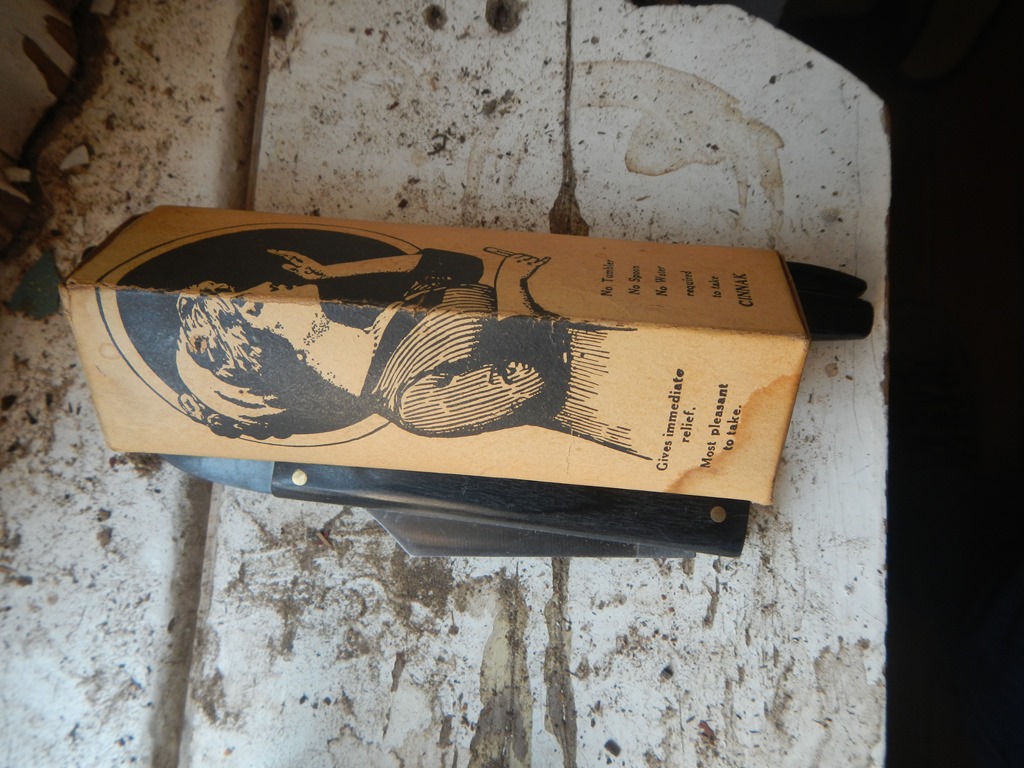
Yesterday I came across an interesting early twentieth century package …

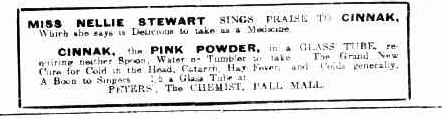
DSCN2273

interesting because of the way the design was printed over the corner of the package, unlike most other packaging of the time where the individual faces of the box were simple standalone designs.

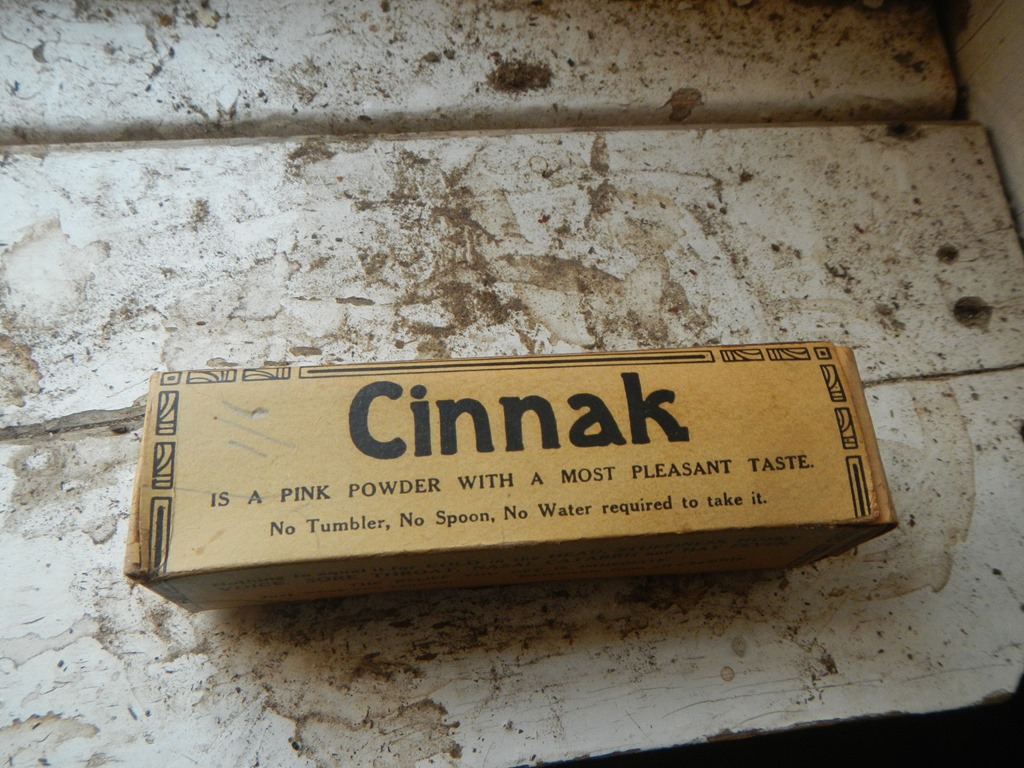
The product itself was Cinnak:

DSCN2275

a product dating from the immediate pre world war I period  to provide relief from colds, whose great selling point was that it could be taken without the need for being mixed into a glass of water.

cinnak 2    cinnak 1

And who was Nellie Stewart ? Well wikipedia was my friend here. Nellie Stewart was an Australian actor and singer of the time who was known for her roles in light comedies and operettas – so an obvious choice for someone to endorse a cold cure …

Posted in Uncategorized | Leave a comment

Moncur castle (again)

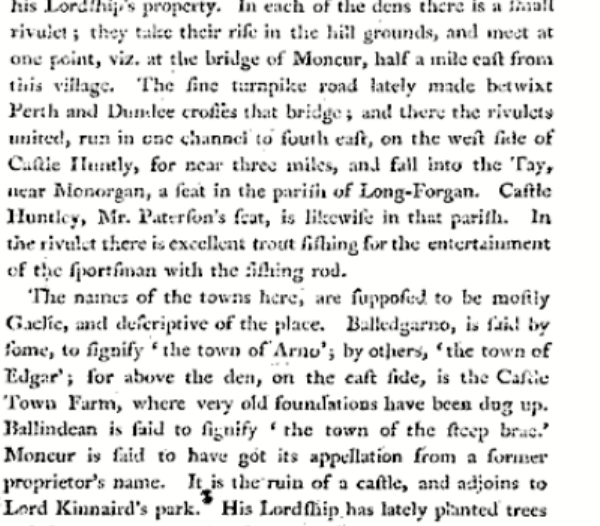
While using the Statistical Account to try and find the locations of farms and properties mention in the servant tax records, I came across the following entry about Inchture from the 1799 appendix:

1799 statistical account of scotland

which sort of vaguely supports my guess about there having been a proprietor ( be they tenant or landowner) named Moncur sometime before the mid 1500’s when the Kinnairds assumed proprietorship …

Posted in Uncategorized | 1 Comment

Not from St Cyrus after all …

More family history news:

The family history legend had been that we had been tenant farmers for a very long time. Obviously not every son got to be a farmer, so some had gone off to do other jobs.

So far so good.

Now I’d kind of assumed that all this had happened in the St Cyrus area as that’s where the immediate family connections were, and where I knew my great grandfather had had a farm.

Not a bit of it.

The 1871 census recorded place of birth as well as where people lived and my great grandfather’s place of birth was Forfar.

My great grandmother was listed as being born in Montrose.

My great grandfather was listed as being a crofter, so I’m guessing that sometime in the 1860’s he moved to the St Cyrus area to take up a tenancy.

Now obviously there’s a bit more work to do here, but I had a bit of luck.

I’ve been using a free account on one of these commercial ancestry sites, MyHeritage, as I find their family tree graphing tool fairly intuitive to use. and what’s more they allow you to export your data in Gedcom format, which most genealogical software can read.

Now, quite often they tell you about possible matches in an effort to get you to sign up, but this time they offered a free match to a family tree based on my great uncle, which took me back a generation, to 1814 no less, when my great great grandfather was born in Kinettles near Forfar.

The information is a bit sketchy – birth marriage and death records where not kept officially until 1854, and there are only partial census records before 1841 – so there’s going to have to be a bit of detective work to fill in the blanks.

It’s also complicated because the land tenure system was such that most of the farms were let to tenants, and the tenant farmers would in turn hire – fee in Scots – farm workers – who were termed farm servants – and other sorts domestic servants for a fixed term – often six months, sometimes a year.

The consequence was that people did move about in their area between fees and tenancies.

But what we do have is the Horse Tax and Male and Female servant tax records, organised by parish, from the 1790’s.

A quick and dirty search shows a number of Moncurs – both male and female employed as servants in the area, and at least one man, Peter Moncur of Kirkton by Tealing, who had to pay the horse tax, and who I might guess to be a tenant farmer.

However more work, much more work, is required …


Posted in Uncategorized | 3 Comments