Newspaper non fiction in colonial South Africa

I’ve written before about Kath Bode’s work resurrecting lost fiction from colonial period Australian newspapers.

At the time, I did say that in one sense it wasn’t a surprise, newspaper fiction had been a major event in the mid to late nineteenth century in the English speaking world.

However, one great gap has always been what was happening in colonial South Africa – clearly there were newspapers and magazines, and no reason to expect that the demand for content was any different, but the lack of digitised resources means that it’s difficult to investigate electronically what was going on.

Happenstance is a wonderful thing however.

I was searching Google Books for something entirely different, and came across a South African book,

Life & travels in the northwest, 1850-1899 : Namaqualand, West Coast & Bushmanland

which, according to the preface, has been compiled from official reports and from magazine and newspaper articles of the time.

So, if people were writing about their travels and explorations, there’s a good chance that they were also writing short stories and novellas about their experience of life, and that these were turning up in the newspapers and magazines of the time …

Posted in Uncategorized | Leave a comment

Queen Victoria’s first love ?

I recently bought a book.

Not an unknown event, but unusually I bought it for the title alone – The Queen, Her Lover and the Most Notorious Spy in History.

The book can be summarised like this:

After the end of communism in Russia the author, Roland Perry, was researching a book on the Cambridge Spies, including Anthony Blunt’s mission to Germany to recover letters between Queen Victoria and her daughter Vicky – the wife of Kaiser Friedrich III – held in Kronberg in Germany.

During the course of his research, Perry met with several former senior KGB officials in Moscow who told him of compromising material in the letters that had been photographed by Blunt and passed to Moscow, before the originals were deposited in the Royal archive.

One of the claimed revelations was that Queen Victoria had had both a sexual relationship and an illegitimate child at the age of 15, with John, the 13th Lord Elphinstone.

There’s a review of the book and an interview with the author (both from the SMH) available online if you wish to read further.

Now, we know that after her death Queen Victoria’s journals and letters were severely filleted by her daughter Beatrice, so severely that only around a third of the original material remains, and once she’d transcribed and edited the journals Beatrice burned the originals,

We also know that that Victoria wrote around 4000 letters to her daughter over her lifetime, so, given the severe filleting, it was more than possible that the letters contained information previously unknown to historians, and possibly embarrassing to the monarchy, which was busily trying to distance itself from Edward the VIII’s infatuation with the Nazis.

So, if you believe the story of the sexual relationship and illegitimate child, it’s possible that the letters referred to these events.

Certainly John Elphinstone was a member of William IV’s court between 1835 and 1837, was showered with honours and promoted to the Privy Council in 1836, and then shunted off to be Governor of the Madras Presidency in 1837, the year of Victoria’s accession.

If you were a conspiracy theorist, one might almost think that his silence was being bought, and then shunted off to India to ensure his continued silence.

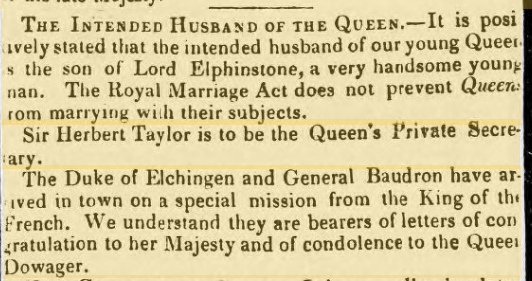
Possibly so, but then we have this from the Monmouthshire Merlin of 8 July 1837

Which shows that the relationship between Victoria and John Elphinstone was public knowledge, and that there was an expectation that he would be recalled from Madras, now that Victoria was queen.

The Exeter and Plymouth Gazette of the same date, follows its coverage of William IV’s funeral with a similar and longer article about Queen Victoria’s future husband and how the Royal Marriage act – which essentially states that all marriages by members of the Royal family require the approval of the reigning monarch – does not preclude Victoria marrying Elphinstone.

So, not only was the relationship publicly known, there was a widespread expectation that, now that Victoria was queen, that Elphinstone would be recalled and that she would, in due course, marry him – something that was even the subject of satirical commentary at the time.

And her relationship with Elphinstone continued to be remembered even as late as 1886, as can be seen in this piece from the Northern Star in Lismore. (As newspapers of the time tended to often reprint contents from other newspapers, especially overseas ones, without attribution, the article may well appear elsewhere).

So, while we don’t know, and will probably never know, if Victoria and Elphinstone ever actually had a sexual relationship, let alone a child together, what we can say is that there was some sort of public relationship, and one sufficiently strong that there was an expectation that she would marry Elphinstone once she was mistress in her own house.

The interesting thing about all of this is the way that Elphinstone has been written out of the conventional narrative of Queen Victoria’s early years and accession, despite the fact that it was clearly well known and discussed at the time.

One wonders, doesn’t one?

Posted in Uncategorized | Leave a comment

Mortality in late Victorian Scotland

Totally unscientific I know, but my little Christmas recreation of investigating my family history has brought home to me just how many people died of what would now be preventable diseases, and in Dundee at least how many these were lung and chest related.

Some were preventable like tuberculosis, other were probably the result of breathing dirty air day in day out – and probably explains why the middle classes moved out to Monifieth and Brought Ferry on the Tay Estuary with they’re (hopefully) cleaner air.

One thing that my work of documenting the contents of Dow’s Pharmacy has shown is the increasing reliance on patent medicines – and when you had a disease with no cure you’d probably grasp at anything that gave some relief and would tend to go back time and again to products that worked for you, and hence increased brand recognition of these particular patent medicines ….


Posted in Uncategorized | 1 Comment

Family History part iii – conclusions and reflections

I think I’ve come to the end of the road as regards the Mathieson side of my family.

Annie, I presume, lived on, but I’ve been unable to find her death record, or a record of a marriage.

The most likely explanation is that at the age of 40 after the death of her father she upped sticks and moved somewhere else, England, Ireland, America or somewhere else.

There’s no one alive to ask, and she didn’t leave much of a documentation trail.

James had tragedy in his life with the death of his first wife, but he worked hard to become the manager of a Co-Op store and seems to have been well enough liked in the community.

But none of the Mathiesons left much of a documentation trail. They weren’t lawyers, journalists or even criminals, just hard working folk who got on with it and didn’t make a fuss.

As a consequence, there’s very little to find to flesh out the story. None of them was something like a music teacher who advertised private lessons, or someone who spoke at trade union meetings – ten minutes with the British Newspaper archive showed me that.

There are still outstanding questions such as whether Clementina and James senior had children other than James junior and Annie, and of course what happened to James and Catherine’s boys after Catherine’s death.

Certainly I don’t recall my mother ever mentioning older step brothers – my guess is that they might have gone to live with Catherine’s parents, but I don’t really know.

Personally it has answered some questions for me and put some things in context.

It has also been an excellent exercise to teach me how to carry out long distance family history research, and use the research tools and resources available for Scottish family history.

I still have other questions about my father’s side of the family, but I think I’ll let the Mathiesons rest for now – I’ve disturbed them enough.

Posted in family history, Uncategorized | 1 Comment

Family History part ii

Following from my success of tracking down my great grandfather and great grandmother, I thought I’d do a little more digging to round out my findings.

This involved finding my grandfather’s birth record, and also the birth record for Miss A – who had been present when my great grandfather died and who I’d been calling Annie.

Well Miss A was indeed Annie and she would have been forty when he died. Given that Clementina died young, I’d guess that Annie might have been the oldest (living) daughter who, as was common in the nineteenth century, took over the running of the house on her mother’s death, and probably never married.

Obviously, to confirm this I need to find Annie’s death record and check for other siblings, but it seems like a reasonable hypothesis in a hand waving sort of way.

However, my great grandparents married in 1871, and Annie was born in 1877, which, given natural fecundity, probably means that there were other siblings, even if they died young.

Also Annie would have only been 12 when Clementina died, and that does seem to be bit young, even for the 1880’s, so it’s possible that she had older brothers and sisters, and as they married she moved into the role of housekeeper as the last daughter standing.

My great grandparents marriage record holds other surprises. Up to now, every connection comes back to Dundee, but no, they were married in Forfar, a town twenty kilometres or so out of Dundee.

Clementina’s father is listed as a linen weaver, which makes sense as Forfar was a centre of the linen weaving industry in the mid nineteenth century. More interestingly my great grandfather, who was also James, like my grandfather, is listed as living at Clocksbriggs, which is a location out of Forfar, near Rescobie Loch.

Google maps shows it to be a wooded location not far from the Rescobie Loch. At first I thought it might be a farm or a smallholding but when I looked at the 1885 Ordnance Survey I discovered that there was a railway station on the old Aberdeen railway at Clocksbriggs – something that explains why my great great grandfather was working as a stonebreaker – at a guess what it meant was he was a maintenance worker for the railway track and broke up stones to make replacement ballast.

Unfortunately, the staff records from the Aberdeen railway and its successors do not appear to have been digitised, so for the moment that will have to remain an interesting hypothesis and noting more.

Equally, my great grandfather had obviously decided that he wasn’t going to be a manual worker like his father, and had learned to be a boot or shoemaker – early on he describes himself as as a shoemaker on official documents, but later on as a boot maker.

Whether these were workboots for coal hauliers or elegant dress boots for ladies, or perhaps both, I don’t know, but he was obviously determined to better himself, and sometime between their marriage and the birth of Annie they’d moved to the nearest big city – Dundee – and set himself up in business, eventually ending up with his own shop …

[Update 29/12/2018]

Well, a little more digging showed that James (my grandfather) married Catherine Marshall Gracie, a domestic servant, in 1906.

At the time James’s occupation was given as a grocer’s assistant. As far as I can tell they had two children – another James Bush Mathieson in 1907 followed by a David Gracie Mathieson in 1909.

Catherine died of tuberculosis in 1913.

As an interesting little aside her father is described as a ploughman, quite a skilled occupation, when she was married in 1906, but by the time of her death, he had made the change from horse to internal combustion and is described as a lorry driver.

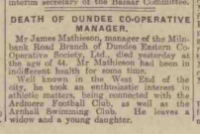
While I havn’t found my grandfather’s death certificate, I did find his death notice in the Dundee Courier, showing he died in late October 1923, and had been unwell for sometime. By that time he’d become the manager of one of the Dundee CoOperative and Wholesale society’s shops, and was consequently a man of some importance in the community …

Posted in family history, Victorian | Leave a comment

Family History …

I grew up in a large messy family of aunts uncles and cousins, and while I only had one sibling, I had a whole scad of cousins and we always seemed to be visiting one another.

What I didn’t have was grandparents. By the time I came on the scene they were dead, and while that seemed to be different from most of my schoolfriends, I had plenty of substitutes in the form of uncles and aunties. No one seemed to have quite as many as I did.

I thought I more or less knew who was related to who and how, but after my mother died – about ten years ago now – I realised that I didn’t know as much about her side of the family as I thought.

Well, it was obviously too late to ask her, so I signed up for the Scottish goverment’s genealogy service and started to trace hers side of the family.

Well, I didn’t get very far.

While the index was online, the records themselves weren’t, meaning that when you found a document, such as a birth extract, you had to request it and then wait three or four weeks for it to arrive in the mail.

Also, useful supplementary documents such as Post Office and trade directories were not online, or even sporadically so.

So I gave up – it was a busy period of my life – and kind of forgot about it until a few months ago the Genealogy service emailed me to say that my account (and prepaid search credits) was about to expire due to lack of use.

Well I had quite a few credits outstanding and the cost of extending the life of my account was only a few pounds – I had to buy some extra credits to carry forward my existing credits – so I used some of the hundred pounds or so I still have in a UK bank account to extend my account.

And that was that until yesterday.

Yesterday was one of these stupidly hot days we often get around Christmastime, so I stayed inside in the air conditioning and played with genealogy, something that was a lot simpler than last time as in the intervening few years they’ve scanned all the registers, and useful supporting documents like port office and trade directories are mostly online.

I already had a copy of my mother’s birth certificate so I knew the names of her parents and that her father was a manager with the co-operative society in Dundee.

A little playing with the genealogy service’s search engine and I had a copy of her parents’ marriage record – Scotland doesn’t issue birth death or marriage certificates as such, details are recorded in registers and when you need a copy for official purposes they provide you with a scanned copy of the entry on official paper that they call an ‘extract’, something that has always caused complications with Australian officialdom – when I became a citizen it seemed like every single person in the DIMIA office needed to have this explained to them.

Anyway, back to the story.

Their marriage record told me a number of things I didn’t know:

  • It was my grandfather’s second marriage – he was described as a 38 year old widower on the register entry. The obvious questions are
    • Who was his first wife?
    • Were there any children?
  • My grandmother was quite old to get married for these times – 30 years old – and her profession was described as a biscuit taster – or possibly tester – annoyingly the scan is not the best and the penmanship is not up to the usual standards of early twentieth century Scottish officialdom – but either way it sounds like a fun job.
  • My greatgrandfather on my grandfather’s side was described as a retired bootmaker – and he obviously had his own shop as he was listed in the 1910 trade directory.
  • On the other side, my grandmother’s father was Robert Littlejohn, a tailor, who possibly worked for someone else as he doesn’t appear in the trade directory.

Well this explained two things – when I was little I remember being taken to see some people whose surname was Littlejohn – who were some sort of relations of my mother’s. I would guess that they were cousins, and that possibly my grandmother, Lydia, had at least one brother.

The other thing is that I remember my mother telling me once that she remembered her father sitting crosslegged sewing up clothes because he was a qualified tailor. It’s possible I’ve got confused and it was her grandfather she remembered sitting cross legged.

That’s about as far as I’ve got with Lydia’s family.

I also managed to find my greatgrandfather’s father’s death record.

He’d died a few months before my grandfather married for the second time and they all lived in 6 North Wellington St in Dundee. Interestingly the name of the person reporting the death to the registrar was a daughter, a Miss A. Mathieson, who was present at the death, suggesting that my grandfather had at least one other sibling.

The other discovery was that his wife, Clementina, had died in 1889, nearly thirty years earlier. There’s no evidence of him having remarried.

I’ve no knowledge of who Miss A. Mathieson was -in my head I call her Annie – as I’ve been able to find that my greatgrandfather’s mother was Annie Laidlaw Bush, and families tend to reuse names.

Given the habit of families in the North east of Scotland to give the first born child the maiden name of its mother as a middle name, I’d guess that ALB’s mother was a Laidlaw.

My greatgrandfather’s full name was James Bush Mathieson, which keeps to the tradition and Clementina’s maiden name was Proctor, which was also my mother’s middle name.

I’ve been able to trace that her father, Andrew Proctor, was a weaver, and that her mother’s maiden name was Anderson. This takes us back to Clementina being born in 1846 or 47.

James Bush Mathieson was born around the same time and his father is listed as a stonebreaker, which sounds like a pretty physical occupation.

While I can probably trace James Bush’s and Clementina’s birth records, and possibly another generation or so back we’ve reached the time when there were only church records, not all of which have survived, which adds a further complication.

However, I think my next task is to trace both Annie’s and my grandfather’s birth records, and also my grandfather’s first marriage. This should be a little more straightforward, as if my grandfather was 38 in 1917, it probably means he was born around 1879, when James B and Clementina were in their early thirties, and well after 1855 when the government took over responsibility for birth death and marriage records from the Church.

Keeping track of all of this is absurdly complicated with lots of scribbles and crossings out, so I’ve decided to do it properly from the start, using the Gramps Genealogy package to keep track of all these complicated relationships and inconsistencies.

Certainly, the complexities so far make you realise just how messy people’s lives are (and were) …

Posted in Uncategorized | 2 Comments

So I thought I’d do a MOOC …

I’ve been doing a lot of reading about the Victorian era on the back of my work documenting Dow’s pharmacy.

During that period the world changed immeasurably, with the electric telegraph enabling long distance near instantaneous communication, the railway and the steamship substantially reducing the cost of freight, allowing global commerce, as well as allowing people to travel beyond their home parishes.

One of my favourite stories is about Rocke and Tompsitt, pharmaceutical wholesalers in Melbourne. One partner stayed in Melbourne, the other relocated to London, and by dint of the telegraph they were able to substantially quicken the turnround on orders for products imported from the UK.

At the same time the penny post – and cheap colonial mails – allowed people to send letters, order goods, and maintain contact with friends and family.

All in all a fascinating period of history.

But I’m also aware that there are gaps in my knowledge, so I thought I’d do some long distance study to identify gaps in my knowledge.

As I live in rural Victoria, online distance education seemed the best solution – we have good internet, and we’re close enough to the city to manage the occasional day trip if required.

So I thought the answer would be a MOOC – a short course, no obligations on either side, I could drop out if wasn’t doing it for me. I wasn’t a total freetard, I was happy enough to pay a modest fee for online tuition and gaining some sort of certificate at the end.

On a more personal note, it is 40 years since I last did any formal study – and while I’ve done a lot of professional training and learning in these 40 years – it’s not the same as academic study, so again a MOOC seemed ideal to let me see how I went with going back to study.

So I went looking.

Ideally I’d have signed up to an Australian one, it’s just easier being in near enough the same timezone for shared sessions, but a UK one would also have been fine given the sort of material that I wanted to cover.

Colonial Australia tended to follow the UK playbook, and things that happened there came here etc etc.

I more or less ruled out US Victorian studies as the history of the post Civil War US and its economic development was quite different.

Well it didn’t really matter.

There was a time when MOOCs were flavour of the month, but not any more. They seem to have morphed into an online training solution in the main.

Now maybe there weren’t ever that many Victorian Studies MOOCs but I can tell you that I found exactly one – from Oxford University’s Continuing Education service.

It was a paid for course, which was fine, but it was only around $500 – which while it’s a reasonable amount of money, the cost was around the same as a multi day oil painting workshop costs J.

Unfortunately, a critical part of the course coincided with when I’d planned to be in Norfolk Island, so that wasn’t going to fly.

Perhaps next time.

But what was interesting was the number of UK universities spruiking masters courses in Victorian Studies, and equally interesting was just how many of them came out of English departments rather than History departments.

Many of them seemed based around nineteenth century literature, and while it is true that literature tells us how people felt and reacted to the changes in society brought about by the changes in technology – Wilkie Collins is full of references to train travel and the penny post, and of course Magwitch’s money in Great Expectations come from his sheep farming business as a ticket of leave man, it doesn’t cover the whole picture with the technological changes, and the appearance of consumer goods, be it toothpaste or patent medicine …

Posted in Uncategorized | Leave a comment

Pot lids

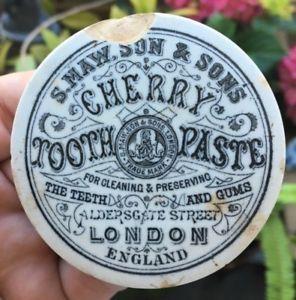
In the latter half of the nineteenth century items like toothpaste and cosmetics started to be packaged in small ceramic pots.

These pots are sought after by collectors of nineteenth century ephemera and good examples go for a couple of hundred dollars

Being ceramic they are fairly indestructible and regularly turn up in bottle dumps and online auctions – the example above was found on ebay and claimed to come from a bottle dump in Claremont WA.

Of course, it’s a rarity for any of these pots offered for sale to come with anything resembling a provenance, but because they’re sought after by collectors we can track how the design changed over the years, giving us a rough chronology – for example, though S Maw.Son and Sons sold their cherry toothpaste for most of the latter half of the nineteenth century we can date this particular pot lid to the 1870’s, which tells this that someone was importing and selling their toothpaste in Western Australia, or just possibly, someone migrating from England brought some with them.

Sometimes of course, the lid tells us something more

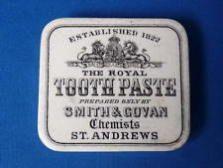
Some chemists (this one is from St Andrews in Scotland) made up and packaged their own products. This particular item is unprovenanced save to say that Smith and Govan were pharmacists and druggists in South Street in St Andrews, and just to add interest, Mr Govan was a noted early calotype photographer in the 1850’s.

Provenanced however, thes pots tell us more – when out of area they let us tie bottle dumps to migration patterns.

Most of these ceramic pots seem to hail from the UK. I’ve done quite a bit of searching over the weekend and most of the examples seem to be from UK firms – there are examples from the United States, but again they seem to be from collectors disposing of their collections.

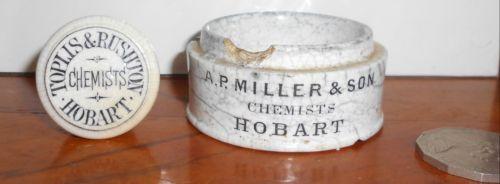
Initially I only found one unambiguously Australian example

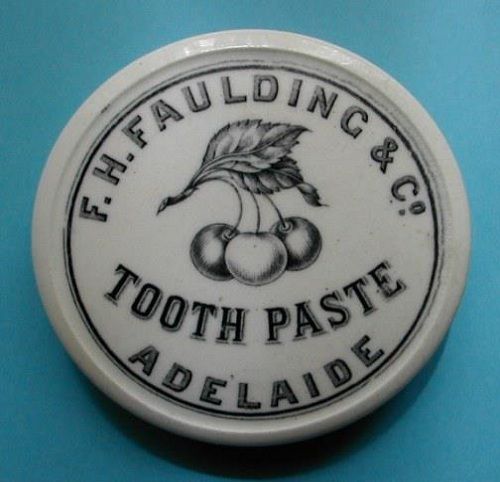
and none from New Zealand. Searching a little more widely I came up with a number of other Australian examples, including this one from FH Faulding

dfc27171be2a892c16e9d397f0ffcb4f

I suspect that as Australia was a much smaller place in those days – under four million people as opposed to the UK’s near forty million in the 1890’s – there were simply fewer local manufacturers and and as we’ve seen with patent medicines, local brans were always at risk of being outcompeted …

[update 14 Jan 2019]

After a lot of time messing about on pinterest, I suspect I wasn’t quite correct in my conclusions.

A lot of chemists in England had ‘own brand’ ceramic containers in the late nineteenth century, with the pots being transfer printed by specialist manufacturers, and I would guess that the chemist either filled, or had these pots filled to order.

In the case of Australia at the same time, I suspect that the containers had to be manufactured, printed and filled overseas, and are consequently considerably rarer as few chemists went to the bother (and expense) of doing so …

Posted in Victorian | 3 Comments

Open science citizen science and stuff

This is a post that has been knocking round the back of my brain ever since I ended up paying $16.50 to get a thesis from the University of Queensland.

First, some terminology:

Citizen science

This term is used in two ways. The first one is really just crowdsourcing where individual sign up on a relatively large scale – say to collect sighting of songbirds in spring.

The second is more interesting. Start delving into local nature clubs, field studies groups, astronomy groups, archaeology and local history societies and you rapidly discover that there are a substantial number of people spending quite a lot of their own money, to do something that looks a lot like something that might well get funding in an academic context.

For example, comet tracking. Amateurs have often beaten the professionals to this by using relatively simple equipment, often based around cheap computers such as the Raspberry Pi and off the shelf telescopes and cameras.

These people are often highly knowledgeable in their field and have serious contributions to make. The work is, on the whole, not cutting edge, but solid observational work documenting things – worth that a nineteenth century scientist, many of whom were themselves gentleman amateurs, would recognise as science.

And this second group can be described truly as members of the scientific community.

In my own work cataloguing the contents of Dow’s pharmacy I’ve had a lot of help from both amateurs – eg the Australian expert on Remington typewriters, professionals such as museum staff particularly cataloguing and research staff, and academics with expertise in nineteenth century Australia, and in this we all treat each others as equals and members of a community of interest. While it might not strictly be citizen science, it’s certainly community cataloguing and archiving.

Open science, Open access

The open science movement really started as a means by which academic libraries wished to wrest back control from the oligopoly of academic publishers, who each year demanded more and more for subscriptions to ‘must have’ research journals.

In the open model, researchers pay to publish their results in journals to which access is itself free. They pay because producing these journals, even if online, costs money to defer the costs of refereeing, peer review, the publication process, and keeping the servers running.

When I used to manage academic repositories for a living, I’d estimate the cost of running the servers, the content management, archiving, backup and all the other sordid minutiae of IT at around $200,000 per annum.

Basically that would get you a couple of highly skilled software engineers to work part time on keeping the lights on, upgrading systems, supervision contents ingest, plus a server to run it all on.

Now an academic repository is just a specialist content management system. An online journal is much the same but with editorial and content control, and while I’m no expert that probably adds another $200,000 to your running costs – bottom line people are expensive, and they want pensions, holidays, in some countries health insurance, as well as just being paid.

However, the costs are a lot less than those charged to libraries in aggregate for subscriptions by some of the major publishers.

There is also the case of what to do with research data. Due to a panic over reproducibility there’s an increasing requirement for researchers to deposit their supporting data. Again all you need is a repository and some people to look after it. If you’ve already got an academic repository you can probably capitalise on existing experience, and while you might need to hire an extra person, machines and storage are relatively cheap these days.

But this gives us a couple of problems.

One is kind of a non-problem.

Citizen scientists need access to journals and research publications. Some might even on occasions co-author with an established academic researcher. The simple solution is to let them have access to the contents, both online and physical of academic libraries. Yes, we probably do need a gatekeeper mechanism to keep the numbers manageable, but organisations such as Museums Australia are probably well placed to do this – basically membership of a learned society or a professional body is probably the only criteria required.

The other problem is what to do with these citizen scientists’ data. It’s not a new problem. If you google me hard enough you’ll find me mentioned in a 1988 Linnean Society report as a biological records co-ordinator in mid Wales. (Actually I wasn’t, or rather not any more, I’d moved elsewhere by the time the report came out so no one ever contacted me about the long term custodianship of their data).

However, the problem of what to do with the data is an ongoing problem.

The costs of hosting a repository on Amazon are trivial – for example Dspace costs around 20 cents an hour or a little under US$1800 per annum. Adding a reasonable amount of storage would cost a bit more, but not eyewateringly so.

Hosting is of course not the same as running and maintaining a public repository. Human beings are expensive, and ones that know what they are doing more so.

The costs are probably beyond most learned societies, simply because of the need to employ people to manage the repository solution.

I don’t have an answer to this, except to say that I don’t think charging people for access is the solution …

Posted in Computers and Internet | Leave a comment

Citizen science and access to libraries

Recently I’ve become interested in the development of natural history in nineteenth century Australia.

After all not only was the Victorian era the heyday of natural history, but in Australia it had an importance in people trying to understand how the ecology of this wide brown land worked and in describing what they found.

There were individuals such as von Muller who was employed as the colonial botanist to carry out a botanical survey of Victoria, the numerous local clergymen, doctors and phramacists who did a little botany, entomology, or zoology as a hobby, and the numerous watercolourists (mostly but not exclusively female) who painted the plants they found in their area.

Put together, they assembled a picture of Austalia as it was before it transformed from a lightly populated pastoral country to the post industrial country it is today. It also gives us an ecological baseline from which to gauge the effect of climate change.

But it’s not only local naturalists. Ships’ naturalists visited as well, including Hooker, Huxley and of course Darwin.

Now the interesting thing about ships’ naturalists is that they were usually employed as assistant surgeons by the Royal Navy – which meant that they had some medical scientific knowledge, and some knowledge of botany and zoology. What’s more, their conmtracts of employment meant that all their journals and records became property of the British government on the end of their contracts – which is why quite a few of the early records are in London.

So, I thought I would do a little bit or reading about ships’ naturalists.

Well there’s not that much written. There’s a book and what looks to be quite an interesting PhD thesis held at the University of Queensland. The abstract certainly suggested that it would be worthwhile downloading.

Except for one little problem – access was restricted to staff and higher degree students at UQ.

So I emailed the UQ library to ask if I could have access to the thesis. They replied that they didn’t handle requests from individuals and that I would have to ask my local library.

We’ll ignore the fact that the thesis was already digitised and it would have been as easy for me to download it directly rather than get it through my local library, but its their data, so its their rules.

Asking my local library was fun. I’m no longer affiliated to an academic institution, but my local library is a member of the Swift consortium, and had been able to get me a book on nineteenth century paleography from the State Library of Victoria in the past so I reckoned I was in with a chance.

So I talked to them. They’d never done this before, but UQ did have a page explaining how libraries could request a copy of a digitised thesis.

And they did give it a go, very successfully. I now have a copy of the thesis sitting on my OneDrive account.

But I do have a little niggle. The process cost me $16.50 in processing charges, which is something I’m happy to pay once. After all I’m basically a dilletante – but on a repeated basis, perhpas not.

And that raises a larger question about citizen science – people doing it are funding it out of their own pockets, and paying for access to materials, and, in these days of open access should that really be the case.

Equally the other thing about citizen science is, what happens to the data?

Posted in Uncategorized | 1 Comment