Citizen science and access to libraries

Recently I’ve become interested in the development of natural history in nineteenth century Australia.

After all not only was the Victorian era the heyday of natural history, but in Australia it had an importance in people trying to understand how the ecology of this wide brown land worked and in describing what they found.

There were individuals such as von Muller who was employed as the colonial botanist to carry out a botanical survey of Victoria, the numerous local clergymen, doctors and phramacists who did a little botany, entomology, or zoology as a hobby, and the numerous watercolourists (mostly but not exclusively female) who painted the plants they found in their area.

Put together, they assembled a picture of Austalia as it was before it transformed from a lightly populated pastoral country to the post industrial country it is today. It also gives us an ecological baseline from which to gauge the effect of climate change.

But it’s not only local naturalists. Ships’ naturalists visited as well, including Hooker, Huxley and of course Darwin.

Now the interesting thing about ships’ naturalists is that they were usually employed as assistant surgeons by the Royal Navy – which meant that they had some medical scientific knowledge, and some knowledge of botany and zoology. What’s more, their conmtracts of employment meant that all their journals and records became property of the British government on the end of their contracts – which is why quite a few of the early records are in London.

So, I thought I would do a little bit or reading about ships’ naturalists.

Well there’s not that much written. There’s a book and what looks to be quite an interesting PhD thesis held at the University of Queensland. The abstract certainly suggested that it would be worthwhile downloading.

Except for one little problem – access was restricted to staff and higher degree students at UQ.

So I emailed the UQ library to ask if I could have access to the thesis. They replied that they didn’t handle requests from individuals and that I would have to ask my local library.

We’ll ignore the fact that the thesis was already digitised and it would have been as easy for me to download it directly rather than get it through my local library, but its their data, so its their rules.

Asking my local library was fun. I’m no longer affiliated to an academic institution, but my local library is a member of the Swift consortium, and had been able to get me a book on nineteenth century paleography from the State Library of Victoria in the past so I reckoned I was in with a chance.

So I talked to them. They’d never done this before, but UQ did have a page explaining how libraries could request a copy of a digitised thesis.

And they did give it a go, very successfully. I now have a copy of the thesis sitting on my OneDrive account.

But I do have a little niggle. The process cost me $16.50 in processing charges, which is something I’m happy to pay once. After all I’m basically a dilletante – but on a repeated basis, perhpas not.

And that raises a larger question about citizen science – people doing it are funding it out of their own pockets, and paying for access to materials, and, in these days of open access should that really be the case.

Equally the other thing about citizen science is, what happens to the data?
Posted in Uncategorized | 1 Comment

A very tangential connection to the Russian Revolution …

Visiting family always seems to involve a boozy dinner with alittle too much red wine, or at least ours do.

And as always with coneversations involving a decent red, sometimes they take some slightly odd turns.

And so it was a few days ago, ironically on the 101st anniversary of the Russian revolution.

We were talking about family history and where various strands of the family had come from. Most of us have been fairly ordinary hardworking folk, in Scotland, or the north of England, or by marriage, Ireland, or more accurately London Irish.

And the story was that when he was small, the great grandfather on the London Irish side worked as a newspaper seller and used to sell Lenin a copy of the Evening Standard most days.

I’m not sure how you would ever prove this, but the dates fit – the London Irish GGF was born in 1894 making him eight or nine in 1902 when Lenin was in London.

However I’m sure he didn’t know at the time who the foreign gentleman he sold his paper to was – however he did go on to be a trade union shop steward, and probably realised afterwards that he might have been selling Lenin his paper.

But memory of course can be a funny thing. It could have been Trotsky, or indeed any other memorable delegate to the 1902 RSDLP party congress that was held in exile in London …

Posted in Uncategorized | Leave a comment

Opera girls …

We’ve started watching the ITV adaptation of Vanity Fair on BBC First.

The lead protagonist, Becky Sharp, is described as the daughter of an ‘opera girl’, a term clearly designed to be redolent of illicit sex and debauchery.

It’s the sort of term that, when reading nineteenth century books, you immediately realise means something sleazy and disreputable, even if you don’t exactly know what it means, and move on.

Well, maybe it means something something more.

Thackeray, as we know, was born in Calcutta and had East Indian connections, and if you look up ‘opera girl’ on the free dictionary, it come up with opera girl being used as the name for a species of ginger, Mantisia saltatoria (http://www.theplantlist.org/tpl/record/kew-253041).

Given Becky Sharp’s character, I wonder if Thackeray had this plant in mind when choosing to describe Becky Sharp as the daughter of an opera girl, rather than some other declassé profession ….

Posted in Uncategorized | Leave a comment

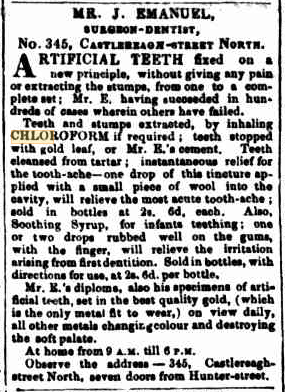
Chloroform

One aspect of the Catherine Morton case that puzzled me was just how common was chloroform in colonial Australia.

So I did some digging.

The key date in the story of chloroform is 1847, the year when Simpson first started using chloroform for pain relief and anaesthesia in childbirth.

The discovery clearly took the world by storm – as early as 1848 there were adverts in the Sydney Morning Herald for dentistry under chloroform:

Screenshot 2018-09-29 13.19.04 SMH 03 Jul 1848 via trove.nla.gov.au
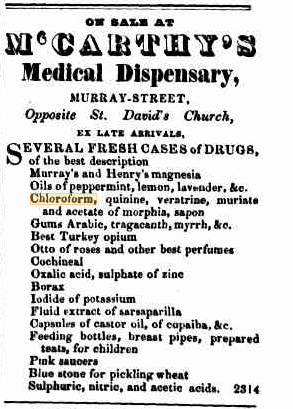
and wholesale druggists were advertising its availability as in this advert from the Colonial Times (Hobart) of 16 February 1851

Screenshot 2018-09-29 13.19.51

So, when Meard asked Mr Witt the chemist for chloroform to anaethetise a favourite dog he wished to castrate, the use of chloroform was most definitely common knowledge – after all Queen Victoria had used it as early as 1853 to relieve the pain of childbirth …

[update 01 October 2018]

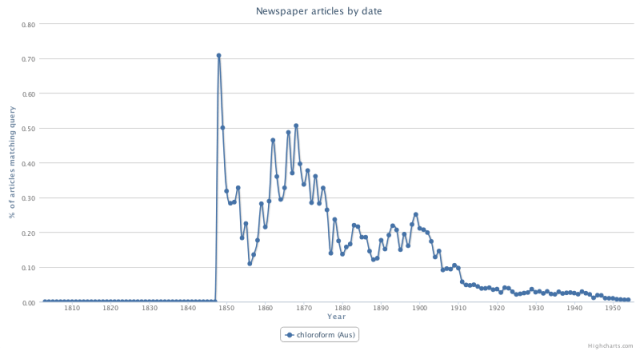
Just for fun, I ran a querypic search on the word chloroform, and as expected it confirmed that the discovery of chloroform was an overnight sensation:

chart

with mentions (in Australia) peaking in 1848 and  minor peak around 1853, doubtless as a result of Queen Victoria being administered chloroform during the birth of Prince Leopold …

Posted in Historical, Victorian | 2 Comments

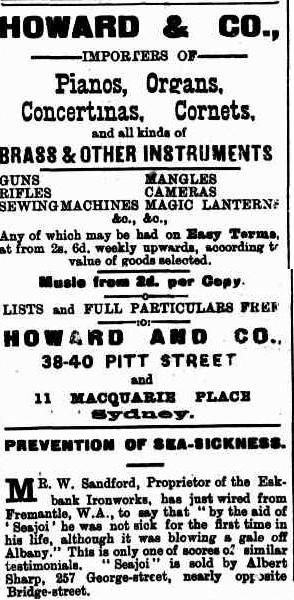
Magic Lanterns on easy terms

I recently came across a study carried out by a researcher at the University of Exeter in the UK where, by searching old newspaper adverts, they found evidence that people in Victorian times could hire magic lanterns and slides for an evenings entertainment.

I fund this idea mildly intriguing, so I thought I would try a quick and dirty search of the NLA’s Trove to see if the same thing was happening in Australia.

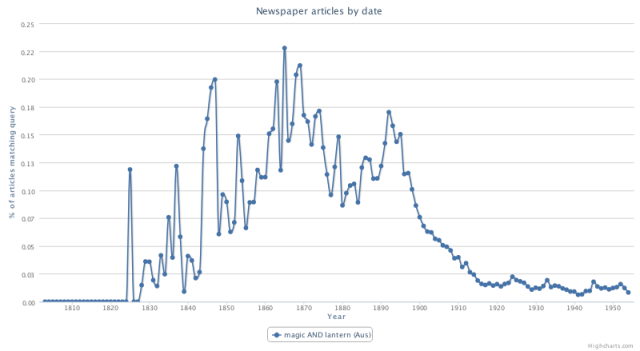
First of all I used querypic to have a look at the occurrence of the phrase magic lantern in the newspapers of the time:

magic lantern

which shows that the phrase certainly was in use from the 1850’s to the 1900’s, when it started to tail off, perhaps because of the advent of the movies.

Naively, I though it would be quite easy to see if magic lanterns were being hired out. I thought that if I restricted my search to only advertising between 1850 and 1900 in Trove’s collections of digitised newspapers I would find evidence of people hiring out magic lanterns and slides.

Not a bit of it. All these lectures by worthy Victorian vicars on the lives of the indigenous population, or missionary work in China overwhelmed any adverts for the hire of magic lanterns.

There is of course the questions as to where the aforesaid vicars got their magic lanterns from. Did they buy them?, where they hired out by missionary societies, did they get the slide sets separately from the lanterns?

All questions for another day.

One thing that was clear though, was that by the 1890s, stores were advertising magic lanterns for purchase, as in this example from the Daily Commercial News of 11 May 1899:

nla.news-page000016981110-nla.news-article157436879-L3-bd09a20ca383ac69390112fe555d1b71-0001

which suggests that if people bought them for home use, they must have hired sets of slides separately.

Which of course begs the question of what sorts of slides. While undoubtedly some of the slide set would have been worthy, we know from the example of stereoscopes in the 1850’s, that one of the drivers could well have been to provide a means of viewing pornographic images at home.

While people might have been quite happy to got to an illustrated talk on missionary work in China, it was after all a social occasion that provided an opportunity to meet people, what people did behind closed doors and the sorts of lantern slides they looked at may well have been different …

[update]

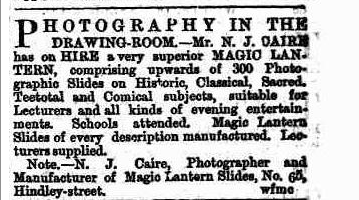
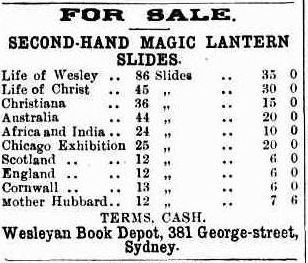
A little more searching, this time for the phrase magic lantern slides has revealed that, as in this advert from the Express and Telegraph of 24 June 1868 in Adelaide, that slides and magic lanterns were hired out

Screenshot 2018-09-09 15.19.59

and that there were retailers of slides, both new

Screenshot 2018-09-09 15.19.05

and second hand

Screenshot 2018-09-09 15.18.38

what’s also interesting is that some of these must have come with pre written lectures to accompany them …

Posted in Historical, Victorian | Leave a comment

Almost an unfortunate misunderstanding …

Recently we’ve been going out for the day scoping out places that might repay a visit, places such as local museums, abandoned town sites and the like.

We might pretend that this is related to our interest in local history but in truth it’s because we have builders, and sometimes they take over the house with machines and noise, and the simplest thing is to give them the keys for the day, and go for a drive.

Now if we were organised we could take a picnic, but we never are so we usually end up having lunch at a bakery in a small country town.

People in country bakeries are universally friendly and usually want to know your business, so we give them the abbreviated version of having builders in to renovate the bathroom, and usually they commiserate and we move on.

Not yesterday. After wanting to know what we were doing and where we were from, the bakery person gave us a curve ball.

‘My Tamsin’s going to Beechworth for the nipple’

I was sure she hadn’t said what I thought she had. And, in Australia it sometimes seems that everyone is from somewhere else and eccentric English pronounciation is not unusual. Best thing is to appear interested and hope things will explain themselves.

“Oh yes?”

‘Yes, there’s lots of girls going from all over for the nipple this weekend’

At this point I had a brain freeze. Ever since Ned Kelly was arrested at Glenrowan in the 1880’s Beechworth has been a sedate kind of place. All I could think of was a ‘free the nipple‘ demo disrupting the Saturday farmer’s market.

But then it all became clear:

‘There’s a big college nipple competition with teams from Bright, Thurgoona, Chiltern and all over.’

And then it clicked. The lady was saying netball, not nipple …

Posted in Uncategorized | Leave a comment

Paperclips

It was only a throwaway comment, but one thing that tickled my fancy about the presentation on the MAMA archaeological dig was the comment that paperclips were not used before the 1890’s.

Actually they were. While the machinery was for making what we now think of as the classic paperclip was patented in 1899, paperclips were around well before then, as can be seen in this stationer’s advert from the Quenbeyan Age of 1880

Screenshot 2018-08-20 16.39.04

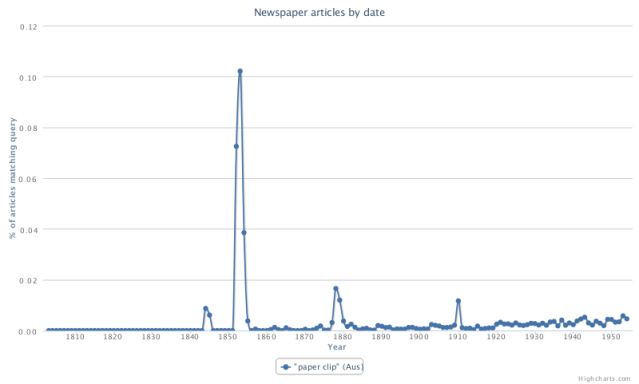
and there are others from the late 1870’s. If you do a search for “paper clip” in Trove you get the following result:chart

The peak in the 1850’s are possibly an artifact caused by a sudden burst of adverts in a West Australian paper, the peak around 1880 probably represents paper clips becoming common and a normal stationery item. Certainly the date coincides with the group of late 1870s patents in the US for paper clips.

This of course didn’t mean that people stopped using pins entirely – even when I started work you would still occasionally get documents pinned together, and banks in France used to pin banknotes to payment slips well into the 1980’s.

Still it’s interesting to realise that something you think of as pretty mundane was once new and innovative …

Posted in Historical, Uncategorized, Victorian | Leave a comment

MAMA – what lies beneath

Despite it being a pretty horrible sleety hail spattered day I had to go into Albury, so I decided to take in the presentation on the results of the archaeological dig that preceded the building of MAMA, the Albury art gallery in 2014-5.

Albury city library have now put some of the finds on display. It was billed as what had been found under QE II square, but it was really what had been found under the MAMA site.

Albury was first gazetted as a town in 1839, and grew slowly through the 1840’s. with two pubs by 1847. It was an important crossing point on the Murray,  and after the 1851 separation of New South Wales and Victoria was also the main border crossing between the now separate colonies.

After 1883, the New South Wales standard gauge rail network met the Victorian broad gauge system at Albury, and passengers travelling between Sydney and Melbourne would change trains at Albury, and goods would be transhipped between the two systems.

Albury was also where the Victorian and NSW telegraph systems connected – it’s important to emphasise that this is particularly important, as in the 1870’s the telegraph provided quick, near instantaneous communication between both the big cities on the east coast and overseas, in a continent bedevilled by large distances and poor overland communications. Even the railways didn’t help much due to slow speeds and long distances – for example, even as late as 2014, when we took the train from Brisbane to Cairns the journey still took over 30 hours.

MAMA is built around the old Municipal offices that date from 1907, but the site had previously been the site of the Albury telegraph office dating from 1868 and the old NSW Crown Lands office dating from 1878 where people both bought government land and registered claims to land.

In 1924 the Crown Lands Office, known as Burrows House, was sold to the NSW state savings bank. Prior to that the Telegraph office had moved elsewhere in 1886, and the old building had been used by Albury as municipal offices prior to their building a ‘proper’ town hall on the site.

It might have been suspected that given these changes there might not have been a lot left, but no, under the Burrows house site was a decent layer of administrative debris, pen nibs, pins – used to pin documents together before the adoption of paperclips in the 1890’s and inkwells, as well as thing such as discarded cigarette papers that must have fallen between the floorboards.

The telegraph office was equally interesting. Prior to the dig, it had not been known that the manager lived on site with his family, leading to a decent deposit of domestic rubbish, such as pottery, patent medicine bottles, child’s toys and the like.

The complete excavation report is available from Albury Library Museum, who also hold images of the artefacts, and the artefacts themselves, as well as the complete excavation dataset, which is available on request. The project was carried out by Archlink, a Melbourne based archaeological consultancy.

What is interesting is not only the range of the finds but the complexity of the site with the changes of purpose of the buildings reflected in the deposition layers

Posted in albury, Historical, Uncategorized, Victorian | 1 Comment

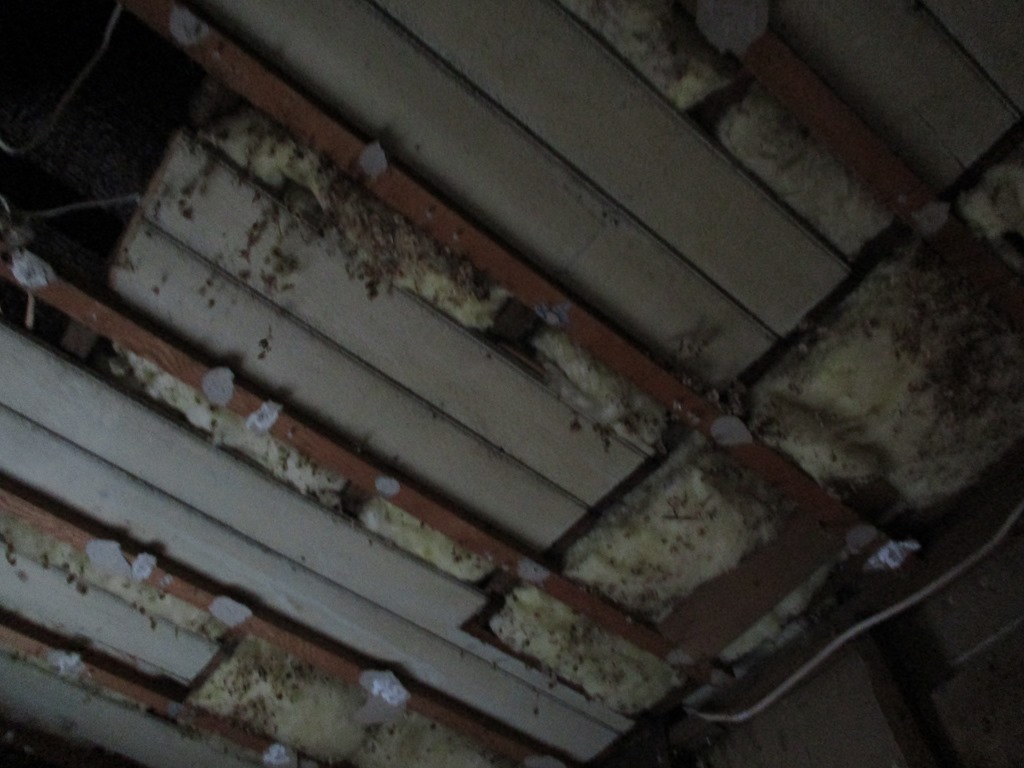
We have a nineteenth century ceiling

When you own a wooden house, as we do, you rapidly realise that you don’t own a static dwelling, but a building that’s been subject to almost continual change – walls moved, indoor plumbing installed, external walls reboarded, extensions and the rest.

So much so, that we’re not exactly sure just how old it is. We say that the original miner’s cottage dates from the 1880’s but we’re not really sure. There’s an enormous lump of freestone masonry that may have been the base of the original hearth, that looks older than the 1880s, and when we found smoke stained bricks from the old chimney under the driveway they were characteristic soft fired handmade bricks, and probably from the nineteenth century.

What we do know is that the rather fine 1860’s front door and acid etched rose glass are not original to the house – our builder told us that he’d helped install them in a previous renovation and that they’d come from another house.

So to this week’s discovery …

The shower in the 1950’s main bathroom had started leaking, and as we’d always planned on a renovation, we decided to rip everything out and replace it with modern fixtures and fittings, rather than try and have it repaired.

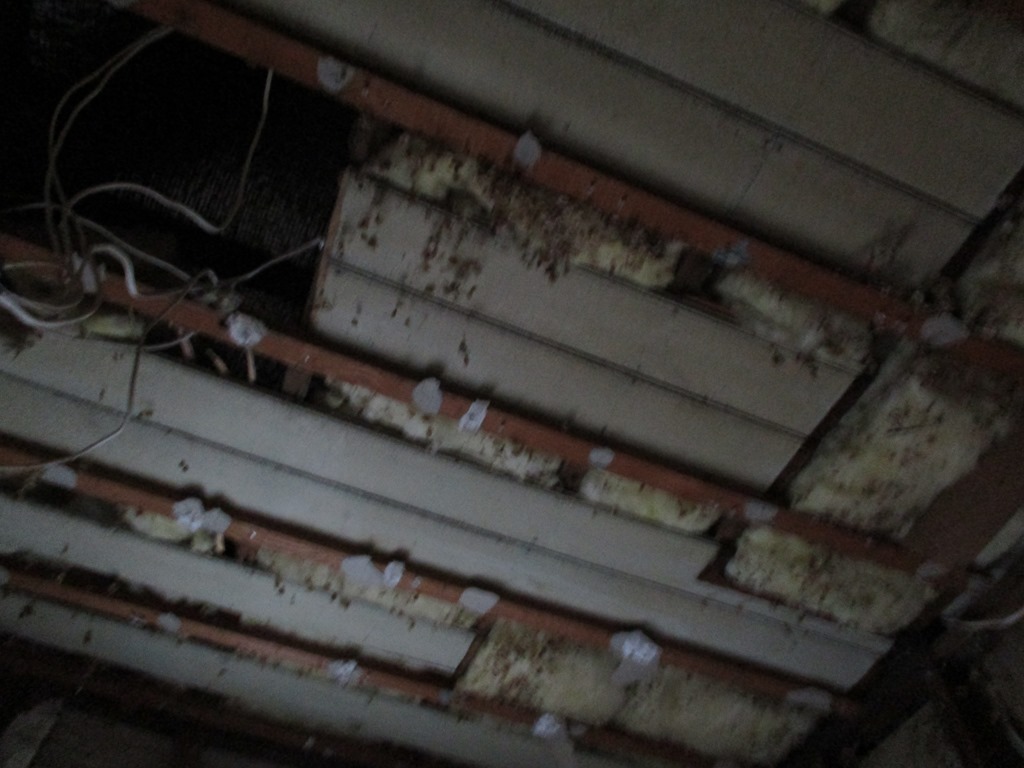
So yesterday, the guys pulled all the old plasterboard sheeting and tiles off the walls, and pulled down the old and cracked 1950’s ceiling

IMG_0106IMG_0107

and there we had it – the painted boards of the original nineteenth century ceiling. They’ve been so badly chopped about they can’t really be repaired, but it’s nice to know they’re still there …

Posted in Beechworth, Historical | 2 Comments

Patent medicines and nineteenth century globalisation

beethams

I spent a good part of yesterday documenting some nineteenth century patent medicine and cosmetic bottles. Many of the brands are totally unknown today, such as Beetham’s glycerine and cucumber, yet were well known in their time.

A fairly simple search of various online newspaper archives brings up myriad examples of advertising, and a search of various federated sites such as Collections Victoria and ehive in New Zealand brings up quite a few bottles, not to mention ebay and the other trading sites used by bottle collectors.

I’ve already written about Hayman’s Balsam of Horehound, but as you dig deeper, it was not the only example of a vanished product. Beetham’s glycerin and cucumber was made in Cheltenham, Kay Brothers Linseed compound was made in Stockport. And there are doubtless others that I havn’t come across yet.

And mixed in with the imported products are a range of locally made equivalents, such as Baxter’s Lung Preserver from Christchurch in NZ, Woods Great Peppermint Cure, and also from Christchurch Bonnington’s Irish Moss cough syrup.

So we can certainly say there was active patent medicine industry in New Zealand and the Australian colonies, with products being imported and sold within the various Australian and New Zealand colonies.

Equally products were imported from the UK, and advertised locally, often reusing the same advertising material as used domestically in the UK, sometimes amended to say things such as ‘available from all good chemists throughout Australia, New Zealand and the Cape colony’.

So why did the British manufacturers compete against local manufacturers?

I suspect that the answer is in part steamships – the development of shipping in the last three decades of the nineteenth century brought down the cost and difficulty of shipping goods from the UK, making it economic to compete with local brands.

Also, there was constant stream of migration from the UK and Ireland to Australia New Zealand and the Cape Colony, and these new migrants probably sought out products they knew and trusted.

We see something similar today where larger Woolworths and Coles supermarkets have a shelf or two of UK products such as Jaffa cakes, Penguins and (English) marmite.

In the nineteenth century, when few people could afford (or indeed trusted) doctors patent medicines, many of which were based on traditional herbal cures, perhaps with a dash of laudunum, or a generous alcohol base, had a major role in allowing people to manage run of the mill coughs, colds, chest infections and digestive problems.

And in an age when many things were unregulated, brand recognition was important, especially when your health, or the health of your children was involved. And I suspect that this helped sustain the trade in imported medicines – people stuck to brands they trusted and recognised …

Posted in Dow's project, Historical, Uncategorized, Victorian | 3 Comments