These damn kiwis – they got me !

A few days ago I read an article as to reasons why New Zealand really hadn’t produced any significant writers before the twentieth century.

I was reading the article as I’ve taken to reading nineteenth century novels as part of trying to understand the Madeleine Smith trial in context – Wilkie Collins was certainly influenced by the trial, as evidenced by the character of Lydia Gwilt in Armadale, and as the past is another country where they did things differently, and also trying to understand the colonial view.

While the Madeleine Smith trial was news in Australia and New Zealand it seems to have been less of a sensation in the United States.

New Zealand I can see – until gold was disovered in the 1860’s the non Maori population was both small – around 50,000, and recently arrived from the UK with organised settlement only starting some twenty years before.

And of course this could explain the lack of literary output – too small a talent pool and a population of hardworking farmers do not a literary scene make, despite the obvious parallels with the vernacular kailyaird writers of North East Scotland.

The authors of the article were clearly thinking literary here, Fergus Hume, even though he ran away from Dunedin to Melbourne wasn’t mentioned despite his importance to the development of the English crime novel

Anyway in the article the authors mention a fictional author, Willie Hollins, who wrote a mystery novel called ‘Greenstone’ about an ethnographer who purloined a sacred Maori carved chunk of greenstone.

I got the reference to Wilkie Collins’ The Moonstone, but just for a moment thought that there might actually have been a Kiwi reworking of the Moonstone …

Posted in Uncategorized | Leave a comment

Madeleine Smith in New Zealand

Well, I though I would do the obvious and repeat my investigation of the distribution of the trial reports in New Zealand.

Well that turned out not to be sensible – the non-Maori population in 1857 was only around 50,000, most of whom were homesteaders, and consequently there were relatively few newspapers publishing then in New Zealand (14 in fact), which makes any attempt to follow the flow of information impossible.

What we can say is that the New Zealand papers that reported on the conclusion of the trial were a month and a bit behind the Melbourne and Sydney papers, perhaps reflecting the time the mail took to get from Australia on to New Zealand, with the news reaching the north island via Auckland …

Posted in Uncategorized | 1 Comment

Melbourne gets the news first

As part of my looking into how the news of the Madeleine Smith trial got to Australia I thought I’d break the reports of the trial down by date and place of publication.

chart

And it’s quite striking – the first reports of the outcome of the trial  were published in Melbourne on 04 September 1857, but the news didn’t get to Sydney until 08 September, and to Hobart (or indeed Newcastle) until September 12th,  neatly reflecting the fact that there was effectively no railway network in Australia in 1857, and most travel between population centres in the eastern states, which were of course separate colonies, was by coastal steamship ….

Posted in Uncategorized | 1 Comment

Madeleine Smith in South Africa (or maybe not)

Having established that it’s likely that the news of the Madeleine Smith trial reached Australia via the India/Sri Lanka route, I thought I’d look to see if there were any searchable digitised newspaper resources available for South African papers.

I decided not to bother searching for English language newspapers in India itself as 1857 was the year of the Indian Rebellion (or Mutiny for the less politically correct) and newspaper publication might well be disrupted or records missing.

However I do know from reading histories of the 1857 events that there was no overland telegraph link from India to Europe, and as there was no Suez canal, the mail would have come the long way round via the Cape of Good Hope, where the British had a well established colony.

So, I thought we might get an anchor date by looking for online archives.

Nope.

The National Library of South Africa has archives on microfilm only – fair enough, they have other priorities, and while the British Library has some online resources from the correct period, which can be searched remotely, you need a readers’ card to access them, and getting a readers’ card requires registration in person, which kind of breaks the remote access model.

I will be in London later this year, so I guess I could shoehorn a visit to St Pancras into the trip but it does seem a lot of extra work for a very simple search query…

Posted in Uncategorized | Leave a comment

Madeleine Smith in America

I’ve previously written about how the Madeleine Smith trial was reported in Australia, so I thought I’d have a fairly superficial look at how it was reported in America.

Remember that in 1857 there was no transatlantic telegraph cable – the cable was not complete until August 1858, although construction had begun in 1857.

Most New York papers have reports of the outcome of the trial in the first few days of August, which is about right – three weeks for a mail steamer to carry the news from Liverpool to New York. Reports of the initial arraignment are a few days earlier, late July which again fits with the 3 week schedule, given that the trial started on June 30.

To research this, I’ve been using the Library of Congress Chronicling America website. While it lacks external tools such as querypic it’s reasonably comprehensive in its coverage, and searching over a fairly tight timeframe suggests that the trial was reasonably widely reported in the east coast newspapers and sensational enough to get a column or two to itself in the overseas news, but not quite the impact that it did in Australia or New Zealand.

Interestingly, there’s also a report in the Polynesian from Hawaii dated 26 September 1857 which had been copied from one of the San Francisco papers (and annoyingly not one that’s digitised, so I can’t check the date and origin of the report), but confirming that the news reports in both Australia and New Zealand had come via the steamer route via India and Sri Lanka and not via America …

Posted in Uncategorized | Leave a comment

Shakespeare and me

Shakespeare and I have never really got on.

Sure I’ve seen productions of his plays that were fantastic, and some that were quite frankly terrible, and the odd experimental version that was, well, odd.

And the reason why I went to see them was that I enjoy the theatre and its magic, not because I enjoy Shakespeare. I never really cleaved to English Literature and its orthodoxies and its insistence that this is what it meant, and how everyone should bow down in front of the great god Shakespeare.

Instead I’ve seen him as a hack writer, a very good hack writer, but a hack writer nevertheless, stealing ideas from literature and half heard stories of places far away. One of the interesting things about Shakespeare is where he doesn’t mention – like the newly conquered Peru or Mexico, or Japan, despite all of them being in conversation and in the popular tales of Raleigh’s of Drakes voyages and raids.

And this in a time when there were black people from Africa in London, Elizabeth was in negotiations with the sultan of Morocco, and there were even two Japanese sailors who had been captured by Thomas Cavendish.

But no, perhaps Shakespeare simply found it safer, politically, to put his plays in Rome, Venice or Athens, places known at least by reputation to most of his audience and about which he could raid his grammar school education. It’s been argued that the Tempest is set off the coast of South America – that may be so, but the identification is hardly explicit.

And computational analysis of the texts have put to bed any idea that he was anything other than a hack and a writer who collaborated with Marlowe among others.

Recently I’ve read two not particularly scholarly books that have reinforced this – Dominic Dromgoole’s Will and me which is part autobiography and what he has come to feel about Shakespeare after years of producing him, and strangely enough Harry Turtledove’s alternate history novel Ruled Britania.

Central to the plot is Shakepeare’s writing of a play Boudicca. As Shakespeare didn’t write such a play Turtledove uses the text of Fletcher’s Bonduca as a source of impressive speeches.

Fletcher and Shakespeare of course knew each other, and in fact collaborated later in Shakespeare’s life, so the device of raiding Bonduca works well – it could indeed be Shakespeare.

Basically what it comes down to is that the Tudor theatre needed plays, lots of them, and that Shakespeare, Kyd, Marlowe, Munday, and the rest of them were in the business of writing them, collaborating, plagiarising and reusing each other’s work. Nothing is truly original and what we know as the Shakespeare canon is only what was attributed to him in the first folio – doesn’t mean that the attributions are correct or are all his own work.

The picture that emerges is of a working writer.

Not some lofty paragon. Not some literary genius but someone who grafted at it – and who had off days – Dromgoole’s commentary on the opening of Cymbeline being wriiten by Shakespeare on an off day when he had a hangover is both wonderfully witty and probably what it was like.

Deadlines. Fights with coauthors and actors. Days when the words wouldn’t come and days when they wouldn’t stop.

And that Shakespeare is altogether more interesting than the rather colourless genius the English Literature types would have us believe in …

(still doesn’t mean his plays aren’t hard work at times)

Posted in Uncategorized | Leave a comment

Echuca …

A couple of Saturdays ago we treated ourselves to a day out and drove, with no clear plan, to Echuca, a town on the Murray about 200km to the west of us.

In the nineteenth century Echuca was a major inland port on the Murray, and, like Morgan in South Australia, a railhead and a transhipment point for grain and freight from the railway to the paddle steamers that plied the Murray.

In fact before the railway systems of South Australia were connected in the 1880’s, if you wanted to get from Melbourne to Adelaide it was either the coastal steamer, or a train to Echuca, riverboat to Morgan, and train back to Adelaide.

While the regular paddle steamers are long gone there are still a number of preserved paddle steamers at the Echuca wharf museum, plus various other attractions, including a mock colonial period street and an old mailcoach that gives rides around the town.

All in all a bit hokey, but it did kind of give a feel of how things might have been a hundred and fifty years ago. And if living history is not your thing there’s number of reasonable restaurants and a couple of second hand bookshops on the main street.

In a strangely naff sort of way I liked it …

Posted in Uncategorized | Leave a comment

Madeleine Smith as a worldwide phenomenon

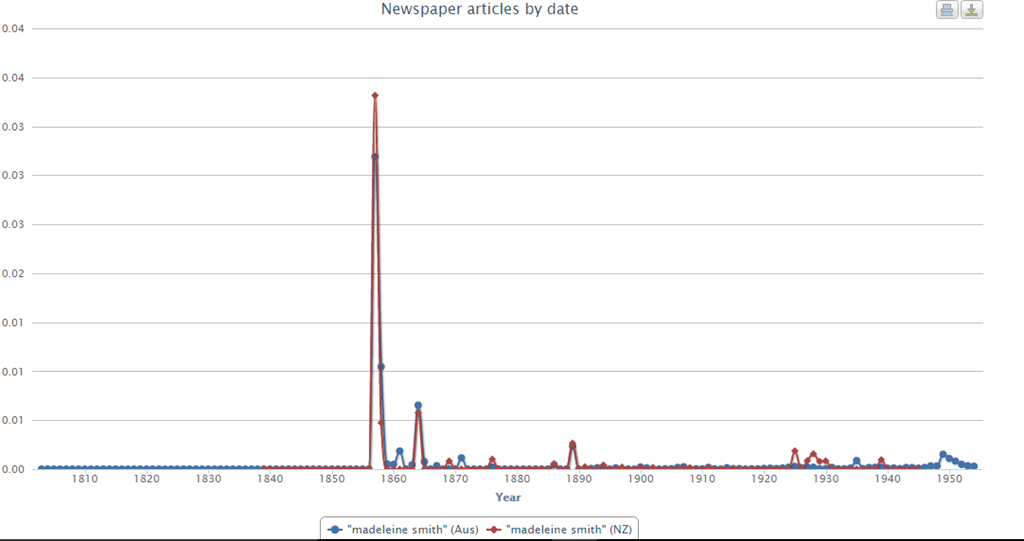
As a final bit of investigation around the Madeleine Smith case I thought I’d have a look at how widely it was reported in Australia and New Zealand.

First of all I went to QueryPic to see if the case had registered at all:

madeleinesmithquery

which it had – a massive peak for 1857 when the trial took place. Remember that 1857 was the year of the Indian Mutiny and the reports of that might be expected to take precedence over a murder trial on the other side of the world.

Searching Trove, the National Library of Australia online newspaper archive, showed it had been major news with most papers reprinting the Times summary of the case [PDF via Evernote] and many the long report of the trial [PDF via Evernote] – both these are from the Sydney Morning Herald.

It was much the same thing in New Zealand, and when the news broke it almost beat news of the Indian Mutiny for importance [PDF via Evernote] and newspapers the whole progess of the trial – as in this PDF from the Otago Witness.

It’s worth noting that even though the trial was old news by the time news reached Australia and New Zealand it was still a major sensation. In the days before either Australia or New Zealand were connected to the outside world via undersea telegraph cables, news could take two or three months to reach the Antipodes. In this case while the trial took place in Edinburgh in early July, news and detailed reports did not reach Australia until nearly the end of September, and New Zealand two or three weeks later …

Posted in Uncategorized | 4 Comments

Madeleine’s ambrotype

Continuing on the theme of what we can learn about life in 1850’s Scotland from the trial of Madeleine Smith, one interesting detail is that she exchanged ambrotypes (an early type of glass plate photography) with her lover, at around the same time that Rochlitz was running his photographic studio in Beechworth, half a world away.

What this reinforces is that portrait photography was already widely adopted by the mid 1850’s and was reasonably affordable.

The exchange of photographs between lovers as a habit is particularly interesting given that only a few years before photography was still nothing more than a gentleman’s plaything …

Posted in Uncategorized | 1 Comment

Travel in 1850’s Scotland

I’ve recently been reading an account of the trial of Madeleine Smith, which took place in Glasgow in 1857 – in essence Madeleine Smith was accused of poisoning her lower class lover because of her upcoming more respectable marriage to a well known business person. Madeleine was tried for murder on the basis of fairly compelling circumstantial evidence, but the jury held the case to be not proven, a Scottish verdict meaning that the prosecution’s case was not compelling enough.

As in all such Victorian murder cases, there is the suspicion that if Madeleine was not daughter of one of the great and the good of Glasgow society she would have hung for it – to slightly misquote Weir of Hermiston ‘she would hae had a fair trial and then be hanggit’.

The Madeleine Smith case was major newspaper event of the time and inspired  Not Proven, a long out of print three volume mid Victorian novel by Christina Broun Cameron. The way that the events and correspondence between Smith and her lover were reported in the newspapers may have also partially inspired Wilkie Collins’ adoption of an epistolatory style for his early crime novels.

But  I digress. When the railway service between Edinburgh and Glasgow began, trains were infrequent and expensive, but roughly fifteen years later, at the time of the trial,  L’Angelier, the victim, who was a warehouseman in a seedsman’s business was able to  travel by train between Glasgow and Bridge of Allan and from Glasgow to Helensburgh to meet Madeleine when she was staying at her parents house outside of Rhu.

I have no idea what a warehouseman in mid Victorian times earned, but a Google search for Victorian wage rates suggests that L’Angelier would be doing well if he had an income of sixty pounds a year.

A third class railway ticket between Glasgow and Helensburgh would possibly have cost a shilling (GBP 0.05). I’m saying possibly, as I don’t know, but other railway fares advertised on different lines suggest that this isn’t a wildly stupid estimate.

So, affordable if not cheap.

Bridge of Allan is a little further than Helensburgh from the centre of Glasgow, but not remarkably so, again making the journey affordable for L’Angelier.

At the same time the Clyde paddle steamer network was already well developed offering travellers the alternative of getting the train to Greenock and then crossing to Helensburgh, or getting a ferry all the way from the Broomielaw quay in central Glasgow.

The fact that these competing routes all managed to stay in business suggests that all were well enough patronised to be profitable.

So, just as the railways invented punctuality, cheaper and more frequent trains allowed poorer people to travel, if not on a regular basis, frequently enough, just as Ryanair and EasyJet opened up cheaper air travel in Europe.

And this had all sorts of social effects. Poorer people could now get out of the city. Wealthier people could afford to summer on the Clyde estuary yet could still travel up to town for business for a few days every week or so. and of course lovers could meet for lochside assignations …

Posted in Uncategorized | Leave a comment