Graffiti on the North Water viaduct

I’ve been trying to pull together some family history stuff to try and see what use farming folk in in the late nineteenth century made of the railways in rural north east Scotland.
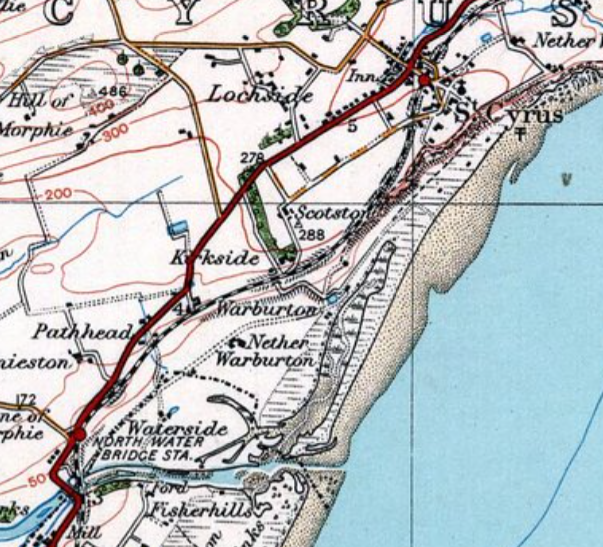
st cyrus 1920s

(digitised 1920 Ordnance Survey map of St Cyrus – National Library of Scotland)

In the mid 1860s my great to the whatevers acquired the lease of a farm at Scotston which was adjacent to the newly built branch line from Montrose to Inverbervie, and I’m guessing that they would have used trains from St Cyrus station to Montrose rather than the North Water Bridge station simply because, while further it is a more level road, a consideration when produce had to be hauled by cart, or people had to walk to the train – remember that the safety bicycle was not in common use to the 1890’s and even then they may have preferred a more level route.

The railway line closed in the 1960’s and I can just remember  the last steam freight trains puffing their way laboriously along the line.

The line was engineered to avoid steep gradients as much as possible but there was no avoiding crossing the North Water (sometimes called the North Esk) which ran through a steep valley before flowing into the sea.

In the late 1700’s a stone road bridge was built crossing the river at right angles but that involved a relatively steep descent  and ascent up the other side – for years there was an original Royal Scottish Automobile Club sign on the Montrose side of the bridge warning of the steep descent and sharp curve at the bottom of the hill.

Steam trains of course don’t do sharp descents and curves, so the builders of the Bervie railway built a rather impressive stone viaduct over the North Esk – it’s still there and now forms part of a cycling route.

Sometime before the 1979 Scottish referendum, someone graffitied the bridge with the slogan ‘Scotland Free or a Desert’ – a slogan originating from the 1820 Radical War and later reused during the Red Clydeside period in Glasgow at the end of world war one. The quote ultimately derives from Tacitus – they hae makit ae desert and hae callit it peace.

SC01959169a1a

(image of graffiti cropped from https://canmore.org.uk/collection/1959169)

The graffiti was there for years, and while researching the use of the railway I idly wondered if it was still there.

It was certainly there in the 2000s and I remember pointing it out to J when we went down to St Cyrus beach – a wild dramatic beach a little like some of the more remote beaches in Victoria – to do a little bird watching (utterly unsuccessful) and take a look at the eighteenth century graveyard.

Strangely, for such a well known local landmark, it proved almost impossible to track down recent images of the graffiti – even Canmore, which includes images showing the graffiti into the early part of this century does not mention it, and web searches do not bring up links to images on Facebook and Instagram – I can only guess that the graffiti disappeared sometime before the rise of Facebook and Instagram, perhaps removed during restoration works…
Posted in Uncategorized | 2 Comments

Outback noir …

There’s a genre of Australian crime fiction known as ‘outback noir’.

And, since I discovered that my local library was stuffed with outback noir books, I’ve read rather a lot of it as my bedtime reading to help me turn off and relax before going to sleep.

Set in small isolated rural communities of country Australia, the stories can be quite formulaic:

– the lead protagonist is someone with some connection with the law, an ex-cop, a lawyer, or a journalist.

– for some reason they come back to some outback community they had some past connection with such as a funeral, to care for a parent with dementia, to sort out a deceased estate

– somehow they become involved in a murder, investigation, such as finding a dead body while jogging

– the local police are either disinterested, corrupt, or obstructive, and do not seem the least bit interested in the protagonist’s statement

– something happens that seems to connect the current investigation to a previous murder

– complications arise due to sexual shenanigans within the community – it can even include a hint of incest

– someone in the police eventually takes the protagonist seriously, and the case is resolved, and everyone lives unhappily after.

While formulaic, in the hands of a skilled writer it can become something else. Part of the charm can come from the writer’s ability to evoke the feeling of these small places left behind by climate change, by rural depopulation, which increasingly seem to have less and less in common with the big east coast cities, and more importantly can tell us something about life outside of the cities, about the suicides and farm foreclosures, the devastation caused by the droughts, the agricultural engineering businesses just hanging on and surviving by supplying under the counter tractor parts, and about the young kids who can’t wait to get away to Sydney or Melbourne.

Not all outback noir sticks to the formula. Most do, but some are different, a lesbian roadtrip to escape the law, a failed search for a prospector’s lost stash, but all tell us something about Australia, and how its changing.

About the impact of mining in the Kimberley and how suddenly in the middle of nowhere there’s a bunch of guys with money to spend, and being young men mostly want to spend it on booze and sex, and its impact on remote indigenous communities.

At its best, outback noir gives stories that help explain about what is happening out there outside of the east cost capital bubbles

Posted in Uncategorized | Leave a comment

Not an archaeologist…

When I was little, I wanted to be an archaeologist.

I really did.

I remember that when I was about eight we had a school inspection and one of the things that the inspector asked kids to see if they understood that there were opportunities was what they wanted to be.

The primary school I attended was socioeconomically mixed, so there were kids who wanted to be postmen, kids who wanted to be accountants, as well as the more predictable doctors, nurses, truck drivers and so on.

When asked, I said I wanted to be an archaeologist, something that produced a stunned silence. In early nineteen sixties Scotland not even middle class kids became archaeologists.

And while I did want to be an archaeologist, there was no understanding in my family, in my school, of how you became an archaeologist. A nuclear physicist or a neurosurgeon, yes, but an archaeologist, no.

So I didn’t become one. Over the years I’ve done bits and pieces with archaeologists, but the nearest I’ve ever got to archaeology was the documentation of Dow’s pharmacy.

In part, the reason why I wanted to be an archaeologist was an obsession with Roman history.

Again in the sixties there was no Roman history or archaeology in Scotland. That’s of course not quite true, but it is true to say that there was no real understanding of the Roman engagement with Scotland.

Apart from some bits of the Antonine wall and few marching camps found by Ordnance Survey surveyors in the late eighteenth and early nineteenth century, there were no visible remains, nor was there much in the way of textual sources other than Tacitus.

The odd hoard of Roman silver had been found by people investigating Pictish hillforts, but that just helped reinforce Tacitus’ (and other writers’ ) stereotype of the Picts as wild hairy uncultured woad painted barbarians.

The fact that the Picts had left little in the way of apparent remains other than a few incomprehensible carved stones didn’t really help, which resulted in a view about the Picts not dissimilar to colonial views about indigenous Australians – not people you’d have round for afternoon tea.

So, what we had was a situation not dissimilar to the situation in England and Wales a century earlier.

Little in the way of apparent remains and some fairly minimal textual sources.

There was one difference though.

People did know that the Romans had been in England and Wales, and so local antiquarians expected to identify Roman sites, and even investigated them reporting their findings in the learned journals of the day.

This also meant that when large scale industrial and railway construction began in the nineteenth century, people were not surprised to find Roman sites and particularly cemeteries.

Lying on the edge of Roman settlements, cemeteries were more likely to be found by railway construction works as most railway lines were routed outside the medieval core of towns which themselves had grown up over Roman settlements – Roman remains in towns were more likely to be found when installing gas, water and sewage pipes.

And on the back of this local antiquarian and field clubs became involved documenting and recording Roman finds.

In Scotland, substantial towns did not really develop until the middle of the medieval period, meaning people installing drains were more likely to find medieval cess pits than mosaics, which while equally valuable, were considerably less glamorous and hence less likely to attract the attention of local antiquarians.

And hence, due to the lack of apparent remains and textual sources, the history of the Roman engagement with the peoples north of Hadrian’s wall was sketchy in the least.

It’s different now of course, and I’m sure that if any eight year old was to say they wanted to be an archaeologist, people would know now how to encourage them, and also, simply because there is more archaeology around, would, when they were older, recommend placements on archaeological digs etc.

Posted in Uncategorized | Leave a comment

Yet another post about retro photography

Like a lot of people I became interested in the whole retro photography thing during the pandemic, but I’ve got to admit that while I’ve had a couple of false starts, I really havn’t done much with it.

I’ve some working cameras, a box full of 35mm film, and a couple of experimental days out, but that’s about it.

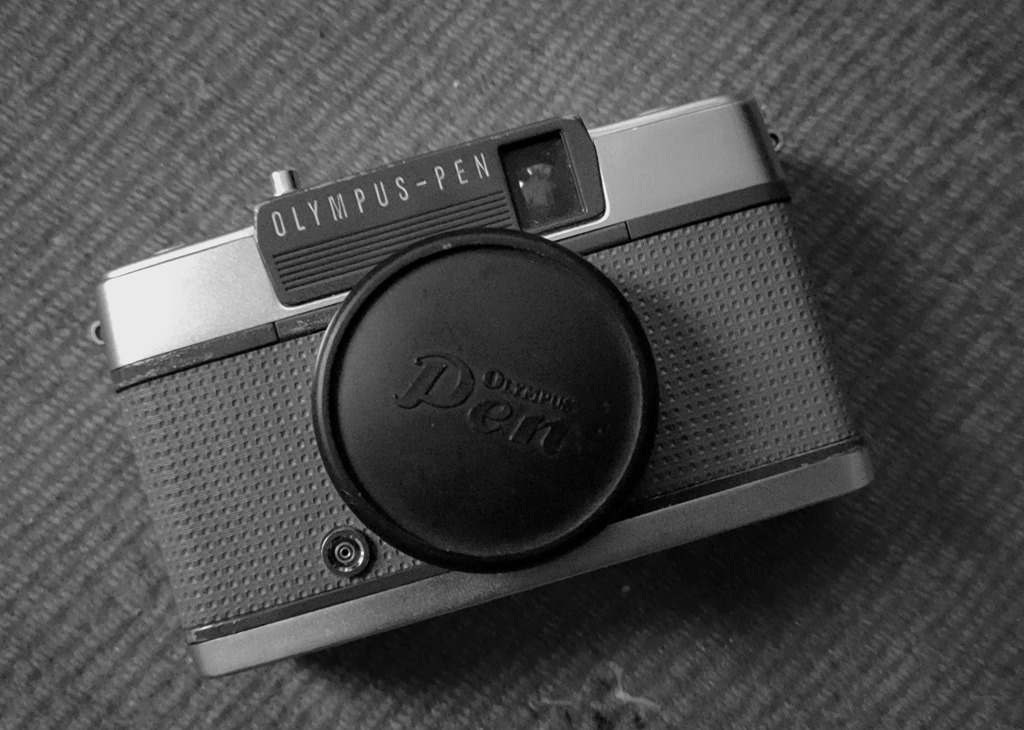
However, more recently, I became interested in the idea of half frame cameras, and, yes, I ended up buying one online from a used camera dealer in Adelaide.

IMG20240111143636-EDIT

Doing this was actually tremendously useful as it helped crystallise my thoughts around the elephant in the room – film processing.

I’d already decided that I wouldn’t bother with the whole enlarging and printing thing, and simply have my films processed and scanned.

One of the results of the retro photography boom is that there are a number of companies that will, for a fee, process and scan films. The only problem is that as half frame photography was always a minority sport, which means that a lot of labs – who of course simply feed the exposed films through an automatic developing machine, and then a custom scanner are not set up for handling half frame media.

Given that you can buy plastic half frame cameras from Amazon and others for something between fifty and a hundred bucks, you might have thought they were more geared up for handling half frame media, but no.

Now, as I’ve written before, I used to do my own film processing as a geeky teenager, and I used to have a basic lab setup with a blackout tent, but I realised that I don’t need a lab, all I need is a change bag – basically a light proof bag in which you put the exposed film cassettes and the developing tank, and then by touch you unwind the film from the cassette into the tank spool, and then close up the tank

Simple, no need for a tent or a lab, even though I’m sure that a certain amount of swearing will be involved the first few times.

Then it’s simply a matter of adding the chemicals, stirring and agitating, and you have a set of negatives.

It turns out it’s possible to buy a tank and all the required flasks and stirrers, not to mention special squeegees for drying the film as a package, and again to buy the chemicals as a package.

As with all these things, the startup cost is not exactly cheap, but the more one does it, the cheaper it gets.

The going rate for having a film processed and scanned is something between twenty and twenty five dollars and the startup cost for home processing is something like $250, so do it often enough it’s cheaper to do it at home and also possibly more fun.

You will notice however that I havn’t mentioned scanning, and that’s for a reason.

Commercial labs will scan every image, which of course includes all the duds.

You can buy a home film scanner, in fact I already have a basic one, bought to rescue some family pictures where we still had the negatives but not the original prints, but again they are designed for full frame film.

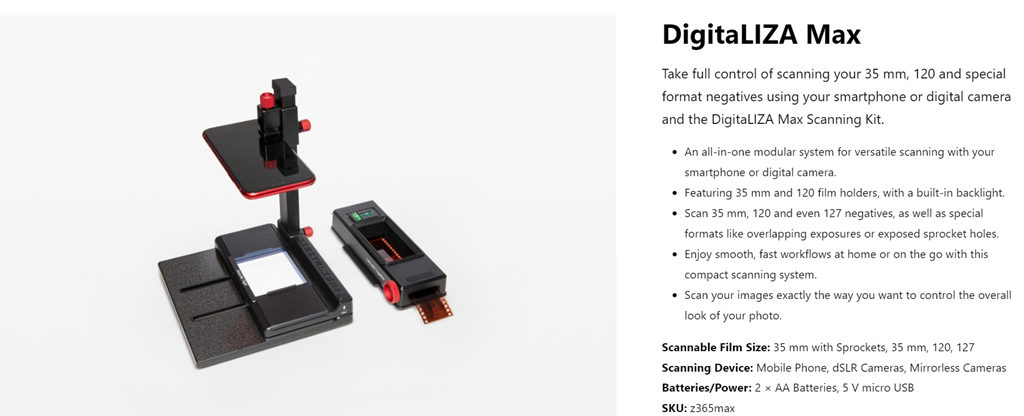
The alternative is to use a light box and a digital camera (or even your phone) to take a picture of the negative and then process it using Gimp – this gives you more control over the image, and by using a mask – basically a bit of card with a rectangular hole the correct size blank out the rest of the backlighting – and yes, capitalism being a wonderful thing, you can even buy light boxes with mounting brackets for doing this very thing

Screenshot 2024-01-11 154031

So, I think I can make this thing work, and more importantly, have fun along the way

Posted in Uncategorized | Leave a comment

Nineteenth century self improvement and the birth of archaeology

Following on from my post about why Roman ghosts were not a nineteenth century thing I thought it would be interesting to take a look at what was mentioned in English language newspapers in Wales about a single  Roman site during the nineteenth century.

I chose Luentinum, nowadays identified with Pumsaint in Carmarthenshire for no other reason that it was mentioned in one of Alis Hawkins’ Teifi Coroner novels set in the mid nineteenth century.

While nowadays it is usually referred to as Luentinum, in the nineteenth century it was more commonly referred to as Loventium, and is close to the Roman gold mines in Wales and sat at the junction of the Sarn Helen, Hen Fford and Fford Fleming roads. It is also mentioned in the seventh century Ravenna Cosmography so was known to antiquarians and classicists – it’s worth remembering that for much of the nineteenth century our knowledge of the Roman world came via the study of the classics and not from archaeology.

Edward Lhwd first identified the likely location of the site in the 1690‘s when tracing the Roman roads in the area.

As the site was well known it’s not surprising it was mentioned several times in newspapers in the nineteenth century, in 1806, 1857, and 1861, but the site remained comparatively remote and inaccessible until the coming of the railway in the mid 1860‘s after which the site became more visited.

As far as I can tell the first excavations at the site were not until 1887 after which time you start to see Field club and local antiquarian society excursions to view the remains and perhaps walk stretches of the Roman roads in the area.

While the site was known, it is only in the late nineteenth and early twentieth century that it attracts any substantial interest, perhaps (a) because of its increased accessibility, (b) an increase in leisure time and wealth allowing local historical and archaeological societies to sponsor excavations and organise excursions to the site.

Of course there needs to be little bit of care in interpreting these results – in the early nineteenth century English language newspapers in rural Wales would only be read by the English speaking gentry, who would have been a comparatively small part of the population.

The local Welsh speaking peasantry wold have been more concerned with surviving than with Roman remains and it’s noticeable that apart from a single mention of Loventium in 1875, there is no mention of the site in the Welsh language press until the 1890‘s.

So really, it is only with the development of an anglophone middle class with sufficient leisure and wealth to indulge their interests that one gets a critical mass of individuals interested in archaeology and archaeological remains.

Given the late nineteenth interest in self improvement, this is not terribly surprising.

Ideally I’d like to also investigate mentions of Loventium in the guidebooks of the time, but as yet I have not been able to track down any digitised sources …

Posted in Uncategorized | Leave a comment

E-readers at the end of 2023…

This morning I came across an article on the CBC on the theme of how despite the pervasiveness of e-readers, sales of printed books are booming, and how while older readers preferred e-readers the prime readership for printed books was the younger cohorts, both gen Z and millennials.

Slightly less than ten years ago there was an argument that we had reached peak e-reader, but that was probably a result of market saturation and the longevity of the original e-reader devices – for example I’m on only my second kindle (and my third e-reader – my first being the long discontinued Interead Cool-er).

Equally, as my experiments with the dogfood tablet show, a very cheap basic android tablet makes a competent e-reader, and with the increasing size of phone screens, it’s almost possible to have an enjoyable experience reading a book on the phone.

Paper books, especially second hand paper books are cheap, you don’t have the upfront cost of an ereader, you can give them to your friends, and lets face it, the better bookshops can be fun places to while away an hour or two just browsing.

Ereaders offer convenience – you get your book online from Stuff Central, it’s often cheaper than the sticker price of the paper edition, and the device is light and easy to carry round – ideal for a train journey or these boring times stuck in an airport waiting for a delayed connecting flight. In comparison books can be bulky to carry round, which given all the other stuff one has to carry about, giving ereaders a definite advantage when travelling.

And of course, if you are on an extended trip of  a week or three you can preload your ereader with reading material.

In the old days, before the millennium, car trips used always find you having to somehow fit in a box with a two or three paperbacks each.

Longer plane or train journeys would often see you dropping off a book at a second hand shop and trying to find something else to read – for example, in Chiang Mai there used to be an English language book exchange shop where you sold your book to the shop and could use the money, plus a few extra baht, to buy a replacement book to read – basically a circulating library of sorts.

And of course, public libraries have got funkier, lending e-books and other media as well as paper books.

So, where does this leave us?

E-readers and ebooks have not been the great disruptor they were hyped to be.

However, they have changed the landscape immeasurably – some booksellers have gone to the wall, and those that have survived have done so by being funkier and offering extra facilities and space to browse.

People now know that they can get a book easily online either as an electronic item or a paper one via the mail, meaning that bookshops have had to provide value add to survive.

Physical books have a sensuousness about them that e-books will never have. Personally I find curling up with a paper book and a cup of tea on a cold wet winter’s dey a more enjoyable experience than sitting with an e-book.

That’s not to say I don’t value my e-reader, I do, it most definitely has its role – and that I think is the key – the e-reader was not truly a disruptive change, but now, ten or twelve years on, we can say that it is now part of a new reading ecology where paper and electronic books both have a role, not to mention libraries and the big second hand online book sellers.

There’s no need to agonise about this, change happens and change has happened …

Posted in Uncategorized | Leave a comment

Half frame cameras

I’ve been a bit lethargic the past week or so, it’s been hot and sticky in the afternoons, with intermittent showers that bring little or no relief from the heat, meaning that I really havn’t done any work outside in the garden other than mow the lawn and the nature strip.

Oh, and I did manage a bike ride one morning before it got too hot.

I did get as far as driving over to the big hardware store in Myrtleford to buy the bits to put together a zucchini cage to allow me to finally plant them out and protect them from the pouched demons, otherwise known as possums, which this year have destroyed most of my summer vegetables, but I’ve yet to summon the enthusiasm to spend a sweat soaked hour or two putting it together.

What I have spent time on, as part of retro photography, is investigating half frame 35mm cameras.

Put simply, a half frame camera takes a smaller size image than the standard image on 35mm film allowing you to squeeze 72 images onto a standard 36 exposure 35mm cassette, the idea being to lower you costs as you only use half as much film and your developing costs are the same.

Of course, you don’t get something for nothing – half frame camera images are taller than they are wide, as opposed to normal 35mm negatives which are wider than they are tall, and this use of portrait mode met some resistance when they were first introduced.

To the Instagram generation, used to mobile phone images which use portrait as the default, this is probably less of an issue.

Given that getting hold of film, and more, getting it processed, can be a bit of an adventure in itself, with shortages of film and developing chemicals, there’s an attraction in economizing on film usage.

You can buy all-plastic basic half frame cameras from Kodak and Agfa through Amazon, as well as some of the big online camera retailers.

These all plastic cameras are basically slightly more sophisticated versions of the cheap disposable cameras that used to be widely available, with the crucial difference that they can be reloaded with film, and used multiple times.

(Before digital totally displaced film I would sometimes use a waterproof disposable camera when sailing or kayaking – a former partner managed to totally write off a moderately expensive camera on a rain soaked horse ride, and after that I was always a little more cautious than I had been. I even sometimes took a disposable camera bike riding for the same reason)

Reviews of these all plastic cameras seem to be positive, but when reading the reviews you need a little caution – a lot of them seem to be written by people who got into the pandemic era retro photography boom, and where the plastic camera might be their first, and only film camera.

That said, more critical reviews by more experienced photographers, also seem to suggest that the cameras work well and produce decent images within their limitations.

They are all fixed focus fixed exposure cameras with an optional flash for lowlight photography, but obviously you are going to be limited in what you can take. In Australia, where the sunlight is brighter and more intense than in Europe, you might find some pictures to be a bit washed out.

The one thing that everyone does comment on is how small and light they are compared heavier more retro cameras, meaning they can be dropped in the bottom of a back pack and carried round just in case opportunity or inspiration strikes.

However, a little digging around on ebay shows that there are a reasonable number of half frame cameras for sale at an affordable price, mostly Olympus Pen models – in fact I’ve seen some for sale in working order for not a lot more than the plastic cameras.

Fully reconditioned ones are also available for a price, but as with all reconditioned cameras they tend to be pricy.

If I was in the market for a half frame camera – which I’m not – I’d probably take the risk and buy a non reconditioned one from Japan without any serious defects.

However, given I have fridge tray full of unused film and some working 35mm cameras, I’m not.

But, if I get seriously into the retro photography thing it’s a consideration given both the cost of film and processing…

Posted in Uncategorized | 1 Comment

Spreadsheet Genealogy

Normally, when you start with family history you begin by building a family tree stepping back via your parents, your parents siblings, your parents’ parents etc, and along the way you might find some interesting tidbits, like the time your great-great aunt Mildred was arrested at a Suffragette demonstration in London in the 1900s, or that her cousin Wilfred made the serving maid pregnant while his wife was expecting, etc, etc.

Actually, what you rapidly find is that tracing everyone becomes massively unwieldy, so most people end up concentrating on their direct line of descent.

And if you have a relatively common surname, that’s probably the best you can do.

If you have an uncommon name and have access to digitised records you can do something a little bit different.

Now, I have a relatively uncommon surname, and the Scottish Government has funded the digitisation of church registers going back to the 1550’s, meaning you can search for births, marriages or deaths for a particular surname in a particular year or set of years.

Usually you get the father’s name, the child’s name, and sometimes, but not always the mother’s name, the date of birth, and the parish it was registered in

It’s not perfect, there’s no easy way of dealing with transcription error, or spelling eccentricities by the original clerk, and of course some of the registers are missing, lost, burned, or eaten by rats, but it’s pretty good.

So, I decided to try the following – use the Scotland’s people site to search for occurrences in the name ‘Moncur’ in a set of 25 year periods (ie a generation) forward from 1585 to 1750 and record the parish name associated with the name.

If my theory that some of our forebears took the name of the now vanished Moncur estate in Inchture, where they lived and worked, as a surname we should see them gradually spread out from Inchture to neighbouring parishes. If I’m wrong, or if there’s another group with the same surname we should get several clusters in different locations.

1585 is the date when the reformed Calvinist church started requiring people to have surnames.

In fact when you run the search, its only after 1605 that you start to see records of the surname ‘Moncur’, so we start from 1605.

I’d originally planned to run the searches through to sometime around 1800, but decided to stop at 1750 because agricultural reforms and the early industrial revolution were beginning to cause a migration from the land to the larger towns and cities.

I compiled this into a spreadsheet recording the number of occurrences of the name ‘Moncur’ for each parish’s baptismal record in a 25 year period.

Parishes of course change boundaries, are renamed, and the rest, so using Google Maps I worked out the distances by road from each parish church to Inchture. While changes in field boundaries etc might change the distances a little, I reckoned that that was good enough for my purposes.

I then used this information to split parishes into two groups, those more than 50km from Inchture, and those less than 50km from Inchture.

I have no justification for picking a 50km limit other than it was more than a day’s walk and might help show how many people remained close to Inchture.

As Inchture sits on the north bank of the Tay estuary, which was and remains a substantial barrier to travel the 50km circle turned out to be more a 50km semi circle.

And it worked better than I thought – the data quite clearly shows that majority of occurrences of the name Moncur in baptismal registers is within 50km of Inchture, and fit the hypothesis that the name spread outward from Inchture.

Except, the data also shows a small number of births with the name Moncur being registered in parishes around Kineff and Catterline, on the east coast of Scotland close to Dunottar castle.

This is quite interesting for two reasons – it’s only around 16km from St Cyrus (where my family had a farm in the nineteenth century, after moving from Glamis) and may be the source of the confusion as to how long we had been in the area as my family accidentally had the same surname as other people living in the area.

Secondly, it might also explain why I’ve totally failed to find a connection to Captain John Moncur – it would make perfect sense, given his sea going career, for him to be one of the unrelated Kinneff Moncurs as Inverbervie, the nearest harbour town of any consquence (and incidentally the birthplace of the magnificently named Hercules Linton, the designer of the Cutty Sark) is no distance at all from Dunottar, and for him to have been apprenticed to ship’s captain there, so I’m guessing he’s the John Moncur whose baptism was registered in Dunottar parish.

We can also guess that he had another job before being commissioned into the Royal Navy during the AngloFrench war of 1778-83 as he was old at 36 to become a Lieutenant, but which would make sense if he was al ready an experienced merchant seaman.

The spreadsheet can be downloaded if you want to play with the data. It was created with Libre Office and is in the open source ods format but should be readily openable by both Excel and Google Sheets.

Posted in Uncategorized | Leave a comment

Nineteenth century vibrators

Yesterday. I tooted a news story from RNZ about how a nineteenth century vibrator had turned up in charity shop in Nelson.

4KZTD83_The_mechanical_device_with_a_hand_held_crank_appeared_to_be_from_the_early_twentieth_century_and_its_online_research_indicated_it_was_a_Victorian_era_vibrator_Samantha_Gee_jpg

Now when anyone mentions vibrators, one does tend to think of sex and sexual stimulation, but this wasn’t necessarily the case for nineteenth century vibrators.

Some were used by doctors to massage torn or damaged muscles, and some were for home use, again usually to relieve aches and pains.

And whatever the official purpose of the device, it might be that some may have been used as aids to masturbation, even if the idea of using a glorified eggbeater seems ever so slightly ridiculous.

We do tend to think of nineteenth century people as being rather uptight and prurient, but equally we know that dildos were used, and that the Victorians were users of pornography, and there was definitely a street in London famed for the sale of erotica.

(Francis Kilvert in his diary from some time around 1870 does mention going to London to buy photographs of the Holy Land, and that in the case of one of the shops he visited, the owner had been fined for selling obscene material.)

So, whatever the public virtues on display, there were certainly private vices as well.

Equally, in the nineteenth century there was a complaint known as ‘female hysteria’, which was really a catch all diagnosis for women who appeared to be overly emotional, moody, highly strung, or just plain ‘difficult’.

Some doctors at the time tended to ascribe it to sexual frustration, and there is an urban myth about doctors masturbating their patients to bring relief, with the suggestion that these eggbeater devices may have been used for such purposes.

This is almost certainly not true.

Of course, there may have been isolated cases where this happened, but that’s probably all they are, isolated cases.

There is a more serious side to this – some doctors used a diagnosis of female hysteria as an excuse to have difficult women incarcerated in private lunatic asylums.

Sigmund Freud, despite sometimes having some silly ideas, did have the rather more sensible idea of ascribing female hysteria to emotional disturbance and in trying to find the psychological cause of the disturbance.

It’s also worth noting that female hysteria was a disease that affected the wealthy classes – those who could afford expensive doctors. The poor managed their stresses and psychological problems as best they could, self medicating with alcohol and patent medicines.

These stresses may also explain some of the truly horrible instances of domestic violence reported in nineteenth century newspapers.

And while some of the early devices were machanical, there was a move towards the use of electrical devices to relieve nervous complaints. Some of the early electrical devices were therapeutic, rather than sexual, and best thought of as early version of a TENS machine.

item-350High

(while considerably later than the period I’m writing about George Orwell in Homage to Catalonia, describes receiving electrical stimulation treatment to restore the use of his injured arm after he had been shot.)

So, bottom line, just because a device is a vibrator, it doesn’t mean that it’s a Vibrator …

Posted in Uncategorized | Leave a comment

The Bologna airport monorail …

When we first visited Bologna back in 2003 the airport was a small regional airport, and you got there by bus from the city centre.

From memory the driver put your bags in the storage area for you and the bus was something like a standard long distance coach.

Since then the airport has expanded and they have built a monorail that allegedly gets you from the airport to the main railway station in seven minutes.

It’s also expensive at €11 each – by comparison a single ticket from Bologna to Ravenna costs €8.

That is when it runs.

It has continually been plagued by technical problems and often does not run and is replaced by a bus.

And that was the case on the day we tried to use it. After lugging our bags through the station and paying eleven euros each for the monorail they told us it was not running and to use the replacement bus.

The replacement bus was not one of the long distance coaches waiting outside of the station but and ordinary Bologna city bus with no space for luggage. Everyone crammed on somehow but the whole experience was slow and unpleasant.

And then we discovered that a cab from the airport to the railway station costs between twenty and twenty five euros. This is the cost for a standard Bologna city licensed cab – Uber and the rest may be cheaper.

And when we dropped our rental car off we got a cab into the city centre to our overnight hotel it cost us €20, including a tip. The next morning, in the middle of rush hour to get our morning flight to London it cost us €25, again including a tip for the driver.

Sure a cab takes longer – between twenty and thirty minutes depending on traffic, but it will take you straight to your city centre hotel, and the cost is not that different to the monorail.

So, while the monorail is a really cool idea, I’d take a cab if there’s two of you – it might even be cheaper!

Posted in Uncategorized | 1 Comment