Mary Shelley and the Dundee Radicals

Last night we watched Mary Shelley on SBS On Demand.

Other than knowing her as the author of Frankenstein, and some vague gossip about her and both Shelley and Byron, I knew nothing – I even had her father, William Godwin, mixed up with William Blake.

I have also never read Frankenstein and only have a cartoonish idea of the story.

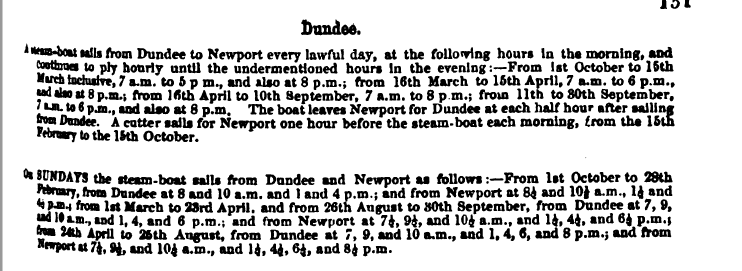
The movie chronicles the formative period of the teenage Mary Shelley, and included a trip to Scotland when she was about fourteen. From the movie, you would think that she stayed in some country house out in the wilds of Perthshire, but no, she stayed with William Baxter and his family in Dundee, becoming firm friends with his daughter Isabella.

Something about this caused the hairs on the back of my neck to go up I’d come across these names before while researching my own family history – not that I was assuming any more of a connection than they’d employed some of my predecessors.

And I was mistaken. Given the tendency of Scottish families to reuse names, and the fact that the same names tend to repeat again and again, it was of course a completely different Isabella Baxter.

But my curiosity was whetted. Why did William Godwin send his daughter on a hazardous sea voyage to Dundee?

The answer seems to be that Mary was unwell and her father thought she should have time away from London to recuperate. So why Dundee?

William Godwin was friends with William Baxter, both men being of a radical outlook and both being members of the Glasite sect. While Baxter went on to become successful as the owner of a major jute and linen business, at this time he was only a moderately successful businessman who owned a linen weaving business.

At that time Dundee was a radical town, a town where during the 1790’s the Society of United Scotsmen had planted a tree of liberty beside the town cross. And in 1819, a reported 10.000 people demonstrated on Magdalen Green against the Peterloo killings.

And like many Scottish towns during the enlightenment, Dundee had its literary and philosophical societies where men would meet to discuss the latest developments in science as well as new and stimulating books.

(It’s worth mentioning that such societies would often put on demonstrations and  experiments for public education – if like me you watched the Royal Institution Christmas Lectures on TV as a child you’ll have an idea of what an experimental night at the philosophical society might have entailed – science as theatre – that’s an idea!)

So, given William Godwin’s aim to educate his daughter and expose her to new and stimulating ideas, Dundee would have been a surprisingly good fit.

At the time the Baxters lived in a house, now long gone, which had originally been built as a dower house for the Countess of Strathmore, where South Baffin street is now


Annotation 2020-08-16 153947

South Baffin Street © Google Maps

Now, it looks as if the house would have looked out over the docks, but before 1820, when the docks were built, what is now E Dock Street roughly follows the original shore line of the Tay and the Baxters would have had a wonderful view of the Tay from their house. What is now Broughty Ferry Road runs along a ridge, and with their house being on the high side of the ridge there would have been unimpeded views across the Tay.

Prior to 1820 the docks were down towards what is now Discovery Quay where Robert Falcon Scott’s ship is now moored.

Dundee 1821

Dundee in 1821 (from John Wood’s plan – https://maps.nls.uk/view/74400021)

The docks however where probably important to the development of Mary’s admittedly gothic imagination – Dundee was already an important whaling port, and probably awash with tales of frozen ghost ships strange creatures from the Arctic, not to mention actual narwhals and walruses dragged off the boats to be cut up for their blubber and their ivory.

Apparently, while living with the Baxters, Mary learned to swim and row – this also fits well with the geography of Dundee in the 1810’s – as can also be seen from John Wood’s map – the open and sandy foreshore around Broughty Ferry, which was developing as a fashionable resort, would have been easily accessible and a few minutes walk from the house …


Posted in Uncategorized | 4 Comments

The afterlife of Madeleine Smith

books fale the age 11 mar 1858


As I have said, I’ve been trying to find references to cases of hysteria and distress occasioned by the Madeleine Smith trial.

In the course of doing this I’ve come across a number of reports which show just how fascinated people were with the case and what happened to Madeleine Smith after the trial – she had the good taste to drop out of sight, which had the unfortunate effect of causing all sorts of rumours that she had gone to Australia or to America.

There’s a wonderful story in the Illawarra Mercury of 30 November 1857 that’s worth reproducing in full:

madeleine smith in america not

On the same page is an article about the doings of Lola Montez in the USA and Canada. How true the story was is not important, it anchors Lola Montez on the east coast of America at the time, something that seems to have given rise to the following rumour in the Ballarat Star

lola Montez and madeleine smith

Obviously completely without foundation.

As far as we can tell Madeleine Smith was living quietly with relatives in London and trying to reinvent herself.

While she’s been portrayed as some sort of conniving woman, she was an ordinary girl who enjoyed dancing, champagne, and as we know from her letters, sex.

And if it wasn’t for her quite explicit letters, which caused a major sensation at the time of her trial, the whole Madeleine Smith saga would be forgotten as just another Victorian murder …


Posted in Uncategorized | Leave a comment

Beads and Trading Links (again)

Six or seven years ago I blogged about an interesting report on the use of beads by Maccassar fishermen to buy access to trepang beds of the coast of Arnhem land from the local population.

The interesting thing about these beads is that they were not South East Asian in origin and were either of Dutch, Czech or Venetian manufacture and have been found in eighteenth century sediment deposits.

At the time I supposed that the Macassar trepang traders had acquired them from Dutch or Portuguese merchants as part of the spice trade.

I’ve recently been reading My Life in Sarawak by Margaret Brooke.

Margaret Brooke, was the wife of the second Brooke Rajah – the white Rajahs – in Sarawak describes how, on a visit to Sibu in the 1870’s, seeing poly coloured  glass beads from Venice for sale in the bazaar.

Sarawak was, of course a wild and untamed place still, and despite (or perhaps because of) the Brooke Rajahs in Kuching, was not seriously exposed to European traders, although Chinese merchants had been present well before the Brookes arrived on the scene.

The local Dayak population apparently were very fond of them and would trade forest products with the local Chinese merchants to acquire them.

This suggests that there must have been quite complex trading networks in place by which the Chinese merchants acquired the glass beads to trade on …


Posted in Uncategorized | Leave a comment

Madeleine Smith in Australia (Not)

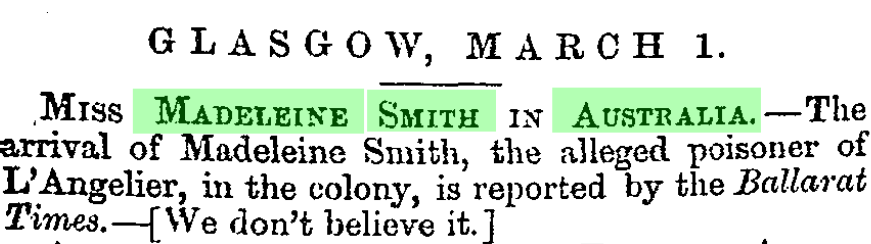
I was trawling various Scottish newspaper archives to try and find further reports of the stress occasioned by the Madeleine Smith trial – I was looking for reports of lunacy or hysteria occasioned by the event when I came across this little snippet from the Glasgow Herald of 1 March 1858:

glasgow heral 1 march 1858

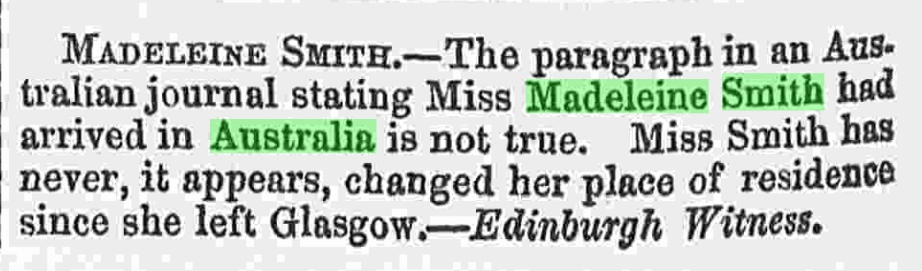
to be closely followed by a refutation from the Edinburgh Witness:

glasgow heral 1 march 1858 refutation

Interesting how even before Australia was connected to the rest of the world by telegraph, false news and rumours spread and were picked up on the other side of the world …

Posted in Uncategorized | 1 Comment

Slavery and Australia

A couple of months ago we had a political storm here in Australia when Scott Morrison, our prime minister claimed there had been no slavery in the colony of New South Wales. Horrendous abuse of the indigenous population, yes, slavery, no.

In the other colonies, principally Queensland, there were some extremely dubious labour practices including blackbirding, but Queensland is not New South Wales, so we’ll give Scotty some slack and say that there was no slavery in NSW.

Half a world away, in Scotland, there has recently been a growing realisation that the profits from the sugar industry in the eighteenth and early nineteenth century that enhanced the wealth of the middle classes were founded on slavery. Just look at the character of Sir Thomas Bertram in Jane Austen’s Mansfield Park, should you want an (English) example.

I’ve even spent some time researching my own family history to search for possible links to the slave trade – of which there are probably none, they were almost certainly too far down the economic pecking order to have money to invest in sugar, but let’s be honest, they may well have wanted to.

Now, I’ve recently just finished Catie Gilchrist’s Murder Misadventure and Miserable ends in which she recounts notable cases from the Sydney Coroner’s court in the nineteenth century. I read it as background to the Dow’s pharmacy documentation project – NSW being rather more slack than Victoria in the licensing of pharmacists, which meant that that trope of Victorian melodrama – husband poisons wife and runs off with governess, or wife poisons husband and runs off with the under footman – persisted for longer in New South Wales.

In truth the murders were a lot less glamourous, but then reality is always a grubby affair.

During a great part of the nineteenth century, the Chief Coroner was Henry Shiell. who was from a plantation, be implication slave owning family, in Montserrat in the Caribbean.

Now, when the slaves were emancipated in August 1834 (while Britain abolished the slave trade in 1807, it remained legal to own slaves until 1834. Some slave owners, despairing of getting encouraged their slaves to breed, including the sexual exploitation of their black female slaves.), Britain actually paid the slave owners compensation – as many of the plantation owners were also landed gentry in England, this was akin to the gentry rewarding themselves for past crimes.

Some, like Henry Shiell’s forebears tried to keep their plantation going with paid labour, but without slavery there was no profit in it, especially given the increasing production of sugar from sugar beet after the Napoleonic Wars.

Others most probably took the money and ran. And where did they run to?

Well one place was most certainly Australia with its developing wool industry in the 1840’s (Magwitch in Great Expectations if you want a literary connection).

So it would not be a surprise that if we were to look hard enough, we would find that some of the wealth of the squatocracy came indirectly from slavery …

Posted in Uncategorized | 1 Comment

Having a psychology degree …

As I’ve said before, I have a degree in Psychology, in fact I have a BSc.

As I did my degree at St Andrews, which could never, as an institution, decide if psychology was properly part of humanities or sciences, it could just as easily been an MA.

Exactly the same course, exactly the same final exams, what was awarded at the end of it depended which faculty you belonged to.

I belonged to sciences, hence the BSc.

This isn’t unique to St Andrews, or Psychology, a number of universities are equally in two minds about archaeology or anthropology – some just cop out by inventing degrees like BPsych, BArch, BAnth etc.

So, where does this put me vis a vis the humanities?

Well, I’m undoubtedly a scientist. While I’m fascinated by archaeology and history, and these interesting (and they are interesting) things the more humanities oriented people say, I do find scientific approaches and techniques as applied (thermoluminescence, dendrochronology and the rest) incredibly cool.

But there’s one other area that floats my boat – written texts.

Blame it all on Stirling main public library. For years, well as long as I can remember, they had a display of the town record books from the fifteenth and sixteenth century in the foyer.

The books where themselves written in a mixture of crabbed Chancery and Secretary hand, and where written in late medieval Scots – language from a time when Scots was so different from English that on more than one occasion diplomatic negotiations were conducted in French.

Helpfully they provided transcriptions into modern script and translations. And I looked at them so often and so long I suddenly realised that could half read the untranscribed bits – not with any fluency, and I didn’t understand some of the words.

Bit of eureka moment that. Just as when I was about fourteen and looking at some pictures of red figure vase paintings I realised I could read the names – Achilles (Ἀχιλλεύς) and Agamemnon (Ἀγαμέμνων).

Equally a eureka moment was going to Flanders and realising that the sign that said ‘Ziekenhuis’ meant hospital.

And I guess this explains why enjoy working with nineteenth century documents and some very simple text analysis.

I’d like to tie this to my psychology degree, but I can’t. Honest truth is that the psychology of language and the accompanying cognitive stuff had very little interest for me what got me going was neurophysiology and ethology – how all this complex bag of chemicals and glop in our heads constructed reality and how we and other animal reacted to the world.

Now if you have a degree in psychology it’s a bit of a curse. Probably not as bad as being a doctor, but people at parties always want advice about little Johnny or mad Aunt Agatha, something which a knowledge of baboon troop sociodynamics rendered me totally useless at giving, so I learned to say I was a behavioural ecologist which had the twin advantages of sounding interesting without anyone knowing what it meant.

And the ‘ecologist’ bit probably helped me get my first job in pseudoacademia as a computer support officer at a biological research station – yes they wanted my IT skills, but the fact that I could talk to the actual researchers about their work and help them apply computer technology – simple mapping or cluster analysis to their research.

And this helped me get my second job, and so on.

Now all this took place in Britain during the Miners’ Strike of the eighties. Driving through Merthyr Tydfil one always hooted in support of the miners pickets, just in case someone decided to chuck a rock at the car.

Jobs, not just mining jobs, but most of the traditional jobs disappeared. Industry disappeared to such an extent that acid rain ceased to be a significant problem, and the IT revolution was taking us on a mad ride to who knows where. Unemployment was stubbornly high at over 10% and jobs were hard to find.

And while, for a time, I felt I should go and finish my PhD, finding and keeping a job seemed much more important.

The skills I’d learned in  my degree, like being able to design and plan experiments became project planning, from buying computers and printers to installing classrooms, allowed me to progress and build a professional reputation as an IT person.

I have this lurking feeling that if I’d done a sensible ‘job ready’ degree such as Industrial Chemistry, I’d have been out of a job and had a hell of a harder time getting another.

I remember once being on the interview board for a research assistant in text analysis, and one of the candidates had a master’s in Egyptology and not a lot in the way of research computing skills.

Some other members of the board were worried by this – I felt that if someone had shown that they could master a complex area of work, they could learn enough to do the rest.

So, what’s the point of this rambling post?

Well our current government seems to have it in for the humanities. What my life experience has shown me is that what you do as a degree doesn’t matter. It’s what you learn in the process:

  • critical and analytical thinking
  • the ability to learn new skills as required
  • being able to master complex material quickly
  • being able to organise and run your own work

and being able to be a self starter …

Posted in Uncategorized | Leave a comment

Killing humanities

Back in 2010 I wrote about the attempt to shut down Paleography at KCL in London.

This morning’s news reminded me of this, with the government announcement that fees for humanities courses are to double.

Normally all that would happen is that I would mutter ‘Stupid, f*cking stupid’ into my muesli, and that J would agree with me and warn me about my blood pressure.

But then I made the mistake of listening to the Education Minister’s announcement. And that really annoyed me with the fatuous comments about producing graduates that were ‘job ready’.

No. That speaks of a view where there is no change and everyone carries on as before, just like in Bob Menzies’ world of white picket fences and where it’s perpetually 1954.

Change, unpredictable change, is the norm. Things happen. Shit happens. Just look at 2020.

When I first went to university in 1974, electronic calculators were an exotic and bulky novelty, people used typewrites and memos were still written on yellow forms.

No laptops. No desktop computers. No email. No world wide web. No mobile phones.

Now my degree was in psychology (mostly neurophysiology and animal behaviour) with a bit of biochemistry and applied maths along the way.

I was in love with my subject and I started a PhD (all this was before Margaret Thatcher’s cuts and ‘realism and responsibilty’). I didn’t finish my PhD for a whole set of complex reasons but along the way I learned about computers, data management, word processing, project planning and the rest. I also learned some good stories, how to talk to people and persuade them that what I was saying made sense.

And these skills were the skills that got me jobs. The skills learned along the way. Yes, teaching Wordstar was crap, but it paid the rent…

No one ever wanted me for my expertise in primate behaviour, but they did want me for these other IT and management skills that I had learned along the way and all the other ones that I learned later on the job.

And that’s the problem with the idea that universities are there to produce ‘job ready’ graduates.

No, what we need are people who are flexible, adaptable and prepared to keep on learning how to do new things, the sort of thing that a good humanities or science education gives, the ability to acquire knowledge and feed the curiosity rat – not the reductionist mechanical view of education that generates squads of suit wearing drones, devoid of any intellectual curiosity …

Posted in Uncategorized | 1 Comment

They’re taking down the statues (continued)

Back in 2015 I blogged about the taking down of the statue of Cecil Rhodes outside of UCT in Cape Town.

Now again, the question as to what to do about colonial era monuments has raised its head again.

They were, in the main, put up to commemorate things that people at the time thought worthy of commemeration.

Now we, with a different perspective, find them uncomfortable and want them gone, just as these statues of Marx, Engels and Lenin that used to dot the towns of eastern Europe are now mostly gone.

Some of these statues have however had second lives – just as a statue of Queen Victoria was removed from Dublin ended outside of a shopping mall in Sydney, a statue of Engels was moved from the Ukraine to Manchester.

And that is the problem. They symbolise different things to different people.

I once came across an example that encapsulates the problem perfectly.

Five years ago I was in a small village in Slovenia on the anniversary of the end of the second world war. In the town square was a monument to some local boys who had fought for the (Communist) partisans, and had died trying to protect the town from the retreating Germans.

Flowers had been laid, wreaths had been laid, and the communist red star had been freshly painted and put back on the monument.

It seemed fitting. These boys, none of them over twenty, had died trying to defend their town. They had also fought for a cause they thought just.

Putting back the red star acknowledged the role of the communist partisans in the war without endorsing their ideology.

The past is very much our own invention, our own interpretation.

An example from Edinburgh:

To us Henry Dundas, 1st Viscount Melville, is one of the bad people of history, and an embodiment of eighteenth century reactionism, who among other thengs, watered down Wilberforce’s bill to abolish the slave trade, effectively delaying it some fifteen years.

The middle classes of Edinburgh who, after the battle of Waterloo, subscribed to build the Melville monument in Edinburgh had a different view.

To them, Henry Dundas, who it commemorates, had helped win the war against Napoloeon, and had been instrumental in supressing the Scottish Radicals, and in the expansion of British colonial interests in India and South Africa.

To them, he was a hero of the age, the bringer of prosperity, and someone who helped ensure there was never a guillotine at the end of George Street (and that they had never faced the prospect of a last ride in a tumbril up George Street).

We may have a different view of Dundas, but his monument is now a well known architectural feature of the Unesco listed architectural skyline of the New Town in Edinburgh.

Realistically, it is never going to be taken down because of its architectural significance.

That does not mean of course, we should laud Dundas. We should acknowledge his role in history, and learn from it…


Posted in Uncategorized | Leave a comment

Social connectedness in 1860’s Britain

yelverton

A nineteenth century British politician – I think it was Disraeli – once referred to the ‘ten thousand’ – essentially the mixture of upper middle class people and members of the aristocracy who actually ran things.

And it’s true – one keeps on coming across the same names time and time again – the governing class of the British state was a pretty small group.

Recently I’ve been having a look at the Yelverton case – story that you really couldn’t make up.

When she was 19, Theresa Yelverton, the Catholic daughter of a successful Manchester textile manufacturer, spied Major Charles Yelverton, an Irish aristocrat, on a cross channel ferry and instantly fell in love with him.

It obviously wasn’t a passing fancy, as she later followed him to the Crimea, where she worked as a nurse during the Crimean war.

Theresa maintained that she did not have sex with Yelverton until after they were married, while Yelverton alleged that they had a torrid few days on the SS Great Britain, which was being used as a troopship, while travelling between Balaklava and Constantinople.

The couple then returned to Scotland where Charles had become commander of Leith Fort.

Theresa said that the couple then married privately in Edinburgh. At the time ‘marriage by declaration’ was still valid in Scotland – essentially, if you said you were married, acted as if you were married, you were married as far as the law was concerned – essentially ‘marriage by declaration’ functioned as an early form of civil partnership and a means of accommodating various informal relationships, particularly among the rural poor.

The couple then had their marriage blessed by a Catholic priest in Ireland. Ireland did not require the legal registration marriages until 1864, meaning that there was possibly no record of either marriage.

So far so good.

But Charles had been seeing another woman, Emily Forbes, the daughter of an army general, and the widow of  Professor Edward Forbes, a professor of Natural History at Edinburgh. (There is a suggestion that Emily Forbes also worked as nurse in the Crimea, but I havn’t been able to confirm this.)

In 1858, while Theresa was recovering in France from a miscarriage, Charles married Emily.

Theresa sued Charles for bigamy. Charles’s defence was that as a member of the protestant Anglo Irish aristocracy, he was legally forbidden from marrying a Catholic, and anyway, show me proof, and of course there was none.

Charles denied everything. However Theresa persisted. Charles offered to pay for her to go to New Zealand, which some saw as tantamount to an admission of guilt.

A court in Ireland ruled that the marriage was valid, as did a court in Edinburgh. Charles then appealed to the English House of Lords, which ruled in his favour.

The case had great legal implications – in Scotland it lead to the end of ‘marriage by declaration’ and in Ireland it helped the cause of Catholic emancipation and lead to marriages between Catholics and Protestants being legally recognised.

But remember the rough connectedness diagram at the top of this post?

Theresa Longworth, as a nurse in the Crimea, was probably known to Florence Nightingale, as would have been Emily Forbes if she indeed served as a nurse in the Crimea.

Emily, via her first husband, would have had acquaintance of both Joseph Hooker and Charles Darwin with whom her husband corresponded.

More importantly her husband was mentor to Thomas Huxley, later known as Darwin’s Bulldog for his spirited defence of the theory of evolution, and helped him publish his discoveries which he had made in the late 1840’s as ship’s naturalist on HMS Rattlesnake in its voyage up the coast of Queensland and on to what is now PNG.

HMS Rattlesnake also served as support to Edmund Kennedy’s ill starred expedition to Cape York, and was commanded by Owen Stanley, after whom the range in PNG is named.

So, basically we can say that scratch hard enough, and everyone in the governing class of 1860’s Britain was connected in some way or another…

Posted in Uncategorized | Leave a comment

Durkin of the Yard …

The Victorians loved a good murder, especially where one involved the aristocracy, financial malfeasance, and a dash of illicit sex.

And murders like these were reported in the newspapers of the day with great gusto, because murders sold newspapers, especially if there were any salacious details to report.

If you read enough of the reports you also realise that many of the novel writers (Wilkie Collins, the Woman in White anyone?) drew the inspiration for their plots from the newspaper reports of the time

If you go through the murders of the 1860’s  in London, one name keeps on coming up, Inspector, later Superintendent, Thomas Durkin of Scotland Yard – the frequency of occurrence of his name in reports of the time suggests that he was the go-to man to lead investigations of nasty murders.

I sort of assumed that there would be a Wikipedia stub about him and his career, but, strangely, there isn’t. I couldn’t find a biography either, just snippets here and there.

What there is, however, is a fairly comprehensive entry on Find a Grave, which not only gives an outline of his career, but also that he was born in Gibraltar – I’d guess that his father was in some way connected with the garrison there – and that he was career officer, joining the police in 1835, and retiring after 33 years service in 1868 with a comparatively modest pension of GBP 216 (about AUD45000 or GBP25000 today or about what a junior army officer, or a middle level clerk in the Civil Service might have expected to earn).

Despite his prominence, he certainly wasn’t wealthy – his pension would have been enough to live comfortably on by the standards of the time, but no more.

Posted in Uncategorized | Leave a comment