Victorian Vaccination …

clip_image002

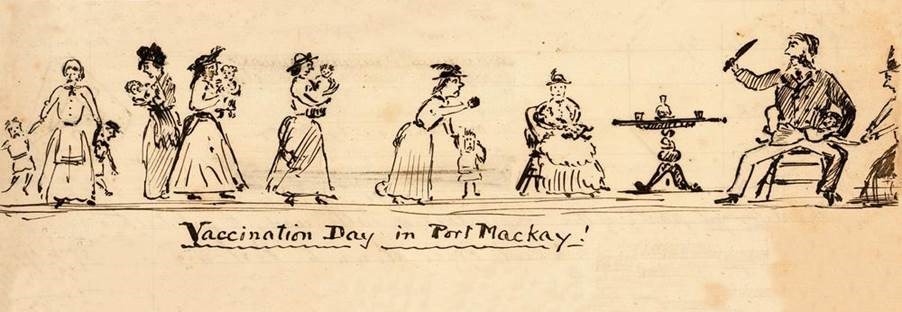
Vaccination day in Port Mackay – attribution

When I went for my Covid shot, the nurse took a look at my arm to choose a vaccination site, noticed an old and faded scar, and asked ‘Was that a smallpox vaccination?’

It was.

In Scotland, where I was born, it was policy to use a lancet to scratch the inoculation site to leave a noticeable scar as proof of vaccination – in effect a vaccine passport.

As a teenager, girlfriends would bitch about how unsightly they were, especially if they’d manage to get a bit of a tan, but to be honest everyone had them, and anyway this was Scotland – short sleeves and spaghetti straps were a lot less common than woolly jumpers and Damart thermals.

Smallpox and tuberculosis were two of the really big killer diseases of the nineteenth century. When I look at my family history it’s quite disturbing to see how many of my predecessors died of lung diseases – usually lumped together under phthisis, which was used as a catchall term for not only tuberculosis but diseases brought on by constant exposure to smoke and pollution.

Primarily smallpox and phthisis were urban diseases – the ones in my family who died of these complaints lived in Dundee or Edinburgh, never those living on the farms, where they mixed less, living an isolated life except for market days, and were possibly less exposed to pollution and either adulterated or contaminated food.

The other interesting thing is that from the mid Victorian period onwards none of them died of smallpox – the reason being that smallpox vaccination became compulsory in Scotland in 1864, although not without some opposition. (There was no cure for tuberculosis – diagnosis was a death sentence and though treatment got better, remained so until the advent of antibiotics)

England had made vaccination compulsory some years earlier, and in Australia, Victoria made vaccination compulsory in 1854 to stop the spread of smallpox in the goldfields appointing public vaccinators for each district.

clip_image004

The vaccinator would make an incision into the skin and scrape in infected material harvested from someone already vaccinated to induce a mild case of cowpox – in fact it was a requirement that vaccinated people had to come back and have their infected material harvested.

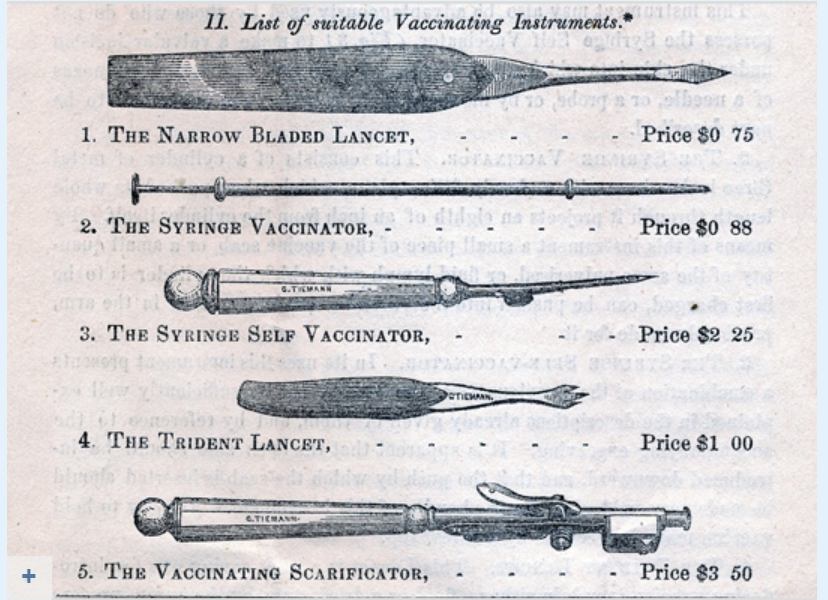
Nineteen century medical equipment catalogues are full of various gruesome instruments for vaccination
clip_image006

Although some vaccinators preferred to make an incision with a lancet and then use a special tool such as this

clip_image008

to transfer the infected material – as perhaps the vaccinator is doing in the sketch at the head of this post.

And of course this reveals another gruesome secret about nineteenth century vaccination. To get the safe vaccination material here from England they transported in in the arm – having no other way of transferring a live vaccine.

This meant starting out the voyage with a group of unvaccinated individuals and progressively vaccinating a pair every eight days or so with material harvested from the previous pair to be vaccinated and hoping that they would be able to harvest live material once they got to Melbourne.

From there the material could be transported (quickly) on glass plates and used to restart the vaccination cycle.

Gruesome as the story is, it worked. Compulsory vaccination and health inspection successfully controlled the spread of smallpox in nineteenth century Victoria.

Of the other colonies, Tasmania enacted similar regulations but didn’t actually enforce them terribly strictly, and New South Wales never had compulsory vaccination. I’m unsure about the situation in the other colonies, although the lead picture suggests Queensland had a vaccination service …

Posted in Uncategorized | Leave a comment

RLS and St Cyrus

clip_image002

I was reading Bella Bathurst’s The Lighthouse Stevensons, the story of the extraordinary Stevenson family, who over several generations built most of Scotland’s lighthouses, not to mention a quite a few elsewhere.

Robert Louis Stevenson, of course, was one of the family who did not take to lighthouse building and ran away to be an author, ending his days in Samoa.

Anyway, in the book, I came across a minor error that obviously slipped through the sub-editing process.

Bella Bathurst states the Alan Stevenson, after he resigned as Chief Engineer to the Northern Lighthouse Board due to illness, lived for sometime at St Cyrus in Fifeshire.

Well St Cyrus in Kincardineshire I know well from summer holidays when a child, and also that we once had a farm there, but I didn’t know of one in Fife an area which I also know reasonably well.

A few minutes with Google Maps convinced me that there was only one St Cyrus in Scotland, and that was the one in Kincardineshire above the mouth of the North Esk and the border with Angus, which was known as Forfarshire in the nineteenth century.

But where did he live?

The answer was Kirkside House, which was amazingly adjacent to what was our farm. I remember old uncles referring to it as ‘The Toorie House’ due to its distinctive round tower and using it as a landmark from the beach to place the location of field boundaries when looking at landslips.

Thomas Stevenson, Alan’s youngest brother married Margaret Balfour, whose parents lived in the Mall House in Montrose, in 1848, with Robert Louis Stevenson coming along in 1850. However despite J’s assertion that every third person in Montrose is related to me in some way, I can claim no connection with the Balfours, unless it was as servants.

We do know that Thomas Stevenson’s family, including RLS, visited with Alan Stevenson when he was in Kirkside House, and while I had a moment of fantasy about some of my forbear’s children encountering the sickly RLS on walks, it actually can’t be true – we didn’t acquire the lease of the farm till the mid 1860’s and Alan Stevenson died in Portobello in Edinburgh in 1865, of something that sounds a lot like what we would nowadays diagnose as Multiple Sclerosis.

I’m assuming that RLS continued to visit family in the area – given that his father and brother David built Scurdie Ness Lighthouse in Montrose, it would be surprising if he did not – after all he would still have been trying to meet his father’s wishes and become an engineer in the family firm …

Posted in Uncategorized | Leave a comment

Is reading onscreen so very different from print?

Earlier today, I retweeted a link to a Conversation article about why we seem to remember more when we read an article in print than we do onscreen.

The concern of the article was based around online learning and the argument was that reading on screen was different, and usually in a more distracted environment, while the physical engagement with the document reading a print article enabled greater concentration.

Equally the article argued that also, because we see digital contents as more disposable, we tend not to engage with it to the same degree that we do with printed text.

Well maybe.

My experiments with the dogfood tablet have inadvertently demonstrated (and this is only anecdotal) that if one has a distraction free environment on can concentrate on the text more.

My other anecdotal comment based on my own experience is that one has to learn to engage with the text.

In my youth I read a lot of science fiction. This gave me the ability to read quickly and retain a story. Unfortunately, this didn’t quite work at university when I started reading research reports and reading critically.

I solved this problem by teaching myself to read closely by writing a precis of the text, something I still sometimes do today.

But what if you lived in a pre-literate society, or one where very few people could read fluently?

When I worked for AIATSIS, I was privileged to hear a recounting of a dream-time story by a group of Aboriginal traditional performers.

Even in an anonymous meeting room in Canberra, it was an enormously powerful experience, spine tinglingly so, with a rhythm to the story and the beating of sticks for effect at critical points in the tale.

At the time, I could not help thinking that this was how the Iliad or the Odyssey must have been when first performed, or Beowulf with its beating alliteration.

You would remember these stories because not only of the performance but because the repetition and alliteration would make them easier to remember.

Even early Greek theatre, or at least those plays that have survived, or the plays by Shakespeare and his contemporaries worked well and were memorable through not only the stories but the images and turns of phrase.

And the same must surely be true of onscreen reading.

The texts need to be memorable.

If they are not memorable one must make them so either by precising the texts or some other trick.

I’d like to see a study carried out to see if students who read onscreen while taking notes retained more than those who read a printed version of the text and did not …

Posted in Uncategorized | Leave a comment

The Jamaican Connection …

 While messing about with family history this weekend I’ve finally found a Jamaican connection.

 As you may remember, I’ve long been puzzled about why there quite a few people who are the descendants of enslaved people in the Bahamas with the same (unusual) surname as me.

However, I’ve come across the Honourable Robert Fairweather, who lived in St Mary’s in Jamaica and died there in 1843.

Not one of my direct predecessors, but a cousin by marriage – the brother of my great^n grandfather’s wife

Born into relatively humble circumstances at Stracathro in what is today Angus in Scotland, he went to Jamaica and became what was described as a planting attorney – not a lawyer as we might think, but an estate manager who held power of attorney over the business of the estate – something which made sense when the owner could conceivably be on the other side of the ocean in London or enjoying the waters in Bath.

Robert Fairweather was a slave owner – he was registered as owning slaves and obtained compensation when slave owning was abolished.

So far, so embarassing.

However, if you delve a little deeper, the story becomes more complex.

When he died, he left fifty pounds to each of his siblings who were still in Scotland, and the balance was to be shared between his six children and his ‘good housekeeper’ Catherine Allen, who was incidentally the mother of his children.

In his will his children are described as free quadroons, meaning that they had one white parent (Robert) and one mixed heritage parent (Catherine) and were not themselves enslaved. It also implies that Catherine herself had one white parent and one black parent.

Given her rather Scottish sounding name, I’m presuming that one of Catherine’s parents was also from Scotland and may have known Robert already.

Then it gets murkier.

Catherine herself is registered as owning five slaves. One of Robert’s children with Catherine, John, is also registered as a slave owner, as is his wife.

John, interestingly, had a private act passed in the House of Assembly to be granted the rights and privileges normally accorded to a white person, and went from being described as a carpenter in a census in the mid 1820’s to a gentleman by the early 1830’s. I’m guessing that John acquired some wealth and position through his marriage and moved up in the world.

What this shows is not only how pervasive slave ownership was in Jamaica, but also that it was not restricted to the white elite – there was a developing middle class of people of mixed descent, some of whom clearly aspired to status, as shown by John’s becoming a gentleman, and going to the expense of having a private act passed to accord  himself the rights of the white population …

Posted in Uncategorized | 3 Comments

Sealers, whalers, and Antarctic discovery

I’m about 80% through volume one of James Clark Ross’s Voyage to the southern seas, mostly speed reading it in idle moments on my newly acquired 7” tablet – the one I bought specifically for offline reading of pdf’s – and a number of things are quite clear to me.

Throughout his account of the voyage Ross recounts meetings with sealers or whalers, or coming across the remains of their camps on remote islands, showing the extent to which whalers and sealers were the first to explore the sub Antarctic islands.

And while the sealers were as gnarly and fetid as we might imagine – he describes meeting a group on the Crozet islands who stank of rancid seal oil who wore penguin skin boots with the  feathers turned inward – he also admits to making use of the sealing vessels’ logbooks to plot his course – the difference being that Ross went to these islands to survey them, not just club seals.

The other thing is that there were women on these islands. As well as Campbell Island, Ross mentions the remains of a hut on the Auckland Islands where a castaway lived with what he describes as a New Zealand woman – as this is 1840 and before large scale European immigration to New Zealand, I presume he means Maori – suggesting that there were more women involved than usually thought to be associated with Antarctic sealing and whaling.

Equally interesting is the practice of deliberately stocking remote islands with pigs, goats and chickens to provide a food source for passing vessels, as well as planting gardens of potatoes, Siberian kale (which we would nowadays more commonly call Russian Kale, Siberian Kale and  Russian Kale, being alternate names for the same variety of kale – Brassica napus va pabularia ), as well as berry patches of gooseberries, red and blackcurrants …

Posted in Uncategorized | 1 Comment

Family history and red herrings …

J’s Australian ancestry is a mystery to me. Her lineal great^n grandfather is Henry Thomas Hill, who worked for Victorian Railways and who died in Castlemaine in May 1882.

He had a wife, Anne Humfries or Humphries and they first appear in the records in Castlemaine in 1848.

I can’t find any record of their marriage, migration to Australia, or their individual births. They may have been free settlers, convicts, people who moved from Tasmania, I simply don’t know.

I can estimate Henry to have been born around 1810 as his death notice gives his age as 72 when he died, but that’s it.

Anne Humfries, who was ten years younger than him, lived to 1904, dying in Carlton. A number of her children were living in and around Carlton and Fitzroy at the time. She was possibly living with one of her children, I havn’t checked that out yet.

When she died, the funeral notice states that her coffin would be taken by train from Carlton to Castlemaine to be buried alongside her husband. This was obviously quite an expensive funeral, with two companies of funeral directors involved. It also suggests a deep and enduring relationship between the two.

Recently however, I came across a Henry Thomas Hill who also died in Castlemaine in 1882, but who married a woman called Charlotte Elizabeth Salt in Warrnambool in 1857.

This immediately raised a red flag – Henry and Anne’s youngest child wasn’t born until 1858.

So while it wasn’t impossible for Henry to have bigamously married Charlotte, it seemed a tad unlikely.

Charlotte had previously been married to William Julian Thomas, who had died in early 1857, with Charlotte remarrying in October of that year.

Interestingly, Charlotte and William married in Port Fairy, and there is a record of a Henry Hill arriving in Port Fairy from Tasmania. It’s possible that they had had a long standing friendship.

Charlotte’s Henry is described as a hair dresser and wood carver which is an interesting combination.

I also don’t think Charlotte is anything to do with J’s family – I think someone has confused the death records of two Henry Hill’s who died around the same time.

What is interesting is that Charlotte’s Henry (who sometimes has his birth year given as 1810, and sometimes as 1819) turns up as either being born in Stone in Staffordshire, or in Middlesex. Obviously he can’t have been born twice, so given that someone has mixed up the deaths of two Henry Hill’s is possible, just possible that one of these births is also our man – but which one I don’t know as yet …

[Update 12 November 2021]

I think I might now have some understanding – there were two Henry Thomas Hill’s one of whome married Charlotte Salt in 1857, and one of whom didn’t.

Somewhere along the line someone has misidentified Charlotte’s Henry as dying in Castlemaine in 1882. This is of course the wrong Henry.

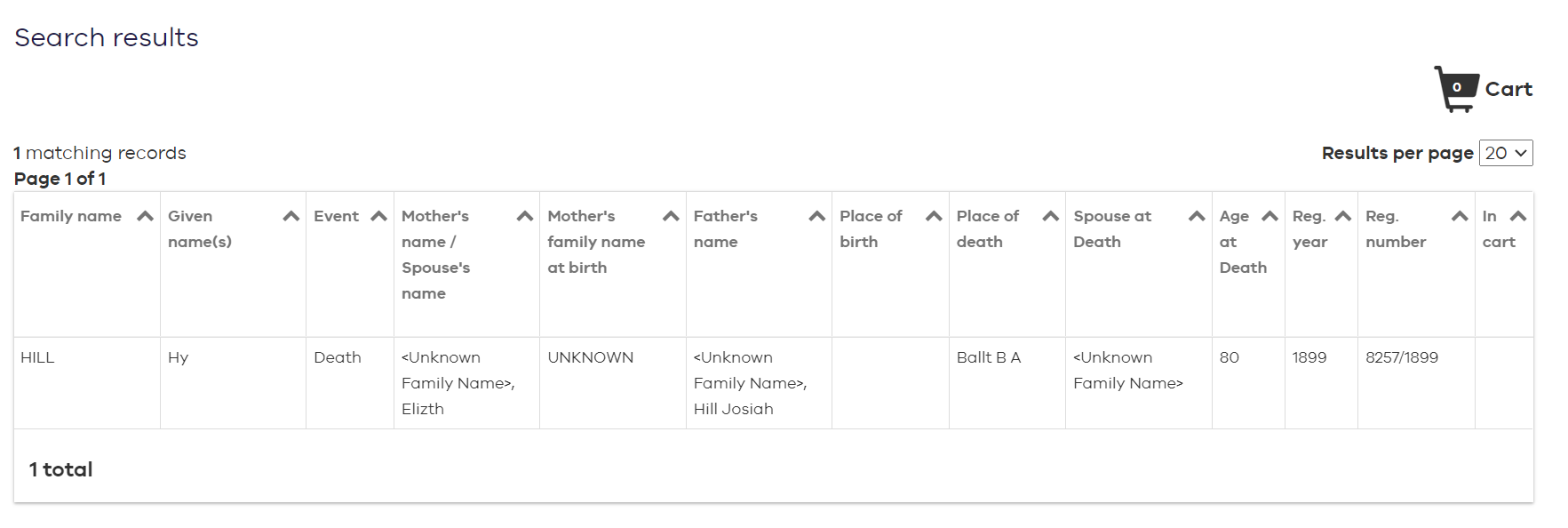
I’ve now found records that suggest that Charlotte’s Henry in fact died in the Ballarat Benevolent Asylum in 1899

screen grab of Henry Thomas Hill Death record

and there he is …

Posted in Uncategorized | 1 Comment

Women in nineteenth century sealer’s camps

Well, I’ve become a bit intrigued by the Elizabeth Farr story, not that I’ve got very far tracing her.

What I have found is that no one really knows much about sealer’s camps – there seems to be an assumption that they consisted of a group of gnarly and probably fetid men that went around clubbing seals, skinning them and rendering the remains.

If the sealers were local the men were usually dropped off early in the season by the seal boat which returned later to pick them up. Obviously if they were from further afield – America for example – they anchored their boat securely while working onshore.

But it does seem that sometimes there were women present in the camps.

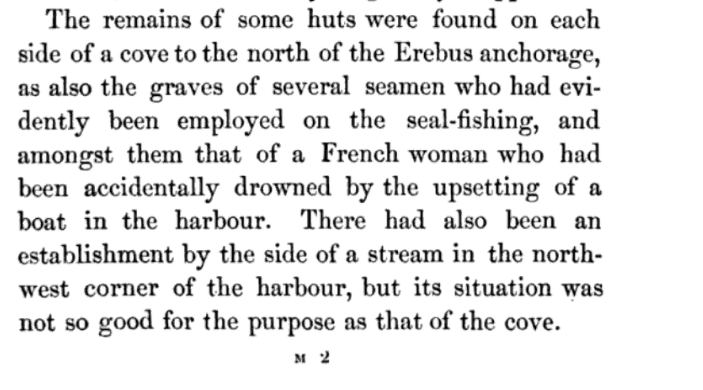
James Clark Ross, on his 1840 expedition to Antarctica stopped off on Campbell Island and in his account of the voyage wrote:

Screenshot 2021-03-25 111436

This of course asks as many questions as it answers. Elizabeth Farr was clearly not a French woman, and it’s not clear from Ross’s account how recent the grave was, or indeed he had confused the grave with another.

However, it does seem to suggest that women were present on occasions in sealer’s camps ….

Posted in Uncategorized | 1 Comment

The Long S in the Sydney Gazette ..

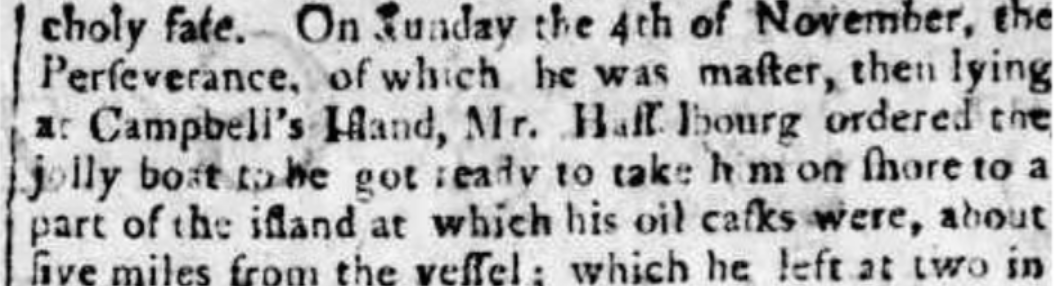
The Sydney Gazette story of Captain Hasselborough’s demise is interesting typographically for its use of the long s.

In the handwriting of the time the long s was only really used as the first s of double s in a word, Haſselborough, rather than Hasselborough.

However, a lot of English typesetters of the time stuck to an older set of rules, which basically meant that the long s was used where we would use a round s, except at the end of the word, so Haſſelburgh instead of Haſselburgh for Hasselburgh and Perſeverance Bay for Perseverance Bay.

Apparently some typesetters in the early nineteenth century switched to following the normal handwritten usage, but quite a few did not.

Sydney was of course a small isolated settlement, six months by ship from England, so it’s not surprising that eighteenth century typesetting practices should persist into the early nineteenth century.

Posted in Uncategorized | Leave a comment

The Lady of the Heather …

I was listening to a Radio New Zealand podcast about the archaeology of sealers’ camps on Campbell Island, way to the south of New Zealand, when I heard a story that I had never heard before.

The last grand daughter of Charles Edward Stuart aka Bonnie Prince Charlie, lived in a sod hut on Campbell Island, a substantial hut with glass in the windows, lace curtains, and a heather bush by the front door, and that she would walk along the foreshore in shoes with silver buckles.’

Unlikely, to say the least. Unless she was really down on her luck, any grand daughter of Charles Edward Stuart, was unlikely to consort with sealers, much less live on an island at the arse end of the world in a sod hut, no matter how elegant it was.

However, my discovery of my own connection with the Sobieski-Stuarts shows that the Bonny Prince Charlie legend did seem to have a hold over people well into the nineteenth century, so I could imagine that some woman may have claimed that her illegitimate daughter was a result of a one night stand with Bonnie Prince Charlie, and that her daughter could just possibly have ended up on a sealer’s boat away down in the southern ocean.

The times do sort of fit – Bonnie Prince Charlie took to the heather in 1746 after Culloden, if one assumes 20 odd years between generations that would mean that our supposed grand daughter would be in her mid twenties at the end of the eighteenth century.

Campbell Island itself was discovered in 1810 by a Captain Hasselborough, who commanded the Perseverance a Campbell company seal boat out of Sydney.

Captain Hasselborough was later to lose his life in an accident in Perseverance Bay on the island.

Interestingly, the other victims on the accident were a ship’s boy George Allwright and a ship’s girl Elizabeth Farr from Norfolk Island.

Norfolk Island was of course purely a penal colony at the time and Elizabeth Farr was said to have run away at the age of 13 to become a ship’s girl – which could be anything from a skivvy to an officer’s bedmate, or perhaps both – apparently quite a few girls and young women preferred to take their chances running away on a seal boat with all the risks of sexual abuse and exploitation that entailed rather than live out their lives in a penal colony where there were substantially more men than women, and where women were equally at risk of sexual abuse.

Their deaths were recorded in the Sydney Gazette at the time – the whole story can be downloaded from Trove – but essentially all three drowned and were buried on the island.

Elizabeth was probably thirteen or fourteen when she drowned, meaning that she would have been born at the end of the eighteenth century. It would fit the story quite neatly if she was the great grand daughter than the grand daughter.

So maybe, just maybe, being the illegitimate great grand daughter of Bonnie Prince Charlie was a story she told about herself.

Interestingly, her mother was also said to have been known as Elizabeth Farr and a convict, meaning that we should have a little bit of a documentation tail about them …

[update 24/03/2021]

I’ve since come across another, grimmer suggestion.

That the story of Elizabeth Farr had become mixed up with a later story of a woman, possibly another ship’s girl, that was put ashore a few years later and abandoned on the island.

It is said that she built herself a sod hut for shelter, and that her skeelton was found a few years later.

It doesn’t answer the supposed Bonnie Prince Charlie link, but could explain the story of the exiled woman and the sod hut …

Posted in Uncategorized | 1 Comment

Venetian glass beads in Alaska

This morning I tweeted a link to a Gizmodo article reporting the discovery of fifteenth Venetian glass beads in Alaska.

Obviously the article is written from a US viewpoint, and makes the point that the beads were probably deposited before 1492 when Columbus arrived in the Carribean,

This is not particularly relevant given that Alaska is a very long way from Hispaniola (where Columbus landed) and the other side of the continent.

What we can say is that these beads were deposited well before any European voyages to the Pacific northwest.

It’s also before the beginning of the Russian expansion into Siberia so we can confidently rule out Russian fur traders as a source.

Interestingly it’s also before the Spanish and Portuguese established a presence in what is now the Phillipines, Timor, Indonesia and Malaysia.

Inuit deposits across the Arctic occasionally turn up belt buckles and other metal artefacts of Russian origin, which shows that there was a pre-contact trading network with Russian settlements further west in the Arctic.

Beads however are kind of special. While essentially worthless they are both pretty and easy to transport and effectively act as a currency, as we see in Australia where the Yolngu traded trepang for beads (the same sort of beads that have been found in Alaska) with Macassan traders and then traded them with communities further south.

These glass beads in Alaska were probably similarly traded, perhaps as part of a network trading furs with Chinese and Korean traders further south, and were traded further north through Kamchatka and on into Alaska.

In Tent Life in Siberia, which describes his role in the failed attempt to build a telegraph line from the USA to St Petersburg via the Bering Strait, George Kennan describes the life of the indigenous people of the Kamchatka peninsula in the 1870’s.

What is striking about his description, is that apart from a few isolated military outposts and Orthodox missions, the indigenous people had contact with few outsiders other than fur traders, and other than tea, Russian enamelware teapots and hurricane lamps, were even then still living what was essentially a traditional lifestyle.

As these beads would predate any substantial Russian expansion to the east, the most probable hypothesis is that they came via China. Chinese merchants had a long tradition of trade with the Siberian peoples closer to the Chinese border, and one could surmise that these merchants sourced the glass beads via the overland Silk Road route, rather than via the porcelain trade with South East Asia, given that there was no European presence at the time they were deposited…

[Update]

There is a second article this morning that takes issue with issue with the date and suggests a late sixteenth/early seventeenth century date is more likely for the beads.

This date is still before any substantial Russian or indeed other European presence in the area, and does not invalidate the hypothesis of the beads being traded from Chinese merchants, the only real change is that a substantially later date makes sourcing via the porcelain trade in South East Asia a possibility

Posted in Uncategorized | Leave a comment