
Geography is important.
At the start of world war one, no one had any idea about the use of aircraft, or the strategic use of airpower to intimidate the civilian population.
At most, aircraft, and they were fragile things made of wire, wood and canvas, and probably more of a danger to the pilots than anyone else and really only good for spying on the enemy.
Flying them took skill and strength. It’s telling that Agatha Christie’s first husband, Archie, who despite paying £75 of his own money (say five or six thousand dollars today) to learn to fly, never made the grade as a pilot.
He was judged competent enough to fly ‘safe’ aircraft in light winds, but was simply not good enough to be trusted with a combat aircraft, and as such spent his time as a ground officer.
The first aircraft had no weaponry, no guns, no bombs. Pilots carried revolvers to shoot at enemy pilots, and might drop grenades on enemy soldiers by simply dropping them over the side.
In time aircraft improved, engines got better and carried machine guns and some were designed to drop bombs.
But at the start of the war, there was none of that.
The Germans had been experimenting with airships, called by the British and others Zeppelins, after their designer Count von Zeppelin.
Large, slow, cumbersome, the could carry bombs and drop them on the enemy, and before aircraft routinely carried machine guns, were relatively safe from attack, and almost impossible to spot at night.
While anti aircraft guns existed, there were never enough of them and there are reports of soldiers impotently trying to hit a zeppelin with their rifles,
On the other hand they were fragile, filled with inflammable gas, and at the mercy of the weather and could easily be blown off course.
And in the first two or three years of the war the German forces used them as bombers, bombing Calais and Dunkirk to disrupt troop movements across the Channel, bombing Paris and London to terrorise the population, attempting to bomb the naval base at Rosyth in Scotland but bombing Edinburgh instead, and bombing Hull on the east coast of England.
But why Hull?
It was primarily a fishing port, not a port where goods were landed or transhipped.
And in part the answer lies in geography.
Germany had two major zeppelin bases, Tønder in Denmark – between 1864 and 1920 Tønder lay just inside of Germany and was known as Tondern – and Evere outside Brussels in Belgium.
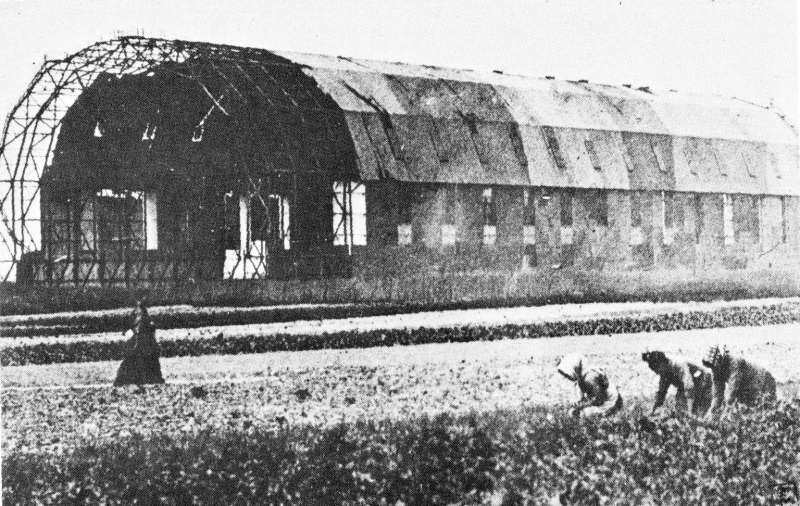
Zeppelin hanger Evere – picture taken between 1915 and 1920 – via Wikimedia commons
Both Denmark and the Netherlands were neutral during world war one, the Netherlands aggressively so, attempting to shoot down any aircraft, including zeppelins, that strayed into its airspace.
This limited where German airships on bombing raids could fly from. Obviously they could not fly over the Netherlands, limiting them to either flying from occupied Belgium, crossing the coast somewhere between Nieuwport in the south and the Dutch border in the north, of from Tøndern flying north of Dutch airspace and south of Danish airspace along a narrow corridor.
Ursula Bloom, who lived in Essex during world war one, mentions watching for zeppelins (and British fighters attacking them), these would undoubtedly have come from Evere.
Hull is not quite directly west of Tøndern, but is the last large town in England that a Zeppelin would pass if it was blown off course before beginning to cross the north sea on a return journey.
Hull is surprisingly close to the Netherlands – when I lived in Hull in the early 1980s I had a little no name black and white tv with a rotary tuner, and in winter, on a cold clear night, it was not unusual to pick up a Dutch tv station between the usual UK channels, and shades of Erskine Childers’ Riddle of the Sands, Hull situated more or less directly west of the Frisian islands.
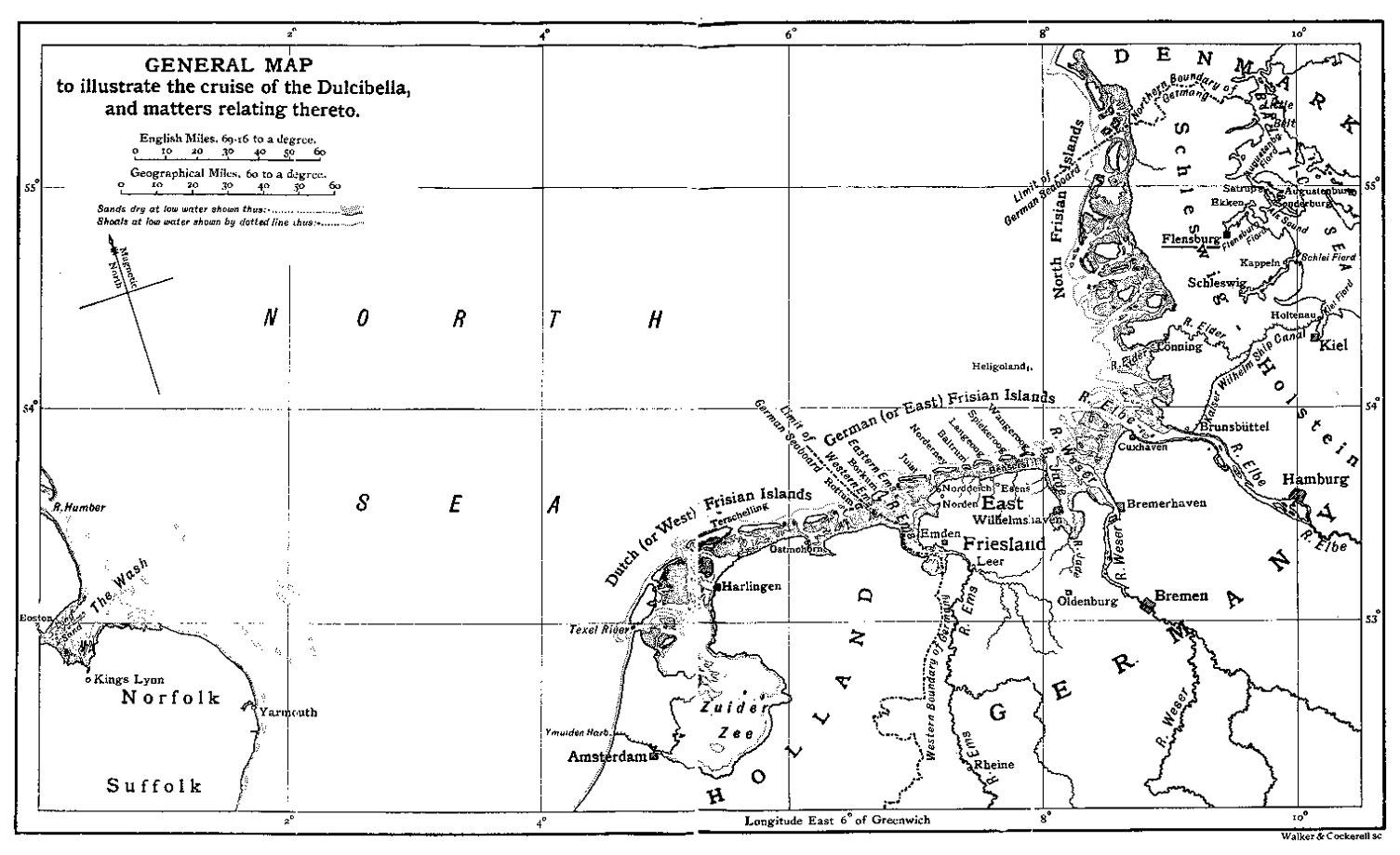
From The Riddle of Sands – Hull is on the Humber estuary and Tøndern a little north of the 54th parallel – via wikipedia, author unknown
Unsurprisingly any zeppelin heading home after being blown off course would probably find a Hull a tempting target, as was the case in early 1916, when an attempt to bomb Rosyth was aborted by rain and snow, with the attacking zeppelins being blown off course.
I suspect the navigation officers when lost, would follow the coast south to somewhere round about Hull before setting a course more or less due east.
While there was the risk of flying too far south and encountering Dutch anti aircraft defences doing this meant a shorter crossing over open water. Given that zeppelins were often at the mercy of bad weather, reducing the flight time over open water was probably felt to safer given the low chance of surviving having to ditch in the sea.
Unfortunately for Hull, this probably meant that the city was more heavily bombed than it otherwise would have been.


