The Lofty Viol

Saturday night, and what to do?

Well last night J and I went to a concert – the Lofty Viol of English early music in the old town hall, just 5 minutes walk from our house.

And it was a treat – an impromptu assemblage of Australian viola de gamba players playing works by the usual suspects ( Blow, Hingeston, Gibbons, Ward etc) in a small and intimate setting – done in the round with an audience of only around 50, without any amplification or modern aids – letting you hear the music as it would originally been heard.

While the room wasn’t wood panelled there was just enough wood in the room to give the feel of the natural reverb that would have come a similar performance in a room with the traditional Jacobean wood panelling, such as the meeting room in Heslington Hall at the University of York where we used to meet to discuss the cost of printer cartridges and quite possibly Cromwell and Thomas Fairfax reputedly met to discuss strategy for the battle of Marston Moor.

(Incidentally one thing I learned last night was that Oliver Cromwell had retained the services of John Hingeston, one of Charles I’s court musicians, as his de facto Master of Music)

Anyway, in a small room – and remember none of this music would have been originally played in anything larger than the great hall of a Tudor or Jacobean stately home – the unamplified music came into its own with the natural reverb of the furnishings adding depth to the music.

For me it was a real treat to hear musicians of that quality in such an intimate setting. I have always had a love for music of that period despite having little in depth knowledge – I remember once driving back from some meeting and being astounded by a performance of some zarzuelas by Antonio de Literes, so much so that I ended up emailing the radio station concerned to track down the cd it came from.

Incidentally I never bought the cd and have always regretted never doing so – perhaps I will – it’s on Google Play, but strangely not on iTunes …

[and of course the actual answer is a streaming music service such as Spotify …]


Posted in Uncategorized | Leave a comment

Evidence for an early Christian site in Bahrain

A long time ago, I became fascinated with the story of Sighelm the ealdorman and whether he ever made it to India.

This minor obsession broadened into a wider fascination with early travel and a possible pilgrim route via the Gulf, allowing pilgrims from India to sail to the Gulf and then travel overland to Jerusalem.

And of course the same route would allow merchants to travel to Constantinople and Damascus.

Now there comes news of the identification of an early (pre-Islamic) Christian site in Bahrain, which helps reinforce my argument that there (a) was a reasonably sized Christian community in the Gulf and (b) provided a route for pilgrims from India to travel to the middle east.

These pilgrims of course would have taken ship, which implies an alternative trade route via the Gulf to the monsoonal route via the horn of Africa to south India and Sri Lanka.

These days, we tend to forget the importance of the trade across the Arabian sea, but it’s worth remembering that one of the first major military actions by the East India Company was the capture of a Portuguese fort on the Straits of Hormuz in 1622, thus opening the Gulf to trade with England …

Posted in Uncategorized | Leave a comment

Doing Family History in Victoria

I’ve written elsewhere about doing family history online, but that was using publicly available resources in Scotland.

This weekend the time came to see what could be done in Victoria.

A couple of years ago we took advantage of ANZAC day long weekend freebie to research J’s Australian grandfather, but there was always a mystery about her grandmother’s death.

After they married they moved to Australia, and while things looked to be on the up at first, by 1925 the marriage was in trouble, and J’s grandfather had ‘taken up with another woman’

The family legend was that at the start of summer 1925 – ie December in Australia, J’s grandmother had knocked on the door of a house in South Yarra to ask for a glass of water and then collapsed and died, and couldn’t be identified for days as her handbag had been stolen.

Well not quite true. A quick search of Trove for newspaper reports showed that indeed while she had collapsed and died, she had been identified within a day or so of her death, and there was no mention of foul play.

People in those days didn’t routinely have means of identification like driving licences and bank cards, so it’s perfectly understandable that it could take a little bit of time to identify the body, especially as J’s grandmother lived in Fitzroy.

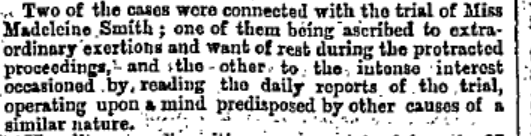
The Argus helpfully reported that a post mortem had been held, but the results were not yet known. A few clicks and $24.30 later we had a copy of her death certificate, which gave the cause of death as Cardiac Syncope and Inanition . It also reported that a post mortem had been undertaken, and the name of the examining doctor, and that no inquest had been held.

That was a bit of blow.

Cardiac Syncope was often used in the nineteen twenties to describe sudden heart failure, but Inanition usually meant starvation – which seemed a little unlikely given that photographs we have taken the previous summer show a healthy young woman of normal weight who swam and pushed her children in a wheelbarrow.

The family legend was that she had a weak heart due to rheumatic fever as a child and that she always felt the cold, perhaps as a consequence, but photographs taken on a summer’s day in 1924/5 show no evidence of this.

As no inquest had been held, the postmortem records are long gone, and there is no way to assess whether or not she was seriously underweight. Perhaps the stress of her situation caused her to become what we would now describe as anorexic, or perhaps she simply died of a broken heart.

We’ll never know.

Our final bit of research was to use ‘Findagrave’ to find her burial plot location. It’s in the old cemetery in Carlton. Next time we’re in Melbourne we’ll take the tram out to Carlton and leave her some flowers …

Posted in Uncategorized | Leave a comment

Ever wondered how effective wooden spears were?

When I look at collections of indigenous wood spears, like the ones on display at MAMA in Albury, I often wonder how effective they were, especially the hardened native wood precontact items.

20191123_160209

The answer: Very, frighteningly so.

What you see above is a hole about the size of a 5 cent coin in the front of our Subaru. Like many modern cars it has a metal fender covered with an aerodynamic plastic fairing. The fairing has a little bit of high density material behind it to absorb minor parking knocks – making it a little like a bike helmet in terms of industrial design, except the shock absorbing layer is thinner.

Now I havn’t been set on by men with spears, but last Thursday, the severe bushfire warning day, we had to go to Melbourne for an appointment.

Driving conditions were truly horrible with smoke, heat, dust and to add to the fun,  bits of tree debris being blown about in 100km winds. The train wasn’t an option as they’d understandably cancelled all the country train services due to the risk of the heat buckling the tracks,  and replaced them with buses with no real guarantee of arrival time.

Rather than go directly into the city we looped round to the east by turning off the freeway at Seymour, thinking conditions might be a little better. They weren’t – just as much flying debris, including somewhere just short of Yea,  a bit of eucalypt branch which managed to impale itself in the front fairing, cleverly missing any of the protective metal bits of the fender behind the fairing.

Fortunately it doesn’t seem to have damaged anything else and it’s a reasonably easy job for the body shop to replace the fairing. I’ve no idea yet as to costs – the fairing’s around two hundred bucks for either a third party one, or one from a dismantler.

However, what it does show is the penetrative power of a hardwood spear, certainly enough to severely maim, if not actually kill …

Posted in Uncategorized | Leave a comment

Bicycle advertising

Undoubtedly, the heyday of the bicycle was between about 1890 and sometime around the end of the nineteen twenties when cars began to we widely adopted as the preferred mode of personal transport.

This period of time coincides (at least within the anglophone world) with women’s struggle to not only gain the right to vote, but also for women to increasingly have equal societal rights to men.

And part of that emancipation was to allow women to go where they please and the bicycle was an important component, allowing women to travel independently if they wished.

This afternoon I’ve been looking at old bicycle adverts on Pinterest, and it struck me that a lot of them featured women, either riding together or independently.

Eyeballing pinterest is of course not in the least scientific, but could this be evidence of bicycle manufacturers realising that women, including liberated women,  formed a large part of their target market, and responding appropriately?

Posted in Uncategorized | Leave a comment

Toilet Parlours (continued)

I was talking about toilet parlours with J, and she mentioned that when she was a teenager there was still an old fashioned Ladies’ Retreat in Melbourne where, not only could you go to the toilet, you could change if you were going out with friends after school – she went to school in Prahran, and her parents lived in Eltham meaning a journey of over an hour each way – and do your makeup etc.

Long gone now, but it perhaps help explain the origins of the term Toilet Parlour, toilet of course originally meaning the act of dressing and preparing oneself: to make one’s toilet

Posted in Uncategorized | Leave a comment

Another nineteenth century post box

In quite a few places in Victoria you can come across old colonial post boxes – sometimes even still in use as in the early example I spotted in Port Fairy.

Well, Beechworth we don’t have any old pattern boxes still in use – but we still have two old pattern boxes, one in Mellish St, and another at the end of Malakoff Road.

As in Mellish St, the postie no longer calls but it’s still there as a historic object:

20191104_182402

20191104_182414

essentially a standard colonial long door format box with the clenched fist boss on the handle for the postie to open the box to get the mail …

Posted in Uncategorized | 1 Comment

Toilet Parlours

There, I was innocently working away documenting old pharmacy bottles when I came across one that caused me quite a degree of puzzlement:

DSCN1688

it’s from Lane’s Pharmacy in Wangaratta. It’s difficult to see from the picture but underneath the Lane’s Pharmacy line on the label it reads Chemist and Toilet Parlour.

Now that’s a term I hadn’t come across. Nowadays we associate toilets almost solely with excretion, and my first thought that was that Lane’s had decided to provide one of these upmarket facilities with an attendant to help with any quick fixups required as well as providing a place for relief.

Personally I’ve never really encountered anything like that outside of Dubai where the attendant handed one a towel after you had washed your hands, or in Morocco, where in one town in the south – I forget where exactly – we had gone to the only hotel in town that had a bar that served alcohol – warm white wine and even warmer red – but at least the beer was cold.

After a beer I of course needed to go to the toilet, where there was all the modern glistening push button flush facilities one would expect anywhere, and a man in a yellow gown whose job appeared to be to flush the urinal for you in return for a dirham – which was only about 15 cents – so hardly worth worrying about.

Anyway, back to the story – curiosity piqued I did some digging, and was rewarded with this from PapersPast NZ

LADMI19261101.2.76.2-a1

A toilet parlour was a beauty salon – and it wasn’t just an Australia and New Zealand phenomenon – the term was also in use in America in the 1890’s

1892-graham

A quick search on QueryPic shows that (in Australia at least) the term was only really widely used in the nineteen twenties and had pretty much gone out of use by the early nineteen thirties …

chart (4)


Posted in Uncategorized | 1 Comment

Egyptomania

I’ve become interested recently in Egyptomania – the sudden engagement of western countries with Ancient Egypt in the nineteenth century.

Egyptomania spawned a whole range of things – from the Egypt Exploration Society to the Amelia Peabody novels and is with us even today with the hype around any large exhibition of Ancient Egyptian artefacts

Before the nineteenth century, Pharonic Egypt was unknown in the west save for some biblical texts and references in a few classical authors. Napoleon’s Savants pushed open the door a little, as did Champollion’s work on hieroglyphs, but in the first half of the nineteenth century what archaeology there was was little more than glorified tomb robbing.

‘Proper’ access didn’t really happen until the 1870’s, indirectly as a result of a financial crisis in Egypt, which resulted in a take over by stealth of the two largest creditors, Britain and France.

This enabled tourism, as exemplified by Amelia Edwards’ 1877 A Thousand Miles up the Nile,and with tourism came curiosity, and gradually a more formal system of regulated exploration and excavation. Of course Amelia Edwards was not the first, or the only lady tourist cum egyptologist, there was Marianne Brocklehurst, Amelia Oldroyd and Annie Barlow to name but three, all of whom used their money to build substantial collections.

But of course it’s not just these high profile collections – many people were infected by Egyptomania which why there’s an Egyptian mummy in Hyderabad, one in Perth museum in Scotland, in Derby museum in England, in Manchester, in Adelaide, in Lisbon, and even in New Zealand, not to mention those scattered across museums in the United States and Canada.

And of course it’s not just mummies – Egyptian artifacts are lodged in museums from Montrose in Angus to Sao Paulo in Brazil.

In fact there are so many holdings it’s impossible to list them all – Wikipedia attempts to list the main holdings but the list is incomplete – Annie Barlow’s collection in Bolton is omitted as is the Marianne Brocklehurst collection in Macclesfield – and of course collections keep on changing as this recent discovery in Sydney shows.

The impact of Egyptonmania spread far beyond collecting and souveniring – the discovery of the tomb tomb of Tut Ankh Amun by Howard Carter spawned a whole new burst of Egyptomania – Tutmania – with Egyptian themed clothing and jewellery.

And it’s with us today – with television specials on Ancient Egypt and tomb hunting drawing substantial audiences from a jaded public.

So Egyptomania hits the public’s buttons in so many ways, despite the deep disconnect between our world and the dark god-ridden world of the ancient Egyptians.

I have no doubt that they laughed, loved, suffered the agonies of loss just as we do, and in a few places the voices of ordinary people shine through, but mostly it’s king lists, praise to the gods, and other highly stylized ritual texts. We know of them, but we do not know them in the way that we know the lives of the classical world, but yet the fascination remains, and that’s something we see today.

So what’s out there?

A quick and rather random survey turns up ancient Egyptian holdings in Australia at

as well as the well known collections at the Nicholson Museum and the Australian Museum in Sydney – the real revelation came with Victorian Collections which revealed a substantial collection held by Queen’s College in Parkfield .

I’m sure there’s others I’ve missed, plus given the role of Australian soldiers in the middle east in the first world war various items locked away in local museums or even sitting on someone’s mantlepiece ..

Posted in Uncategorized | Leave a comment

A left turn on the family history front

Researching family history can be incredibly frustrating, especially when one tries to find people born before the start of systematic record keeping in the 1850’s.

Just to make it doubly confusing people in my family line at least kept on reusing names, James, David, John, George to name but four, and given that a lot of them were resident in the same area of north east Scotland it can be difficult to sort out who is a direct ancestor and who wasn’t.

So, in order to save myself some work, I sometimes go searching various family history wikis to see what I can find about these common names.

Well yesterday I was searching for James Moncur and I found an entry that stopped me in my tracks:

james moncur nz

This James Moncur had clearly married a Maori woman – in fact two separate Maori women and had a number of children, all of whom had Maori names as well as western names.

Now, Pakeha men having children with Maori women was not exactly unknown in the early days of European settlement, but what was interesting was that his relationships appeared to have some legal status, and that the children were probably baptized.

The actual entry is slightly confusing and it’s just possible it has conflated two James Moncurs, but Matilda Juliet turns up on another genealogy website:

matilda juliet moncur

A little more digging revealed that James had been born in Stepney in London and had been a master mariner. He appears to have died while at sea in 1845, while master of the Gypsey, sometime after May 1845.

As well as searching Papers Past NZ, I also searched Trove for shipping information and turned up this entry from 1832:


sydney herald admiral gifford 1832

Unfortunately, it doesn’t give the name of the Moncur concerned, but it probably wouldn’t help much – James Snr was now living in Sydney, having been a master mariner for the East India company.

His daughters, Susannah and Sophia had come to Sydney in 1832 to join him, and they established a millinery business:

misses moncur millinery

We also know that by the time of Sophia’s marriage in 1837 James Snr had died

sopie marriage 1837

It may be coincidence, but it’s worth noting that one of James Jnr’s daughters was also named Sophia – perhaps named for his sister.

While James Jnr was born in Stepney in London, James Snr was born in Dundee in 1774, suggesting that his father had moved to London at some stage in his life. The Stepney connection is perfectly explicable – in the eighteenth and early nineteenth century Stepney was where the docks and commercial waterfront was, with most ships sailing from there.

Now one of the other members of my family history curiosity cabinet is John Moncur, who was a naval officer during the Napoleonic wars.

I don’t know where John Moncur was born, nor do I know if he had any children, but I do know he died in Greenwich in 1814 at the age of 71, and he was commissioned as a lieutenant in 1790 when he was  roughly 46 years old.

This in itself is a puzzle – lieutenants were usually midshipmen who had passed the lieutenant’s exam at around the age of nineteen, suggesting that John may have had a career before he joined the navy, perhaps as a master mariner.

With a wild leap of supposition, it’s just possible that James Snr might have been one of John’s children – he would have been fifteen or sixteen when John was commissioned and may have moved to London with John’s family …


Posted in Uncategorized | 3 Comments