I’m late, I’m late !

Last night I was idly watching Michael Portillo’s Great British Railway journeys (SBS has bought a load of these years old and shows them after the news as an antidote to the lunacy of the world), and in the episode Michael visited Croft on Tees on the edge of North Yorkshire where Charles Dodgson, better known as Lewis Carroll, spent most of his formative years before boarding school and Oxford.

Crucially Dodgson moved to Croft in 1843 at the age of eleven or thereabouts and was apparently fascinated by the then new and shiny railway between York and Newcastle.

One thing that apparently fascinated him was people rushing about and constantly looking at their pocket watches to ensure that they did not miss their train – for the simple reason that punctuality was a new thing in the early 1840’s.

Before then neither mail coaches or steamships were punctual to the minute – the vagaries of the weather and, in the case of mail coaches, poor roads, ensured that being on time was more a matter of quarter hours than minutes.

To be sure, people had meetings and appointments, but before the railways  being punctual to the minute rarely mattered, or was necessary. Trains were of course different and changed our world in many ways, just as the internet has today

Posted in Uncategorized | 1 Comment

Finding George

Well, today happens to be the 25th of April or ANZAC day, the anniversary of the Galipolli landings and a solemn day in the Australian calendar, perhaps too solemn, but that’s a different discussion.

Anyway, after my success with open source genealogy, we thought we’d take advantage of the fact that Ancestry.com have a free day on first world war veterans’ records to go searching for Judi’s grandfather, who everybody thought had been at Galipolli but no one was sure.

While the actual records are at either the National Archives in Canberra or the Australian War memorial, the searchable online ones are annoyingly only available via Ancestry.

Annoying, but digitisation costs money and the servers need heating, cooling and power to keep the disks spinning, and that all costs.

Finding Judi’s grandfather was easy – we needed a little more work to find that he had been in the landings and had been injured a few days later, and sent to a hospital in Malta before being redeployed to Egypt, from whence he was transferred to the AIF facility in Wiltshire for additional training before being sent to France.

In the course of all of this he met and married Judi’s grandmother, was put in detention and had his pay docked for going AWOL around the time J’s mother was born, and somehow managed to survive the whole bloody business and be discharged in September 1919, having signed up five years earlier at the start of the war.

We managed to piece this together with the aid of google and wikipedia to find the locations of army camps or the terms we didn’t understand, including even a suburb in Melbourne that was split into two in the 1950’s (but the train station kept the old name), plus a bit of playing with the scanned images – people’s handwriting then was just as bad as now, and harried record and pay clerks seem to have been worse than anyone.What it taught us is that you can find out a lot, and I mean a lot quickly with a bit of work. (Oh and we saved pdf copies of everything for work after the paywall reappears …)

Posted in Uncategorized | 2 Comments

Mary Queen of Scots and Darnley’s death

I’ve been reading John Bossy’s Under the Molehill, about the identification of a mole in Mary Queen of Scots household who leaked information about  various plots to Walsingham’s office during her detention in England.

In the book, Bossy repeats a titillating story about Mary’s behaviour after she knew Darnley was dead.

When Mary knew her husband was dead she sent for a number of ‘light ladies and women’ to come to Holyrood House and participate, stark naked, in a a ball, and in the course of which they cut off their pubic hair, which was subsequently served in puddings to the gentlemen present who were sick.

This story is supposed to have come via Robert Beale, a diplomat who led negotiations between Walsingham’s office and Mary Queen of Scots. Beale claimed that he had had the story from Archibald Douglas, one of the conspirators for Darnley’s assassination at Kirk o’Field.

And it’s certainly a titillating story. But possibly not true, or possibly not exactly what happened.

The second part of the story, about the women’s pubic hair does not ring true. It just sounds unlikely and more like something made up.

The first part of the story about the nude ball, again sounds unlikely. For a start Edinburgh in the middle of February is no place for nude shenanigans. However, we know from the work of William Dunbar and others that court entertainments during the reign of James IV sixty years earlier were part burlesque, part something not unlike Commedia dell’Arte.

Unlike English theatre of the time Commedia dell’Arte featured female actresses who were often scantily dressed, and were often characterised as courtesans or prostitute. Notably Ben Jonson referred to a Commedia actress as a ‘tumbling whore’.

Now I know of no work on court entertainments during either Mary or James V, but Commedia dell’Arte was as popular in France as in northern Italy, and crucially Mary had spent a large part of her life at the French court, and there’s evidence to suggest that Commedia performances took place in the French court, perhaps due in part to the influence of Catherine de’Medici.

So it wouldn’t be surprising if there were Commedia style court entertainments featuring scantily clad actresses at HolyRood.

The story of the ‘nude ball’ could be a twisting of the actual event to further blacken Mary as a loose and frivolous woman given her alleged affairs with both David Rizzio and Bothwell.

And strangely this blackening still goes on. Forty or so years ago, when I was a student at St Andrews, I heard it claimed that Mary had an abnormally large clitoris, and was. by implication, oversexed.

This is almost certainly not true. The person who told me this may have believed it to be true but there is no evidence that this was the case. And certainly a Google search (incognito mode, doors locked, blinds drawn, definitely NSFW) does not turn up any evidence, or a possible source for the story. I tend to think that this myth is a reflection of the need of the justify Mary’s deposition by characterising her as an oversexed sexually loose incompetent, rather than the fact that she was a young woman who loved life and was seriously out of her depth in the febrile atmosphere of Reformation politics in sixteenth century Scotland …

Posted in Uncategorized | 1 Comment

The stories we tell ourselves

One aspect of life in Australia is the domination of overseas anglophone media. Our bookshops are full of books by overseas authors, our tv of overseas shows, all reviewed in our newspapers, which also recycle work by by overseas reviewers.

Now if we really were just a ‘Hot Britain’ or a ‘Hot Canada’ this probably wouldn’t matter. But of course we’re not. We’re 24 million people on a hot dry continent on the dark side of the world, and a quarter of us came from somewhere else, and most of us live in one of the five or six big cities.

And this makes us unique. We live on the most different, the most alien of the continents other than Antarctica, with strange vegetation and stranger animals, seasons that are six months out of sync with the northern hemisphere.

We are, in effect, a suburban version of Mars. And you would expect that this would give rise to some pretty unique writing, and at 24 million, we’d have a strong enough voice to be heard.

Not a bit of it. Our literary giants have mostly escaped to the north to pursue their careers there, and our standard run of the mill working writers find their voices drowned by the northern hemisphere publishing machine.

I’d have thought we’d have had a healthy range of crime fiction telling ourselves grim stories about bushrangers and colonial life, or about the various suburban mafias that flourish among migrant communities in the outer suburbs of our cities.

Not a bit of it. If it exists, I should have found it by now.

Which is kind of curious. Crime fiction are the stories we tell ourselves about what’s bad in our society, stories about corruption, stories about the dark places we’d rather not go.

And then, in a strange random intersection I cam across our new science fiction writing. Now science fiction is something I’m over. From the age of about twelve to the age of about forty I read science fiction obsessively, though not exclusively.

The golden age greats, cyberpunk and the rest, I read them all. Dystopias and utopias all. Growing up in the cold war spending afternoons lazily watching airforce jets practise for armageddon, the grim dystopian stories seemed to make sense and describe a possible future.

If crime fiction describes who we are, including the unpleasant bits, science fiction describes who we seek, or fear, we will become. And strangely even fantasy writing can fill that role. After all Dracula can be read as story of scientific progress and advancement defeating an old and alien evil.

And then I happened across two collections of Australian science fiction/science fantasy stories by two different writers, one bought a light relief to read on the interminable country train to Melbourne, the other bought because it had the word ‘Roman’ in the title and I’ve always had a soft spot for stories of classical times.

And they were different, original and reflected that we are a suburban version of Mars, or a disparate group of city states pretending to be a single polity or whatever.

Science fiction, which allows us to invent the future, lets us tell stories about who we are and who, or what we might become …

Posted in Uncategorized | Leave a comment

Mark Antony’s Lost Legion

I’ve been rereading Charles Miller’s The Lunatic Express, which is ostensibly a history of the building of what is now the Mombasa Nairobi railway, but is much more than that – essentially a history of the early days of British involvement, and latterly, colonialism in East Africa.

In the book, Miller mentions the off the wall hypothesis that the Masai are the descendants of a lost Roman legion, the basis of which seems to be

  • warriors wear red cloaks
  • warriors carry short swords
  • warriors use a battle formation akin to the testudo

and of course three coincidences do not a hypothesis make. In fact the idea seems to be on the level of Howard Dubs’ hypothesis that the population of Liqian in descended from prisoners taken after Crassus’s disastrous foray into Parthia.

As it is the Masai/lost legion hypothesis probably owes more to nineteenth century racial prejudice and a misplaced belief in European exceptionalism than solid facts.

In fact the most interesting thing about the hypothesis is that a google search produces few if any references to the hypothesis, and what it does turn up seem (to me) to be references or quotes from Miller’s book, which has an infuriating footnoteless index.

Miller was clearly well read and well versed in East African history – I doubt he invented the existence of the hypothesis, but where did it come from ?

[update]

I’m still no closer to finding where the idea came from – I suspect some nineteenth century traveller with a classical education and a set of imperialist prejudices, but I can think we can confidently say that the hypothesis is a pile of the proverbial.

Masai oral histories place their origin to somewhere in the Turkana valley around the year 1500 when they coalesced out of other tribal groups. DNA studies show that the Masai, unlike other closely related groups such as the Samburu have had repeated admixtures with Cushitic speaking peoples from what is now Somalia and Ethiopia, but with no serious evidence of mixing with ethnic groups from elsewhere.

Posted in Uncategorized | Leave a comment

Sergeant Edmund Parry

20170208_parry

Quite some time ago, we took a long trip out round by Grenfell to look at some sites associated with the bushranger Ben Hall.

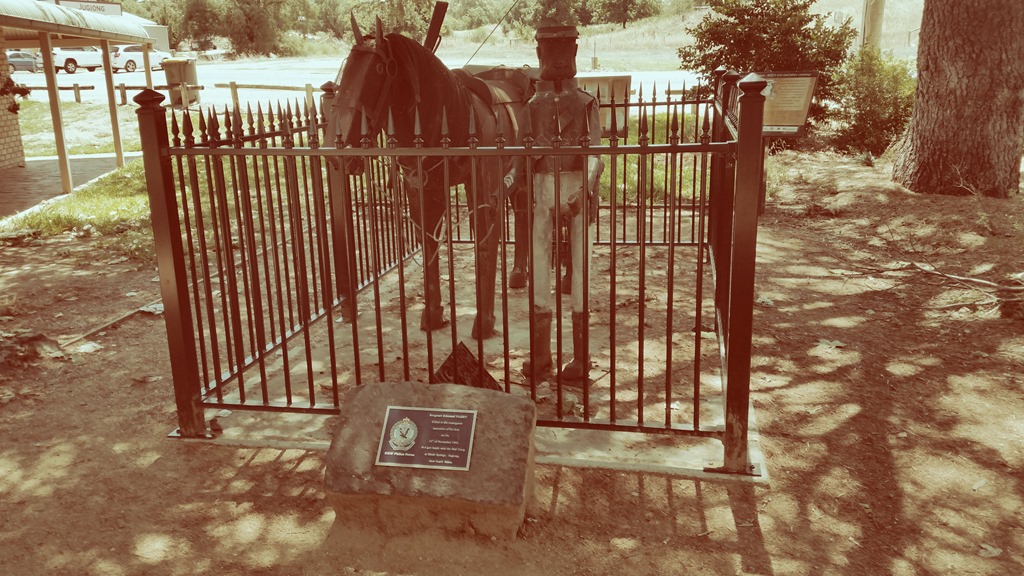
Well happenstance is a wonderful thing. Yesterday on our way back from Canberra we stopped in Jugiong to go to the loo and eat lunch in the park, as we often do, but as it was a hot day I parked under a big pine tree next to a modern bush style sculpture of a nineteenth century trooper and his horse.

And of course, I read the inscription, and it turned out to a monument to Edmund Parry, a police sergeant was who was killed in a fracas with Ben Hall and his gang when they held up the mail coach in Jugiong in 1864.

Apart from showing the lawlessness of the times, it also shows quite how far bushrangers ranged ….

Posted in Uncategorized | Leave a comment

ANU Classics Museum …

2017-02-06-a

despite all the years I worked for ANU, I never once visited the Classics Museum.
Well, today I did –  it’s a nice but small collection of Greek and Roman pottery, some rather nice Roman glass, the inevitable selection of coins, as well as a couple of later Roman grave markers, some statuary and a few papyrus fragments and a nice bit of Coptic textile.
Very much a cabinet of curiosities rather then a full blown museum, but nevertheless, if you are in Canberra somewhere near ANU, it is worth twenty minutes or so for a short visit …

Posted in Uncategorized | Leave a comment

Turgenev and the Red Queen

In 1876, Turgenev wrote a poem Croquet in Windsor about the Bulgarian atrocities in which he imagines Queen Victoria watching a croquet game at Windsor in which the balls were the heads of massacred bulgarian christians.

A very powerful image, and one reminiscent of Alice in Wonderland.

Alice in Wonderland was first published in 1865 in English, a language Turgenev was less familiar with, despite his several visits to England, and not published in Russian until 1879 as Sonya in a kingdom of wonder.

However Turgenev was familar with French and published his own translation in French of Croquet in Windsor in Le Figaro, so is it possible that he had read and enjoyed Alice in Wonderland, which first appeared in French in 1869?

Posted in Uncategorized | Leave a comment

Open source genealogy–lessons learned

Well, my little fun exercise chasing John Moncur through Napoleonic era naval lists and so on has shown me that it’s perfectly possible to use open source materials, with two important caveats – firstly, the person investigated has to be a ‘person of quality’ (Jane Eyre would know what is meant here), ie someone who appears in the army or navy lists, or local almanacs which include lists of electors from the days when only property owners could vote.

Women are invisible, or they are at least until 1811 with the first census, and the same goes for ordinary people including tradesmen and small farmers who did not meet the property qualification.

The second major requirement is that the documents need to have been digitised and OCR’d to render them searchable. Thanks to the Google Books project, a lot of them are, and the OCR conversion of the scans is of sufficiently high quality to ensure that the text is more or less searchable.

As well as these two requirements. having a slightly unusual name that is sufficiently unique to make searching reasonably straightforward definitely speeds the process …

Posted in Historical | 1 Comment

Open source genealogy

Out of curiosity I thought I’d see what I could find out about John Moncur, who was a Royal Navy Master and Commander at the end of the eighteenth century, and who just possibly might be an ancestor of mine, using only openly available databases and freely available digitised documents – and this is what I came up with:

  • John Moncur is listed as a Royal Navy commander gazetted in 1796 in the 1812 Gentlemen’s and Citizen’s Almanack Dublin. (digitised via Google Books)
  • He is also listed as a serving  master and commander of a Royal Navy ship in the New Jamaica Almanack of 1801. (digitised via Google Books)
  • The 1802 navy list gives his commission date at 22 July 1796 (Hathi Trust public search)
  • Previously listed in the Universal Directory of 1790 as a Lieutenant, first commissioned in 1779 suggesting he was approximately 36 when commissioned as a lieutenant. (digitised via Google Books)
  • Not listed as taking part in Battle of Trafalgar (UK National Archives Trafalgar Database)
  • Recorded in the Gentleman’s magazine as dying at Greenwich 5 April 1814 at the age of 71, suggesting he was born in 1742 or 1743 (digitised via Google Books)

What I havn’t been able to find (yet) is where he was stationed or what ships he was master of. Some inconclusive googling suggests he wasn’t attached to the West Africa (or anti slave trade) squadron, as his name does not appear on any of the crew lists for these ships between 1808 and 1814.

However, I’ve not been able to identify all ships involved with any certainty or find complete crew lists for the ships I could identify. I’m sure the information is held in the UK national archives or maritime museum, but may not be available online.

On the other hand, what it does show is that with two or three hours fiddling about with google search terms you can come up with quite a reasonable amount of information …

[update]

and with a little more fiddling I find:

  • Listed in Naval Chronicle (1803) as an Agent Afloat attached to HMS Thalia
    • (an Agent Afloat managed the hire and use of merchant ships co-opted as naval transports for men and supplies)
  • Listed as Commander HMS Thalia between November 1801 and May 1803
    • HMS Thalia listed as being sent to the West Indies

which is potentially interesting …

Posted in Historical | 5 Comments