An indecent assault at Lauriston

Screenshot 2024-10-26 135336

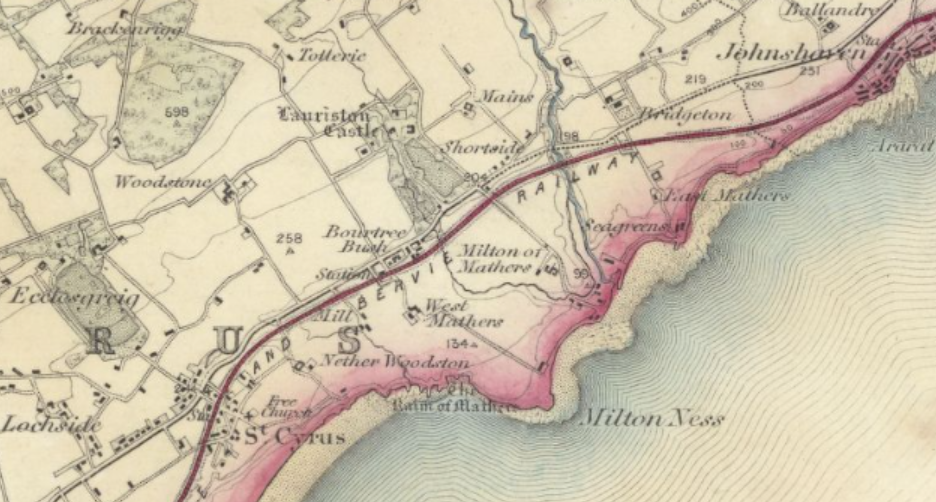
(digitised 1880’s map from The National Library of Scotland)

When I went down an internet rabbit hole about crime and nineteenth century railway carriages, I mentioned that I had come across a report of an incident on the Montrose to Bervie line in 1886.

I was interested in the case because of my family connections to the area, and the use they may have made of the line.

Researching the story was a pain. Britain of course has no equivalent of Trove or PapersPast – you have to pay to search newspaper archives, or more accurately the British Newspaper Archive lets you search for free but you have to pay to download the article.

All I had at the start of the exercise was a name and a rough date, but I managed to find a snippet on the BNA that gave me a firm date for the first newspaper report of the incident.

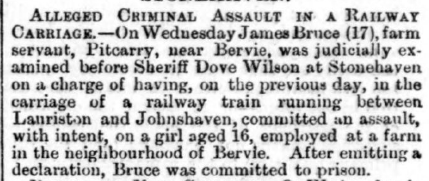
Fortunately the State Library in Melbourne has a subscription to the Gale Newsvault and I was able to find a copy of the report of the incident from the Dundee Courier

Screenshot 2024-10-23 144650

The case was obviously taken seriously by the authorities with the accused being held in jail pending a full trial.

Another Newsvault search and I was able to track down a report of the trial from the Aberdeen Journal.

The accused had opted for a jury trial, which at that time in Scotland meant that the victim had to appear in court and be questioned by the accused’s lawyers. It also meant that the victim’s deposition (formal statement of the crime committed) was read out in open court.

I am purposely not going to give the victim’s name or the name of the farm where she was employed because, as I said, my family come from the area and some families have been in the area for generations.

The deposition is quite graphic with the victim describing how the accused put his hand up her skirt and then tried to wrestle her to the ground. There is also a description of how her clothing was torn and how her knees and body and neck were bruised.

Not nice.

Reading the trial transcript in the paper what struck me was how sensitive the trial judge was. After character witnesses confirmed the victim’s good character he shut down any further attempts to malign the victim.

The accused admitted putting his hand up her skirt but claimed he did nothing else, perhaps hoping that a partial admission of guilt would result in a lighter sentence.

It didn’t. The judge sentenced him to six months hard labour with a warning that if he had been older he would have received a sentence of several years …

Posted in Uncategorized | 1 Comment

Crime and the nineteenth century railway carriage

Train travel revolutionised life for Victorians.

Suddenly it became possible for people on modest incomes to travel more than they could comfortably walk in a day, and in a shorter time, be it for a school teacher to visit friends and family or for a farm worker to travel in search of a better paying job, or even for an office worker to live out of town.

But train travel also brought its own risks, robbery, murder or sexual assault, and partly the reason lies in the design of trains in Victorian times.

If you’ve travelled by train recently, either or a local or intercity service, the chances are that the train carriage you travelled in was open plan.

You might have travelled in what is called a standard corridor coach in Britain and beloved by heritage railways in the UK – in it seats are arranged in groups of six in little compartments with a sliding door that gives access to a narrow corridor giving you access to the lavatories at the end of the coach, or onto other coaches and perhaps a buffet coach if you are lucky.

As well as their British versions I remember travelling in their big bottle green French equivalents as well as one in Slovenia as late as 2015.

But why would you design a train carriage like that – current open plan designs are so much more sensible.

The answer lies in the design of early train carriages, which evolved from the early stage coach design. Early British, and other, trains consisted of a set of wooden compartments with no access to each other, no toilets or any other modern facilities, and sometimes passengers were locked into their compartments between stations.

This led to a quite understandable fear of being trapped in a compartment with a murderer, a robber or a rapist, with no obvious means of escape.

Victorian newspapers are full of accounts of men being robbed and thrown from a moving train, young boys being assaulted by vicars, and young women being assaulted on trains.

While doing some family history research I came across the story of a young woman suffering an attempted rape on the Montrose to Inverbervie line (unfortunately I havn’t found an open access source for the story), which shows it was a constant risk even on quiet country lines.

This was far from am isolated incident – the newspapers of the time report a depressing number of assaults including the more high profile cases of Catherine Scragg, or that of Valentine Baker’s attack on Kate Dickinson.

By the time of these attacks passengers were no longer routinely locked in their compartments, and there was supposed to be a communication cord to attract the attention of the train conductor – as a deterrent they were completely useless as there was no way a train conductor could render assistance until the train stopped at the next station.

One feature of both the Dickinson and Scragg cases was that they opened the door of the compartment while the train was in motion and stepped out – they were able to do this as most coaches had a running board, as in this picture of a preserved Caledonian railway coach, along the length of the coach as an aid to boarding.

Undoubtedly dangerous, but these women were in fear and desperate to escape. It might even have been possible by hanging on to the door to bang on the window of the next compartment to attract attention and gain some help.

So when you read about women in the nineteenth century routinely using hatpins that could double as a stiletto, or a distinctly vicious looking fruit knife, it wasn’t a joke, there was a very serious reason…

Posted in Uncategorized | 2 Comments

Not researching Florence Nightingale and PTSD…

A lot of people tend to assume I have some sort of a degree in computing, life sciences, archaeology or archival studies, history even, and while it’s true to say I’ve spent time working in jobs associated with these fields, my actual degree is in psychology.

Might seem strange, but that’s how it is, and while my psychology years are long behind me I’ve retained an interest in the treatment of the brain damaged and mentally ill in the nineteenth century.

And the nineteenth century is an interesting time, because it saw the first large scale attempts to treat the mentally ill and those with brain injuries, even if, in the case of larger public institutions it was usually a case of “lock’em up and shut’em up”.

Of course it wasn’t all sweetness and light – in England, and other British Empire territories, there was the abuse of the Lunacy Acts to lock up inconvenient and difficult women – even Dickens considered having his wife Catherine locked up in an asylum so that he could have a free and open relationship with his mistress.

At the same time there were institutions such as Sunnyside Hospital in Scotland where there appears to have been a genuine desire to treat the patients rather than simply seclude them from society.

Five or six years before the Crimean war, in the US there was the notable case of Phineas Gage, the railroad worker who survived horrific brain injuries and recovered to the extent he was able to support himself despite some personality changes following the injury.

Today, we would use his case as an example of neural plasticity, but at the time the emphasis was more on the changes in behaviour following his injury.

A few years ago, while researching something else, I came across a report from 1856 in the Scotsman – then the newspaper of the Edinburgh establishment and Scottish gentry – which seemed to suggest that not only were there officers being treated in the Royal Edinburgh Asylum for brain injuries sustained during the Crimean war, but that there might even be an early case of what we might characterise as PTSD.

There is also some evidence from Florence Nighingale’s correspondence that she recognised that soldiers in the Crimea suffered from not just physical trauma, but mental distress as well and that affected their recovery.

Now there has been relatively little work on the occurrence of PTSD like symptoms, or the consequences of brain trauma in nineteenth century conflicts – army medical doctors were perhaps not the most caring, and army medical records are not necessarily complete or accurate – in the case of the lower ranks, there’s a suggestion that some army doctors were creative with their diagnosis to ensure that men discharged on medical grounds – which meant some illness or injury, rather than “malingering”, were discharged in a way that guaranteed them an army pension, however small.

In the case of officers, I’m not sure, but certainly the evidence of the report in the Scotsman suggests that some at least were treated in a mental hospital after their return.

This is something that I always meant to follow up on and investigate further, but never did, until a post on Mastodon alerted me to the Florence Nightingale digitisation project.

The idea behind the project was quite simple.

Over her lifetime, Florence Nightingale wrote thousands of letters, certainly upwards of 3000, and because these letters were from Florence Nightingale, people kept them, and then later generations kept and collected them, meaning that a lot of her letters eventually ended up in libraries and archives.

The idea behind the project was to digitise them and reunite them online making the whole of her correspondence available for research.

The project appears to have started with high hopes and to have excited quite a few institutions as in these posts from Leeds University and Derbyshire records office.

There’s only one problem – the links to the digital archive site are dead. The site certainly existed – the wayback machine shows it was certainly up and running at the end of 2019, but it drops out of the record in early 2022.

Which is a bit annoying.

It looks as if the site simply went away. A quick hunt and click seems to show that most of digitised content is still online via the various host institutions, but what is lost is the ability to search across the corpus of her correspondence.

There seems to be an initiative on the part of the Howard Gottleib Archival Research Centre in Boston to bring the archive back together, but so far, nothing.

So, why do I care?

Well, having started on this dilettante project to investigate mental trauma among the survivors of the Crimean war, I thought a good way would be to look at who she wrote to about mental trauma, and possibly brain injury during the Crimean War period and immediately thereafter, and then follow up on her correspondents – even such information which can be gleaned from family history sites that Dr Someone was working at a mental hospital can be useful.

Unfortunately, at the moment that’s clearly not to be – I’ll have to come up with another line of attack …

Posted in Uncategorized | Leave a comment

A trip to see the dead Egyptians

IMG20240925120611

Actually there were no dead Egyptians, coffins yes, but no dead Egyptians.

oplus_32

Open coffin showing interior design

The National Gallery of Victoria had partnered with the British Museum to bring a collection of ancient Egyptian monumental sculpture and some other artefacts to its winter exhibition in Melbourne, and we decided on a day trip to the city to see the exhibition.

So, up before the sun at 0515 for showers, tea and toast, not to mention some cat feeding, before driving down to Wangaratta to catch the morning train to Melbourne.

It was school holidays meaning that the train was more than usually busy. and as always V/Line was incapable of producing any kind of hot drink, be it coffee tea or something else, but at least this time they had an operating buffet on the train.

Somewhere south of Seymour the train stopped in a passing loop where the single standard gauge track parallels the double tracked broad gauge line to Shepparton to let the northbound and late XPT through, something that made us around ten minutes late into Southern Cross.

No matter, we still had plenty of time and hopped on a local Metro train to Flinders Street from where we walked up to Cafe Andiamo in de Graves Street for brunch before hopping on a tram down to the gallery.

It was a wet day, and that coupled with it being school holidays meant that the exhibition was crowded with bored teenagers sent out for a cultural experience instagramming each other and taking selfies, but we managed to see most of what we wanted without too much difficulty.

IMG20240925121934

All in all I was slightly disappointed in the exhiibition, I’d hoped for more artefacts depicting everyday life – after all even the Pharoah of Egypt wore woolly socks with his thongs on a chilly winter night – but the curators had decided to concentrate on the monumental, which I always find sightly dehumanising.

Equally, there was no real historical narrative to the exhibition so artefacts from the Ptolemaic (Greek) period and a rather fine drawing of Tiberius as Pharoah were displayed without any real explanation.

However, as always, Melbourne is a long way from Egypt, or indeed any of the great European collections of Egyptian artefacts and it was good to be able to see a range of pieces.

IMG20240925130308

Afterwards we nipped upstairs to have a look at the Gandara art from the quasi Greek kingdoms in Afghanistan with very Greek looking representations of the Bhudda, and then down to the NGV annexe on Federation Square, before a little shopping and catching the train home.

The train home leaves at 1802, making dinner a problem – V/Line’s catering is notoriously erratic, and we get back too late to sensibly eat dinner. Sometimes we have something at a cafe before leaving, other times we’ve bought sandwiches from the Woolworths Metro in the station and eaten on the train.

This time we ate before we left at the newly opened Mercato Centrale Italian themed food court just down from the station which offered the chance for a slice of pizza, a glass of wine and an expresso lungo before heading home, which made for a civilised end to what had been a long trip

Posted in Uncategorized | 1 Comment

Crinolines and toilets

It’s usually said that crinolines went out of fashion in the late 1860s.

Now we all know fashions change, but it’s an interesting observation that crinolines begin to go out of fashion about the same time as indoor plumbing, and particularly the standard ‘sit down’ flush toilet start to become more common in middle class households.

I’m told it’s difficult to sit down in a crinoline, particularly if it’s one of the more rigid wire reinforced designs, which must have made using a pedestal toilet a trial.

Prior to then the use of chamber pots was the norm, and the business of going to the loo was probably easier to manage even if our twenty first century sensibilities are slightly offended by the idea of peeing in a pot, and then disposing of the pee.

It’s also worth noting that you can also see this reflected in the history of women’s underwear – until the 1840’s women did not usually wear underpants, which would probably have made the business of having a pee while wearing a long and voluminous skirt easier.

From the mid century onward, underpants became more common, but even then they were usually an open crotch design to make the business of going to the loo that bit easier.

As always adoption was probably uneven, and some did, some didn’t, and some did some of the time, and of course the adoption of new technologies such as the safety bicycle would have had a role of this as no one who came off their bike would wish to risk having their private parts exposed.

However adoption was uneven, David Kerr Cameron in his social histories of NE Scotland mentions that farm girls did not routinely wear knickers until the turn of the twentieth century, but then that could be for practical reasons – it might simply be that it simplified the business of having a al fresco pee while working in the fields …


Posted in Uncategorized | Leave a comment

A Trip to FNQ

Winter has been cold and seemingly never ending, so a few weeks ago we decided to go on a short break to FNQ.

As we’d been to Europe last year, and for some other reasons, we had a pile of Qantas points – almost enough for a return flight from Melbourne to Cairns, and if we paid a little bit more, we could get business class on the way back.

So we did that.

The only disadvantage of buying our tickets on points was that we had been booked via Sydney, rather than a direct flight to Cairns.

This was less of a problem that it might have been as I still had a few days to run on my Qantas Club membership – I’d bought a one year membership for our Europe trip last year as the departure times for our flights via Singapore to London with stopovers both ways were massively inconvenient – having the Club membership meant we could get a shower in Singapore and London, something to eat, and a gin and tonic.

(In Singapore, J who likes a weak G and T, complained about the amount of gin in the glass, only to be met by a cheery ‘oh, most people ask for a bit more’).

Qantas club domestic is not quite so good as international, more crowded, and the food not so nice, but, we weren’t complaining as it saved us having to try and find something not too overpriced while waiting for our connecting flight.

Anyway, Qantas got both us and our bags to Cairns successfully, and we picked up our rental car.

As always, what you get bears no resemblance to what you actually requested, and we ended up with a Haval Jolion – slightly larger than we wanted but surprisingly pleasant to drive, even if it had a few weirdnesses like a delay on the boot lock – apparently the idea was you lock the car, grab your bag out of the boot, walk away and the boot then locks itself.

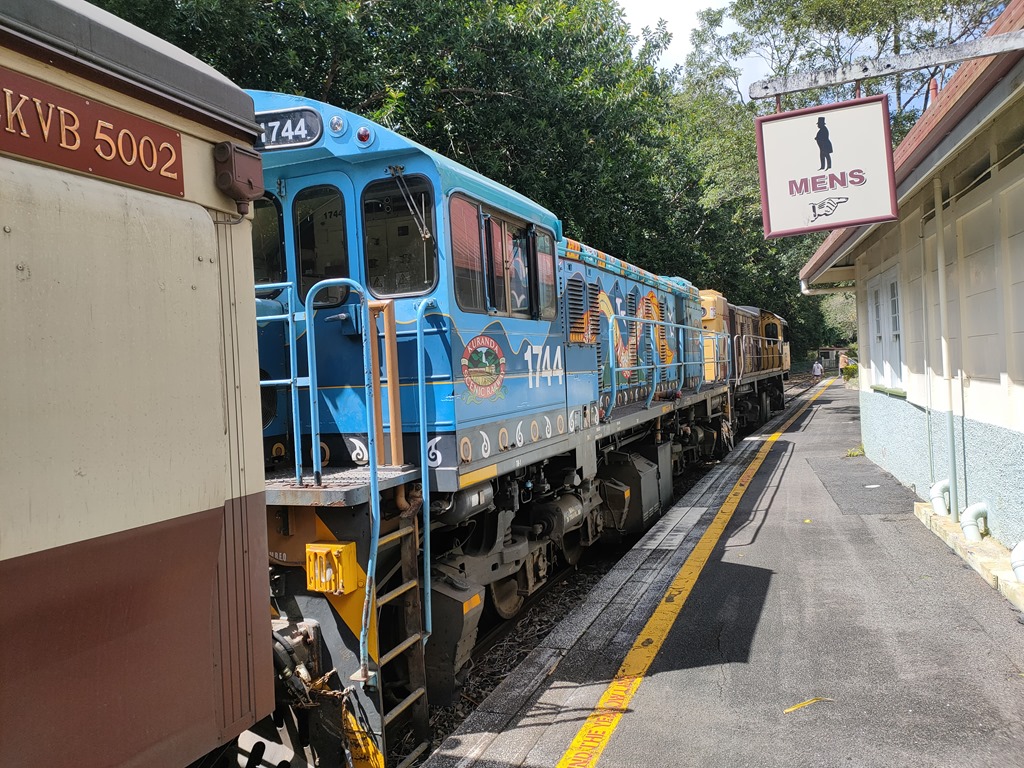
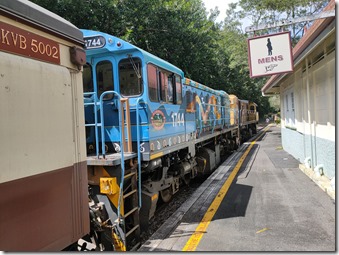
In Cairns it was the annual Cairns festival, and we did tourist things, including a trip on the Kuranda Scenic Railway.
IMG20240824114126

Operated by Queensland Rail, booking was antediluvian. No online booking system, you filled in a web form that was mailed to them, they mailed you back with options, you replied as to which suited, and then they emailed a booking reference docket, which you then printed out and showed to the ticket clerk in Cairns station, who then issued you a ticket and charged it to your card.

Even Sri Lankan railways were a little more sophisticated than that when we visited eleven years ago.

Never mind, the trip was worth it, even if Kuranda is full of tourist tat. We did luck out finding a Sri Lankan cafe on Condoo street that didn’t look anything special but did a mean line in vegetable curries.

While we were in Cairns, we ate at Yaya’s Greek restaurant. In fact we ate there twice it was so good.

The first time we had a table on the balcony and could look out on the Cairns festival fireworks. Truly wonderful Greek food, decent retsina, what more could you ask?

Being the sort of people we are we also had a look at Cairns Art Gallery. Here the gods were against us as they were between major touring exhibitions, and while what was on show was good we’d have liked to see the Margaret Olley exhibition, but we were a week too early.

We also missed the museum as we didn’t realise it was closed on Sundays.

After Cairns we drove up to Yungaburra, an old slightly hippyish town on the tableland, which was much as when we last visited back in 2014 when we brought the car up on the Sunlander.

(On our way out of Cairns we had to stop at a level crossing for the Spirit of Queensland, the tilt train that replaced the Sunlander, and we had this instant plan that at some point we would fly to Cairns, get the train back to Brisbane, and fly home after a few days in Brisbane – obviously we need to work out the details, it’s not much more than a thought bubble at the moment.

However, one thing we do know is that a stop over in Bundaberg to go visit the old pharmacy museum in Childers is fraught with difficulty with trans arriving at silly times – doing the reverse journey from Brisbane to Cairns is slightly easier, even if it means joining the Spirit of Queensland well into the evening having caught a Rockhampton tilt train service the day before.)

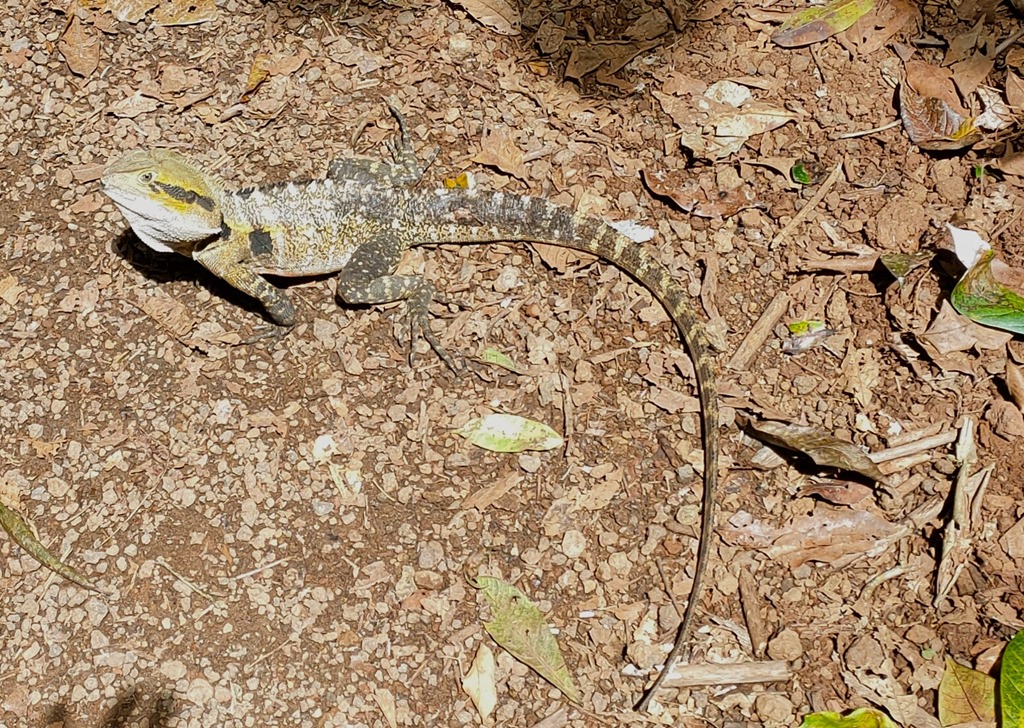
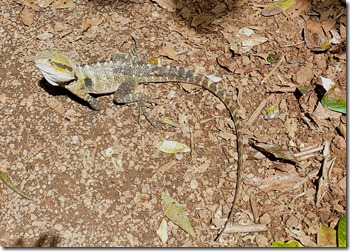
We had a bit of a walk at Lake Eachem in the Crater Lakes national park. It was supposed to be a circular walk but we misread a sign, and ended up coming back on ourselves, but we had a good time, encountering a colourful lizard and as well as fish in the shallows, some small turtles.
IMG20240826123423

After our walk, and after stopping to pick up supplies in Mareeba, we drove back to just outside of Kuranda where we stayed in an AirBnB in the rainforest.

The next day we drove on to Port Douglas via Mount Molloy and a quick visit to Mossman to suss out Mossman gorge – essentially we only really wanted to do the walk rather than the full cultural tour thing, and we found that the more serious walk was closed due to storm damage.

After that we drove back along the coast to Port Douglas where we checked into our holiday apartment – we were staying in the same block close to the beach as we did ten years ago and everything was much the same, even though the management had changed and there had been some updates to the facilities.

Port Douglas was originally a steamship port bringing workers to the mines following the discovery of gold in the hinterland in the 1870s, but after the Kuranda railway from Cairns was completed at the turn of the twentieth century Port Douglas slid into gentle obscurity as a fishing port and holiday destination before a wave of hotel and resort building in the 1990s – now it is most definitely a holiday destination, and small enough to be walkable – there’s only really one main street and the road in along the peninsula even now.

We originally had planned on a swim that afternoon, but the surf was up and it was blowing half a gale, so we cried off. The next day, we did get in the water, the wind had dropped a bit but the sea was still pretty rough and we didn’t do much more than jump about in the breakers.

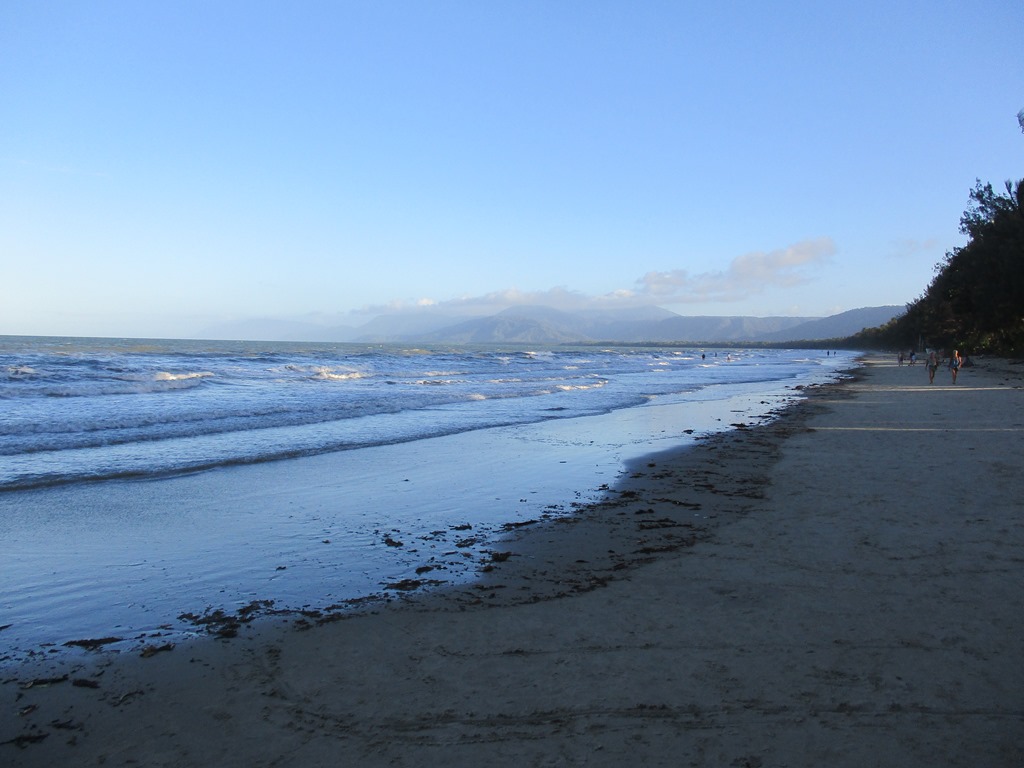
IMG_0897

Dinner at an upmarket restaurant, Melleuca, that evening was a holiday treat to ourselves and very nice it was too.

While I was in the restaurant I got a text, which of course I ignored, J and I were laughing and having fun and the chances were it was just a scam message about unpaid motorway tolls.

Well, when we got back to our aparthotel unit I checked the phone, I had indeed had a text, claiming to be from Telstra and asking me to click on a link to help resolve a problem with my home internet. Alarm bells rang, so I logged into the Telstra app and indeed there was a genuine message about a problem with our home connection and we were running on a 4G backup connection.

Now our solar power system has a management dashboard that shows power usage and generation in real time, and if I think the power’s been out at home I log into the dashboard – if I can see real time data when the sun is up it means that we have electricity and we won’t be greeted by a fetid mess in the fridge or freezer when we get home.

This worked well as a test, until our present internet modem which includes cellular backup – the test now means we have power, but possibly our fibre optic connection is down. I can restart the modem remotely but not our fibre optic box as the Telstra app doesn’t give you an option.

So, via the app I contacted Telstra to explain I was away from home and could not do anything (like pull the cord out of the fibre optic box, count to 10 and plug it back in).

The support person, who from his name I suspect was in a call centre in Dubai, initially seemed to have difficulty with the idea that I was in FNQ and not at home and hence not able to nip back and restart the fibre optic box, but he eventually realised that I couldn’t do anything to help resolve the problem, so he upped our 4G backup data quota to allow us to us the data when we finally got home – I’m guessing he was possibly confused by the solar power system phoning home and it looked as if there was some low level usage going on.

No matter, and if the fibre optic attachment point has died they’ll have to fix it, which will probably mean a person in a van – or as happened last time we had infrastructure problems three vans (one NBN, one Telstra and a cable contractor.

Anyway, it will probably be fun sorting this out, even if it’s an odd definition of fun.

The next day we did very little and what we did do was probably not interesting to any one but ourselves.

Great travel writers never mention this but the trouble with holidays is that every so often, you have to have a day when you do your washing, tidy up and organise things, do some shopping and the rest.

To the best of my remembrance neither Bruce Chatwin, Eric Newby or Robert Byron discuss having to get their undies washed, or recount going to the supermarket to buy some of life’s necessities, but sometimes you need a day just doing the prosaic. (Actually, Peter Fleming, whose 1930s travel writing is under estimated in my opinion, does recount days like this in News from Tartary when he describes his journey, mostly on horseback, with Ella Maillart across the far west of China and Tibet, ending up in what was then British India.)

Well the day after our night out was our prosaic day – mind you not that prosaic as we started with a swim in the ocean and finished with a meal in a fish restaurant, and we hopefully ended up with enough in the way of clean clothes to last the rest of the trip, otherwise it was a bludge day waiting for washing machines and driers and the like.

We’d booked the fish restaurant purely because it was on the next block up the street from our hotel. We thought it would be good but not wonderful.

Well it was actually pretty bloody good, and that revealed a problem with Port Douglas.

There’s a lot of money around so restaurants compete with each other to provide good food and excellent service, which they do, rather than on price. I don’t mind a splurge or two, in fact I rather enjoy it, but it will do some damage to the credit card along the way, but then life is for living.

And to be honest the next day we just chilled, swam in the sea, and relaxed.

The sea was its calmest so far, blue and very little chop giving us time for a decent splash about in the surf – the best swim yet of the holiday.

As it was a Friday afternoon the beach was more crowded than it had been, and had its usual complement of pale breasted topless European backpackers sunning themselves, who were mostly ignored by the locals who were more intent on getting a swim in.

That evening we ate at a really good Thai place serving authentic Thai food with authentic amounts of chili. They took no prisoners but the food was good and went well with a couple of cold Singhas, given the night had turned sticky and humid.

The next morning we were due to check out, but we got up absurdly early and went for a final swim in the ocean – sea was pretty flat, inviting and warm. Complete cliche with the palm trees behind us but we had a good swim.

A little surprised at how few people were out for an early morning dip, but that was their business not ours.

Our next destination was an off grid cottage in the Daintree rainforest, and that meant heading to the big Woolies supermarket in Mossman for some supplies as we would be self catering for most of our time in the rainforest, that and some of the necessities of life, a couple of bottles of wine and a six pack of beer.

We were a little early for check in to our unit so we drove to Daintree village for lunch – a couple of ham and cheese wraps, and then back to the cable ferry across the Daintree, where we promptly got stuck in a massive tailback due to roadworks then on to our rental cottage which turned out to be up a fairly steep track.

Amazed at just how well the Jolion handled the track – my respect for the car is growing every day – despite it being a fairly standard SUV without a great deal of power.

Then the joy of unpacking. Discovered that the unit’s washing machine didn’t work as the cold water line was disconnected for some reason, but we were able to hand wash items and spin them so at least we would not be taking back a case or two of smelly sweaty washing.

The whole setup is very private, which is just as well as the toilet and shower are in a separate leanto necessitating some naked prancing to the shower and toilet in the morning.

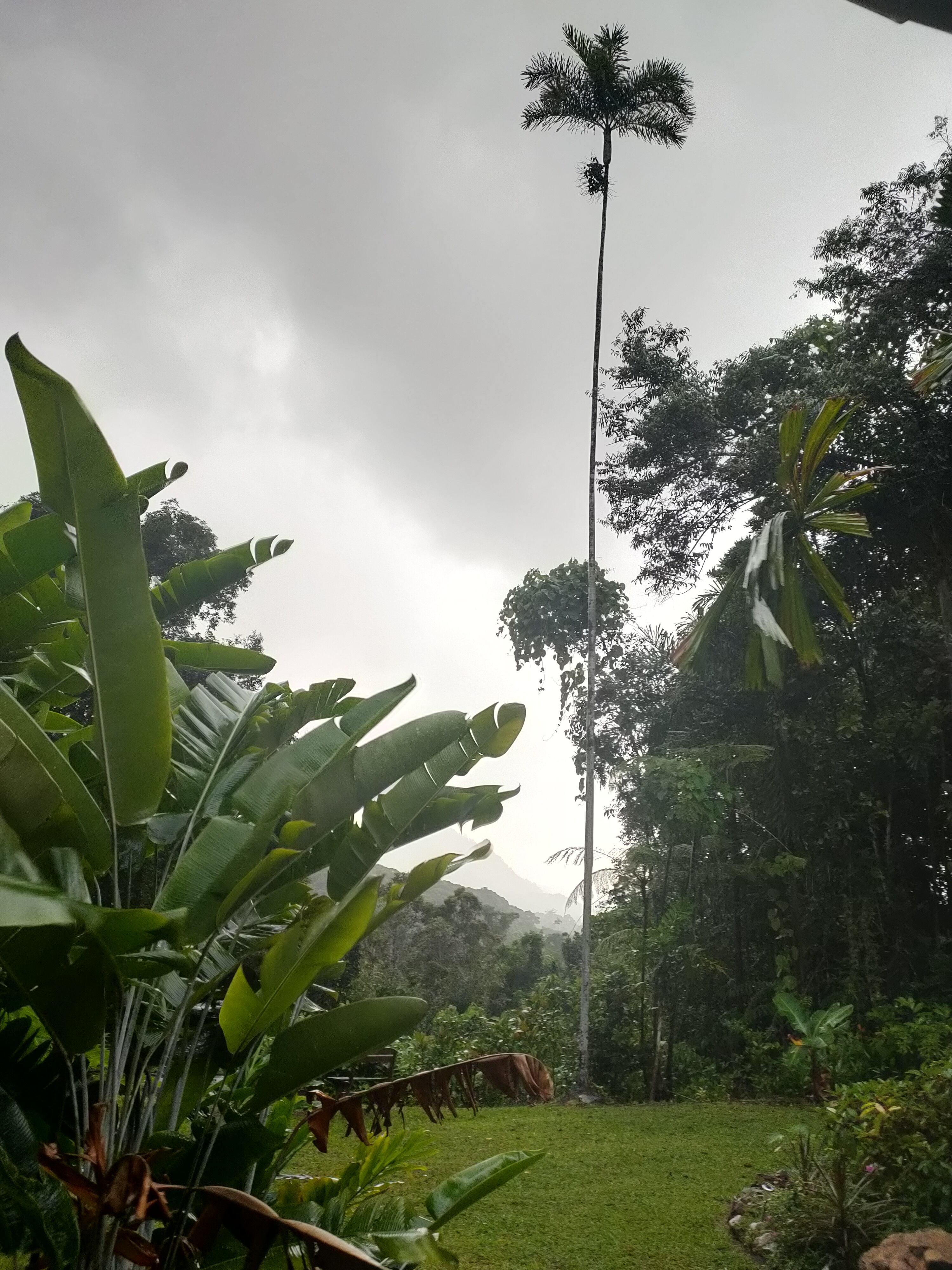
The whole house is like some mad hobbit inspired fantasy – basically an open A frame with a large open area on the ground floor and a sleeping area above with spectacular views out over the ocean, but built out of local boulders and with the A frame structure plonked on top.
oplus_32

Rainforest

We were kept awake at night by something calling loudly in the woods behind the unit. There was said to be a cassowary that hangs about as people have been stupidly feeding it, but that wasn’t in making the racket, cassowarys (a) don’t make that sort of noise (b) are not nocturnal.

We searched for various bird calls, and the only thing we found remotely like it was an American Barred Owl, which it clearly wasn’t – our best guess is that a native owl has a similar call and it was after baby possums.

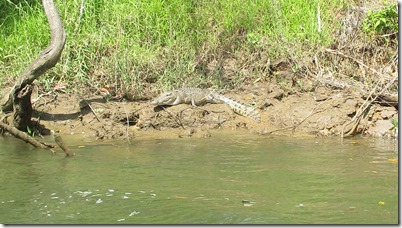
Up early the next morning to go and see crocodiles – complete with a wonderful orange tropical sunrise.

We left very early as we had booked an early morning tour and had to negotiate some fairly substantial roadworks on the road back to the ferry, and of course the ferry across the Daintree itself.

We arrived in good time and had a pretty good trip with a knowledgeable guide.

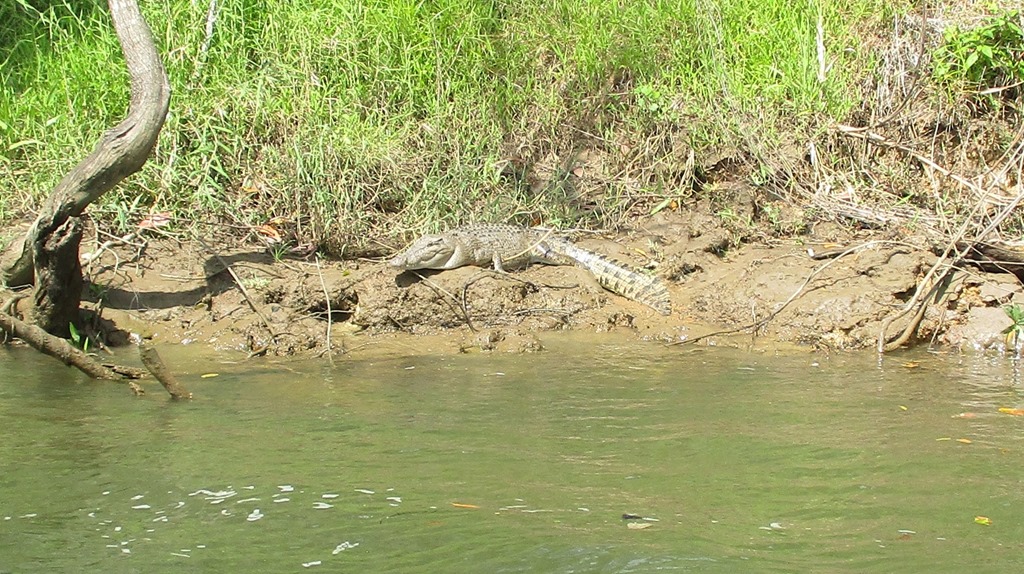
Early morning is the time to go as a lot of the crocs are lying out on the bank basking and letting their bodies warm up in the comparative morning cool.
IMG_0914

Then back across the ferry for a lazy afternoon, dinner, and an early night, this time undisturbed by screaming wildlife, and to wake to another spectacular orange dawn.

And today we simply enjoyed the day, bludging out, reading, painting and talking.

The next day, our last, we woke to another wonderful tropical dawn and a minor crisis.

I made one cup of tea, but when I went to make a second, the power was out.

In an ideal world, the diesel powered back up generator would have started, but for some reason it didn’t.

This was a problem, as not only were we off grid we were out of cellphone range, and without a functioning NBN connection we couldn’t call anyone.

We managed to get one bar at the bottom of the garden on J’s old iPhone, so we messaged the owner.

While we were waiting for a reply, I scraped together breakfast – fortunately there was a stove top coffee maker provided, and the stove ran on bottled gas.

After what seemed a long time, but was only thrirty minutes we got a message back from the owner (who lives in Brisbane) that she had called her dad, who should be round shortly.

Dad, when he arrived, seemed as nonplussed as we were, tried all the obvious things, and decided he needed to phone a friend, which of course he couldn’t, nor could the people who installed the solar system run a remote diagnostic check because there was no internet – in the same way that I can use our solar power system to check the power is still on at home.

Anyway, armed with some photos of the diagnostic screens he went off to talk to someone about it, promising to give us an update, and advising us to go off and enjoy our day.

So we did.

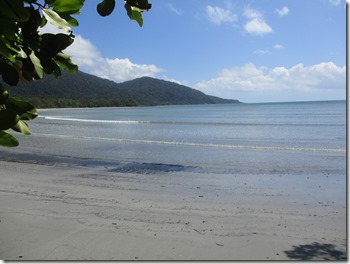
We drove to Cape Tribulation, the end of the bitumen road and walked on the beach, stopped off on the way back at a place advertising organic coffee and pies for lunch.
IMG_0922

The pies were not local, they actually came from an organic bakery in Byron bay, but still pretty good. In the middle of all of this we had a text from Dad to say he’d got the power back on, the generator was running and something seemed to have flattened the batteries over night.

Ignoring the question as to why the batteries had flattened – there had been plenty of sun in the days before to top up the batteries, and indeed why the generator had not autostarted as it should, this at least meant we could have showers at least.

We were not totally convinced about the power staying on, so we booked for a restaurant more or less at the bottom of the hill, rather than risk eating in and the power going out.

This wasn’t a great loss as we’d already eaten most of the fresh fruit and veg we’d bought in Mossman, so it would have been tinned tuna and a pasta salad with tinned asparagus anyway …

However, the whole power outage experience was quite interesting, bringing the realisation that there is this network of small hi-tech companies installing and monitoring off grid power systems all over the remoter parts of FNQ – Dad, when he came back to check on the state of the batteries mentioned that the company that looked after and maintained the system was in Townsville, some 400km away.

Strange how the arrival of the internet, and particularly the NBN has enabled this high tech side of off grid living.

And then it was over (well almost) – after our meal out at the local motel/pub we dashed to Cow Bay to have a look at it in the last of the light, and the back to our unit.

That night it rained, as in seriously tropically rained, but cleared a little after sunrise.

We were not that worried as our holiday was effectively over, and we drove back via Port Douglas for lunch and then back to Cairns for our last night in FNQ.

As the season was effectively over we could afford to splurge on a room at the Pullman, which while most of it is a concrete hotel tower still retains a grand lobby reminiscent of the grand colonial hotels still found in South East Asia. I’m guessing that the original possibly (I’m guessing again) 1930s hotel took after the ‘grand hotel of the orient model’, and at some point they replaced the back of the hotel with a modern annex.

That evening we ate at a restaurant on the waterfront. While we were eating, we were treated to another tropical downpour, but this one didn’t last and we were able to walk back before the rain started again.

Then it really was the last day.

Just to be different, we got up at 0630 for a swim in the hotel pool – cut short by another tropical squall, and then it was simply the mechanics of travel – take car back to rental company, shuttle bus to the airport, flight to Sydney, connecting flight to Melbourne, shuttle bus to a hotel as it was too late to sensibly drive back that evening.

Actually, the floor manager at the Mantra remembered us when we checked in, and gave us a voucher for a couple of drinks at the bar, so that was a plus after a long journey, and then after checking out yet another shuttle bus to the off site parking garage we use to collect our car before driving home.

Oh, and by the way, the internet was working perfectly when we got home …

Posted in Uncategorized | Leave a comment

Lipstick and revolution

Over on one of my other blogs I mentioned that I’ve been trying to identify the provenance of some photographs from the Spanish civil war including this one of a group of Milicianas, young women republican soldiers

Women_Soldiers_-_Google_Art_Project

The young woman on the right is clearly wearing lipstick, which is not the first thing one thinks of in connection with the Spanish civil war, but it’s not that surprising.

While before the first world war, middle class young women did not use cosmetics, or if they did, very discreetly, as the more obvious use of cosmetics was associated with cabaret dancers and actresses.

Louise Bryant, who later married the revolutionary John Reed, caused a stir in rural Oregon, when as a school teacher, she wore powder and perfume

800px-Anna_Louise_Bryant,_smoking

and as can be seen in this later picture, lipstick.

So why lipstick?

A lot of it is to do with the first world war. Sociologically, the reasons are quite complex, but young middle class women began to replace men in some jobs and became more liberated with their own incomes as a consequence, and of course in a number of countries the absolutely horrific death toll of the war led to a shortage of eligible young men, because, to quote Olivia Coleman’s character in Mothering Sunday, ‘they’re all fucking dead’.

This of course meant that young women inevitably began to compete with each other to secure a ‘nice young man’.

Some didn’t of course – if you look back into your family history you’ll almost certainly find some female relatives who you would have expected to be married in the 1920s who weren’t.

And if one looks at photographs of the time you notice the increased use of lipstick.

It could be put down to the influence of the growth of cinema, but it’s probably more the case that cinema, and female movie stars, reflect reality.

Now there’s been some research on the increased use of powder compacts by young women in the 1920’s and 30s, and certainly when I was documenting the contents of Dow’s Pharmacy for the National Trust, I came across quite a few powder compact refills that I would date to the 1930s on stylistic grounds

IMG_0736

There were also quite a few lipsticks, but almost all were from after World War Two

DSCN5013

While some were locally made, quite a few were imported, and that may be why I found few if any from the inter war period – shortages meant that they were all used, and few if any survived. It’s notable that after World War Two, Australian industry started producing replacement cosemetic products to replace imported ones.

I must confess I havn’t found any scholarly research on the use of lipstick in the 1920s and 30s, but both newspapers and photographs of the time show that lipstick was clearly being used by young women in England, France and America.

And the young woman soldier in the original picture?

One tends to think of pre Republican early twentieth century Spain as backward and repressed, but the Spanish cosmetics company Puig started making lipstick in 1922, and hand wavingly, I would guess that in the cities young women would have access to the fashion magazines of the time and see movie stars wearing make up and wish to copy the look, so it’s more that possible that by the 1930s young women in the cities routinely wore makeup and lipstick …

Posted in Uncategorized | Leave a comment

The Last Cavalry

I have been down an internet rabbit hole with this one.

I was reading an Italian novel (in translation) and it mentioned the last Italian cavalry charge as taking place in 1942 at Poloj, in what is now Croatia, where an Italian cavalry unit was encircled by Yugoslav partisans and mounted a charge to escape.

What surprised me is that they were still using cavalry that late in the war – soldiers mounted on horseback to cover the rough trackless terrain yes, but full grown cavalry?

But then both the Italian and Greek armies made use of mounted soldiers during the war in Albania and northern Greece, but then if you had trained cavalry, it probably made sense to use them to patrol trackless terrain.

There’s a good article in Wikipedia on cavalry, which includes an extract from a book by Erich Kern, in which he describes an attack by mounted Hungarian hussars with parade ground horses on a Soviet position, something that caused the Soviet defenders to break and run when charged by ton after ton of top quality Hungarian horseflesh.

If you’ve ever heard the ground thud under racehorses, you might just be able to get a glimpse of just what a terrifying thing a cavalry charge was with ton after ton of seemingly unstoppable horse coming towards you.

But Poloj?

It was if anything a Pyrrhic victory – the break out succeeded but at tremendous cost with many of the men and horses going down to the partisans’ machine guns in much the same way that at Balaklava the pride of the British cavalry was destroyed by Russian cannon in the Charge of the Light Brigade…

Posted in Uncategorized | Leave a comment

Google lens and the NKVD

Normally, I concentrate on either Roman antiquity, or nineteenth century history, but I’ve been down a World War 2 rabbit hole with this one.

When we were in Italy last year, we stayed for part of the time in a tiny medieval borgo on the edge of the Appenines overlooking the vineyards of rural Tuscany.

The area was crisscrossed with walking tracks making it relatively easy to walk up the hill away from the agricultural area to the heavily wooded hilltops – a different, more primeval Tuscany, littered with Etruscan tombs and abandoned farmsteads, as well as the occasional remains of bunkers left over from the Second World War.

If you have read Eric Newby’s Love and War in the Appennines, and wondered how easy it would be for escapee to hide out on isolated farms, a muddy morning looking for Etruscan tombs is enough to convince you that it would not be as difficult as you might think to hide out in the forest especially with some help from the partisans, as Newby had.

During the Second World War, after Italy’s surrender to the Allies, the Germans, supported by Italian forces still loyal to Mussolini, fought a vicious guerilla war across these hills against a mixture of Allied forces, partisans, and those parts of the Italian army loyal to the new pro allied government.

For the Italians, it was in effect a civil war between pro and anti Fascist forces, as well as being part of a much larger conflict. And the ruined bunkers ? These were usually built by the Germans as strong points overlooking strategic roads and passes in the hope of hindering the Allied advance.

Both sides carried out extrajudicial executions of suspected traitors and collaborators, as well as acts of mass murder against innocent peasants, and the killing of prisoners captured during firefights in the mountains.

As I have said it was a vicious, brutal war.

Anyway, I was looking for information on the location of Roman and Etruscan sites, and I stumbled across a site documenting left over World War Two bunkers and emplacements, when I came across a confronting image of what purported to be execution a young woman by German soldiers.

The young woman was naked, but there was something about the image that did not seem quite right. She seemed relatively relaxed and showed no signs of physical or sexual violence as might have been expected, and the quality of the image was less grainy than the images of the surrounding soldiers.

So, as an experiment, I grabbed a screenshot of the image and pasted it into Google Lens (I had previously used Lens to track the provenance of an image with some success), expecting that it would come up with some World War 2 photographic archive sites.

It didn’t. It came up with a list of American pornography websites.

Not what I expected, but as a number of these sites routinely scrape the web looking for content, perhaps not unexpected given the subject matter.

Lens searches initially only give you the top ten or so results by default but clicking on the ‘more results’ button I also got links to a number of Russian language sites, one of which had quite a detailed technical analysis of the image (and also of some other equally confronting images).

These days, while I can still read simple Russian, I’m badly out of practice and have to resort to Google Translate for more complex texts, so Google Translate it was

That said, the upshot of the article was that Stalin’s NKVD, who employed some excellent photographic manipulators, appear to have produced a number of manipulated images to illustrate German atrocities on the Eastern front, and that these images made their way into a number of Soviet era histories as if they were the truth.

I’ll add a caveat here, the Russian language site that contained the detailed analyses had an agenda about the systematic use of image manipulation by the Soviet authorities during World War 2 to exaggerate the brutality of the German forces on the Eastern Front.

However, having read the quite careful analyses, I’m convinced that whatever the agenda of the website concerned, the image under discussion has been manipulated for propaganda purposes and that it has been perpetuated as a true record of an extrajudicial killing.

After all, the camera never lies, does it?

Posted in Uncategorized | Leave a comment

Paris–Impressions of Life 1880-1925

After last year’s trip to the Pierre Bonard exhibition at the NGV, this year’s burst of Francophilia was a trip to the Belle Epoque exhibition at Bendigo Art Gallery.

Strictly it wasn’t the Belle Epoque period, which is normally bracketed by the Franco Prussian War and the horrors of the First World War, when, under the Third Republic, Paris was a liberal and cultured haven unlike the repressive and dull atmosphere of other European capitals – rather the exhibition covered the period between 1880 and 1925.

Most of the material was from the Belle Epoque, with a large collection of impressionist paintings from the period, early cinematography, enlivened by a nice range of artefacts including these rather splendid golden snails

IMG20240624112139

which once adorned a snail vendors shop.

The exhibition was nicely set out, and well captioned. In truth the only post world war one material were some dresses by Worth to show how women’s fashions had changed compared to the pre WW1 clothing on show, and some immediate post World War I cinematography produced by students for the Bal des Qua’z’Arts in 1919.

I’ve only really two criticisms of the exhibition one minor, one major. The minor one is that they should have made more of the rise of informal photography after the 1885 arrival of the Box Brownie, and the major, was to fail to acknowledge the impact of the First World War on the city, when the guns at the front could be heard most nights and Paris was occasionally shelled by German long range artillery.

That said, it’s an interesting exhibition, and well worth the trip.

Getting there was little more complex than a trip to the NGV in Melbourne. There’s no direct public transport links to Bendigo from where we live, meaning that while you could take the train, you would need to go via Melbourne meaning a six and a half hour trip, so we drove, given it was only 250 km.

As  usual we stopped roughly halfway at Murchison, which has reliably clean public toilets, even if one time I found myself sharing with a brown snake, a nice riverside area with picnic tables, multi coloured glass fibre cows and a decent bakery for pies and sandwiches – there’s even decent public wifi available courtesy of Greater Shepparton  council if you need to pull out your laptop to send a couple of emails.

This time I was derided, probably rightly, by J for being fascinated by the self service library machine next to the Heritage centre.

While it would be possible to go and return in a day, we opted to stay overnight with dinner at Clogs Pizzeria – it may not be traditionally Italian but it’s a fun informal and welcoming place. In fact we stayed two nights and ate at Clogs both nights as there wasn’t a lot of choice on Sunday or Monday nights in the middle of winter.

Driving home, we originally planned to take in the relatively new Shepparton Art Museum, but realised that we would be driving back on a Tuesday when the museum is closed so basically returned via Murchison and a pretty good chilli beef pie and takeaway coffee with the cows.

Shepparton Art Museum will have to be a day trip once the weather has warmed up a little …

Posted in Uncategorized | Leave a comment