Muybridge and hip-baths

Eadweard Muybridge was undoubtedly a most peculiar man, but his huge collection of photographs of naked people doing quite simple things has proved an invaluable resource for studies of human locomotion.

His images also help give us an idea of how nineteenth century people did some quite ordinary tasks such as washing themselves.

Muybridge doesn’t have (as far as I can find) an image of someone using a hip bath but he does have this photograph of a naked woman helping another wash while using a bath not that different from the classic hip bath

which gives a general idea of how one might use a hip bath. I’ve also found a wood cut of a woman being helped to bathe by her maid

which is not dissimilar from Muybridge’s photograph, and reminding us that having a bath was not a totally private experience – there would have had to be servants to heat the water and sluice one down.

Bathing with a ewer and basin would have been a bit more private, as seen in this animated gif based on a Muybridge set of images of a nude woman washing her face

but even so someone would have had to heat the water in the ewer first showing how dependent the nineteenth century middle classes were on their servants.

(incidentally Muybridge’s models seem to have had fun doing the bath sequence – there’s a photograph of one woman pouring presumably cold water over the other closely followed by a woman jumping from the bath…)

Posted in Uncategorized | Leave a comment

Lenin and … fish and chips

While delving into the Okhrana’s presence in London I came across a few snippets about Lenin, and his time in London.

Lenin did not really like London. Too grey, too polluted and and the continual damp of an English winter gave him a series of colds.

But there was one thing he liked about London – fish and chips – apparently he and his wife would regularly pick up fish and chips from a chip shop on Gray’s Inn Road, when out for a Sunday afternoon walk.

And perhaps that’s not really so strange.

Ivan Beshoff (at the time the usual English transliteration of ов was off, while today we would use ov), was a veteran of the Battleship Potemkin mutiny during the abortive 1905 revolution, knew Lenin in London, and later went on to found a fish and chip restaurant in Dublin.

And who knows, it could have been meeting Lenin in London that gave him the idea …

Posted in Uncategorized | Leave a comment

Amy Faulkner

Amy Faulkner was clearly a troubled young woman.

Only 16, she had had some sort of argument with her parents and was no longer living at home.

In May 1892 she boarded a train in Bradford, and somewhere near Leeds station she threw herself out of the train sustaining non fatal injuries, but nevertheless sufficient to require a night in hospital.

She initially claimed that she had been attacked by a tall dark man and had been thrown out of the train. She later admitted that this was a lie and she had deliberately thrown herself from the train.

In the 1890s, attempting suicide was still a crime and my guess is that Amy’s first instinct was to lie and claim she was attacked.

After all the punishment for attempted suicide could be a fine, or a period in prison. Amy, while she was employed as a dressmaker probably would not have been able to pay a fine, and certainly would have wanted to avoid prison.

It’s a sad case, but what it shows is that the idea that women travelling alone on trains were at the risk of attack, and even though the reporting of incidents was on the whole sensible and restrained, the commonness of such occurrences can only have produced a heightened sense of fear.

The other strange thing about this case is the hast sentence or two – clearly the excuse of trying to avoid an attacker was a common excuse when young women attempted, and failed, suicide, which again reinforces the idea that attacks on women travelling alone were distressingly common.

This is reinforced by the case of Fanny Elizabeth Bull, who despite her nervousness in court was encouraged by the railway company’s solicitors to take her case to a higher court to make an example of her attacker, something not only in her interests, but in the interest of every woman travelling to work (remember this was a time when increasing numbers of women travelled to work) and cycnically, in the interests of the railway company to promote train travel as safe for women commuting alone…

Posted in Uncategorized | Leave a comment

Harriet Daniels

Not all assault cases ended in favour of the victim.

In 1888 a young woman named Harriet Daniels claimed that she had been assaulted by a coal miner, one John Phillips in a first class railway compartment in a train near Ruabon in Wales, close to the border with England

It seems to have been a violent assault leaving Harriet dazed at the very least.

Unfortunately no there are no reports of the proceedings as the press were excluded from the hearing

I’m not sure why the press were excluded, perhaps because of the graphic nature of the victim’s deposition. The case did go forward to the assize court, but it did not end well for Harriet

Why and how, I simply don’t know, and not having access to the court records I can’t take it further.

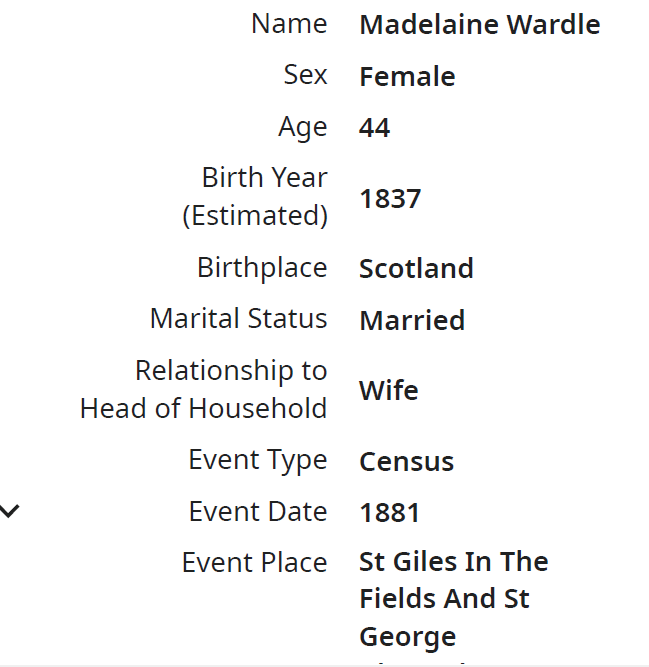
While I was at it I tried using the free search facility at  UK census online to find Harriet, or at least give me some clues as to where to look. This wasn’t a great success. There’s no Harriet Daniels listed in the 1891 census returns for the pre 1974 counties of Denbeighshire, Merionethshire, Montgomeryshire or Flintshire, or the adjacent English counties of Cheshire or Shropshire.

In the 1881 census, there is a Harriet Daniels listed as living in Merioneth

who is listed as being a 21 year old servant. None of the press reports give enough detail to confirm that this is the same Harriet Daniels, and as domestic servants sometimes moved about checking the census records on Ancestry probably wouldn’t help much.

I’m guessing that after her failed case she left the area for somewhere, such as Liverpool, Birmingham or Manchester where no one would know her and she could start anew.

Searching more widely there is a Harriet Daniels of roughly the right age listed in the Staffordshire return for the 1891 census

which I’m guessing is the same Harriet Daniels. Since the name ‘Harriet Daniels’ seems to be relatively uncommon, searching the census records would probably confirm if the Merioneth and Staffordshire Harriets were one and the same, but I have no way other than wild supposition to show if she was the same Harriet Daniels as that involved in the failed court case (and just to add to the fun, there’s a Harriett Daniels in the 1881 census for Staffordshire who doesn’t appear in the 1891 census raising the possibility of a typo …)

Posted in Uncategorized | Leave a comment

Fanny Elizabeth Bull

While train travel undoubtedly revolutionised life for Victorians, it did, especially in the days of non corridor trains, expose women to the risk of being sexually assaulted.

The most prominent case that I’ve come across is that of Kate Dickinson, who was assaulted by Colonel Valentine Baker, which is unusual in that she went to court and prosecuted him for assault.

Most women preferred to keep quiet due to the risk of having their reputations dragged through the courts and snide insinuations made by lawyers about what today we would call their sex lives.

And in an assymentric society such as Victorian Britain, rich powerful men who could afford lawyers would always would always win in a case brought by a woman of lower social status.

However, I’ve just come across the case of Fanny Elizabeth Bull, a young governess, who was subject to an attempted rape in 1885 on a local train in London.

Fanny fought back, bit her assailant on the cheek, and as in other cases opened the door on the moving train and at some risk to herself, stepped out on the running board to attract attention.

There are two interesting things about the case – Fanny is decribed as a governess, which while she might be badly paid was seen as a respectable occupation for a young woman – it is notable that some newspaper reports are headlined ‘Assault on a Lady’, a governess having higher social standing than a clerk.

The other interesting thing is that in the longer accounts of the court case, such as in this one from the Sunday Times, we see an attempt at the initial hearing to persuade Miss Bull to take the case further, despite her fears of damage to her reputation should she appear in the Central Criminal cour in London

which neatly demonstrates the reluctance of young women to risk damage to their reputations and perhaps marriage prospects, by appearing in court in a sexual assault cases, with the consequence that such cases were not prosecuted with the full rigour of the law.

It also shows that, as in the case of the Lauriston assault, the judges and lawyers were well aware of the problem and tried where possible to work round the problem and reassure the victim that she had done nothing to damage her reputation…

In this case, the lawyers were obviously successful in persuading her to go to trial in a higher court and Miss Bull’s assailant was tried in September 1885 at the Central Criminal Court (aka the Old Bailey) where he was sentenced to three months hard labour

Posted in Uncategorized | 3 Comments

Keeping your cool

When I was researching hip baths I had great difficulty in finding suitable images – basically it seems that no nineteenth century cartoonist, artist or photographer produced an image of a hip bath in use which has ended up in the public domain.

I couldn’t even find a nineteenth century soft porn image, so I ended up settling for the above image from the Wellcome collection. I’m assuming it is public domain – given that you can buy prints, towels and t-shirts online with the image I reckon it’s a fair bet.

The Wellcome collection doesn’t give a provenance – the description given is

A man smoking and reading the paper fully clothed in a hip-bath; self-help hydrotherapy in hot weather. Wood engraving.

which is almost certainly incorrect. I’ll explain why in a moment.

Both Microsoft and Google’s visual search tools bring you back to the Wellcome collection, via the beach towels etc, but don’t turn up a source.

I did try searching the Punch archive, which is where most of the more common nineteenth century cartoons come from, but no luck.

There were other magazines similar to Punch, including ones published in Melbourne and Adelaide, but so far I’ve been unable to find a source for the cartoon.

So, why do I think the Wellcome Collection description is wrong?

Well, for starters, the man has taken his hip bath outdoors into his garden – you can see the garden fence behind him, and he has a watering can beside him.

Secondly, he’s not fully clothed – while he has his slippers on he is by no means fully dressed and is wearing some tight fitting leggings, possibly cotton long johns, and has a sheet wrapped round him, which would wick up the cool water from his bath, and keep him cool.

We know that in the nineteenth century people would often put a sheet in a hip bath and wrap the damp warm sheet around them while sitting in the bath, there’s no reason at all why someone shouldn’t have decided to use a cool damp sheet to keep them cool, much in the way that in the days before air conditioning, people would cool down during the summer heat by sitting in a cool or tepid bath – a former colleague once told me that he would often do his research reading in a cold bath on hot afternoons in Adelaide.

Can we guess when it dates from?

The description of the image says it’s from a wood block. Until lithography came along in the mid 1880’s, most illustrations in newspapers and magazines were engraved on wood blocks made to fit the column width of the publication, so I think we can be confident in saying the image dates from some time before 1890.

I’d guess, and it is only a guess, that the man’s hairstyle dates the image to the 1860’s, but I could easily be out by five years either way …

Posted in Uncategorized | Tagged , , | Leave a comment

The hip bath

I’ve been cataloguing the contents of Lake View House for the National Trust

Other than its connection to Henry Handel Richardson the main value in Lake View is that it is a typical 1870’s corridor villa with an external kitchen block, and that the original floor plan is intact, meaning that there are six rooms, three on each side opening off a central corridor running the length of the house.

And there is no indoor plumbing, as would be the case in 1870 when the house was built – the water pump in the yard was it, and I assume that there would have been a discreetly located outside privy somewhere – it’s long gone and I have not been able to find an old photograph that hints at its location.

The house is dressed with a number of wash basin and ewer sets – essentially you filled the ewer with hot water heated in the kitchen, poured it into the basin and washed yourself with the aid of a sponge or a flannel.

But a bath ? That was a different question.

Heating enough water for a classic bath tub would have been a major undertaking, but that Victorian invention, the hip bath, made life simpler

Hip Bath, Lake View

It’s not often realised, and I certainly didn’t, but a hip bath can be very economical as regards water use. Unlike a normal bath tub, it would only need a few jugs of hot water to fill it.

In German a hip bath is called a Sitzbad, because one sits in it as in this nineteenth century cartoon of a man sitting in his bathtub wrapped in a sheet and reading the paper, the point being that only immerses a small part of the your body

To have a bath in a hip bath, you part filled the bath with warm water and sat in it, displacing enough water to cover your nether regions and you would then proceed to soap and wash yourself with a flannel. Sometimes people would use the bath naked as we would use a bath, other times they would put a sheet in the bath, the idea being that the sheet would wick up the warm water, and if you wrapped the sheet round yourself after washing, you could sit comfortably in the bath having a little aah-moment to yourself with out your exposed bits getting chilled.

Done in a warm room with the fire going, or in the kitchen with the stove lit, it would be a pleasant experience even in winter…

Posted in Uncategorized | Tagged , , | 1 Comment

Fairies and socialism

Towards the end of the 1880’s, improvements in lithographic printing meant it became possible to produce books with coloured illustrations relatively cheaply.

And one of the first markets was children’s books – often given the increasing interest in folklore in England at the time, the books were either fairy stories or tales set around the Lancelot and Guinevere theme, or sometimes loosely based retellings of the Greek myths.

One of the principal illustrators, there were others, was the arts and crafts movement artist Walter Crane.

Walter Crane worked with William Morris and others in his arts and crafts group producing faux medieval paintings. When he turned his hand to children’s fairy tales not surprisingly he stayed with the faux medieval theme drawing fairies and princesses with flowing tresses and impractical drapery.

(Incidentally, through his association with Morris he probably met Madeleine Smith, except by then she was known as Lena Wardle and married to George Wardle, Morris’s business manager. Whether Crane knew or cared I don’t know)

William Morris was what we could describe as a gentleman socialist – and while he was not a member, influential in the founding of the Fabian Society (Incidentally Lena Wardle was also involved the the Fabian Society in the early days), and later was instrumental in the founding of the Socialist League.

Morris was the sort of man like my grandfather who was full of the romance of revolution – holding my mother up at the window of their apartment to see workers with red flags and banners marching down the street and telling her that she was seeing the future being made – but who would have been horrified by the bloody insanity of full blown revolution.

Walter Crane was not one of these.

When the Socialist League split split into factions he went with those advocating revolutionary change, and not only produced art work in support of the revolutionary anarchist factions, spoke out in defence of the workers executed following the Haymarket affair at some cost to himself. (It’s important to remember that in the nineteenth century the term anarchist was used as short hand for socialist groups advocating revolution, whether or not they advocated violence.)

He also protested about the Boer war and contributed to various anarchist newspapers,

and produced various illustrations and woodcuts, almost all in the arts and crafts style, in support of political change. In short he seems to have been a true believer.

Nowadays much of his work is out of copyright and has been raided and reused to illustrate articles about the contemporary phenomenon of “fairy porn” – young adult romantic fantasy fiction where fairies and elves have moderately explicit sex – perhaps not the future he would have expected for his work …

Posted in Uncategorized | Tagged , , , | 1 Comment

Anarchists, revolutionaries and female spies

I’ve become intrigued by the 1894 story of the anarchist Polti being arrested through the agency of a female detective to whom he showed some documents, and it’s all a little bit strange.

The early newspaper accounts mention a female detective (unamed) being involved.

So my next question was what was the female detective’s involvement.

Polti, and his accomplice Farnara went to trial in the Old Bailey in April 1894. Farnara pleaded guilty to the charge of seeking to blow up the Stock Exchange and added that he wanted to kill all capitalists, while Polti pleaded not guilty.

Reading the Old Bailey transcript of the trial it’s quite clear that Farnara and Polti were seeking to make a pipe bomb or bombs and most of the transcript deals with them seeking to have the bomb tubes made up and them having both dynamite and sulphuric acid in their posession.

The interesting aspect of the trial is that the judge directed that the documents would not be read into the transcript and that it would feed Polti’s vanity to do so, and there is no mention in the trial proceedings of the female detective, but then the only detective named is the officer who questioned the innocent metal fabricators who were asked to make up the bomb cases.

Farnara was sentenced to twenty years, Polti to ten, after which he appears to disappear from the records, meaning we have no idea where he served his sentence, or if indeed he did serve it

Now, we know that various left wing anti capitalist groups planned attacks at the time both in England and mainland Europe, and that England, which was extremely relaxed at the time about allowing foreigners residence – no passports required and as long as you didn’t commit a criminal offence you could disappear into the large immigrant communities in London.

Trotsky did it, Lenin did it, even Stalin, who lived in Stepney at the time of the 1907 party congress in exile. (I used to wonder, given Stalin’s involvement in robbing banks in Russia for the party, if Stalin had been involved in the jewel heist that led to the Sidney Street siege – but unless he was involved in the early discussions it’s unlikely as he was exiled in Siberia at the time.)

And the result of this laissez faire attitude to foreign ‘politicals’ was that the Special Branch were paranoid about anarchist terrorism, and the possiblity of overseas anarchists forming common cause with Irish Fenians to blow up gatherings of the good and the great.

So did Polti’s documents suggest links between terrorist groups, and did he get a lighter sentence because he surrendered his documents to the police?

We’ll probably never know, but it’s an interesting parallel that of the two women involved in the Sidney Street events, one, Nina Vassileva, received a sentence of only two years, which was commuted after a month or so despite her clear involvement in a murder.

The other woman involved in the Sidney Street events (and the associated Houndsditch murders), Sara Rosa Trassjonski was confined in Colney Hatch asylum and then threatened with deportation, although the order was never carried out due to the poor state of her mental health, which makes me wonder if the use of female secret agents was part of Special Branch playbook in the years before the first world war…

Update 05/02/2025

I’ve done a little more reading on the subject – the Okhrana clearly had agents within the migrant community, and these agents clearly also had informers among the migrant community.

More interestingly there are letters in the British police archives from the Russian Imperial embassy about the conditions attached to ‘off the record’ meetings – no names, no notes and in a public place such as a railway station waiting room – clearly suggesting that there was some information sharing between the Okhrana and Special Branch.

And that leaves me with a little puzzle.

Rosa Trassjonsky was clearly traumatised by the experience and had clearly been investigated by the Okhrana prior to her fleeing to London, and the stresses of the experience led her to descend into insanity. There’s no evidence that she was an Okhrana informer, and I think she was simply a poor broken soul.

Nina Vassileva is a more interesting and enigmatic case.

After her release from prison she continued to live in the East End of London. Unlike many of the emigre revolutionaries she did not attempt to return to Russia after the 1917 revolutions although she did later work for the Soviet trade mission in London.

This was during the 1920s when there were no official diplomatic relations between Britain and the Soviet Union.

There’s some evidence that she was under Special Branch surveillance for most of her life – was she an Okhrana informer and perhaps also worked for Cheka or its successors – after all the Cheka was probably as likely threaten family members still in Russia as the Okhrana to secure her co-operation – or was she something else – perhaps an informer for the British intelligence services.

I guess we’ll never know. She continued to live in a series of bedsits in the East End dying in 1963, and almost certainly any sensitive files relating to her have been shredded …

Posted in Uncategorized | Tagged , , | 2 Comments

Female detectives, spies and assassins…

I’ve been reading Sara Lodge’s book on female police detectives in the nineteenth century, and excellent it is too.

Understandably, most of the material that she covers comes from the British Isles so, out of interest, I searched both Trove and Papers Past for evidence of female detectives in Australia and New Zealand. I was fairly cursory about it, but suffice to say there were enough in the way of court reports to suggest that the police in both Australia and New Zealand were using female detectives at the end of the nineteenth century.

And certainly it’s well known that the police employed women to search female detainees, some of whom may have been officially employed, or in the case of the indecent assault on a country train in Lauriston, a woman known to the police who was trustworthy to care for the victim and report on her injuries.

In the Lauriston case the victim, and supposed perpetrator were taken off the train at the small fishing village of Johnshaven where there was a policeman stationed.

Given it was a November evening, and possibly the last train of the day on a rural branch line, it would have been impossible to fetch help from a larger police station, so putting the victim into the care of a local woman was possibly the best they could do.

Equally at the same time the various Matrimonial Causes acts of the mid to late nineteenth century gave rise to a class of private female detectives who assembled evidence of errant husbands – at the time we are talking of wives suing their husbands for divorce had to provide evidence of behaviour such as desertion, sodomy, incest or beastiality, rather than simple adultery or infidelity.

And both in combnation, led to the development of the female police detective.

But there’s an interesting turn here – were there also female spies or secret agents?

In 1896 an Italian anarchist was arrested in London for plotting to carry out a bombing. (In the 1890’s there was a bit of a panic in Britain about foreigners carrying out bombings and murders for political purposes and always the fear that somehow these socialist and communist agitators might form common cause with Irish Nationalists and engage in a sustained campaign of terrorism. Remember that Alexander II of Russia had been assassinated some years previously and various Russian and Austro Hungarian politicians had been the victims of assassination attempts by people usually labelled as anarchists – the term anarchist being used as a catch all for the alphabet soup of left wing European politics)

Anyway, my Trove search for “female detective” turned up a report of the 1896 arrest in London of the Italian anarchist, Polti, and mentioned a female detective was involved, suggesting that the police, including possibly the Special Branch used female agents, possibly as spies.

One newspaper report does not of course make a story, but then there is the slightly strange tale of the attempted assassination in New York of the Irish nationalist O’Donovan Rossa by Lucille Yseult Dudley a British nurse working and living in the United States.

At the time of the assasination attempt some newspapers alleged that Lucille Yseult Dudley was a British spy.

The British government at the time claimed that Dudley had acted alone and had a history of mental illness and had previously attempted suicide, and certainly, after her return to England she seems to have spent time in Broadmoor, before running a nursing home with her sister.

The question of course is was she simply mad, was she a British agent, or was she manipulated by the British, as may also have been the case with Fanya Kaplan, the woman who shot Lenin in 1918…

Posted in Uncategorized | Tagged , | 1 Comment