Did Charlotte Bronte smell?

When you visit old early nineteenth century houses one thing you notice is the absence of a dedicated bathroom. The Brontes didn’t have one in Haworth, nor did Hamilton Hume in Cooma Cottage.

Privies, yes, sometimes, as can be seen Mr Seller’s house on Quality Row in Kingston on Norfolk Island, but no bathrooms.

And of course, the reason for this was that before the advent of piped water and household hot water services, having a bath was a major undertaking.

Heating even enough water for even a classic tin bath would have been a major undertaking, so most people made do with a ewer and a basin, and even then would most likely have washed in cold water, which would have been a character forming experience in a Haworth winter.

So, while most people did wash, it would have been more of a hurried sponge down with a cloth, and even then, perhaps not every day.

Equally, people did not was their day to day clothes as often as we do. Clothes were expensive – remember just about everything had to be hand made so people had fewer clothes, and washing them would have involved heating a large copper of water – hence the idea of Monday as washday.

So, if we were to stand next to Charlotte a a bus stop, we would probably notice a slight smell of body odour, just as when travelling in poorer countries one sometimes notices a slight smell of body odour, even where the culture emphasises washing.

She probably wouldn’t have smelled terrible.

Women in England typically did not wear underpants until at least the 1840’s – Rowlandson and his contemporaries took great delight in drawing cartoons showing society ladies unfortunate enough to slip on the stairs or fall off their horses and accidentally display their bare bottoms – which probably would have helped with hygiene, especially in the warmer months, but I suspect that even so there would have been a hint of body odour.

And this of course begs a question – colonial Sydney, even Hobart ,was warmer than the Yorkshire moors, and people would undoubtedly have sweated more and smelled more, especially over the summer months …
Posted in Uncategorized | 1 Comment

Caribbean Slavery and the Highland Clearances

Back in August I wrote about how the payout from the emancipation of slaves in West Indies may have financed the development of the squatocracy and their landholdings in Australia.

I’ve just come across an interesting discussion paper that argues that a similar thing may have happened in Scotland.

The argument goes something like this: a number of owners of sugar estates (many of whom let us not forget, were Scottish), suddenly found themselves cash rich from their emancipation compensation payments, and saddled with suddenly unprofitable sugar estates.

The sugar estates were disposed of, and the cash used to buy land in Scotland, and where there was a crofting population that had not been cleared in the first wave of the Clearances, they were ‘encouraged’ to migrate, to free the land for the more profitable sheep.

It’s an interesting, and somewhat provocative idea …

Posted in Uncategorized | Leave a comment

The Port Fairy mailbox

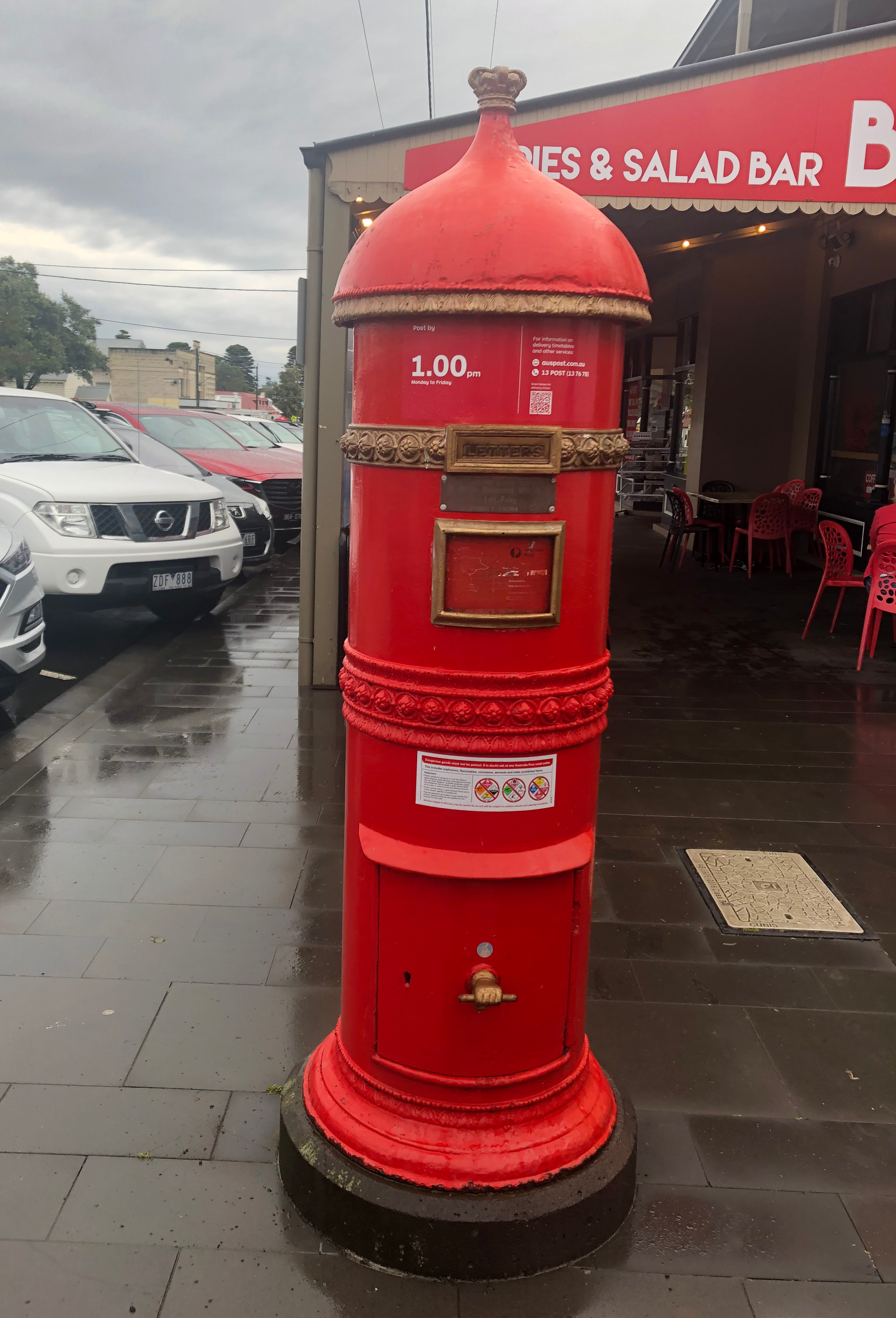
Back in 2018, I wrote how there was still an early Victorian short door mailbox still in use in Port Fairy.

At the time the mailbox was looking a bit faded and unloved, and in need of a coat of paint.

Well I was back in Port Fairy a few days ago and can report that the mailbox has a bright new coat of paint, including a touch of gold on the crown, rim, and door handle:

and that it is still in use.

If you look round the back at the base you can clearly see the manufacturer’s name – G Couch, Engineer, Alliance Iron works, Melbourne

as there is on all short door and long door mailboxes, as in the example in the Flagstaff Hill collection in Warnnambool

Posted in Uncategorized | 1 Comment

Sir Humphry Davy and Frankenstein

Royal_Institution_-_Humphry_Davy

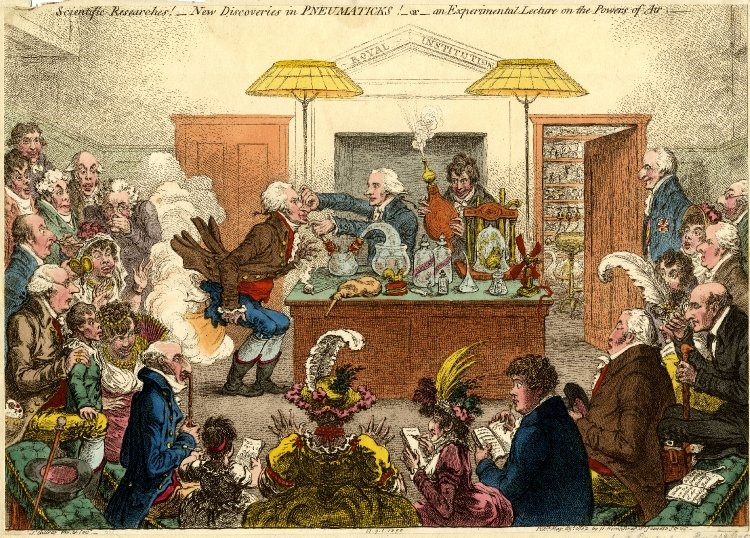
Humphry Davy, the noted chemist, and technology evangelist (satirized by Rowlandson above) was a friend of William Godwin, and was also known for his experiments with electricity, including building a truly ginormous voltaic pile around 1806.

Remarkably, Davy was also friends with both Robert Southey and Simon Taylor Coleridge through Davy’s work with nitrous oxide, or laughing gas. Davy, as well as conducting scientific work on its properties would also invite friends round for a sniff and then ask them what they experienced, something vaguely reminiscent of the twentieth century experiments with psychedelic drugs.

Mary must have heard talk of his experiments and demonstrations and may even have seen some of them, including perhaps the jumping frogs leg experiment pioneered by Galvani.

What’s interesting and less well known is that Shelley was also fascinated by galvinism and had his own voltaic pile in his rooms at Oxford.

Whether Davy ever met Shelley and Mary together is unknown, but he certainly knew of them and perhaps a little of their scandalous lives.

It would seem unlikely if they didn’t cross paths, as Davy was a regular visitor to northern Italy and what is now Slovenia, as evidenced by this plaque on a house in Podkoren on the Sava river that I was surprised to come across when we were on holiday in 2015

S6301658 (2)

(There’s a story about this plaque: It was originally put up in the 1890’s and the inscription was in German as Podkoren – or Wurzen as was – was part of the German speaking part of Austria Hungary. Come the end of the first world war and the dissolution of Austria Hungary, Podkoren ended up in Yugoslavia. At some point in the 1920’s, someone took down the original plaque, flipped it over, and recarved the inscription in Slovenian … )

Posted in Uncategorized | Leave a comment

Mary Shelley and the Bracknell vegetarians

In among other things, I’ve been continuing to delve into Mary Shelley’s time in Dundee.

It’s all taken longer than I meant it to, in part because I bought a couple of books on the subject and one of them took nine weeks to arrive. However I’m finding the exercise quietly fascinating.

We often talk about social networks, but in both Percy Bysshe Shelley’s and Mary’s escapades, we can see them at work.

For example, William Godwin knew Samuel Taylor Coleridge, and Mary would have heard Coleridge read or recite the Rime of the Ancient Mariner, including the journey south to the south pole. That combined with the stories of the Dundee whalers, and the sight of the whale ships towing their catch up the Tay, must have had a powerful effect on Mary, who of course had never seen arctic or antarctic ice.

When she saw the Mer de Glace glacier on Mont Blanc, it must have seemed like the site of her gothic imaginings of the polar ice fields.

The other interesting thing I’ve come across is that Shelley was a vegetarian. That itself is not exactly news, nor is the fact that Cornelia Turner gave Shelley Italian lessons, and perhaps something more, before her husband abruptly terminated the relationship in mid July 1814, shortly before Shelley eloped with Mary.

Given Shelley’s promiscuity, his proclaimed belief in free love and his often expressed wish to live in a sort of Romantic hippy commune, it wouldn’t be surprising if he had had a relationship with Cornelia.

However, what interested me was the social network aspect of this. Cornelia’s father was a friend of William Godwin, and it was William Godwin who introduced Cornelia to her husband.

Cornelia’s parents were both members of the politically radically Bracknell group of vegetarians, and it’s not difficult to surmise that Shelley’s espousal of vegetarianism would have given him an entree into the group, after his failure to obtain the lease of Nantgwyllt in the Elan valley.

(Nantgwyllt is now underwater, having been submerged when the Elan valley dams were built to supply Birmingham with water. Nantgwyllt Anglican church, while worth a visit on its own account, is a late Victorian confection built to replace the medieval church which was also submerged beneath the Elan valley reservoir).

So, wheels within wheels …

Posted in Uncategorized | Leave a comment

Collodion what?

image

Yesterday I was puzzling over the rise in the use of the word collodion as a term for early photographs. The term derives from the collodion process (or wet plate process) which allowed photographs to be made using glass plates rather than the metal plates used in daguerreotypes.

The collodion process meant that multiple images could be made from a single negative, rather than daguerreotypes which only allowed you to make a single image at a time.

Not surprisingly, the invention of the collodion process in 1851 took the world by storm and rapidly displaced the daguerreotype as the preferred photographic process. As can be seen from the advert above (from the Cardiff and Merthyr Guardian on 10 November 1854), people who continued to style themselves as daguerreotypists (because people knew what than meant) advertised that they in fact used the newer collodion process in their work.

The collodion process was what Lewis Carroll, an enthusiastic amateur photographer used to take his pictures of Alice Liddell.

So, in what contexts was the word collodion used?

I looked at Welsh Newspapers Online between 1850 and 1860 to look and see what word followed collodion. I only looked at the English language newspapers – the Welsh language newspapers are a confusing mixture of Welsh editorial and mixed English and Welsh language adverts.

And this is what I found

Collodion 7
Collodion Photographic 3
Collodion Plate 2
Collodion Picture 2
Collodion Process 10
Collodion Portraits 8

Most of the uses of collodion referred the mechanics of the process, plate, process, and so on, but quite a number referred to the use it was being put to, eg Collodion Portraits, to emphasise that the images were being taken with this new technique …

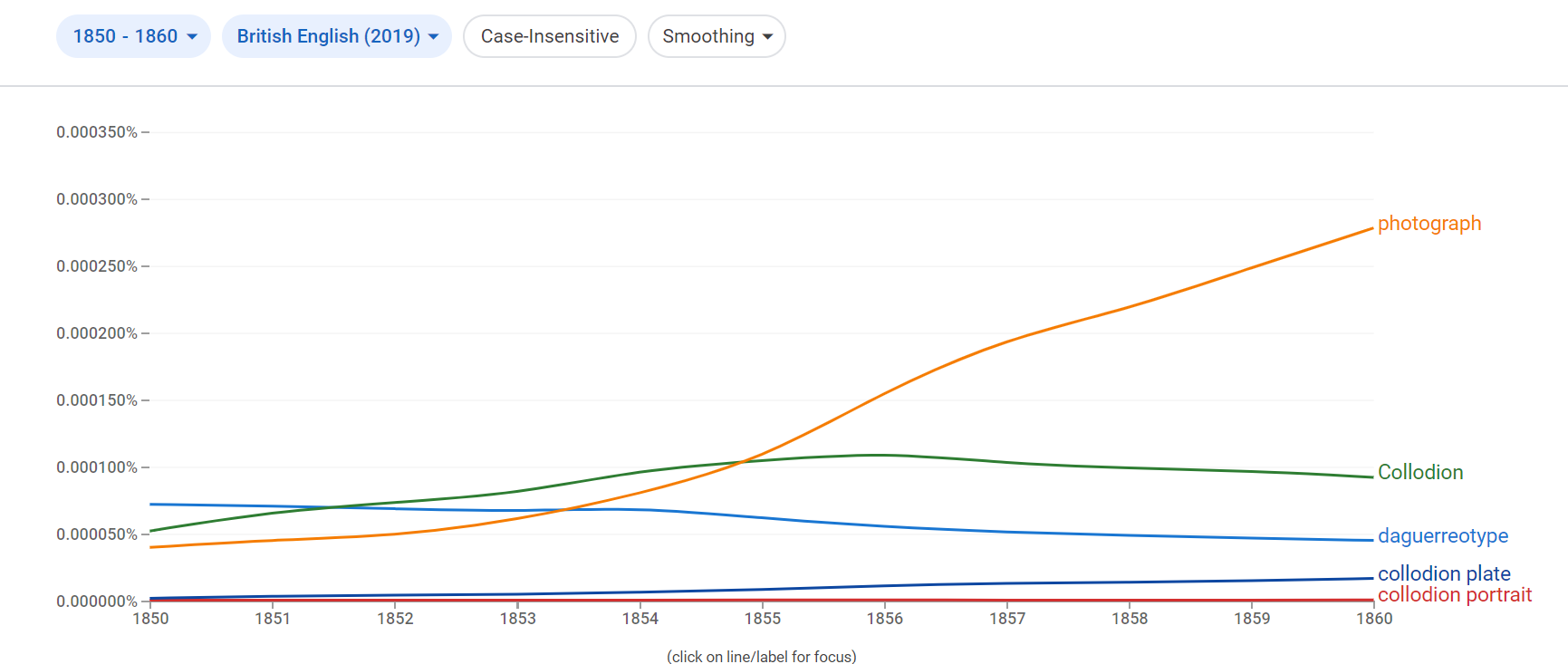
So I then used the Google Ngram viewer with the British English Corpus for the period 1850-60 to compare the use of the terms collodion, collodion portrait and collodion plate with the terms daguerreotype and photograph

collodion

Which basically shows that the change was from daguerreotype to photograph. While collodion in combination with various words was used, this was in contexts to emphasise that the new process was used, rather then for the images themselves …

Posted in Uncategorized | Leave a comment

And the winner is …

Following on from my trying to work out when we started calling photographs photographs, I though I’d use the Google Ngram viewer one more type to look at the relative usage of the following terms for photographs over the period 1840 to 1880:

The terms I checked were:

  • daguerreotype
  • calotype
  • ambrotype
  • tintype
  • collodion (the name of the wet plate process)
  • photograph

The results were a little surprising

Annotation 2020-09-05 161319

while daguerreotype was indeed the most common term before 1855, the term collodion, as in collodion process was a pretty common term.

I then checked to see if the term collodion process was the term actually in use

Annotation 2020-09-05 163344

which it clearly wasn’t.

What this means I’m not sure, I’ll have to go and look at usages of collodion in context …

Posted in Uncategorized | Leave a comment

When did we start calling photographs photographs?

The first photographic images widely used were known as daguerreotypes after the technique used.  (There were other techniques and names in the 1840s and 50s, eg calotype, ambrotype, but daguerreotype was the first.)

Later on we started calling them the more generic term photograph, but exactly when did we start doing that?

For example Beard, the first commercial daguerreotypist in Britain, was still calling them daguerreotypes as late as 1855, but the diarist Francis Kilvert, writing in 1870, refers only to photographs.

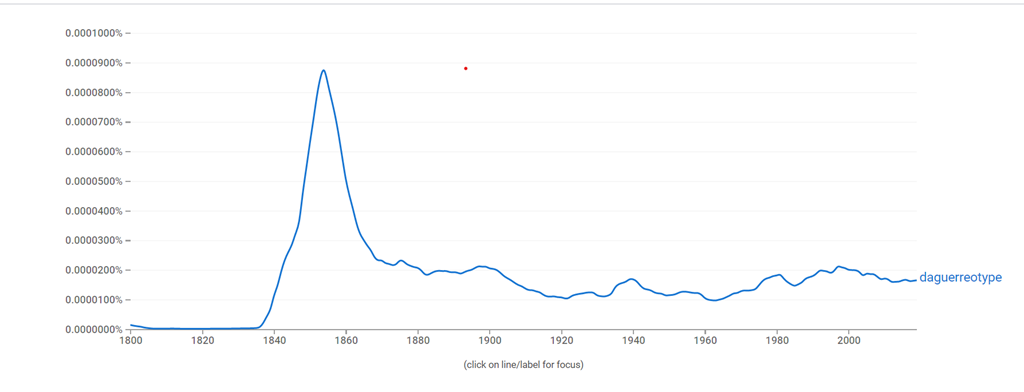
Well to find out I did some very simple investigations – first of all I used the Google Ngram viewer to look at the yearly occurrence of the term daguerreotype in the English corpus:

ngram of daguerreotype

which gives us a peak usage of the term around 1853 or 1854.

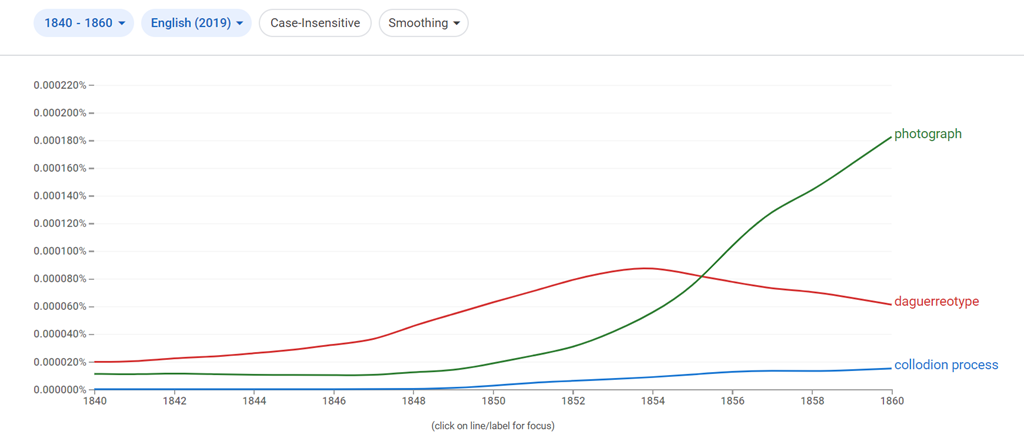
Again using the Google Ngram viewer I compared the occurrence of the term daguerreotype versus photograph over the period 1840 to 1860:

photo vs daguerre ngram

and we can see that the crossover occurred around 1855.

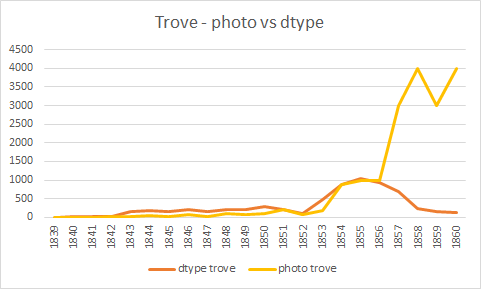
To sanity check this I then checked the relative occurrence of the two terms in both Welsh Newspapers online and the NLA’ s Trove. As the Trove dataset is richer I graphed the two of them separately to stop the Welsh data being drowned out the Trove data.

image

image

So, in the Welsh data we see that the data more or less matches the Google Ngram data with the crossover occurring about 1855. Interestingly, the Trove data shows something else, with both terms being used equally in the first few years of the 1850’s, with use of the term photograph taking off in 1856.

1855 of course was the date of Roger Fenton’s seminal Crimean War images, and in reports of the exhibition of his photographs, reporters use the term photograph, rather than referring to the particular technique used, suggesting perhaps that this helped drive the initial adoption of the term in preference to daguerreotype …

Posted in Uncategorized | 1 Comment

The earliest Australian Daguerreotype advert ?

I’d fed the cat, and it wasn’t quite time to start cooking dinner, so I thought I’d trawl Trove for the earliest advert I could find for someone offering to take your daguerreotype

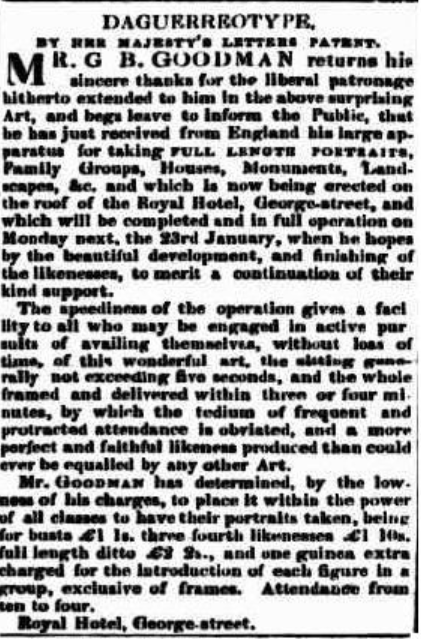
Annotation 2020-08-27 175619

from the Australian of 18 January 1843. The text of the advert suggests that he was in business before then, perhaps in 1842, but I was not been able to find earlier mention of him in Trove. 

A bit of creative Googling found him to be George Barron Goodman who arrived on the Eden on the 4th of November 1842, and rapidly started promoting himself as a photographer

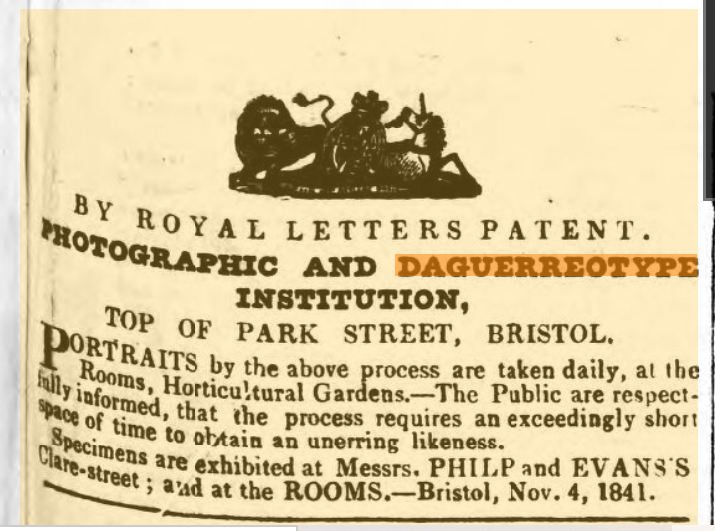
In contrast, the earliest advert I can find in Welsh Newspapers online dates from the Monmouthshire Merlin of 10 November 1841

monmouthshire merlin november 1841

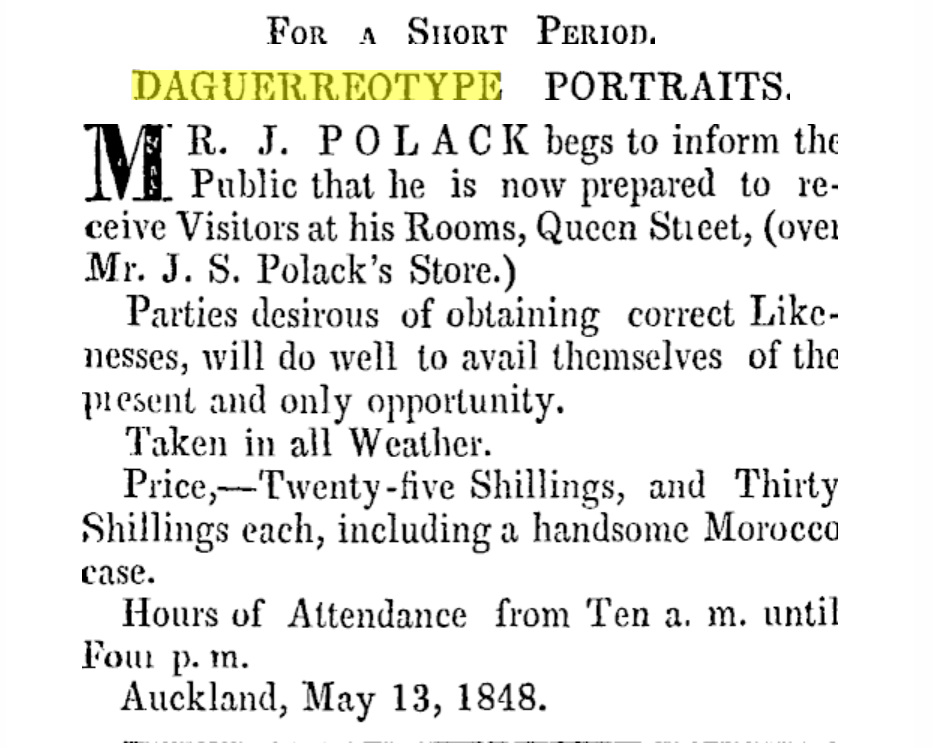
and in New Zealand from a comparatively late 1848

daguerreotype new zealnder 13nmay 1848

To give this some context, the daguerrotype process was only invented in 1839, and the earliest mention in Welsh Newspapers online  is from 1840.

Being a daguerreotypist was a highly skilled profession, requiring a knowledge of optics and chemistry. For example the Dundee Directory for 1850 lists two daguerreotypists in a town whose population was roughly 65,000, and suppprted a reasonably sized middle class.

Prince Albert, a known geek, didn’t have his picture taken until 1842, and Queen Victoria was not photographed until 1844 …

Posted in Uncategorized | Leave a comment

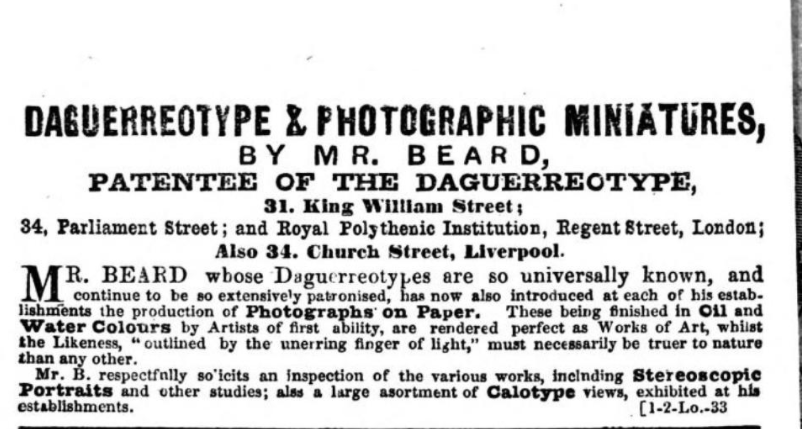
A daguerreotype advert from 1855

From the February 1855 edition of Bradshaw’s guide:

early daguerreotype advert

interesting to see that daguerreotypes and stereoscopic images were being advertised as early as 1855 or perhaps not as J A Rochlitz was working as a daguerrotypist in Beechworth in 1857, and had previously been working, again as a daguerreotypist, in Ballarat and as we know, Madeleine Smith exchanged photographs with her lover.

None of this should surprise us – Prince Albert had his photograph taken in the early 1840’s and Queen Victoria was an enthusiastic adopter of photography, and of course this was the time of the Crimean War and Roger Fenton’s celebrated photographs.

What is also interesting about the advert is that the daguerreoptypist also advertises the use of watercolourists to add colour to the image, something that is also seen in the pornography of the time.

What it does show is how widespread the adoption of photography was by the middle classes by the 1850s …

Posted in Uncategorized | 1 Comment