Charlotte Bronte and Patience Kershaw

The moors round Halifax and Bradford are for ever associated with the Brontes.

But there’s also another history there, as for example in the Chartist inspired near insurrection of 1842 sometimes referred to as the Pull Plug riots, which saw soldiers fire on protesting strikers in Preston and Halifax and perhaps in other places.

The moors were not wild places but where coal was find close to surface, the site of small scale mining, and it was at one of these mines that Samuel Scrivener, investigating the employment of women and children in the mines encountered Patience Kershaw, a 17 year old hurrier, who routinely dragged wagons full of coal out of the mine for the miners who employed her.

And of course the Brontes, living in Haworth, could not have been unaware of both the 1842 insurrection or of conditions in the mines, even if Charlotte and Emily Bronte were both living in Brussels in 1842. They would doubtless have been kept informed of events by letters from home and from newspapers sent from home.

The miners for the most part lived among the community, besides the silk weavers (like J’s family who gradually made the transition from self employed weavers to mill worker), the wool combers and weavers, and the farm workers, rather than isolated mining villages, so the miners, the hurriers and the rest must have been a familiar sight going to and from the pit

In fact Charlotte, the most politically astute of the sisters, appears to have visited the village of Wilsden on the moors researching for a projected novel based on the Chartist events and certainly her 1849 novel Shirley, set against a background of Luddite machine breakings in the early 1800s could well have been inspired by the pull plug riots.

Charlotte Bronte most probably never encountered Patience Kershaw in person. But her father, a parson, must have officiated at their weddings and funerals, and Charlotte must have known who they were, and at least an inkling of the conditions that they lived in …

Posted in Uncategorized | 1 Comment

Miss Dickinson …

I tried to find out what happened to Kate Dickinson after Valentine Baker’s trial for rape and assault, but I’ve drawn a near total blank.

Secretly I wanted her to become a campaigner for women’s rights or alternatively one of these indomitable Victorian lady botanists who strode the jungles of south east Asia, armed only with a botanical press.

But no. Only in my dreams.

The only reference I’ve found is in Richard Hall’s 1980 biography of Samuel and Flora Baker, in which he states that Miss Dickinson withdrew from public life after the trial, never married, and devoted the rest of her life to painting watercolours, and that she died in 1915.

Irritatingly, he doesn’t give a source for this information, but given the accuracy of much of the rest of his research, I’m prepared to assume it’s accurate …

Posted in Uncategorized | Leave a comment

Victorian short door mailbox still in use

We were in Port Fairy a few days ago and parked outside of the Ederle restaurant, and there it was, an 1870’s short door receiving pillar still in use by Australia Post

short door 1870 mailbox port fairy

The design is slightly more ornamental than the later long door type with a wreath of roses around the middle of the pillar and again round the mail slot.

Interestingly it doesn’t say “Receiving Pillar” on the body of the mailbox – I’m guessing that’s a later feature, but at the moment it’s only a guess ..

Posted in Uncategorized | 2 Comments

Wreck Beach

We’ve just had a few days away at Apollo Bay, originally with the intention of doing some walking, swimming and sketching.

Of course, with unerring talent, we neatly managed to coincide with a howling storm that blew up out of the Southern Ocean, which curtailed these activities somewhat.

wreck  beach 1

However we did manage a walk on Moonlight Head and down to wreck beach. On a good day, at low tide, you can walk out on to a rock platform and see the remains of the Marie Gabrielle (lost November 1869) and the Fiji (lost September 1891). In the picture above you can just see some of the wreckage including the anchor of the Marie Gabrielle behind the raging sea.

When we visited it was only safe to walk to within about 100m of the wreck site but it certainly showed just how treacherous these seas could be.

Both ships were a total loss.

In the case of the Marie Gabrielle it seemed at firts that everyone survived despite being trapped on a wild rough coast in what was then very isolated and remote country

marie gabriell the argus 18691130(The Argus 30 November 1869 via trove.nla.gov.au)

with the crew eating limpets until they were found and brought to Cape Otway light station.

However, if you expand the search into 1870, the following year, the tale turns grimmer with allegations  that the crew were deserted by their captain. There also seems to be some suggestion from later news reports that some human remains were found in the area a few months later. There is some suggestion that the remains were of Maori or South Sea Islander origin and it may be that they were travelling alongside the European origin crew, either with or without the captain’s knowledge

The Fiji’s wreck was a rather less fortunate affair with several men being lost

fiji wreck the age 18910908fiji wreck inquiry evening news sydney

(reports from the Age 8 September 1891 and the Evening News in Sydney both via trove.nla.gov.au)

and charges of incompetence being laid against the captain.

Posted in Uncategorized | 2 Comments

Sophia Duleep Singh–the empire strikes back

This week saw the hundredth anniversary of women getting the vote in the UK (and Ireland which in 1918 was not yet a separate polity). It was at best a partial victory in that the vote was restricted to women over 30 who met a property qualification, but it was a victory of sorts.

I’ve been retweeting a series of articles from the University of St Andrews that give a taste of just how acrimonious the struggle was and how women were forced into direct action to make their point.

Another interesting aspect of the struggle is that a number of the key players were not born in the UK. I’ve already mentioned the wonderful Muriel Matters who among other coups de theatre, hired a dirigible with the intent of disrupting the opening of Parliament by dropping pro women’s suffrage leaflets over the procession.

Muriel Matters, was of course from Adelaide, where women got the vote in 1894. There’s no actual date for women’s suffrage in Australia, with the some of the colonies granting women the vote before Federation, and others after despite the Commonwealth giving women the right to vote in federal elections in 1902. Victoria was the laggard, not granting women the right to vote in state elections until 1908.

But I digress, I’d like to introduce you to Sophia Duleep Singh, daughter of the last Maharajah of the Sikh Empire, who after being deposed by the British, was kept in a gilded cage, at first in Perthshire, and later in Norfolk, and forever forbidden to return to India. (I’ve mentioned Duleep Singh before in connection with Sam Baker and a hunting trip in the wilds of Ottoman Europe where Sam ‘acquired’ the woman later to be his wife from an Ottoman slave market. According to Richard Hall’s account of Sam and Flora’s Nile expedition, Duleep Singh had acquired himself a mistress in Vienna and might have been less interested in hunting than he might otherwise have been.)

Strangely, Queen Victoria was fond of Duleep Singh and his exiled family and was Sophia’s godmother, as well as granting her a grace and favour apartment in Hampton Court.

Sophia was allowed to travel to India after her father’s death, and was radicalised by the experience, meeting many anti-British Indian revolutionaries. On her return she joined the Women’s Social and Political Union, selling their newspaper outside of Hampton Court much to the annoyance of George V.

Sophia was more radical than that, supporting the use of bombs to bring about women’s suffrage. During the first world war she worked in a hospital caring for Indian soldiers wounded on the western front, and camapigning always for better treatment for Indian soldiers.

After the war she continued to campaign for women’s suffrage both in Britain and in India, and was true radical all her life …

Posted in Uncategorized | Leave a comment

A Chinese coin in Chiltern

I’m still working away on the Dow’s Pharmacy documentation project, but to be honest the last few weeks have not been that interesting, basically enumerating and classifying the stock of empty unused medicine bottles that had been left behind.

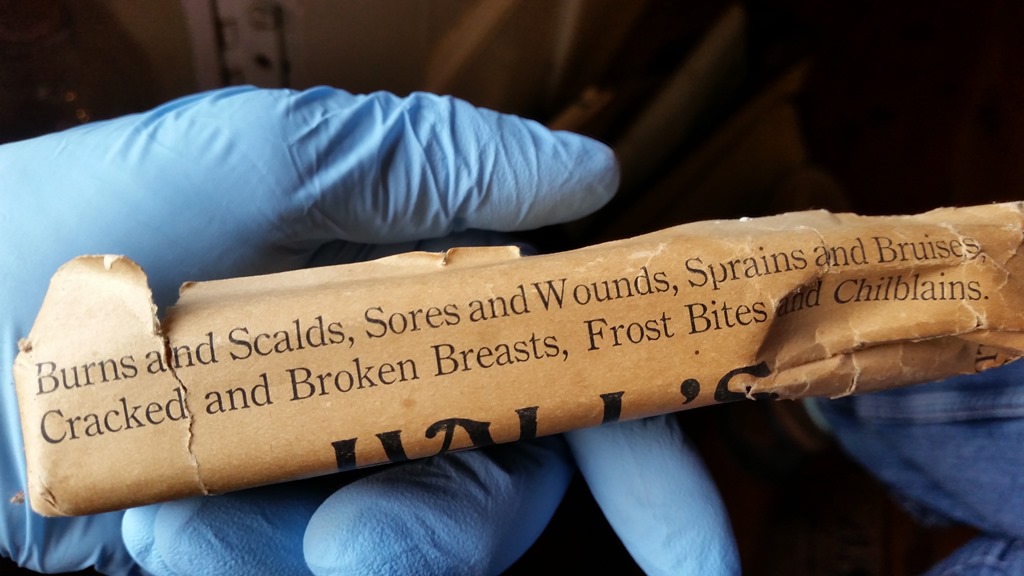
However yesterday I found a little brown paper envelope from the State Savings Bank in among the bottles

20180208_140126

Now we know that decimalisation happened in 1966 and the Pharmacy closed for good in 1968, so the fact that the bag is printed $2 – 5 cent coins, puts it at some date between 1966 and 68.

I opened it, hoping we might have a mixture of 5c coins and some old 6d coins, but no it contained a mixture of screws and grommets,

20180208_140210

and a single Chinese 1 cash coin

20180208_140718

which is rather corroded and worn. Unlike the imitation ones sold as lucky charms today it’s got a design on both sides, and looks genuinely old and worn.

Not being an expert on Chinese coins that’s about as far as I can go, as to what it is, but why would it be in a pharmacy in rural Victoria?

Well, Chiltern was a gold rush town and like Beechworth and the other gold towns round about had a community of Chinese miners in the mid to late nineteenth century. My guess, and it is only a guess, is that one of these miners dropped a coin, and old Mr Dow found it about a hundred years later, didn’t know what to do with it and put it in a bag of bolts, perhaps even thinking it might stand service as a washer ….

Posted in Uncategorized | 1 Comment

Baker Pasha

While I was researching Valentine Baker’s attack on Rebecca Dickinson, I also came across his obituary. Several obituaries in fact, and all quite hagiographic.

Most dealt with his attack on Miss Dickinson by ignoring it as much as possible – ‘a single moment of madness’ etc.

Why?

The world had moved on and Baker, whom everyone agreed was more than competent as a military organiser had been doing the British empire’s bidding, first in Turkey, which then of course was still the Ottoman Empire and still included northern Greece, Bulgaria, Albania and Macedonia as well as bordering on the Caucasus and Iran, and then in Egypt.

It also probably didn’t harm Baker’s gradual rehabilitation that he was friends with Fred Burnaby, who was a favourite of Queen Victoria, and the British Empire’s pin up for pluck and derring do.

But why Turkey?

In 1877 shortly after Baker’s release, Turkey lost a war with Russia. Badly.

Baker had been found a job with the Turkish army, and distinguished himself by turning a rout into something resembling an orderly withdrawal. Incidentally, Burnaby was there as well, allegedly on behalf of a British aid organisation.

Since the Crimean war, Britain had been absolutely paranoid about Russian expansion – not just in central Asia towards Afghanistan and India, but in both south eastern Europe and in Iran. The British nightmare at the time was the Russians taking Constantinople and having direct access to the Mediterranean from Bosphorous.

In the Russo Turkish war, Russian troops go as far as San Stefano, which now Yeşilköy, on the outskirts of Istanbul – to give a sense of perspective as to how close they were to the heart of Constantinople, Yeşilköy is the site of Ataturk International Airport.

At the same time Turkey lost several northern provinces, including Kars province.

In short the British desperately needed to prop up the Ottoman forces and modernise them in case there was another war, and Baker, with his organisational skills was the man for the job.

Later on Baker moved to Egypt to head the Egyptian gendarmarie, which was intended to be something rather like the Turkish Jendarma rather than a neighbourhood police force.

Again history explains all.

By 1879 Egypt was only nominally part of the Ottoman Empire. The Head of Government, the Khedive, ruled Egypt as if it was an independent state.

The Khedive Ismail had run up vast debts building railways and developing the country. Egypt was broke.

Britain and France, the two principal creditors, deposed Ismail, installed his son Tewfik as a puppet ruler and a hand picked government to impose austerity and try and claw back some of Ismail’s debts.

Needless to say, the Egyptians didn’t like the government imposed on them, disaffection spread in the army and eventually there was a full scale rebellion under Urabi Pasha.

The British were terrified that Urabi would seize control of the strategically important Suez canal that was Britain’s link with its empire in India, and renege on its debts.

An army was sent to prop up Tewfik and crush Urabi’s rebellion, which they did, shelling Alexandria in the process.

Afterwards, someone was needed to rebuild and reorganise the army and the gendarmerie to ensure order in the countryside.

Baker got the gendarmarie.

Originally it had been suggested that he should command the new British officered army, but apparently Queen Victoria disapproved of him commanding British officers.

It’s probably no coincidence that the next time we hear of Baker and Burnaby together it’s in a clash with the Mahdi’s forces in the north of the Sudan on the Red Sea coast where the gendarmarie broke and ran in front of the Mahdi’s warriors.

Britain probably didn’t care desperately about the Sudan, but it did care about the security of the passage through the Red Sea.

Burnaby was to die a few weeks later in a firefight with the Mahdi’s forces.

Baker had in the meantime been wounded in the face, after a British counterattack, and later died of malaria while convalescing in Cairo.

Posted in Uncategorized | 1 Comment

Those Baker brothers …

While reading about Victorian crime and sensationalism I came across a story that you have to put in the “you couldn’t make this up” category.

Like all such stories, it has a sordid and dramatic beginning:

On the 17th of June 1875, Colonel Valentine Baker of the 10th Royal Hussars, a personal friend of the Prince of Wales, attempted to rape Miss Rebecca ‘Kate’ Dickinson in a first class railway compartment on a London and South Western train.

At that time trains were of the non-corridor type, each compartment had a separate door, which on some lines was locked between stations to prevent passengers getting out while the train was en route.

Fortunately this was not the case on this train.

Some where between Woking and Esher, Col Valentine pushed Miss Dickinson into a corner of the compartment, attempted to kiss her repeatedly and put his hand up her dress. Struggling, Miss Dickinson tried to  pull the communication cord, but the mechanism had not been connected properly and it failed to work.

Miss Dickinson survived, severely shaken, by opening the compartment door while the train was in motion, and clinging to the outside of the train while standing on the running board. When apprehended, Colonel Baker’s clothing was said to be in disarray, Victorian reticence not wishing to into the sordid details but some commentators suggested that Colonel Baker’s fly buttons were undone.

It is worth remembering that many mid Victorian women did not wear underpants, something which made it easier to pee when going to the loo wearing a long and voluminous skirt, instead wearing a shift and long stockings under their dress, so when Miss Dickinson states in her deposition that Colonel Baker’s hand was under her dress on her stockings above her boot, she could be suggesting that she felt his hand on her thighs, rather than somewhere below the knee.

Miss Dickinson, a well connected upper middle class young woman was persuaded by her brothers to press charges, a rarity at a time when rape or assault required the woman to file a civil suit for damages against the perpetrator.

Colonel Baker was bailed on a surety of two thousand pounds and later convicted, sentenced to a year in prison and fined the, for then, remarkable sum of five hundred pounds.

Furthermore, rather than being allowed to quietly resign from the army, he was cashiered, thrown out in disgrace.

After his sentence, some of his powerful friends tried to have him rehabilitated, but Queen Victoria, to her eternal credit, refused let him back as a commissioned British officer. Instead he found service with the Ottoman army.

We know this because Miss Dickinson pressed charges. Given his behaviour, one cannot but wonder if he was some sort of sexual predator and had committed previous crimes and got away with it due to the reluctance of his victims to press charges, or indeed because his victims were from a lower social class.

This would be simply another sordid tale, as well as one of great courage by Miss Dickinson, were it not that one of those who stood surety for the unfortunate Colonel Baker, was his brother, the explorer Samuel Baker, who, in 1864, was one of the first europeans to see Lake Albert, which lies between Uganda and the Congo.

By the time of his discovery Samuel Baker had already had a colourful career. He had lived for several years in Ceylon, and helped found the British hill station of Nuwara Eliya (which we visited in a rainstorm in 2013). After his wife died he returned to Europe, worked as a project manager building a railway in Romania, and befriended Duleep Singh, the last Sikh Maharajah, who had been deposed by the British, and was now exiled in a gilded cage in Scotland.

On a shooting expedition in the winter of 1858-9 to south eastern Europe with Duleep Singh, Baker, who had been widowed a few years previously, acquired a fourteen year old slave girl of Hungarian origin from the slave market in Vidin, in what is now Bulgaria, but was then part of the Ottoman Empire. Baker claimed to have rescued her from slavery, escaping across the Danube on an ice floe, but the reality may have been rather more prosaic.

The slave girl, Flora or Florence, became in turn his lover and his wife. Despite the strangeness of their meeting they seem to have formed a genuine and long lasting relationship, lasting until Baker’s death in 1893. Florence lived on for another twenty years, and was buried beside him in Worcestershire.

Baker originally claimed that they had married in Romania after her rescue, but never offered any proof. Perhaps in part due to his irregular home life, Baker set off with Flora in 1861 to find the source of the Nile.

They encountered Speke and Gordon on their way back from finding the source of the Nile, in a small settlement in what is now south Sudan, but pressed on, on Speke and Gordon’s advice, to find Lake Albert.

Despite his success in Africa, Baker was never really accepted by the Victorian establishment, perhaps because of his relationship with Flora,and how he had acquired her.

Despite their marrying in a “proper” Anglican ceremony in London in 1865, Queen Victoria always avoided meeting him due to the suspicion that they had not really been married when he went on his African expeditions with her in tow.

In tow is not quite the right term, by all accounts Flora was a strong woman who rode horses and helped make the expedition a success, perhaps because she was simply better than Baker in managing the porters. By all accounts, Baker not the most patient of men.

Quite what impact the irregular nature of Samuel and Flora Baker’s relationship had on Queen Victoria’s views on Colonel Baker and his conduct is unknown, but given that Colonel Baker was both a member of the Marlborough club and the Marlborough house set, she probably didn’t have a particulaly high opinion of him to start with ….

Posted in Uncategorized | 3 Comments

Black swine in the sewers of Hampstead

I’ve been reading quite a lot about the Victorian period, and particularly about Victorian crime, newspapers and newspaper reporting as well as reading a number of Victorian sensation novels such as Wilkie Collins’ “Woman in White” and Mary Braddon’s “Lady Audley’s Secret”.

Doing this in parallel, especially with my reading about the Madeleine Smith trial made it quite obvious to me that the reporting of crime in newspapers had clearly influenced the ‘sensation novels’ of the 1860’s.

Besides the normal tales of human greed and misbehaviour, some of the stories sound almost theatrical and wildly dramatic.

Examples include the governess who conspires with the husband to have the wife locked up in a private asylum, or worse poisoned, the maidservants made to serve dinner to the master and his (male) friends with their breasts exposed, or the grim story of the young governess hired to accompany the family on a trip to Italy, only to be raped and abandoned in Florence to make her own way home.

Shocking stories all, perhaps even more so to the twenty first century reader who is unused to stories of servants and their maltreatment. The stories often sound more like stories of the maltreatment of Filipina or Indonesian maids in the Middle East than something we associate with Europe.

The newspapers of course played a part.

Freed from stamp duty in the mid 1850’s there was a circulation war among the newspapers. At the top end, the (London) Daily Telegraph took on the Times, and lower down the scale, the News of the World appeared – characteristically its first issue featured a tale of ‘grievous ravishment and violation’.

And crime reporting played a part in selling newspapers, allowing the very Victorian combination of salaciousness and moral rectitude.

And it was against this background that the sensation novels appeared. It’s important to remember that when they first appeared they didn’t appear as novels to bought in railway bookstalls, but as serials in magazines – hence both their length, and their convoluted plots, just like some of the better and more complicated TV series today.

The sensation stories sold magazines, and if they were successful, they became books in their own right.

(Quite where this leaves Fergus Hume, who arguably created the first Australian best seller with his sensation novel ‘The mystery of a hansom cab’ some twenty years later is a different question)

Inevitably the sensation novels drew on the crime reports. They also make frequent reference to the penny post – fast and efficient, and to the railways – to anchor themselves firmly in the present day of the 1860’s and seventies, just as Bram Stoker referred to Kodaks and typewriters to give an air of modernity to Dracula, something which now passes the reader by.

So, the black swine.

I had been groping towards what I’ve outlined above, when, via Dr Beachcombing, I came across the book ‘Black Swine in the Sewers of Hampstead’ about Victorian sensationalism. This was just before Christmas, and I thought it might be a fun seasonal read, so I tracked down a copy via AbeBooks.

Well, in fact it turned out to be a semi autobiographical account by a professor of English at Brooklyn College in New York, describing his research into Victorian sensationalism on the basis of a collection of newspaper clippings from the 1850’s and 1860’s. And it’s good. It crystallises just about all I’ve spent the past few months groping towards.

However, the author, Thomas Boyle, who sadly is no longer with us, was circumscribed by his collection. For him, searching and finding material in the pre-internet 1970’s and 80’s was a complicated manual process, involving visiting document repositories and spending long hours carrying out manual searched of indices, or poring over blurry photocopies of old newspapers.

It’s a little easier now. With papers past in New Zealand, and the NLA’s trove we can find and search for digitised reports from the time just as I did with the Madeleine Smith case, and that of the murder of Mary Dobie.

And because the newspapers in Australia and New Zealand reprinted some of the more dramatic stories from Britain, we have easy access to a range of reports. While one still has to do the work, one could perhaps, by looking at the newspapers of the time track down the sources for the inspiration for Fergus Hume’s ‘Hansom Cab’ without numerous and tedious trips to the NLA and the National Library of New Zealand.

The same goes for the various bushrangers of the 1860’s and 70’s, and more intriguingly, to me at least, the role of the Chartists involved in the various disturbances of the 1840’s, such as the Pull Plug riots, who were transported to Australia, almost as political prisoners, who then appear in various protest meetings for miners’s rights in the 1850’s in Australia, such as the monster meeting in Castlemaine, the Madman’s gully meeting in Beechworth, and of course the Eureka stockade in Ballarat …

Posted in Uncategorized | Leave a comment

Queen Victoria’s bun in Jamaica

jamaica and the uk obverse

jamaica and uk reverse

I’ve previously written about the heads used on Queen Victoria’s coins, and how there had been an abortive attempt to introduce a common currency throughout the British Empire.

One place where it didn’t work was Jamaica, where the local Afro Caribbean population didn’t like bronze pennies or half pennies. One explanation, which may be apocryphal, is that people did not like to be seen putting bronze coins in the offering plate at church services, bronze coins being associated with poverty and slavery.

To counteract this, the colonial government minted pennies and half pennies of the same size and weight as the British originals, but in cupro nickel rather than bronze, and with quite a different design.

If you look at the side by side images above you can see that apart from being the same size and weight, the coins differ markedly in design. In fact the only common element seems to be the use of the Leonard Wyon bun head – and that’s only because the coin is worn. In fact they used a different head by Wyon  in which Queen Victoria compliments her bun head hairstyle with a diadem. The same design turns up on Channel Island coins as well as other places.

jamaica half penny

I’m afraid that the example in my collection is pretty worn, making it difficult to spot the diadem.

jamaica diadem head

The diadem is rather clearer in this 1871 example from ebay.

Note also that Victoria is simply styled Victoria Queen, just as she was on pre 1877 Indian coinage before Disraeli created her Empress of India.

I’m guessing that the logic was that the coins were for use in Jamaica and other associated Caribbean islands and as Victoria was Queen of Jamaica. (Equally, British coins did not acquire IND.IMP until the introduction of the veiled head coins in the late 1890’s.)

Later coins such as those of Edward VII and George V used the robustly imperial title King and Emperor, while of course British coins stuck with IND.IMP until 1947 …

Posted in Uncategorized | 1 Comment