The lacunae of copyright and digitisation

Ever since I first visited Turkey twenty years ago I’ve been aware that the Ottoman empire’s role in the first world war is something, with the exception of Gallipoli, we tend to ignore in the English speaking world, tending, understandably, to concentrate on the meat grinder of the western front. Even in Australia, where despite Australian forces having a significant role in the conquest of the middle East, we tend to focus on Gallipoli and the western front.

Yet, the history of the end of the Ottoman empire and the attempted partition of Turkey under the treaty of Sevres after world war one are important for understanding why we’ve ended up where we are in that troubled region.

Histories written in English about the conflict tend to concentrate on the victors rather than the vanquished, but I recently came across the amazing Rafael de Nogales Mendez, a Venezuelan soldier of fortune who fought in the Spanish American war, was a double agent in the Russo Japanese war, and eventually ended up as an officer in the Ottoman army, where he witnessed but did not participate in the Armenian genocide and who fought in the middle east including the siege of Kut.

He also apparently encountered T.E Lawrence on one occasion.

De Nogales wrote a book about his experiences with the Ottoman army which I thought might be interesting to track down and read, thinking naively that there was bound to be scanned version online somewhere, and that at worst, one of the Indian print on demand houses would be able to make me copy, much as I did with Ernesta Drinker Bullitt’s diary.

Not a bit of it. The Spanish language edition of de Nogales book was published in 1925 and the English language edition by Charles Scribner and sons in 1926, three years after the public domain cut off date of 1923, so despite Nogales dying in the late 1930’s, the work is still in copyright until 2021, on the assumption that the publisher renewed copyright as required.

Now that in itself isn’t a problem. If I was prepared to pay for a print on demand copy, I was prepared to pay for a second hand copy, except that there aren’t any available via Abe (I tend to use Abe due to their global coverage, I guess that there might be a copy lurking on one of the militaria sites that I missed.)

There are reprints available via the Armenian Genocide documentation centre, but they are not particularly cheap.

Living in a rural area means that I no longer have easy access to a large public library, and anyway, a worldcat search suggests no large library in Australia holds a copy.

So, what we have is this – digitisation makes access to original source material incredibly easy, but the 1923 public domain horizon essentially means that anything published after that date won’t be available 2019 at the earliest.

Equally,  old books are difficult to track down and purchase, in part because of the economics of the industry where the global book barns that mainly sell recent second hand paperbacks have come to dominate the industry, and have taken that lucrative section of the market away from second hand bookshops, making the specialist second hand bookshops less profitable, and hence either more expensive or non existent …

Posted in Uncategorized | Leave a comment

The founding of Beechworth …

Beechworth started out a grazing community, but with the discovery of gold in 1852 the town suddenly exploded acquiring banks, a post office and doubtless pubs.

But there’s another little monument up a back road celebrating the first Congregationalist service in 1858

DSCF0298 (2)

suggesting that the wild days of the gold rush were over and life was becoming more respectable …

Posted in Uncategorized | 2 Comments

Greeks in China?

While we were in Byron there was an online spat about a documentary that apparently suggested that Greek craftsmen may have worked on the terracotta army in Xian.

I’ll say apparently as I havn’t seen the documentary, but something that the discussions seemed to miss was the influence on Bhuddist art in Afghanistan of the Greeks who came in the wake of Alexander the Great’s expedition to Afghanistan and India.

There are some quite nice and distinctly Greek looking statues of the Bhudda dating from around the time of the terracotta army, and given that many Bhuddist missionaries and monks travelled north from what is now Afghanistan and northern Pakistan, and they may have taken their Greek influenced sculptural traditions with them, which may have also influenced Chinese sculpture in general…

Posted in Uncategorized | Leave a comment

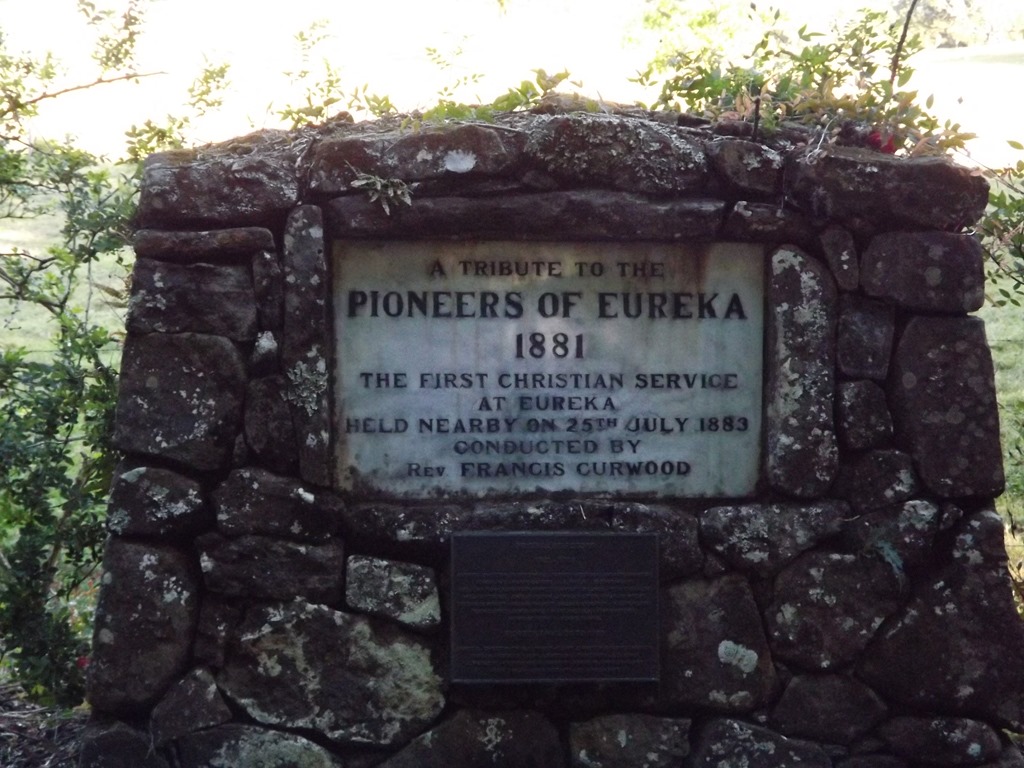
Eureka !

DSCF0286

Eureka Pioneers memorial, Eureka NSW

Earlier this year, we’d moved to Beechworth in Victoria. While we’re pretty content with things in general, we decided we needed to do some remodelling of our house plus a modest extension and a new hardwood deck – and as we’re in a heritage area that meant endless paperwork and permits.

On top of this we’d had one of the wettest winters for years – the backyard developed permanent pools that we half expected to be colonised by tadpoles.

All of this meant I hadn’t got the garden laid out, or the builders had been able to start, so we decided on a trip away to the Byron hinterland in northern New South Wales where, being sub tropical, it was warm and dry.

Rather than Byron itself we stayed in a studio in Eureka, a small village about 10kms out of Bangalow, which is an older if touristy town with some nice old nineteenth century shopfronts, a decent restaurant or two and some pleasant coffee shops.

Eureka had hardly anything. The shop, the post office, the pub had all gone, all that was left was a primary school and a couple of churches, which made for a laid back atmosphere. In contrast, Federal, the next village along had kept its post office and shop, and had acquired a really fun outdoor Japanese cafe – excellent Japanese vegetarian food – and a weekend only restaurant that did a small selection of classic American dishes like ribs and pulled pork, all served with the trimmings. Cash only, bring your own beer, and very relaxed.

While Byron is pretty touristy, and there’s a lot of people with ‘proper’ jobs in agriculture, there’s also an alternative vibe on the back of the protesters who came to protest at the clearing of the old growth rainforest in the seventies, and who put down roots and stayed on.

This makes for a lot of hippie weekend  markets – more an event or a day out that a seious market. The weekend we were there it was Mullumbimby’s turn so off we went to the market, which was a little bit like a small scale eighties festival with people selling veggie food – somosas and chickpea empanadas anyone ? –plus Indian cottons and people selling spiritual awakenings – made me quite nostalgic for my time in mid-Wales in the eighties and worth it for the retro alternative vibe.

The rest of the time we bushwalked in the rainforest – swimming in the ocean was off the menu due to a constant onshore wind.

The other really good thing we found was the Tweed Valley art gallery – a small regional gallery which had inside it a recreation of Margaret Olley’s Sydney house cum studio –definitely worth a visit if you’re in the area. (The Margaret Olley connection comes through the fact that her family had a property in the area and Margaret had to row across the Tweed to catch the school bus in the 1930’s).

On the way back south we overnighted in Armidale (having gone the long way via Bellingen, another alternative hangout) and Dubbo in the central west. I can’t say much about Dubbo as it was pouring with rain and we took the easy way out and ate in the hotel, but Armidale looked interesting – good solid nineteenth century buildings in the town centre including an array of big solid brick churches. We ate in a pretty good Indian restaurant but the town – which is a university town after all – was amazingly quiet on a Thursday evening – hardly anyone seemed to be out and about.

The next day we stopped off in Tamworth for brunch and I had a chance conversation in a bookshop with someone who used to work in Armidale – apparently UNE’s move to online teaching has meant that the number of students on campus is down, and of course, with material online, they’re not buying books are they? (or if they are it’s either e-texts or books bought online), an interesting take on the online revolution.

Our final day driving back was longer than it should have been – we were going to take the back way via Wagga, but when we got to Forbes we found the road south was still closed due to flooding, so we ended up dog legging across the country to the Sydney Melbourne freeway, including a complete failure to find anywhere for lunch in Cootamundra – it’s one of these towns where everything still closes at twelve noon on a Saturday – including the cafes …

Posted in Uncategorized | Leave a comment

Roman coins in Japan and Chinese skeletons in Roman London

Well, we’ve had two unrelated stories that hint at there having been more contact between Rome and contemporary cultures in China, Korea and Japan.

Personally I tend to dismiss this. Roman mirrors and glass have previously turned up in graves in both Korea and Japan, but that doesn’t imply direct contact, merely that the artefacts were traded on from one to another.

Like the Roman coins reportedly found at Oc Eo, it doesn’t mean that there were any Romans there. The fact that the Okinawa coins are reportedly copper, and hence low value items, suggests that they weren’t used as portable wealth, but were there as curios, perhaps along with the Ottoman coins found alongside them.

And sometimes, coins, due to being made out of hard indestructible materials do turn up in unexpected places, such as my finding an Isle of Man 10p coin in a bag of river gravel mulch in Canberra.

The skeletons however tend to suggest something more – skeletons usually being indicators of people. And people do tend to go everywhere – two Japanese sailors ended up in Tudor England having been captured from a Spanish treasure ship by English privateers. And of course Pliny has a story of people who might have been Inuit being washed into the mouth of the Rhine, so while there might have been a couple of people of east Asian origin who ended up in Roman London through some strange sequence of events, it doesn’t mean that they were running the felix draco takeaway or that they themselves are representatives of a larger community, it was pure happenstance …

Posted in Uncategorized | Leave a comment

Carrot tea – an experiment

Some time ago I read a novel set in Moscow during the Russian civil war which mentioned people drinking carrot tea – something I had not come across before.

Google was not much help – the most I could turn up was a discussion on stackexchange, so I decided on a little experiment today when I was making a carrot salad for lunch:

S6301741

first of all I grated some carrot quite finely using a carrot grater (you could use the shredded carrot that some supermarkets sell, or grate the carrot with an ordinary box grater, but the result is not quite as fine as you get with my genuine Russian carrot shredder).

S6301742

I then took some of the shredded carrot (which was quite wet – carrots hold a lot of moisture) and stuck it in the oven at 130C for round about three quarters of an hour.

S6301743

The result was something pale orange in colour and slightly crumbly. Coarser grated carrot would probably take longer. I’m guessing that traditionally the grated carrot would have been dried on the stove.

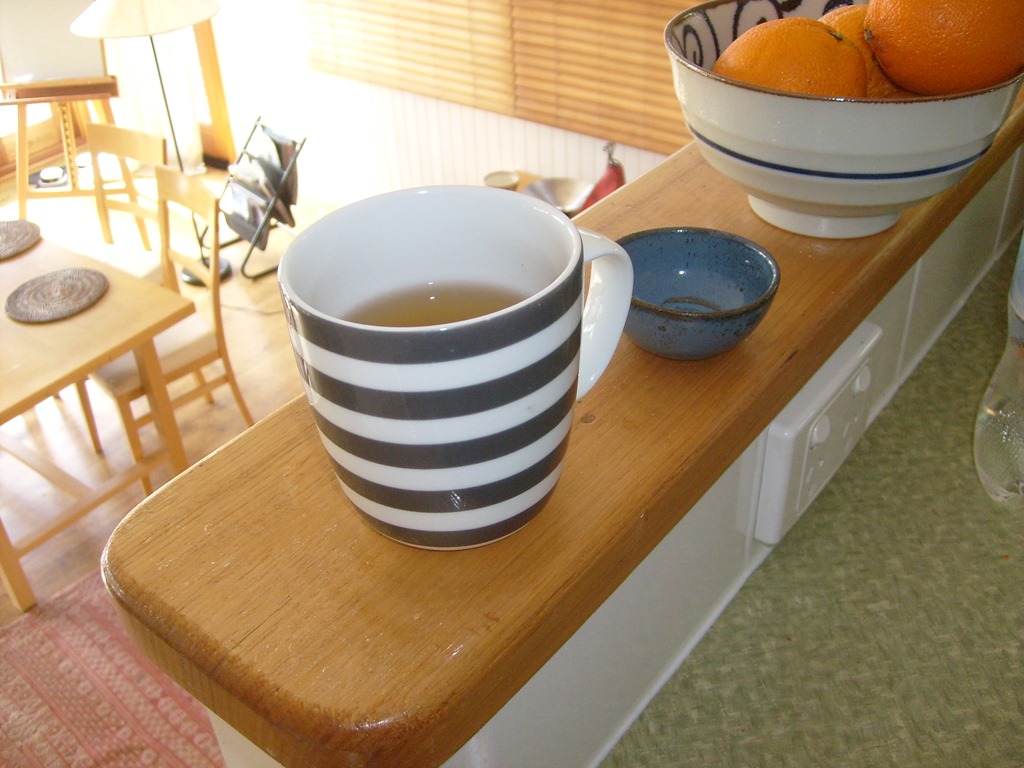
Once it had cooled, I put it in a teapot and poured hot water on it, producing an orange coloured brew slightly reminiscent of a mild assam tea:

S6301744

It had a slightly earthy after taste and was not at all unpleasant.

Personally, I didn’t find it wonderful enough to want to repeat the experience, but it was perfectly drinkable.

If you do a google search for “морковь чай” – literally carroty tea – you’ll turn up a number of Russian recipes, including this one, which shows I was not too far off. Interestingly there are other variants, including carrot top tea, carrot top tea with shredded carrot, carrot tea with blackcurrant leaf, all of which are touted as being good old peasant remedies for hypertension and urinary health.

I’ve also come across some literary references to people adding dried currants to carrot tea, but that’s an experiment for another day …

Posted in Uncategorized | Leave a comment

Reading Ernesta

Almost a year since I started with Ernesta Drinker Bullitt’s Uncensored Diary from the Central Empires, I finally got around to reading my Indian print on demand copy, and if you are interested in such things it was worth the wait.

Ernesta Drinker Bullitt was married to the American diplomat William Bullitt, and she accompanied her husband on a journey to Germany in 1916, shortly after their marriage, and, she kept and published a diary of her journey.

Contemporary sources in English about life in Germany and AustriaHungary during the first world war are understandably a bit thin on the ground, so Ernesta’s diary is an interesting historical resource.

As the spouse of a diplomat, she was of course to some extent insulated from the shortages and rationing, although she does record seeing long queues for bread and meat, and shortages of butter and eggs affecting even in the political class, as well as the need to have one’s ration cards ready to hand to a waiter in a restaurant.

She also took an intelligent interest in what were termed ‘women’s issues’, including the increased provision of child care as more and more women were drafted into the workforce to cover for men drafted to the front, and interestingly concerns about how, after peace, women were to be eased out of jobs to free them for men returning from the front, and her diary records the measures put in place, and what she was taken to see.

Obviously, as the wife of a diplomat, she was most likely only shown the best workers restaurants, kindergartens, clothes recycling factories, but she provides a record of these measures. Likewise when she accompanied her husband to occupied Belgium, the Germans tried their best to present their occupation in the best possible light, although she also records large scale acts of civil disobedience by the populace.

Her diary is just that, a diary, and as well as visits to childcare centres and so on she also records dinners and diplomatic functions, and indirectly the existence of a peace party within the German political class who as even as early as 1916 increasingly believed the war was unsustainable and it was better to seek a political solution.

She was also in Berlin during the battle of Jutland, and describes how the German press described the battle as a major victory, and a major attempt to break the British blockade which was seen as a major cause of the food shortages as it was believed that the ReichsBank had the cash reserves to cover food imports if only they could get the goods into the country. Interestingly she also records that the London papers were available in Berlin, though only in a few select hotels, where it could be expected only foreign diplomats and journalists were staying.

At the same time she also records deep concern at the impact on the harvest of the wet summer and how shortages of grain might lead to increasingly stringent rationing of bread and potatoes.

From my personal viewpoint it’s slightly annoying that her diary mostly covers Germany and her visit to Vienna and Budapest was only for a few days and does not provide as much detail as her account of Germany, even though she was in Budapest at the time that Rumania declared war on AustriaHungary (and coincidentally set a Krupp75mm gun on its journey to end up outside the public toilets in Beechworth).

Generally, the book is engaging and well written, and not without moments of levity, including how, prior to the first world war, Prince von Blucher leased the island of Herm in the Channel Islands from the British government, and then, eccentrically, commenced to introduce a colony of kangaroos (actually red necked wallabies) which bred successfully. (The wallaby colony declined after world war one and none now live on the island).

Despite some of its superficiality and sometimes uncritical reporting of the German response to the shortages of men and resources it is a valuable source of information on life in Germany in the summer of 1916.

Posted in Uncategorized | 2 Comments

The Chiltern Gun

Doug's WW1 gun photo 2      Doug's WW1 gun photo 1

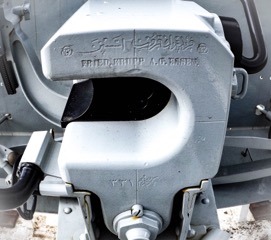
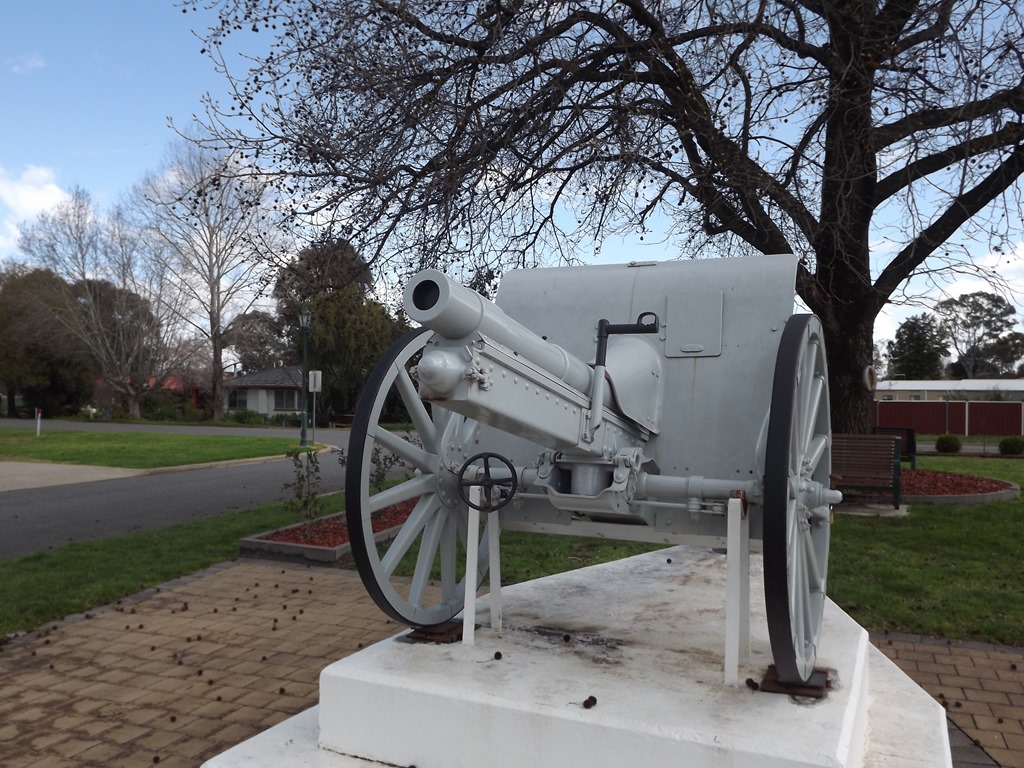
Some time ago  I wrote about the slightly unusual provenance of the Beechworth gun. Well there’s another Krupp 75mm gun close by in Chiltern, and as you can see from the photograph, it was one purchased directly from Krupp by the Ottomans.

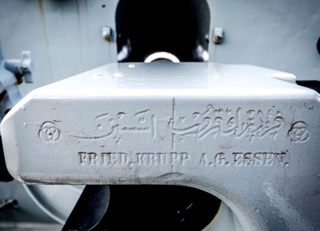
This one has been heavily painted so it’s difficult to read the build date stamped on the top of the breech:

Doug's WW1 gun photo 3

but you can just about make out the key data for the serial number and build date:

٤o١ – (451), Build Date – ١٣٢٣ – (1907)

which matches the record from the Brisbane military museum.

Apart from someone having been a little too enthusiastic with the dove grey paint, the gun looks to be in good condition with some of the wooden parts having been recently replaced. While obscured, the breech markings would probably come up well enough using with brass rubbing techniques, or blowing a little finger print dust over the key area.

DSCF0284

(thanks to J for tweaking the pictures with Lightroom to bring out the text on the breech)

Posted in Uncategorized | Leave a comment

What’s under your roof ?

When you have an old wooden house, as we do, you don’t really have an old house. Unlike a brick house, like the 1860’s terrace we had in England, wooden houses have boards replaced, floors relaid, possibly several times in a century, with the result that you don’t really have an old house.

Or so I thought.

Down the street they were replacing the roofing iron on a nineteenth century cottage. Nothing unusual in that, but I looked up in curiosity, noticed there was something odd, looked again, and realised that the old wooden roofing shingles were still there under the tin – ie when they had replaced the shingle roof with corrugated iron, they’d simply laid the metal sheets over the old shingle roof.

I should have taken a photograph with my phone, but I thought I’d come back with my SLR and take some better quality shots.

Mistake – by the time I got back the roofers had put the new sheets of metal on and were finishing off. Still it shows that history is all around us …

Posted in Uncategorized | Leave a comment

Christina Broun Cameron

As I’ve said elsewhere, I’m currently reading Judith Flanders’ book on the Victorian creation of crime and crime fiction, and I came across a reference to a sprawling nineteenth century three volume novel, Not Proven, by Christina Broun Cameron, which combines elements of the Madeleine Smith case and another equally infamous case where the wife was accused of murdering one of her children, and was shut away by reason of insanity, and where the nursery maid become the husband’s lover (and possibly was before the murder) and eventually his wife after his first distraught wife dies in the asylum.

Like the much better know Woman in White by Wilkie Collins, it combines the elements current crimes to create a new confection, and at the same time reflects concerns of the times – in this case philandering husbands and female serving staff.

So I thought it night be fun to track down a copy to read.

Well there are no copies of the original 1864 three volume set available on Abe Books, either listed under the author’s name or under the title, but a search turned up a version digitised and reprinted by the British Library back in 2011.

And this led to a game of chasing rabbits down holes. The reprints are indeed available through the usual suspects (Amazon, BookDepository) as print on demand, but confusingly both only list by title and don’t tell you which volume is which. They’re also quite expensive for print on demand – something like A$75 for all three volumes. (Each volume is around 300 pages making the page cost around $0.09 a page when the actual print cost would be more like $0.01 a page, plus the cost of binding – let’s be generous and say $0.02 a page giving a production cost of $18 –which is around the same cost  proportionately of the Penguin edition of the Woman in White, although you can get that and other classics from the time more cheaply by buying other editions by other publishers who specialize in out of copyright works)

But if they’re digitised, the scanned source documents should be available – that is after all how print on demand works.

Not a bit of it. The BL will tell you it’s stored on a filesystem somewhere but unlike the internet archive there appears to be no portal to access and download them, making the content effectively useless. So it’s inaccessible …

Posted in Uncategorized | 1 Comment