How the news of Lincoln’s assassination reached Australia

Inspired by having gone to see Lincoln last weekend I thought I’d do some digging to see how the news of Lincoln’s assasination was reported in Australia – more to see the impact of the telegraph link to the rest of the world on news reporting than anything else.

Until the arrival of the telegraph Australia might as well have been Mars, with most settlement in the south eastern corner of the continent meaning that ships bearing news faced a long voyage of several thousand kilometres from Singapore or Java. Even now when flying to Europe from Sydney the first five hours of the 24h  journey are spent flying over Australia.

I’m not an expert on the American Civil War or even American history – most of what I know comes from watching Ken Burns documentaries – but the civil war was remarkable for being the first ‘modern war’ with mass conscription, blockades, steam powered battleships, not to mention the use of railways and the telegraph.

I’ve written elsewhere that the Russo Japanese war of 1905 was the prequel to World War one. It may have been so historically but the American civil war was dress rehearsal for the western front with two large conscript armies mauling at each other, niether capable of a breakthrough.

It was attrition – the South had less yet did not need to invade or secure territory, the North had more but had to secure and hold the areas of the South it captured as well as deny the South access to trade to resupply its armies.

Australia was not untouched. Even though it was half a world away the war had its effects. (Wikipedia has an article that serves as a good jumping off point if you want to know more).

So, how to gauge the impact of Lincoln’s assasination?

Australia has, through the NLA’s Trove a large online collection of digitised newspapers from the 1800’s to the 1950’s. However, searching Trove directly didn’t really work as simple searches tended to throw up articles that referred to Lincoln’s assassination rather than direct reports.

There’s an advert for a geneology company on tv that has the tagline ‘You don’t need to know what you’re looking for, you just need to start looking’. Not true – when dealing with historical events you need to be able to control your query.

This is where Tim Sherratt’s Querypic comes in – essentially it’s a tool that allows you search for a phrase on a year by year basis and plots the relative occurence of the phrase. Very neat, I wish I’d thought of the idea.

So first step – check that we have content from the correct period referring to Abraham Lincoln:
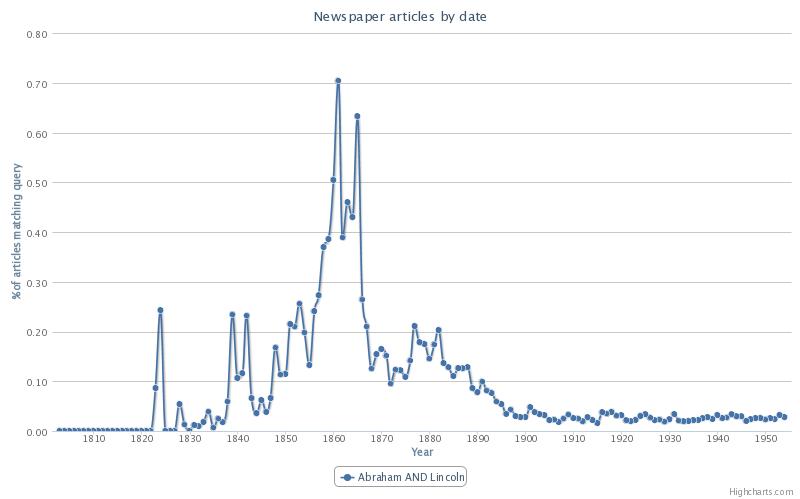
abelincoln

which we do.

Then we need to find the correct phrase – nineteenth century languages and conventions are different from ours. ‘Abraham Lincoln shot’ and ‘President Lincoln shot’ both give quite broad peaks:
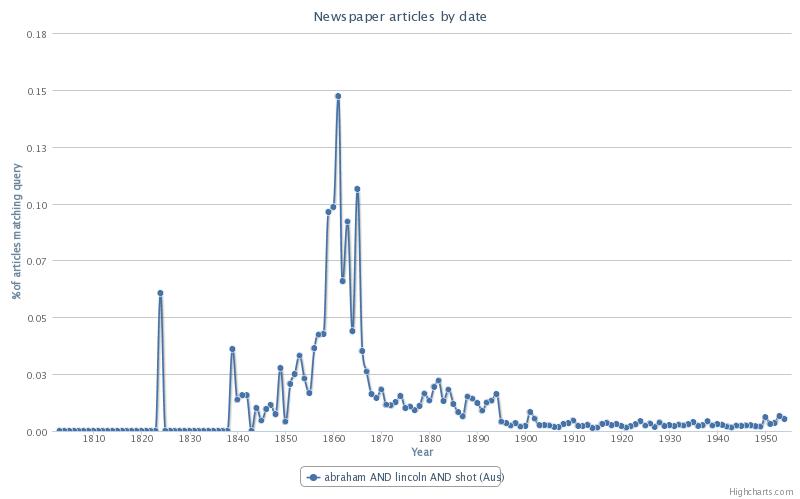
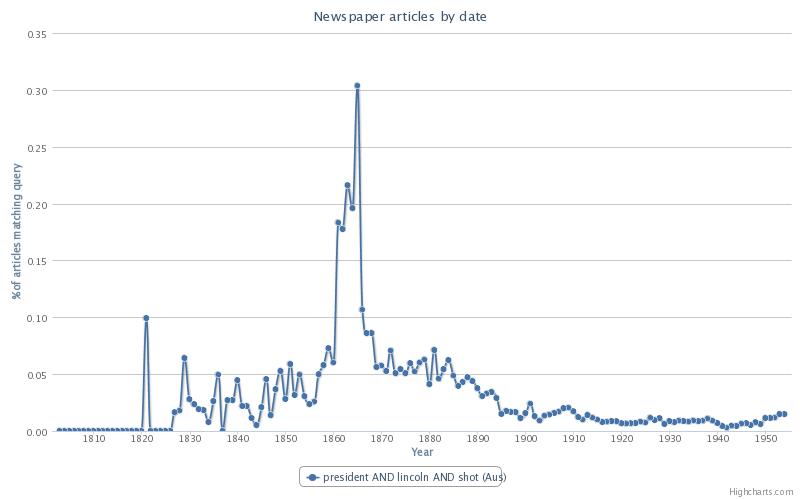
abraham_lincoln_shot presidentlincolnshot

However, ‘President Lincoln Assassination’ gives a very clear tight peak in 1865 – meaning that most news reports used the term assasination in preference to shot:
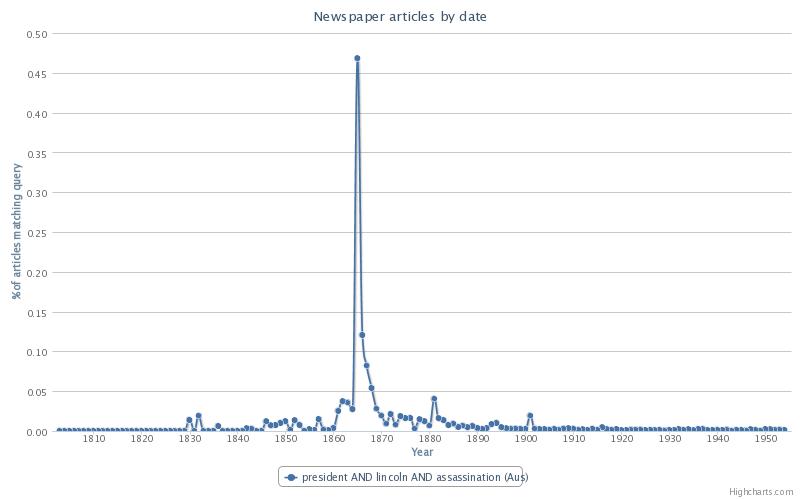
president_lincoln_assassination

Querypic has this nice feature that you can click on a year and see details of the articles referenced and then click through to the articles themselves.

And what did I find – most news reports are dated to late June despite Lincoln being assassinated on April 15 – puzzlingly even Reuter’s telegram is dated to June 29.

The reason turns out to be quite simple. While I correctly remembered that M’Douall Stewart surveyed the route of the line in 1862, I failed to remember the line was not in service until 1872, meaning that news of Lincoln’s assasination had to come by sea with the mail from England, and the news did not reach Adelaide until late June 1865 at which point it was telegraphed on to Melbourne and Sydney.

So while the telegraph did help spread the news, it was only after the news got to Australia that it had a role to play. Judging by the number of reprints of the Reuter’s telegram and the longer news report it was seen by the editors of newspapers across the south eastern states as a very significant event, even though it was by then ‘old news’.

The other interesting fact is that despite a significant trans pacific trade the news came via England, not San Francisco, begging the question as to when the news of Lincoln’s assasination reached California …

[update]

Some more lunchtime digging has more or less answered my supplementary question about getting the news to California.

The American transcontinental telegraph line to Sacramento replaced the pony express in 1862 so we can probably assume that news was in Sacramento within a day or so of Lincoln’s assassination.

Unfortunately the Library of Congress’s Digitised Newspaper collection is incomplete and searching for ‘President Lincoln Assassination’ for 1865 doesn’t throw up any leads so I can’t prove it, but it’s probably a pretty safe bet.

Certainly the news wouldn’t have got any further as the first trans Pacific cable didn’t come into service until 1902 and schemes like the Alaska Kamchatka telegraph line were five or six years in the future.

Official mail would probably have gone via England. However there were whalers and other ships that could have carried newspapers – in the nineteenth century it was quite common practice for ships to drop off newspapers at distant ports, but obviously none did in this case meaning the news had to wait until the mail boat from India got to Adelaide …

Posted in Uncategorized | 5 Comments

Lincoln – the movie

Yesterday it rained. In fact it rained a lot. It was also a Sunday.

The previous day, we’d gone and bought some additional plants for the front yard to plant round the new car parking spot we’d had put in last November, it not being an act of sanity to plant out the area during summer with its scorching days and bushfire alerts.

Well we got the tools out, the plants sat in a row on the path and we were just doing the ‘is that best here or over there’ bit when the heavens opened.

We retreated to sit on the covered part of the deck and sip mint tea while we waited to see if the rain would clear. It didn’t, but while it slackened for a moment,  I recovered the tools and moved the plants back up behind the house to wait for another day.

So what to do on a wet late summer afternoon? Well we’d been meaning to go and see Lincoln, so that’s exactly what we did.

The movie should have been titled ‘How not quite Honest Abe got the 13th Amendment passed’ – but then that probably wouldn’t have sold.

The movie revolves around the politicking involved in getting the 13th Amendment to the US constitution through Congress. The 13thAmendment is the one that forbids slavery in the United States, and while Lincoln had proclaimed the emanicipation of slaves earlier in the civil war as part of his extraordinary measures in wartime, the long term legal basis of emancipation was distinctly shaky.

The film revolves around the politicking and dealing that took place to get the amendment passed before the South surrendered – if the South surrendered the war would be over, Lincoln’s emergency powers would expire and the legal basis of emancipation would be dubious, with the consequent risk of there being unfinished business left over and eventually provoking a second civil war.

Despite what you might think from the trailers, this is not an action film. It’s about talk and deals, and beautifully if simply photographed. If you like politics you’ll enjoy it. or more accurately you’ll enjoy all but the last thirty minutes.

The film is overlong with a slightly maudlin ending in which Lincoln is reconciled with his wife (one of the subplots is his marital tensions), the South surrenders and Lincoln is shot. The film would be better if it ended on a high note after passage of the amendment – Honest Abe wins the day rather than a drawn out ending that has little dramatic value.

That said, it’s a good film and worth seeing if you have the chance.

Posted in Uncategorized | 1 Comment

Living in a Box

I’ll be 57 next month. That’s three years short of the earliest date I can sensibly retire. (Australia’s tax laws are such that while you can retire at 55, you don’t get any tax concessions until you are 60. The Aged Pension (Think State Pension in Europe, Social Security in the US, won’t kick in until I’m 67.)

At the same time we’re starting to think we’re done with Canberra and thinking about going to live in the bush somewhere.

One idea we had was to buy a block of land, put our stuff in store while we built a house. That of course begs the question of where to live in the meantime. One idea was to live in a shipping container, thinking that it could double as a guest cabin/art studio afterwards.

I’ve a little Pinterest board showing examples and they look kind of achievable, but I have  a suspicion that getting local government planning approval would turn out to be a lot more hassle than converting the container.

The way round, of course, is to find a design that’s been preapproved. Unfortunately most of the designs I could find after a web search tend to be for mining camp accommodation and not really what we want at all.

Pity, I kind of liked the idea of living in a bright orange box in the woods …

Posted in Uncategorized | Leave a comment

The unsatisfactoriness of online newspapers …

Newspapers, as in the form they’ve existed for the last two hundred years are dying.

Killed by the internet, after all why pay for content when you can get it for free, and also by killed by  choice – it’s quietly amazing that as well as the SMH I can read the Guardian, the Irish Times and the Washington post for free. No longer tied to what’s available locally and all while sat at the kitchen bench listening to the scream of cockatoos as they try and destroy the tv antenna.

Yes not being able to access the Times or the NYT is a pain but one can still get one’s quality journalism fix.

However, we still get the print edition of the SMH delivered. It’s part of the morning ritual to wander down to the end of the drive, look about distractedly, peer in the agapanthus and eventually find where the paper was thrown the window of the delivery van, brush off the odd snail and carry it back triumphant to read at breakfast.

Not this morning. For some reason, be it an invasion of giant snails, newspaper stealing kangaroos or whatever, no paper.

Not a disaster. I’ll fire up my tablet. So this is how my breakfast went.

Got tablet from study and powered it up.
Cut up fruit and made coffee while waiting.
Tapped on the SMH app, read National headlines.
Internet connection died.
Talked to cat while finishing muesli.
Internet connection back but SMH app has time out delay.
Give up and fire up Guardian, skim headlines.
Eat toast, drink coffee.
Return to SMH which now consents to work.
Read World and business headlines. Skim headlines on ABC web app
Shut down tablet and go to work.

This is not as rich an experience as you get with a paper. No cartoons, no whimsical fillers, no happenstance because an interesting picture of some words from something you wouldn’t normally read catches your eye.

Yes I got the headlines. I didn’t get content, didn’t get happenstance.

I didn’t have a bad experience but it wasn’t rich nor did I get depth. That’s why every morning I’m still out there peering in the agapanthus ….

Posted in Uncategorized | Leave a comment

Kindle reading …

I’ve been a kindle devotee for something like four months now.

What’s interesting is how it’s changed my reading habits. Pre-kindle I would mostly read ‘serious’ books around my interests in classical and recent east asian history, not to mention the Russian Revolution and its aftermath, but very little in the way of fiction. Most of these books were bought second hand via Abebooks and I’ll admit to still having a substantial backlog.

Post kindle is different. More fiction. In fact I’ve been indulging in my slightly guilty pleasure of reading Roman murder mysteries, ie mystery/detective stories set in classical times, though not exclusively.

Now as I’m well over 21 I don’t need to explain my actions but it’s curious and I wonder if it is an artefact of the content of the Kindle store and Amazon’s habit of selecting like content (if you liked that you might like this), especially as my Amazon.com purchase history is eccentric, due to using Amazon.co.uk and Bookdepository as well as Abebooks when I almost exclusively bought books made from dead trees.

You would think, given that Amazon owns all of them, as well as a stake in Librarything, that there would be a way to merge your purchase histories/libraries to get better suggestions, but apparently not …

Posted in Uncategorized | 1 Comment

Exercise

Following on from my New Year’s resolution to get fit, I’ve been sticking pretty well to my exercise regime, except obviously for our week down in Yanakie, but even then we got  a couple of reasonable bushwalks in  Wilson’s Prom including Oberon Bay and back.

I’ve had to change my regime slightly, as it’s now definitely dark at 5.15  (and this morning distinctly chilly) I have to content myself with a 15 minute powerwalk round the streets followed by an effortful 2.5km on the cross trainer, that always raises a sweat.

The result is that despite not changing my diet I’ve lost a little over 2kg in a month and feel fitter. Obviously I’ve still got a way to go but I’m happy for having established an exercise regime that works for me …

Posted in Uncategorized | Leave a comment

Richard iii

Anyone interested in my slightly cyncial $0.02 on the discovery of Richard III’s remains should head on over to http://knowledgegeek.tumblr.com/post/42300155337/richard-iii …

Posted in Uncategorized | Leave a comment

A week off the net

get your hotmail now
get your hotmail now, a photo by moncur_d on Flickr.

Last week we withdrew from social media.

Involuntarily.

We spent last week in a cottage at Yanakie near Wilson’s Prom in Victoria. We’d been there before in 2007, but then we didn’t take laptops with us andd phones were just phones, good old GSM mobiles that just worked. This time we had smart phones and we took a laptop to let us check the weather and the news, send the odd email, upload pictures to flickr and the like.

We took the windows netbook that had worked so well during our trip to South Australia. We didn’t expect stellar performance, but we expected something. The same was true of our smart phones – we expected to check the weather and email, but not much more. We were on holiday and tweeting and blogging were off the agenda.

How far off the agenda internet access was became clear the first time I powered up the laptop. It successfully connected to Virgin, but at speeds reminiscent of a slow early nineties dialup link.

In those text based days you could do a lot at 2400 baud, and 9600 baud was stellar, but of course we’re no longer in the text based world. Things timed out on us, so much so that accessing websites was a near impossibility.

Our phones would still let us collect email. I’d guess that twitter would also have worked though I didn’t try. Apps, which are of course really single purpose content display web clients didn’t, for much the same reason the web didn’t work on the laptop. Too slow, too many timeouts.

Fortunately we didn’t need to do any online banking or pay bills while we were way – if we had that would have necessitated a drive to a population centre with a decent 3G service – meaning that we could just revert to a relaxing disconnected world.

We had the radio, we knew what was happening in the world, cellphone coverage was just good enough to let us successfully call and book a table the truly excellent Trulli’s Pizza in Meeniyan the one night we went out for dinner, and that meant a forty minute drive across country Victoria on the one night it rained, but in truth we just unwound and disconnected.

And in the course of this we discovered the pleasure of not being connected…

Posted in Uncategorized | 1 Comment

Language learning, cultural awareness, and toilets

I recently posted on the suggestion that the Romans sometimes used bits of pottery to clean themselves after they’ve been to the loo.

Other cultures are known to use stones as an alteranive to more flexible solutions, so the use of pottery fragments in long drop dry latrines shouldn’t come as a surprise as a solution in a culture that hadn’t yet invented toilet paper or had universal flushing toilets and the infrastructure to deal with toilet paper.   The cynical might say that the user experience of Victorian hard toilet paper (think Izal) was probably not that dissimilar to using pessoi.

One could imagine a cultural rule that went something like ‘if there’s a spongestick available use that, otherwise it’s pessoi‘, just as in Greece and Turkey today if there’s a little bin in the loo, it’s for used paper – paper goes in the poo-paper bin rather than down the loo. There are other examples such as the etiquette around bucket flush toilets in south east Asia.

Now this comes back to what I’ve previously said about how learning a language is actually about learning a culture. In the case of the Romans they’re all dead so we have to reconstruct the culture using a mix of archaeological and literary sources, but the same problems apply to learning a culture, and it’s the everyday ones that trip you up – like German campsite toilets with a toilet paper dispenser outside the stall rather than inside – things that of course you know about but don’t because you are not from here.

I’m using toilets as an example as most people from most cultures are reticent about talking about or asking questions about what what you do and how you do it in there.

For example I once helped train some aid workers from Somaliland on how to look after their computers which were used to track food distribution to refugees. These were educated, funny, literate people, but they had a problem, they kept slipping off the toilet – why? – because they were used to squat toilets and couldn’t (a) get the idea of sitting on a western wc, and (b) the men had never developed accuracy as when they normally peed it was from a squatting position.

In other words learning languages are about learning a culture, and should include questions like ‘what do you have for breakfast?’ – important as I once inadvertantly put flaked dried fish on muesli in Borneo thinking it was some form of crushed seeds to add body to the muesli, ‘how do you use the loo’, ‘how to you buy x‘, etc, etc

Closing the circle, this is one reason why studying the European classical period has value – it’s well researched, has a vast knowledge, but because it is subject to ongoing research we periodically come up with left field discoveries like pessoi – and that helps us think about gaps in our knowledge about other cultures …

Posted in Uncategorized | Leave a comment

Cleaning your bottom Roman fashion

The archaeological world is mildly agog today over the suggestion that the Romans used bits of pottery to clean their bottoms.

Now we know about the infamous sponge sticks and we have remains from the cesspit at Bearsden fort that suggests that Roman soldiers may well have used sphagnum moss to clean themselves, but pottery?

It’s not as unlikely as it seems. The Anglo Saxons and the Vikings used leaves (leading to a joke about the only leaf not to be found in a toilet being the holly leaf) or scraps of cloth, but what do you do if you live in a dry climate without access to water?  If there’s no leaves and no water and you need to scrape yourself clean after a difficult moment you need to be inventive and use something as a scraper – and a stone would do the job.

Bedouin tribesmen are reputed to do exactly this. And I found this youtube video about some people in Peru that did the same thing. After all toilet paper was a Chinese invention and unknown to he Romans and while we might feel that a sponge was a more acceptable and comfortable alternative, if you can’t wash it out you’re left having to carry something fairly disgusting round with you after you’ve been – after all sponges were expensive and most people were nowhere near rich enough to afford to throw them away.

Personally, sphagnum seems a hell of a lot more comfortable, but there are times when needs must …

Posted in Uncategorized | 3 Comments