Ceramic medicine pots

Sometime ago I wrote about the paucity of decorative ceramic medicine pots in Australia.

These pots, usually with a nicely printed lid are quite common overseas, but seem to be less common in Australia, and at the time of my initial post I hypothesized that the pots were manufactured and printed overseas, and the expense of importing them made it not worth the effort.

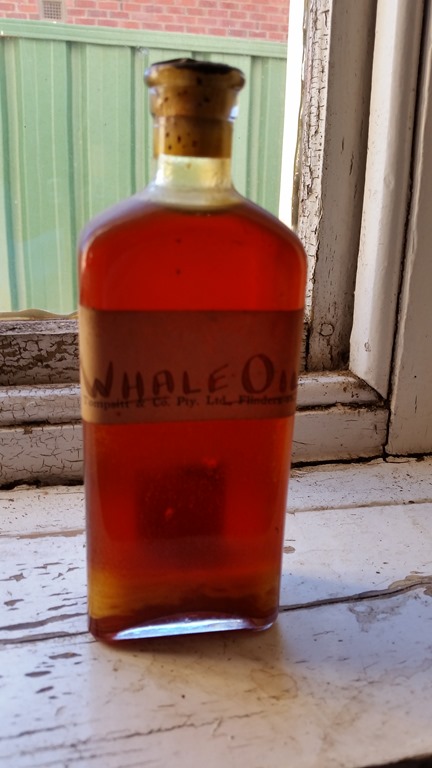
So, just as bottles were valuable and attracted a deposit 

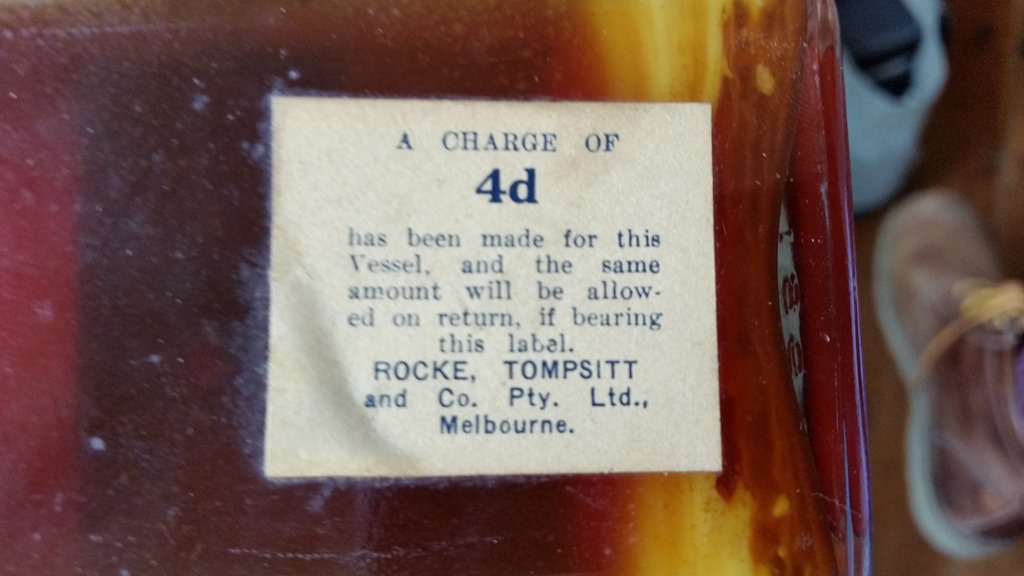
C19 bottle of Whale Oil and 4d deposit label on rear

we might guess that the same applied to ceramic pots.

And that was just a hypothesis until yesterday when I was cataloguing a plain ceramic medicine pot from Duerdin and Sainsbury, a wholesale druggist in Melbourne, who were around from at least the 1860’s until they merged into DHA – Drug Houses of Australia – in 1930.

The pot is quite unremarkable and a little battered

20190731_094601

as with all such items an exact date is difficult but stylistically the paper label looks to be late nineteenth rather than early twentieth century

20190731_094607

but the real find is a deposit sticker on the base of the pot

20190731_094706

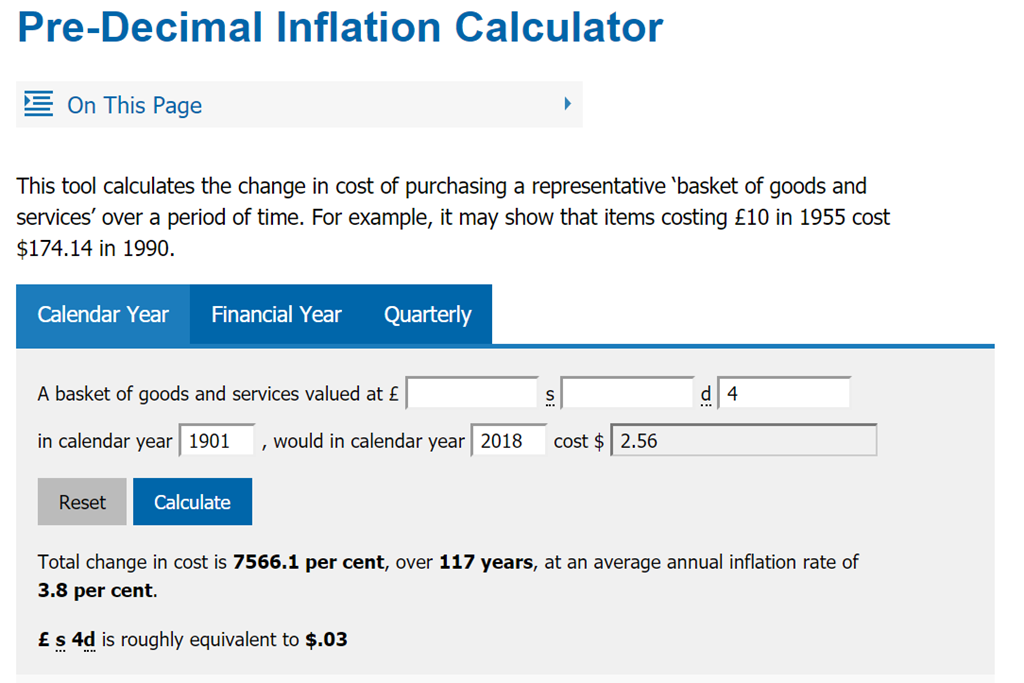
which means that Duerdin and Sainsbury considered the pot relatively valuable, and what’s more wanted the pot back for reuse – and 4d was a reasonable sum – using the RBA’s pre decimal inflation calculator, 4d in 1901 comes out at a little over $2.50 today

Annotation 2019-08-01 095521

and closer to $3.50 if it dated from the 1860’s – so, given we don’t know the exact date of the pot, we can wave our hands and say that the 4d deposit was worth around $3 in today’s money – not massive, but certainly enough to make you think twice about throwing the empty item away …

Posted in Uncategorized | 1 Comment

And it’s not just magnetic media …

Now I know I’ve been banging on about the loss of knowledge as regards analogue magnetic media – audio and video tape – but yesterday I was reminded that it’s not just knowing about magnetic media that’s important.

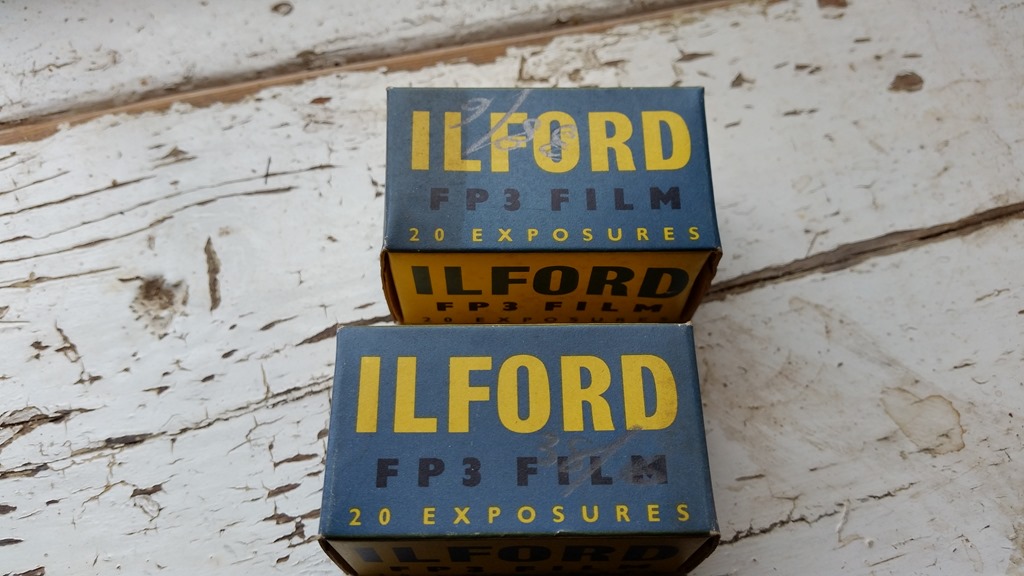
Yesterday when I was cataloguing some unused films at the project:

20190719_135353

Now, the shop closed in 1968, a couple of years after decimalisation, but the film stock is older –  the latest film has an expiry date in the late sixties – March 1969 – but a lot has earlier expiry dates – mostly the mid sixties but some, in an obscure size, the mid fifties of the last century.

I guess, that as the owners never threw anything away they just kept the stale film stock on the shelves in case someone was desperate enough to buy it.

Now, from my teenage years well into the nineteen nineties I was an enthusiastic amateur photographer, developing and printing my own pictures – even had my own home lab at one stage, and consequently I thought I would be reasonably familiar with the material – Kodachrome, Tri-X, EktaChrome and Ilford FP4 and HP5 – all as 35mm film of course, and consequently should be fairly straightforward to document.

Well, how the mighty are fallen.

Well there’s a small amount of 35mm film, but most of it was in earlier formats 120, 127 and even 616, but no 126 film, which was strange it was first released in 1963, but at least all the formats that I found had been documented.

But it was a different story with the film types. While some that were still in use in the 1990’s, such as Kodak Tri-X and Ektachrome were documented it was a different story for the earlier types Kodak Verichrome, Ilford HPS, FP3, Sellochrome are sparsely documented if at all.

I suspect that the reason is that while amateur and professional photographers produced reasonable documentation on the films they used from the beginning of the web- say the mid nineties – until film stopped being a mainstream medium a decade or so later, they never documented what they never used, never bothered scanning spec sheets etc.

There is some information out there on photographic chat boards about what these few people mad enough to still do wet film processing did to successfully process and recover images from old exposed unprocessed films, but that’s as far as it goes – a lot of the basic information is simply missing – or if it’s still around is sitting dustily and ignored in some photographic society archive.

Now, in the scale of things, it’s nothing big, but just suppose we found a bag of unprocessed film cassettes containing images related to the early American or Soviet space missions, or old roll film with pictures taken during the heroic ages of archaeology and anthropology – how good a job could we do of recovering the images ?


Posted in Uncategorized | Leave a comment

The dimming of the late 20th century

I’ve recently blogged about digitising analogue tape cassettes, and reading old 9 track tapes, both of which covered the problem of getting data back from old media.

The equipment goes, people retire, and suddenly the data’s inaccessible. It’s inaccessible because not only does the hardware cease to work, the people with the expertise get old and retire.

It’s not a new problem – it’s been known about for at least 10 years, but it’s an increasing problem.

For example, when I started at York in the mid 1980’s we had a room with various computers in it, all of which had different disk formats – even if they looked the same you couldn’t read a 3.5” Mac disk on an Apricot, or a PC. and much the same could be said for 5.25” floppy disks – some were single sided, some double sided, and some had decidedly weird sector maps.

Our solution at the time was to connect all the various machines to the university VAX cluster, and transfer files as binary items using the Kermit file transfer program, Kermit having the advantage of being truly multiplatform and error correcting, so that what was sent was the same as received.

We usually then converted word processor document to a standard format such as Wordstar, using a specialist software conversion tool such as word for word. (Word for word is long gone but many of its conversion filters live on in Libre Office. AbiWord also supports a range of exotic conversion filters such as TeX.)

Nowadays, we probably couldn’t provide such a service. The machines are either dead or in the case of York,  donated to the Jim Austin computer collection, and we may no longer be able to read the media, or identify which machine wrote it – after all one 3.5” disk looks very much like another.

However, it’s also the death of expertiese. I am retired and what’s more live 20,000km away, and most  of my colleagues who had anything to do with file conversion and equally retired and equally scattered if not quite so far away.

And this constitutes a problem. We’re getting older, perhaps forgetful, and not close to the hardware, and I’m sure there’s valuable data out there sitting on someone’s shelf in a box of old floppies  …

Posted in Uncategorized | 1 Comment

Nineteenth century lunacy in the Cape Colony

A few months ago, I wrote about lunacy in the Victorian goldfields in the nineteenth century, or rather I didn’t, but I did pose the question about the treatment of the wandering disturbed who inevitably would have been attracted to the goldfields and who possibly eked out a living begging and doing odd jobs on the fringes of goldfields society.

I recently came across a South African book – Homeless Wanderers: Movement and Mental Illness in the Cape Colony in the Late 19th Century – which I bought for its title alone, thinking that it would deal with the wandering lunatics that would have equally been attracted to the goldfields and diamond mines of late nineteenth century South Africa.

The book didn’t turn out to be that – rather more an account based on nineteenth century colonial records on the treatment and management of the mentally ill in the Cape Colony, something that appears to have been done with some compassion, despite either the lack of facilities or real knowledge of mental illness.

Prior to the mid nineteenth century, the mentally ill were either cared for by their families, or else rejected and left to wander the countryside. Only if they were violent psychopaths were they confined, and then more society’s protection than their own good.

All colonial societies faced the problem of those who arrived, became mentally ill, and having no family to care for them, became a problem for society, and hence the establishment of asylums to care for these unfortunate individuals.

In fact the colonial administration tried, where possible to track down family members who might be willing to bear the costs of treatment, as well as passing laws to discourage the mentally ill being dumped in the colony – the fear being that ‘mad cousin Charles’ would be sent out to the colony to get them out of the way,

What emerges though is a vivid picture of the treatment of the mentally ill, and one aspect that I had not really thought of – the difficulty of transport of the mentally ill in a developing colony – such as the tale of a disturbed woman confined for her own safety in ‘a brick shed in the wilds of Pondoland’, miles from any railhead.

Presumably the shed was used as the only secure accomadation available, and even then the local magistrate was concerned that her repeated attempts to dig her way out of the earth floored building would lead to a wall collapsing and injuring her.

Likewise, there were the cases of women, mainly Russian Jews, fleeing persecution in their native company, who were stressed and traumatised by the experience of losing everything and being at risk of rape and exploitation while fleeing, and who, when pregnant or when they gave birth suffered episodes of extreme anguish.

We learn of these cases of course, precisely because these women were refugees, with little or no immediate family to turn to, and therefore were subject to discussion by the Colonial authorities.

And while there were attempts to recover costs, there was also a degree of reciprocity amongst the various settler polities in Southern Africa, including were, in the case both Rhodesia and the German colony of South West Africa facilities to care for the disturbed were less developed (or in the case of Rhodesia in the early days, non existent) that it was better that individuals be treated in South Africa.

Treatment of course, at this time essentially being confining disturbed individuals somewhere separate from the rest of society, and at the same time providing a relatively stress free environment in the hope that the individual might in time recover.

There were no anti psychotic drugs, or punitive treatments such as electroconvulsive shock at this time, so other than attempts to calm disturbed individuals through the use of opiates, treatment usually consisted of rest and what might now be called occupational therapy through gardening and handicrafts.

So, an interesting book, even if it covered a different aspect of the topic than I expected …


Posted in Uncategorized | Leave a comment

What was thrown away and didn’t survive

The most recent post on the Christchurch Uncovered blog has been gnawing away at me over the past few days.

In the post the author suggests that what we find in the archaeological record are those items that were seen as cheap and hence disposable, and in the case of Christchurch in the nineteenth century that seems to be cheap imported willow patterned crockery.

Other more valued items were cherished, had a longer lifetime, and were replaced less often.

And the same goes for items such as bottles and pickle jars – irrespective of the value of the product the containers had value because they could be reused, and were not easily replaceable – just as my mother hoarded reusable jam jars for preserving fruit – a habit gained from the second world war where glass jars were scarce and it was important to make supplies of fruit last.

So perhaps what we see in old rubbish dumps is the stuff that wasn’t valued and could not be easily reused – after all, while a single Keiller’s ceramic marmalade pot might make an impromptu jar for flowers, one probably doesn’t need twenty seven of them.

And the there’s also the stuff that was thrown away almost immediately, such as the wrappers for patent medicine bottles.

We’re lucky enough in Dow’s Pharmacy to have a bottle of Hall’s Vegetable Pain Conqueror, complete with its 1880’s paper wrapper.

Paper wrappers on the whole did not survive, as they probably ended up as waste paper to help light the fire – the wrapper was not valuable but it was useful.

The consequence is that we don’t know a lot about Victorian and Edwardian packaging.

We have enough examples to know it existed, but possibly not enough to say much more than that.

Which us a shame, as packaging does tell you something about a society.

It tells you what they valued, and what they didn’t.

And I’ll illustrate this by a little story:

In the days of film photography, in the nineteen eighties, I used to like taking (and developing) 35mm black and white photographs.

In the main I used Ilford FP4 and HP5 film, and sometimes Tri-X from Kodak.

All these films came in a nice firm cardboard box, the film was in a nice metal cassette, and the cassette came in a nice plastic container with a push on top.

The other film I used was OrWo from the then GDR. Cheaper, perhaps not such a good grain quality, but definitely usable. The OrWo film came in a crudely printed soft cardboard recycled paper box and the plastic cassette was simple wrapped in lightproof silver paper.

Now I had all my own darkroom equipment, even my own enlarger, and I could process the films myself, which of course meant I rapidly ended up with pile of used empty cassettes and plastic film containers.

The way you could really save money was to buy film in bulk and reload used cassettes, which is exactly what I did – all you needed was a darkroom, a bench, an empty cassette, and some masking tape.

The only really tricky thing was popping off the end of the metal cassette to get the spool out – they weren’t designed to come off (or go back on).

Strangely enough the OrWo ones, which were plastic, and had been designed to be reused were the easiest to work with – so I tended to end up with reused OrWo cassettes stored in lightproof Ilford and Kodak containers.

The moral of the tale of course, is that it was only these bits of packaging that were useful were reused, no matter how good the original material. The cardboard boxes, and possibly the metal film cassettes were thrown away.

In the 1980’s that meant thrown in the trash, and they would simply have disappeared, but the OrWo cassettes and Kodak film containers would have survived as they were useful. In the nineteenth century, the equivalents of the useless metal cassettes would have ended up in a hole in the ground, while the reused items would have been reused until they became damaged and unusable

Posted in Uncategorized | Leave a comment

Books and bookshops

I like books.

Always have, and always will. And what I particularly like reading about is history, especially late antiquity and early medieval, plus a fascination with the Victorian era.

And what I’ve learned about these fascinations I’ve learned by reading books. Perhaps I should have made a career out of them, and perhaps I should have followed my eight year old self when asked what I wanted to be when I grew up, relied ‘An archaeologist!’.

Well kids don’t really know what they want to be, but I’d just read about the discovery of Tutankhamun’s tomb, and certainly it was one of the things that lit the flame.

Unfortunately, no one in my family had had a quasi academic career, and what careers advice was available through school was worse than useless so I ended up following a fairly standard set of courses, decided I didn’t like them, tried biochemistry – not a success, tried psychology, or more accurately animal behaviour and neuropsychology and loved it, so much so that I tried doing a PhD. Well that didn’t work out but along the way I learned a lot about computing and data which I parlayed into a succession of research support roles, making me a sort of academic groupie.

But along the way I read, voraciously, and being close to universities and cities with big bookshops, my idea of an enjoyable Saturday afternoon in winter was to browse bookshops.

When I was young and poor I had a little game with myself – I’d set myself a budget for the afternoon and scour the second hand bookshops to see what I could find that was relevant. If I could find one history book I could spend the balance on a coffee, or else a mystery novel or some science fiction, and the rest went into the pot for next week’s hunt.

And of course I didn’t always stick to it, but it was fun, and of course when I could afford to buy books without having to worry too much I stopped playing the game.

All good, but then I found myself living in Canberra, which had many qualities, but a good bookshop wasn’t one of them, well not until Borders came along.

This was the early noughties, there was nothing like Amazon in Australia, and while there were a few small companies selling books online, they didn’t have the catalogues of the big international players.

This was a problem to me, as I’d just started working on a project which involved a lot of IT stuff, but I needed to know more. I also had the problem that the Australian dollar was worth bugger all internationally so buying direct from Amazon in the US or UK wasn’t really an option.

Now the thing about computing books is that they are often really expensive new, but older editions are cheap second hand as they may refer to an earlier version of software.

So I discovered the early online second hand booksellers, and bought a pile of remaindered books about text manipulation and archiving to keep myself ahead of the curve.

And I started buying some of my recreational reading the same way – not always cheaper – but certainly doing so delivered greater choice.

Then the kindle (and other e-readers) came along. Great for linear reading, great for the mystery novel you read on a long flight, and absolutely useless for anything with footnotes and references which needs something a bit more non-linear, more hypertextual.

So the mix of what I bought changed – and indeed not everything is available on the kindle, not to mention that some publishers set their kindle prices within a dollar or two of the price for the physical copy of the book making second hand or remaindered a viable option even for books you might consider ‘disposable’.

And now I’m retired and living in a rural area – no decent bookshop within miles, and even though there’s a shop than specialises in bin ends and remainders in Albury – I sometimes still go and play the book hunt game for old times’ sake – almost everything I buy is bought online from second hand vendors.

Is it the cheapest way of doing it? Probably not, but it delivers choice, unimaginable choice, and that’s certainly worth paying for …


Posted in Uncategorized | Leave a comment

What 1860’s women actually wore to go swimming

Punch to the rescue:

This rather charming cartoon from the 3 August 1867 edition of Punch (see http://www.victorianweb.org/periodicals/punch/seaside/15.html for attribution etc) clearly shows that most of the young women depicted are wearing a simple shift.

Which makes perfect sense – it allows reasonable freedom of movement, hides the shape of their bodies, and probably allowed them to swim a few strokes if they wished.

Given that photography in the 1860’s was a cumbersome business there are very few beachside photographs, however Punch cartoons, satirizing as they do the habits and foibles middle classes are drawn from life and are mostly reasonably accurate as regards dress, etc


Posted in Uncategorized | Leave a comment

Three men and a Bradshaw–a review

I’ve been reading a book – Three Men and a Bradshaw – which is an edited set of Victorian travel journals by John Freeman, a London clerk.

John Freeman’s journals date from the 1870’s and are roughly contemporary with those of the better known Francis Kilvert, but unlike Kilvert’s, his journals only cover holiday trips with his brothers, rather than the full run of daily life.

However while John Freeman can seem a bit priggish at times – he was teetotaler and an enthusiatic member of the Tonic Sol Fa movement, his diary does reveal rather a lot about travel and vacationing in the 1870’s.

Like Kilvert – who railed against having to wear cotton pants to go swimming – he enjoyed swimming nude in the sea – the Freeman brothers enjoyed a naked dip or two, but then it was still the norm for men to swim naked in the 1870’s.

And that actually leads to a little puzzle. While on Jersey the brothers went for swim one morning, accompanied by Lucy, who was the wife of John’s elder brother George.

Lucy had intended to swim with the brothers, but was unable to as all the bathing machines had been put into storage for the winter.

Now a bathing machine was more than a changing hut – it was pushed out into the sea to allow whoever was inside to enter the sea without being seen, and indeed they often had quite large canvas hoods that folded down to ensure privacy.

Equally we know from department store catalogues and cartoons in Punch that bathing suits for women were available from the 1860’s onwards – and these usually consisted of a heavy serge dress and pantaloons, which would undoubtedly make swimming rather difficult.

Photographs from the era are almost unknown, and cartoons from Punch usually refer to the situation at crowded resorts such as Brighton on a public holiday, so we don’t actually know what the situation was at all resorts, especially remoter out of the way ones.

However, there’s also some evidence that some women only wore a light shift to swim – but unfortunately the only  evidence I’ve found relates to a moral panic in Margate, but it does remain interesting that Lucy was obviously happy to swim with the brothers – all of whom would have been naked, and possibly wished to wear something rather lighter than a heavy serge bathing suit to do so.

However, there’s more the journals than nude swimming – what shines through is the importance of the penny post for keeping in touch with family – the brothers are always writing letters home or interestingly receiving post restante letters from home – it’s always interesting to realise how much the penny post in Victorian times was about two way communication – much as we would use Facebook Messenger or email to maintain a conversation. This of course was function of the general efficiency of the Victorian era post office – letters were invariably delivered, even in remote areas, within a day or two of being posted, and in big towns there would be several collections and deliveries a day.

The other major trope is the effiiency of the various private railway companies.

The Freeman brothers used the rail network extensively for their walking holidays, and their journals are full of comments about the trains – mostly that they were late – sometimes ludicrously so, and dirty.

Despite what may be our view today, the mid Victorians clearly did not view the railway companies as models of unbridled efficiency.

The other aspect to the trains was that in the 1870’s the railway network was not complete – for a walking holiday in Devon the brothers had to use a coastal packet to complete their journey to Ilfracombe, and even when it was complete taking an overnight packet boat from London to Edinburgh was a more comfortable alternative than taking the train …

Posted in Uncategorized | 2 Comments

Murder most foul (or perhaps not)

A couple of years ago, I became fascinated by the Madeleine Smith case – not by the story itself, involving as it did sex and murder among the middle classes of 1850’s Glasgow, but how it was reported world wide.

Madeleine was accused of poisoning her lover by putting arsenic in his cocoa.

She wasn’t the first to do so, nor was she the last, but she was one of the first to be reported in newspapers around the world, in part due to the development of the electric telegraph – although of course the Madeleine Smith case happened before Australia was connected to the rest of the world by telegraph.

She wasn’t the first – the murders perpetrated by Sarah Chesham, aka Arsenic Sally, in the early 1850’s in Essex were reported reasonably widely in Australia.

Other earlier murders less so. For example, Ursula Lofthouse, who murdered her husband in 1835, and was incidentally the last woman to be hanged in York, appears not to rate a mention, despite the case being reported widely in Yorkshire at the time.

However, the use of arsenic by women to dispose of unwanted husbands and lovers was certainly common currency by the 1850’s, and is the reason that sales of poisons became restricted in the late 1850’s in England, and a little later in Victoria and New South Wales.

It didn’t stop it happening though. Louisa Collins, the last woman to be hanged in NSW, managed to poison both her husband and lover, probably to get an insurance payout.

What is interesting though, when you read the newspaper reports of the time is how careful the authorities were in Victorian times to determine the cause of death, usually having autopsies performed by two separate doctors, and often having tests for poisons performed by two analysts.

Just as in the case of the attempted rape of Catherine Morton in Beechworth in 1858, where the victim was blindfolded and given bottles of different substances to smell to confirm the use of chloroform, there seems to have been an attempt by the authorities to use objective scientific methods to obtain a conviction rather solely relying on witness statements.

Of course this could work against them – in the case of Louisa Collins, her husband was a wool processor and employed arsenic in his work – and it was possible to argue for accidental poisoning.

I was curious to see if I could find reports of similar scientific tests being used in murders in the Beechworth area during the gold rush period. Arsenic is often found in gold deposits and is still a hazard in the washout from old mine tailings, so I would have expected to find cases of suspected accidental poisonings which turned out to be murder or attempted murder.

Well, I didn’t find any, but I did find a sensational case from the 1880’s. The fullest report can be found in the Albury Banner and Wodonga Express of 16 July 1886, and a rather shorter version made it into the Press in Christchurch in New Zealand.

Essentially, the murder victim’s body had been burnt, perhaps to get rid of the evidence, and the alleged perpetrator, Harriet Stevens,  claimed that she had a small taxidermy business and consequently had a legitimate use for arsenic. She also claimed that the victim’s house had been struck by lightning at the time of his death and that was why the body had been burned.

Despite two of her previous partners having died in mysterious circumstances, the evidence was not enough to convict Harriet Stevens of the murder of John Plum.

Incidentally her (last) husband John Stevens appears to have been an equally dubious character, but nowhere near as bad as Harriet Stevens …


Posted in Uncategorized | Leave a comment

Libraries …

Yesterday I tweeted a link to an article from the Atlantic about how libraries, and we really mean university and research libraries, are seeing a massive decline in the use of the books on their shelves.

No real surprises there. Some years ago, ANU cleared a lot of books off their shelves to make space for student study areas – informal sitting areas, classic desks, power sockets and wifi – basically the aim was to provide a warm and congenial workspace.

Likewise if you visit the State Library in Melbourne, the reading rooms are crammed with desks equipped with power sockets and of course wifi is everywhere.

Even more humble establishments like the Albury Public Library, provide well equipped workspaces, and even really small public libraries can provide a viable workspace – just add wifi and desks.

Everything else is online. Digitised newspapers, older books, the rest it’s all online.

It’s even possible to do family history online – no more trekking to old record offices, or sending off requests for copies of old documents, all you need is a computer and some sort of affiliation to access some databases.

My best example is the work I’m currently doing for the National Trust, documenting the contents of Dow’s Pharmacy in Chiltern.

Some of the work is fairly mechanical – brown glass bottle ~120mm h, metal cap, etc, printed label …, but some of it isn’t.

Some of it involves tracking down vanished pharmaceutical companies and finding information on when they were in business, what they sold, who, if anyone, they were taken over by, etc etc,

Background information, and in many cases more interesting than the actual material – like the story of Hayman’s Balsam of Horehound, and what it says about nineteenth century trade patterns and the rise of newspapers as advertising media following improvements in printing technology, cheap woodpulp paper, the reduction of taxes on newspapers, not to mentions increasing literacy.

Or the fact that Australia had no home grown glass making until 1872, and that consequently bottles were valuable, as can be seen in the case of this nineteenth century bottle of whale oil

20190517_141049  20190517_141113

with a sticker on the back informing that a deposit of 4d – quite a substantial amount of money then, and in purchasing terms a hell of a lot more than the 10c container refund you get in South Australia today.

All this information could not have been assembled without the aid of Trove, Welsh Papers Online, the Science Museum in London, Collections Victoria, MAAS in Sydney and others too numerous to mention.

Once, not so long ago, I would have needed to visit a range of institutions to do this work, and some of it would frankly have been impossible for me, as a volunteer, to do. Even though I have the skills to do the research I would have had to cover the travel costs somehow.

But now it can be done, and is done, either sitting at home in my study, or else in a draughty nineteenth century shop byulding in rural Victoria.

And that’s the power of digitisation, and why, increasingly, reference books are basically wallpaper …

Posted in Uncategorized | 1 Comment