Sighelm and Indian pilgrims to Jerusalem

Some years ago I became quietly obsessed with the question as to whether an Anglo Saxon notable ever made it to India. The jury’s still out as whether Sighelm managed the journey, but everything I’ve read since has convinced me that it was more than possible with a whole commercial network crisscrossing the Indian Ocean from East Africa to Oman to India, to Sri Lanka, plus extensive trade networks via Alexandria and Gulf to Byzantium and the west.

And today, another pebble to add to evidence – today’s BBC magazine has an article about an Indian pilgrim refuge in Jerusalem that’s been operating since the crusades.

The fact that one man could do it 800 years ago suggests that others attempted the journey, and perhaps not only sufis but other people of other faiths on pilgrimage, travelling and buying space on ships with merchants.

So, did Sighelm get to India?

No idea, and I doubt we’ll ever know. Could he have ? Almost certainly.

Written with StackEdit.

Posted in Uncategorized | Leave a comment

A political mockingjay

Today’s Bangkok Post reports that a Thai cinema chain has declined to screen Mockingjay – the latest in the Hunger Games series.

Hunger Games was incredibly popular in Thailand, and the three finger Hunger Games salute was used by anti coup protesters immediately after the coup as a means of mocking the military. In a nicely Orwellian touch, the military responded by making the three fingered gesture illegal when used in public.

There’s of course the political protest story here, but there’s also another story – about how a globalised media influences the iconography of protest, in just the same way that protesters in Tharir square in Cairo held up signs saying ‘Game Over’ when Mubarak fell.

Five, ten years ago this wouldn’t have happened. It would have been flags, banners, and slogans screamed through loudhailers.

Globalisation and the communications and internet revolution is changing the world, but not necessarily in the ways we expected (or predicted) …

Posted in Uncategorized | Leave a comment

Greeting cards and thank you notes

Amanda, J’s niece, has a daughter who’s just turned three.

Old enough to appreciate that she’s had a birthday so we sent her a card (we also have a glove puppet for her but we were totally disorganised, so we ended up ordering one of these print on demand and send express cards at the last minute – the glove puppet will have to wait until Christmas), reckoning that she’d appreciate one of her favourite cartoon characters.

Well she did. Now in the old days her mum would have helped her send a thank you note – say a set of scribbled orange blobs claiming to be a picture of something, and J would have stuck it fondly on the fridge.

Well, that’s so last century. We got a text message with emoticons. Given she’s three I’m guessing her mum might have helped her a little.

Which was nice. Provoked the same fond reaction, even though it didn’t end up on the fridge.

But that actually opens up a bigger question now that the card sending season is coming – even if you send people physical cards (albeit ordered from said print on demand  people), what do you do about the ecards, text messages and so on you get in response?

You could print them out, but that seems a bit boring. I have an alternative idea -I’ve got one of these cheap $10 media display units, so I’ll convert them all to jpegs, save them to a USB, and autoplay them on the kitchen tv. I could even be a bit kitsch and add some festive music.

Yes, it’s a bit naff, but at least it’s fun …

Posted in Uncategorized | Leave a comment

Queensland Rail withdrawing sleeper services

Way back in June, we rode the Sunlander from Brisbane to Cairns, knowing that it was the last year we could make such a trip, as the sleeper service was being withdrawn in December.

Turns out that Queensland Rail are also going to withdraw the sleeper service from two other trains, The Westlander from Brisbane to Charleville way out west, and the Inlander the service from Townsville to the mining town of Mount Isa.

Effectively, this means no more sleeper services in Queensland, and apart from a service still operated by NSW trains, no sleeper service left in Australia except for tourist services like the Indian Pacific.

I guess we’re probably seeing the same as in Europe, where the discount airlines have eaten the sleeper trains lunch …

Posted in Uncategorized | Leave a comment

Cannons, Cooktown and the Russians

We’ve been having a little panic over the appearance of a Russian battle group in the Coral Sea – this isn’t the first time we’ve had one – Cooktown town council panicked in the 1880’s about the need to defend themselves from the Russians during another time of paranoia and received a single Crimean war vintage cannon from the Government.

There might be bit of poetic justice there. It’s also important to realise that British and French warships attacked Petropavlovsk-Kamchatsky on coast of Siberia, north of where Vladivostok now stands, during the Crimean war. Global reach was as much a nineteenth century thing as a twentyfirst century concern.

And Cooktown, while today it’s a sleepy town at the end of the bitumen, in the 1870’s and ’80’s was a dynamic go ahead gold mining centre with direct shipping links to Guangzhou, Singapore and India, and crucially had a telegraph link south.

While most of the mail from the outside world came via Galle and Albany, some of the mail from the UK landed first in Cooktown and, before Australia was connected to the outside world, the Cooktown wire helped spread the news of events overseas.

So Cooktown had some strategic value. What’s also not realised is that Russia has had a long history of involvement in the Pacific.

During the American civil war, when Confederate commerce raiders were wreaking havoc, the Russian navy patrolled the Pacific in support of the Union forces. Russia also had interests in Hawaii and other places, mostly on the back of whaling and a bit of general commerce. And there was a great concern that Russia might plant a colony in New Guinea. (In the event it was the Germans who created Deutsche Neu-Guinea in the north of the island and the British, in combination with the Australian colonies who created a protectorate in the south as a buffer)

So it’s hardly a new thing for there to be a Russian presence off the coast of Australia – nor is paranoia about Russian vessels off our coast

Posted in Uncategorized | 1 Comment

A day in Brisbane

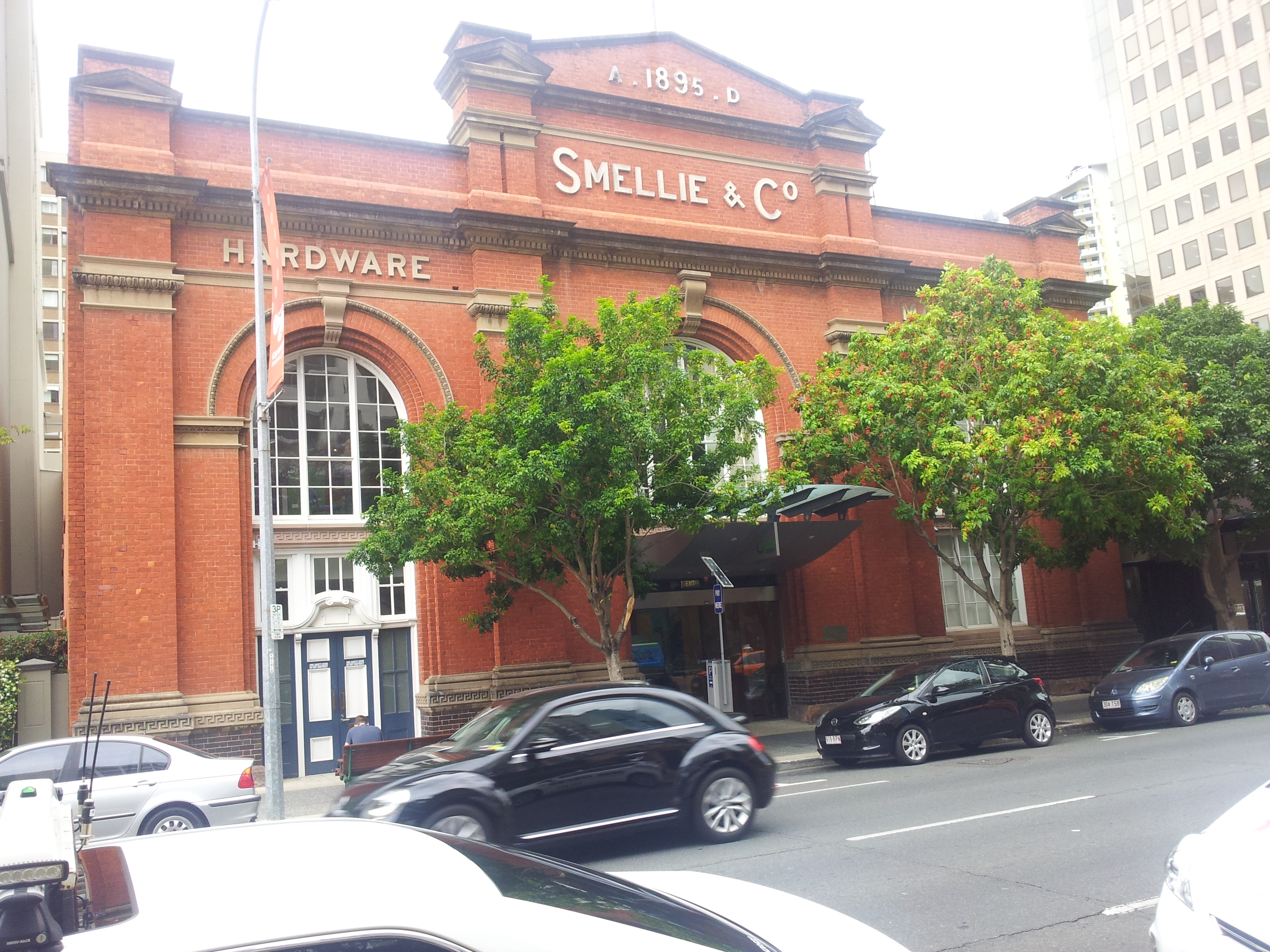
2014-11-03 12.50.34 Yesterday, I went to Brisbane for a work thing – it wasn’t all work – I managed to snap this rather fine bit of 1890’s architecture in Edward Street just down from QUT in the old core of the city – but it was interesting.

As it was a work thing I didn’t have time to goof off and take a gander at the quasi romanesque building that so fascinated me last time I was in Brisbane and the QUT art museum was closed – it was a Monday – but I saw enough of the old core to see that there’s quite a number of interesting vernacular buildings, including the old State House in the middle of the QUT campus – again, like the old parliament building in Sri Lanka – one that’s most definitely out of the nineteenth century parliaments – colonies for the use of  design book.

Being November the city was heading into it’s hot sticky tropical phase, and as part of the run up to the G20 summit, the centre seemed to be crawling with cops, all checking that the drain covers had been properly secured and not tampered with.

On the other hand the city was quite fun – where else would you get someone with a bit of entrepreneurship selling bananas and cold bottles of water at a dollar apiece out of a streetside stall outside of the botanic gardens and nicely undercutting all the franchises and takeways clustered round QUT.

Journeying in from the airport I shared a cab with a colleague but on the way back I rode the train, which was cleaner and faster than Sydney’s equivalent and I was quietly surprised at just how good the on board wifi service was.

I’d brought the recently resurrected Ookygoo with me to write up my notes and I was also quite impressed at just how fast it was and how well it performed. The only gripe I had was that when I got to the airport, Qantas’s free wifi service for customers was truly borked, and instead of letting me login, the authentication web server just continually looped – on my personal Android mobile and my work iPhone, as well as on my laptop – so it wasn’t that it had been traumatised by the appearance of iceweasel.

The last few time I’ve flown, it’s been with Virgin, and I’ve been impressed by both the quality of their catering and their provision of useful things, like standup desks, in the departure lounges to let you get a bit of work done and recharge your laptop battery. Qantas are obviously trying to lift their game, and with things like the (borked) free wifi and there can be no argument they’re on track. Certainly the inflight catering was better – dinner on the way back was actually edible, even if the offering for morning tea on the flight up was some fairly disgusting looking white chocolate confection.

As I don’t usually eat morning tea, that was no hardship, but it did remind me of the time many years ago when I was on a flight to Melbourne with J and we were offered a ‘light refreshment’ which turned out to be tepid instant coffee and something made of coconut with flecks of something brown in it.

J took one look at it and said ‘I wouldn’t eat that if I were you’, and ever since I’ve tended to view airline nibbles with suspicion. I quess that shows that the old maxim of ‘do a good job and people forget, stuff up and they remember‘ still holds …

Posted in Uncategorized | Leave a comment

Black Samurai

I’ve written before about the Portuguese and Spanish voyages of exploration in East Asia, including the possibility of a group of Portuguese sailors being the first Europeans to land in Australia.

These early european sailors had in part been driven to find a sea route to Japan, a country that had acquired near mythological status in the late medieval and early renaissance imagination.

Of course, when they got there, they found something different from the myth, but equally fantastic. No gold roofed pagodas waiting to be plundered, but instead a wonderfully exotic culture and a set of feuding polities, whatever their nominal loyalties, as interested in expansion as the Spanish and the Portuguese.

Both the Spanish and the Portuguese armed and used Japanese mercenaries in their wars of exploitation in East Asia, and introduced the use of firearms into warfare in Japan.

At the same time we find stories of Japanese going the other way, either formally, as in the Tenshō embassy, or less formally as in the story Christopher and Cosmas, two Japanese men who were captured off the coast of Baja California when Thomas Cavendish’s commerce raiders intercepted a Spanish galleon bringing cargo from Manila.

The two Japanese were captured, and there’s circumstantial evidence to suggest that the spent time in England before setting out on a second voyage, on which they disappeared from the historical record.

However, the traffic was not all one way. Those of us of a certain age will be familiar with James Clavell’s Shōgun, a fictionalised account of the life of William Adams, an Elizabethan sailor who rose to prominence in Japan.

William Adams was not the only one, but this weekend I happened over an even more remarkable story, that of a Black samurai. In its telling the story is not that remarkable – a black youth, taken as a slave in Mozambique, or perhaps Guinea or the Congo, becomes a page to a Jesuit official who is visiting Jesuit missions in Japan. A Japanese warlord, known to be fascinated by all things Western, is fascinated by the black page and somehow acquires him, perhaps as gift from the Jesuit official.

The page, the Japanese called him Yasuke, we don’t know his African name, somehow became a member of the samurai class and served as a warrior.

A fascinating story, and perhaps there were other instances. And of course there’s a tenuous link to the story of the Kilwa coins – coins from the coast of East Africa that somehow ended up on an island off the coast of northern Australia.

I’ve speculated on various possibilities in the past, one of which was that there were black sailors from east Africa and Somalia working on Portuguese and Dutch ships sailing to the spice islands, which are now part of present day Indonesia. The story of Yasuke, while fascinating in itself, also provides indirect evidence of the presence of black people from Africa among the Portuguese and Spanish mercantile and religious community in early renaissance east Asia ..

Written with StackEdit.

Posted in Uncategorized | Leave a comment

Wilkie Collins and Physiology

Before I go to sleep in the evening I like to read for twenty or thirty minutes with a hot drink – probably a sign of growing old.

I usually read stuff I find entertaining and relaxing rather than serious stuff and currently I’m reading Wilkie Collins Moonstone – google for it if you’re interested, it’s on Gutenberg with synopsis in Wikipedia.

It’s a long complex epistolatory novel, ie one in which lots of individual narratives combine to make one story – a bit like The Bridge or the Killing if you like Scandi-noir TV.

The plot is actually quite fantastical, but as with all good writing, the story, not to mention Wilkie Collins’ often highly humorous turns of phrase, carry you forward.

What I also found interesting was the way that Wilkie Collins brings in what was then a very early understanding of biopsychology and physiology to legitimise the slightly improbable end of the story, in much the same way as Bram Stoker referred to the use of  typewriters and Kodak cameras in Dracula to give an air of scientific modernity to the investigation of the mystery.

What’s of course interesting is, for this literary device to work, Wilkie Collins must be drawing on what was then common knowledge in his readership and thus implies a degree of scientific curiosity among his readers, which is not perhaps what we first think of when we think of the early 1860’s …

Written with StackEdit.

Posted in Uncategorized | Leave a comment

A little bit of history in Beechworth

Beechworth, in Victoria, is an old gold town, and quite historical.

Hidden in plain sight is a little bit of world war one history. If you go to the public loos from the main street you walk down the side of the RSL which has a couple of old guns on display.

One is a German second world war anti aircraft gun, and the other is a 75mm Krupp field gun made in Essen in 1904. There’s no mystery as to why these weapons ended up in Beechworth – after both the first and second world wars Australia distributed captured weapons to be used as memorials.

Now you might expect that the Krupp gun was captured from Ottoman forces, or possibly from German forces on the western front, but, when you look at it, the markings are most definitely not Ottoman, and simply don’t look right for German weapon – the crown is wrong and no German Kaiser had a name starting with C.

So, what’s its provenance? My first guess was that it had been an AustroHungarian gun and had been captured after being loaned to Ottoman forces in the closing days of world war one – and this was based on the fact that the crown looked vaguely east European and I though it might be one used by AustroHungarian forces.

I was however a bit troubled by the CI cipher on the barrel – Krupp stamped the date of manufacture on all weapons and there was no Emperor Karl until 1916, and anyway, his name starts with a K in both German and Hungarian.

The truth is a little more complex. The cipher is that of Carol I of Rumania, as is the crown. In 1916 Rumania joined the first world war on the side of the allies in order to make a landgrab for territory with a Rumanian majority that was formally part of AustroHungary. It did this because on the southern section of the eastern front Russia was successfully pushing back the Austrian forces.

It wasn’t a particularly successful action and Rumania was defeated by the Central Powers after the collapse and disintegration of the Russian army in the months before the October revolution in 1917.

This meant of course that the Central Powers (Germany, AustroHungary and the Ottoman empire) captured a lot of munitions and weapons from Rumania. Ottoman Turkey had previously purchased a large number of Krupp 75mm guns from Germany that were of the same design as the captured Rumanian 75mm guns making is a no-brainer for the Ottoman forces to redeploy the captured guns – they had the ammunition – they had men trained to use them – they had spare parts, etc etc.

The Ottoman 26th division had been deployed to the Rumanian front, and after Rumania’s collapse was redeployed to Palestine where they met with Australian forces. The implication is that the Ottoman 26th division brought some captured Rumanian guns with them.

At some point the Beechworth gun must have been captured by Australian forces during the end game of world war one in the middle east …

Written with StackEdit.

Posted in Uncategorized | 4 Comments

Private pictures and public knowledge

A week or three ago I blogged about the great selfie crisis. Since then I’ve come across an interesting little problem.

If you’re a regular reader of this blog you’ll know that one of my interests is that chaotic period of Russian history between the February revolution and the end of the civil war in 1923.

I was putting together a little presentation about the roles of various fellow travellers and was looking for a photograph of Louise Bryant – who was the wife of John Reed – he of Ten days that shook the world – and a journalist and writer in her own right, and continued to report on the revolution and civil war after Reed’s death.

In the course of my searching I came across a picture of Louise Bryant sunbathing naked on Provincetown beach in 1916.

Provincetown is at the tip of Cape Cod and in the early years of the twentieth century was a summer time artists colony. Louise Bryant had a play performed there, and in the summer of 1916 had an affair with Eugene O’Neill while holidaying there with John Reed.

Given that Louise was a free spirit it’s hardly surprising that she did such a thing as sunbathe naked, and the existence of such a photograph confirms things that we might well suspect about goings on within the artistic community in Provincetown a century ago.

The picture itself is not a particularly high quality image, slightly grainy, suggesting it was taken on a fairly basic camera – it’s also almost certainly posed, which is not surprising given the slow film (and forgiving) emulsions in use at the time, especially for amateur roll films, suggesting that Louise both knew her photographer and knew she was being photographed.

The (probable) use of roll film is also interesting – at the time most serious photographers used large format cameras to get the sharp image quality they wanted – suggested that the picture was most definitely taken by a friend, but who ?

Even in liberal Provncetown, it’s probably not the sort of thing that you get processed at the corner drugstore suggesting that Louise had an accomplice both in the taking, and the processing of the film.

We know from Louise and John Bryant’s correspondence it was taken in the early summer of 1916 just before her affair with Eugene O’Neill turned serious.

Intended as a private picture, sent to John Reed while he was working on a journalistic project in Chicago, the picture surfaced among John Reed’s papers after his death.

We know he received it, as in his letters back to Louise he makes a number of references to both the photograph and the Provincetown dunes.

This is not the first time and certainly not the last time that someone has sent a nude photograph of themselves to a lover, but it does raise a number of interesting questions about when the private becomes public.

Given that the picture is almost a century old, and that Louise Bryant died in 1936, and her daughter, who did not have any children is also now dead, it probably doesn’t matter, but it does raise the question as to at what point private photographs can freely be considered to be in the public domain …

Written with StackEdit.

Posted in Uncategorized | Leave a comment