Rural life in Denmark and Scotland

Since we’ve moved to Beechworth we’ve been making some use of the streaming box that our ISP included in the bundle, and one of the things we’ve been watching is 1864 Denmark’s War about the second Schleswig war.

Now, I know almost nothing about Danish history in the nineteenth century, but the production values for the tv series appear to be high so I’m going to assume that the representations of rural life, are not that unrealistic, even if the reality was smellier and more squalid.

The interesting thing is how similar the representation of rural life is to the descriptions of rural life in Scotland at the same time, both through novels such as ‘Sunset Song‘ and historical works such as David Kerr Cameron’s Cornkister Days.

Which of course begs the question as to how similar (or dissimilar) rural life was for people in northern Europe before the impact of industrialistation …

Posted in Uncategorized | Leave a comment

Finally, we’ve moved …

I’ve been quiet recently, but I’ve been absurdly busy -finally, we have moved in to our new house in Beechworth.

For a long time we had been planning to move out of Canberra when I retired, and shortly before Christmas we bought ourselves a new house in Beechworth in Victoria. The house is only new to us, in fact its core is a wooden miner’s cottage dating from sometime between 1900 and 1910.

Like all wooden houses, boards have been replaced, rooms relocated and so on, but the core of the house is still the original Federation cottage. For a long time I had fantasised about owning such a house and having a lemon tree in the back yard, and I now have both.

Of course buying a house left us with one to sell, and taking a long hard look at our Canberra house we realised it needed a few finishing touches, like new vinyl in the laundry and a new carpet in the bedroom, plus the garden needed a serious trim and tidy, all of which took longer than we hoped – we had hoped to have sold by Easter, but the house only listed the weekend after Easter.

Fortunately it sold after only a couple of weeks, so we made up some lost ground there even though the post sale dickering during the cooling off period dragged on a little.

And then we were done and had thirty days to hire a truck and move.

Now the removalists have rules about when they can take. They’ll take furniture, they’ll take household goods, even plants but they won’t take stuff like Judi’s paints and chemicals for her artworks, or the gas bottle for the barbecue, and they’ll tell you you’re better off moving things like computers and other domestic electronics yourself, so we ended up with a series of trips where we’d drive in convoy taking both cars, down to our new house, overnight and come back. Basically an 800km roundtrip. In between we became seriously adept with packing tape sealing up and packing boxes.

And then, the day before the removalists came, while we were taking the cat to the cat motel while we moved, our Subaru Forester stopped dead on an intersection and the dashboard lit up like a Christmas tree – it turned out that the alternator had died and also fried the battery – fortunately nothing else had died.

I had to have the car towed to an NRMA service centre to be fixed, and that left us without a car as we’d stupidly left the old green car in Beechworth, so we ended up hiring a car, and ended up with a Corolla hatch.

Taking the positive view, having the car die in the city where there are tow trucks, garages and a choice of car hire options was a lot better than on the freeway out in the bugger all – the way it stopped dead could have been very dangerous – hopefully we’d have been able to coast into the breakdown lane.

The Corolla was a revelation – it was a 2016 model with all the toys – a reversing camera, six speed automatic transmission and ran the cheapest discount unleaded we could buy, and was miserly with it as well – driving it compared to our lumbering SUV was like fast forwarding twenty years – even if at times the automatic transmission sounded like a sexually frustrated washing machine – certainly something to give us food for thought as we were thinking about downsizing to single smaller car in a year or so once we were sorted.

And sorting is what we’ve been doing for the past three weeks – opening boxes, finding where to put things, screaming in frustration when we can’t but we now could say we’ve done most of it.

We had the foresight to buy a flat pack wardrobe from Ikea that once assembled should solve most of our storage problems, that and a couple of no name melamine pantry cupboards in the studio and we should be right for storage.

But unpacking isn’t all there is to moving, there’s the touchy little matter of settlement, when your buyers (or rather their mortgage company) pay you and you give them the title deeds which are of course held by your bank as security for your bridging loan.

In principle a simple exchange. In practice, a complete nightmare.

Our bank lost our documents. They store them in a secure storage facility somewhere, and when they are needed they get a courier company to retrieve them and take them to your local bank office to do the deed.

Well the papers were collected but didn’t arrive. Worse the courier company had lost sight of them, somehow they fell through the tracking system and it took a week to find them. It wasn’t just that they’d ended up in Broome (or wherever), but that no one knew where they’d gone.

Our buyers had of course got their own removalist booked and had given notice on their rented property so were effectively stuffed. They weren’t, we negotiated a deal where we let them move in as if they had taken possession, but that they would have to get out and pay us for any repairs required and forfeit their purchase deposit if for some reason the sale didn’t complete, but in the meantime they assumed responsibility for all the taxes and charges.

It took what was a fairly nerve wracking week for them to find the papers and complete settlement.

But it’s done now, we’re in. We still need to fight with the bank to recover the extra costs incurred due to their stuff up but everything is done.

All in all, moving interstate proved more difficult and stressful than moving half way round the world, but hopefully we won’t need to do it again.

But it’s not been all bad.

There’s been the simple pleasure of opening the back doors onto the deck on misty Sunday morning and hearing very English sounding church bells ringing through the mist, or late on a freezing night pulling off the freeway into Albury – our nearest approximation to a city – in the hope of finding somewhere still open to eat and finding a truly excellent (and genuine) Tandoori restaurant – complete with a gaggle of waiters standing around watching MTV India as things wound down.

And of course moving to an area which is kind of country brings some surprises. Of course the Albury hardware megastore has a range of shotgun safes in the home security section, just as the bike shop rents and services chain saws.

Different, but I think we’ll enjoy the change …

Posted in Uncategorized | Leave a comment

Not fixing Ernesta …

Way back in October, I wrote about my attempts to clean up the digitised text of Ernesta Drinker Bullitt’s account of her journey through Austria Hungary and Germany in the midst of the first World war.

At the time I fully intended to clean up the text, proof read it and contribute it back.

Didn’t happen.

About the same time as I started on Ernesta, I took the decision to retire at the end of 2015. The need to finish off various bits of work meant that Ernesta took a back seat. Coincident with all of this we took the decision to sell up and move out of Canberra to country Victoria, something that’s taken a ginormous amount of time to organise, so I’m afraid that poor Ernesta has languished in a corner of my cloud storage account.

But I did want to read the book, so a month or so ago I gave in and ordered a print on demand version from one of these Indian specialist print on demand companies. I’ll admit I partly did this because there’s a couple of old reference texts I wanted that are available through the same people, so I thought I’d try out the process on something less crucial.

Well the book took an age to come, something I’ll blame on the Indian postal service more than anything else, but it arrived well packed sealed in plastic inside a cardboard sleeve, and covered with a zillion postage stamps.

Print quality was good and clear – yes there’s the odd artefact from the scanning process but the book is perfectly legible, and well bound with the edges nice and sharp. The paper used is good quality, perhaps a slightly lighter weight than I would have specified, but otherwise fine.

The cost of the whole thing was about what you’d pay for a new Penguin Classics paperback here  in Australia – not extortionate but not remarkably cheap either.

That said I’d certainly go down this route again with hard to find texts, especially those that I was using as reference material …

Posted in Uncategorized | 2 Comments

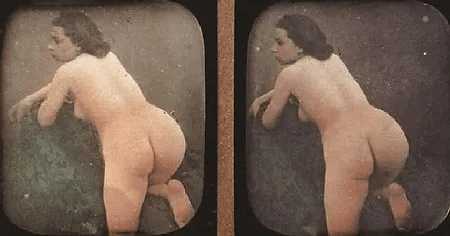
Tintypes, stereoscopes and porn

stereoscopic-nude-2

I started out, innocently enough, looking for images from the Crimean war, and falling through a set of internet rabbit holes, found myself looking at a website devoted to early erotic daguerreotype and ambrotype stereographs.

Stereographs are of course made from a pair of slightly offset images, that viewed from the correct distance through a viewer give an impression of a 3D image.

Popularised by David Brewster among others, stereographs were very popular in the early days of photography, and obviously they were popular for more than viewing pictures of Queen Victoria being graciously pleased.

The erotic images are perhaps a little less explicit than those you can find on the internet today, the models are plumper, pubic hair is rather more evident, but basically not a lot has changed in the 150 or so years since these images were made. And interestingly quite a few of the surviving images have been expensively hand tinted suggesting that there was a market willing to pay and pay well for such material.

I’m reminded of the diarist Frances Kilvert’s comment on a visit to London which included an attempt to buy  some religious photographs from a shop in Burlington Arcade and that the proprietor of the gallery was reputed to  sell obscene French photographs, suggesting that such material was available to those with the money to pay for it and the business was profitable enough to cover the running costs of a shop in an upscale location …

[27/07/2016]

Coincidentally, I happened across this article on early French erotic postcards a few days ago – worth a read if you’re interested in the seamy side of Victorian life …

Posted in Uncategorized | 4 Comments

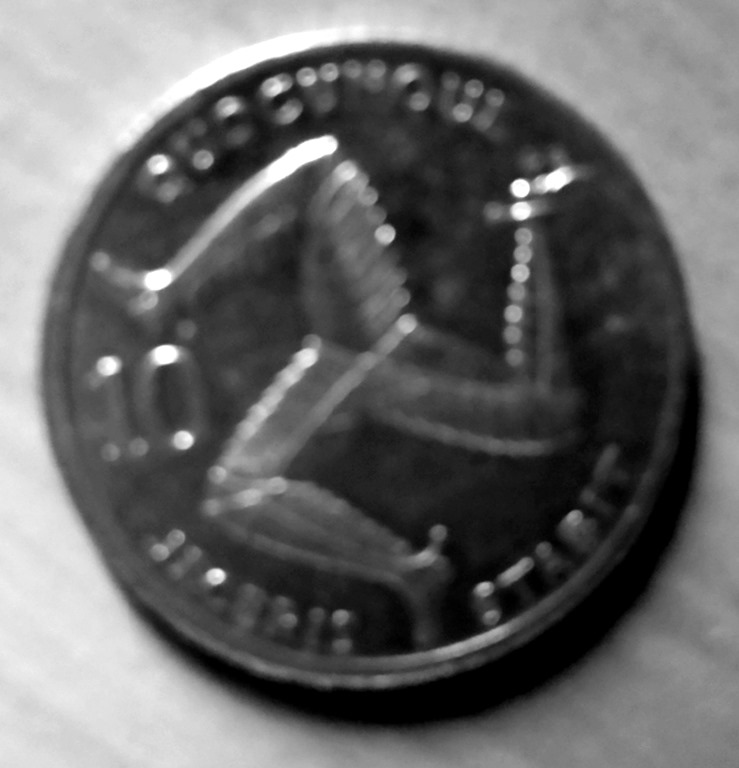
A 10p mystery

iom_10c

On our back deck, beside the outside tap, we have a couple of ornamental bamboos in pots. This afternoon, as I was filling a bucket, I noticed something shiny under the roots of one of the plants and, being curious by nature, I had a closer look.

It was a coin, a ten pence coin, but one from the Isle of Man. Well, neither of us has ever been there, and we can be sufficiently sure of Australia’ strict biosecurity laws to guarantee it didn’t come with the plants or the potting compost.

The pots do however have an ornamental stone mulch on the top. These mulches are quite often come from Thailand, Indonesia, or elsewhere in south east Asia, so it would just about be believable if I’d found a couple of one or two baht coins.

My only guess is that sometime between 1992, when the coin was minted,  and whenever a river somewhere in south east Asia was dredged for river pebbles, someone from the Isle of Man who was visiting the area slipped and dropped a couple of coins.

I’ve written before about out of area coin finds, such as Roman coins in Africa and of course the Kilwa coins, so it was kind of interesting to have a personal experience such as this, even if it was with something as mundane as a 10p coin from the Isle of Man …

Posted in Uncategorized | 1 Comment

Epistolatory

  John Leech’s 1861 cartoon for Punch of a man reading from Collins’s book. Photograph: Universal History Archive/Getty Images

I’ve been rereading Wilkie Collins’ ‘Woman in White’ while at the same time watching ‘The Bridge’ on SBS, and I’m struck by their similarity of structure – lots of individual events and stories, told (or centered) around different characters, all of which appear initially to have no real connection and some of which become connected, and others vanish.

Posted in Uncategorized | Leave a comment

The Ly-Ee-Moon

While we were at Tathra last week we went to Green Cape for a swim at Bittangabee and a walk from the lighthouse back towards Bittangabee via Pulpit Rock.

About 300 metres from the car park you pass the cemetery from the wreck of the Ly Ee Moon which came to grief sailing from Melbourne to Sydney on the evening of the 30th of May 1886.

It’s quietly affecting especially the list of the dead, including such pathetic descriptions as ‘an unknown Greek, given passage at the request of the cook’, and ‘a man with a German accent’.

However, I was also intrigued by the name of the ship, which was clearly Chinese, at a time when most ships in Australian waters had staunchly anglo names.  As in many things wikipedia is your friend – search it for Ly Ee Moon and it comes up with Lei Yue Mun, the name of a channel in Hong King harbour, not surprising given that the ship was first built as a paddle steamer for the opium trade. She also had a walk on part as a blockade runner sailing into Charleston during the American civil war when paddle steamers were preferred due to their ability to handle shallow draft harbours rather better than the screw powered ships of her time.

After her time as a blockade runner she returned to Asia, ferrying Chinese migrants to Cooktown and acting as a backup mail ship should the telegraph cable from Darwin to the Netherlands East Indies fail, and somewhere along the way was rebuilt as a screw powered vessel, caught fire and was scuttled and raised again, and became a ship on the Melbourne – Sydney run.

The wreck itself was controversial – the lighthouse was operating and conditions were such that it should have been clearly visible. There were strong suspicions of incompetence at the time but nothing was ever proved.

History is all around us – you just need to look.

Posted in Uncategorized | Leave a comment

The treadmill we make for ourselves ..

It’s an open secret we’re fixing our house up for sale. Having decided to retire there didn’t seem much point to staying on in Canberra – rural Victoria seemed a way better option.

Of course when you put your house up for sale you realise that the kitchen ceiling needs repainting, the toilet door lock really should be fixed, and that little bit of board needs installing.

So, last week we reached the point where (almost) everything was done save some outside weeding and and pruning, and we decided to reward ourselves with three days on the coast.

We went to Tathra, which also gives you a digital detox. Cellphones don’t work there – not quite true, up on the headland, Telstra ones do, but if you’re Optus, Virgin, or anyone else, forget it.

Down on the bay, not even Telstra works. Which is kind of interesting. No one looks at their phones in restaurants. They talk to each other.

Of course, as we found when we went for an evening picnic, some unexpected places get a signal, but basically from about 10km out of Merimbula, north to the edge of Bermagui, there’s not a deal of coverage.

Which is fine. Promotes a relaxed lifestyle, and if you do need to check email or twitter, it’s either a coffee somewhere with free wifi or a drive up the coast.

Gets you off the treadmill we make for ourselves.

Posted in Uncategorized | 1 Comment

An automated survey

There we were, sitting on a beach in the Mimosa rocks national park sharing a picnic and watching the sun go down,  when my phone rang.

A surprise in itself, as we expected to be well out of cellphone range, but it was a Victorian number, so as we’re buying a house in Victoria, I answered it

Bad mistake.

“This is a short automated survey about federal politics”

For a millisecond I was tempted to launch my phone into the waves.

Don’t these people understand people have lives and only sad people are going to fill in a survey…

Posted in Uncategorized | 1 Comment

Boer war reminiscences

When I first lived in York, I lived in Milner Street, in a brick terrace house built in the early 1860’s by the railway company to lease to its clerks.

The name ‘ Milner’ always puzzled me – the adjoining streets were Beaconsfield Street and Gladstone Street, names that were a little too early for the 1860’s, but then the streets had clearly been bit piecemeal with blocks of half a dozen houses being built separately.

My guess is that sometime at the end of the nineteenth century the council decided to tidy up the street names and (re)named the streets after notables of the time.

Beaconsfield was of course Disraeli and Gladstone was self evident. But Milner ?

My best guess is that the street was named for Arthur Milner, the British High Commissioner for the Cape Colony and one of the instigators of the second Boer war. I could of course be hopelessly wrong, but the only Milner of note in Wikipedia is indeed Arthur Milner.

I’ve got to confess that I only heard of Arthur Milner while watching a travelogue on tv where the host visited a pub called the ‘Lord Milner’ in Oudthoorn – something deeply symptomatic of the lack of information about the Boer war.

Later on I lived elsewhere in York, in a street built in 1904 and with an impeccably English name, but one of the cross streets was named Colenso Street, something I always thought a trifle weird and out of place. Not until I read Thomas Pakenham’s history of the Boer war did I realise that Colenso was the site of an important battle of the war.

At the same time, my parents lived in Edzell, a village in Angus, Scotland, hard by the Kincardineshire border. Unusually, as well as the conventional war memorial for the first and second world wars, it also has second memorial, this time to the Boer war – the immediate question being why Edzell and why not other towns?

When it comes to the Boer war it’s as if a veil has been drawn over the whole sorry story of the war, and a sorry story it is too.

However the Boer war is more than just the story of a colonial landgrab  – if it hadn’t been fought the experience of the BEF in France during the early days of the first world war might have been sorrier than it was, for the simple reason that the Boer war was the first time in fifty years the British did not simply fight hopelessly outgunned tribal levies, but fought a foe equipped with modern weapons and an understanding of modern warfare.

So why is the Boer war so little discussed ?

Posted in Uncategorized | Leave a comment