
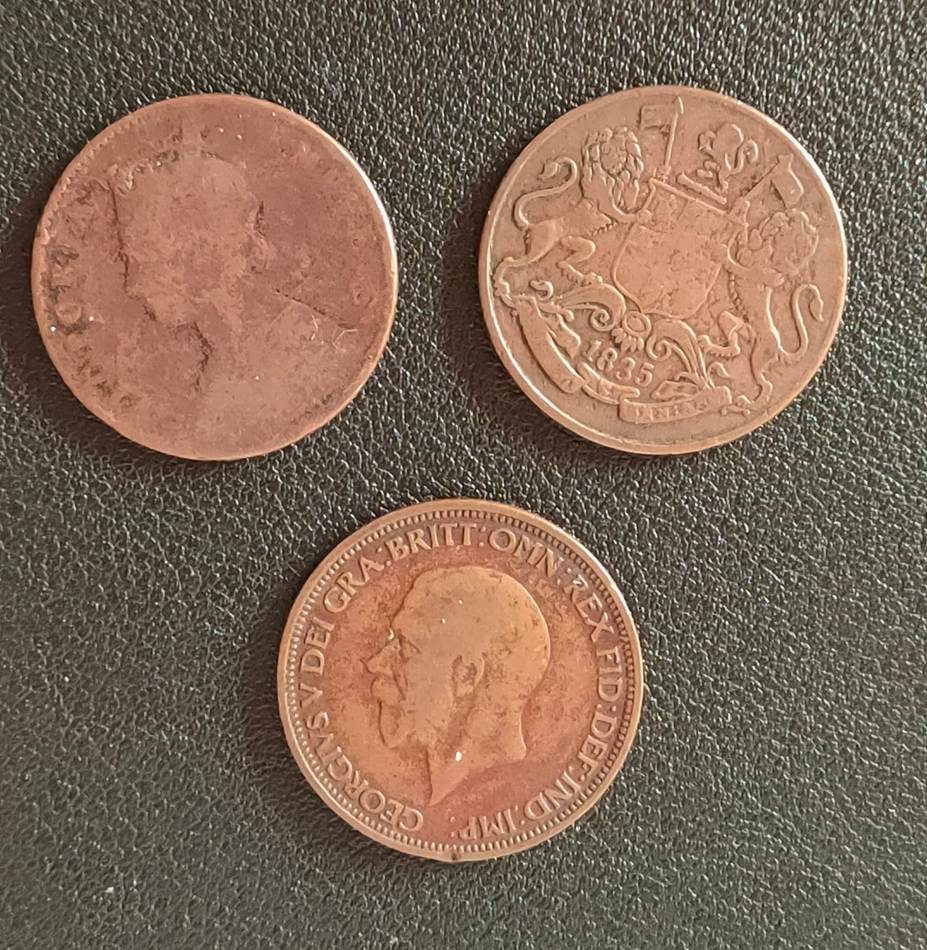
I’ve been down a rabbit hole. It all started when I noticed that the Indian colonial quarter anna coin was almost, but not quite, the same size and weight as the old British half penny.
So what was a quarter anna?
The pre decimal Indian Rupee was divided into 64 pais or 16 annas.
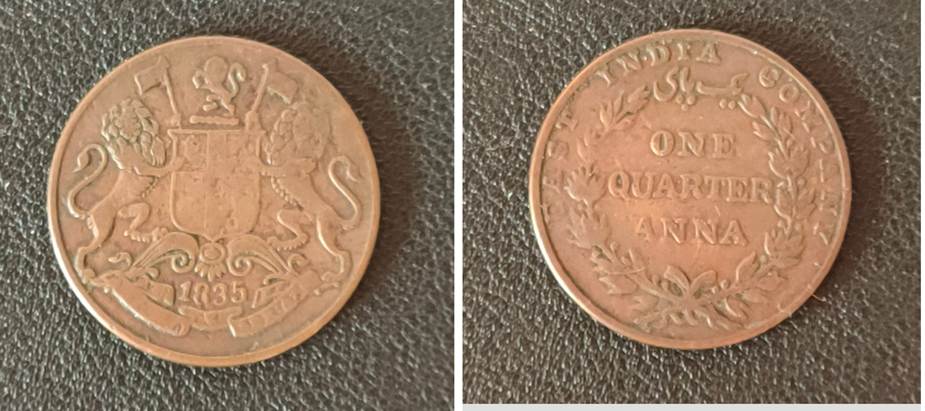
For some reason, rather than issuing 1 pais coins, the East India Company denominated them as quarter anna coins, with the company crest on one side and the value in English on the other, enclosed in a wreath surrounded by the company name.
In 1858, after the Indian Rebellion, the British government took over the administration of India, and continued to issue quarter anna coins of a similar design, with a crowned Queen Victoria on one side, and the value, again in English, in a rather more elaborate wreath on the other.
Before 1876, the coins bore the inscription ‘Victoria, Queen’ and after 1876, when she became Empress of India as part of Disraeli’s schmoozing, the inscription changed to ‘Victoria, Empress’.
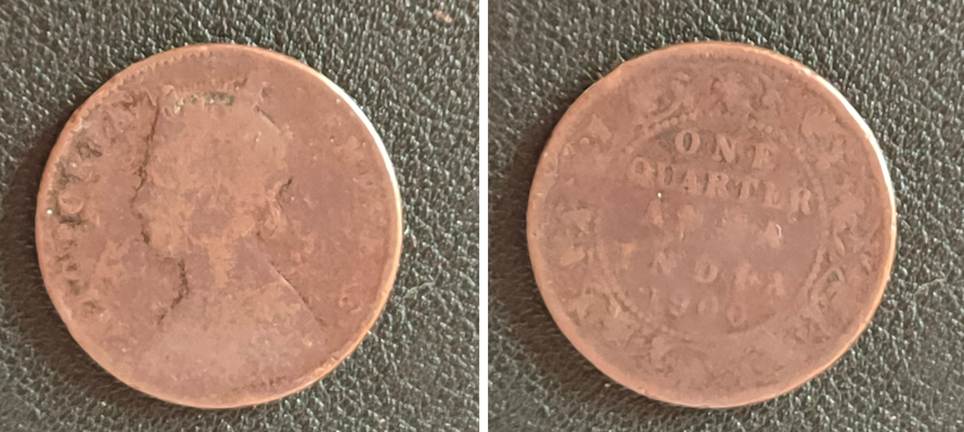
As can be seen, some are very worn. The British kept on minting the same design until 1947, only changing to a bald headed Edward VII after Victoria’s death, and then to the same portrait of George V in imperial robes and a crown as used on Australian coins, and then to a portrait of George VI, again with a crown.
There were squillions of them minted, and because of their similarity in size and weight to the British half penny there was some leakage whereby quarter annas leaked into both British and Australian circulating currencies as pseudo half pennies, and are sometimes turned up by metal detectorists on old homestead sites and even in people’s back yards.
So what was a quarter anna worth?
Not very much. Before the first world war the Indian rupee was fixed at one shilling and six pence (sometimes written as 1s6d, at other times 1/6), or eighteen British pennies, meaning an anna was a little more than a penny (1⅛d to be exact) meaning that to all intents and purposes a quarter anna was worth the same as a farthing (¼d).
And this is where I went down the rabbit hole.
Given that detectorists sometimes find them, I wondered if there was a problem with leakage into the circulating currencies.
So I searched Trove, the Times digital archive, Welsh Newspapers Online and Gale Newsvault for mentions of the quarter anna coin, half expecting to find letters to the editor complaining about the coins being passed off as half pennies.
Well no. Not a one.
No one was sufficiently exercised by the quarter anna’s resemblance to the half penny to complain about it.
So the next question was what could you buy for a half penny in 1897, the high point of the British Empire?
The Bank of England’s inflation calculator gives the value of a rupee, 1s6d, as being around £8 today, or roughly A$16, meaning that an anna or a British penny was worth around a dollar.
However, what a penny would buy was different to what a dollar would buy today.
In the 1890s, a penny would buy you a copy of The Age or the SMH, and in Britain, a copy of the Manchester Guardian, or the Yorkshire Post, the Irish Times, the Daily Telegraph or the Scotsman. The Times of London in contrast snootily priced itself at 3d.
In the 1890s, 2d could buy you a pint of beer in London, or a one way ticket on the Tube, so basically a halfpenny would not actually buy that much.
The one thing a halfpenny would buy was a copy of the Daily Mail.
Launched in 1896, advertising itself as ‘a penny paper for a halfpenny’ and pro imperialist and right wing from the start it appealed to lower middle classes of England. Advances in printing technology had meant it was possible to print the paper cheaply and in bulk and it was soon selling an unheard of million copies a a day.
It was a phenomenon, and also innovative, with competitions to maintain interest and boost circulation, sponsoring aviation competitions in the early days of flight, and employing the first female war correspondent during the second Boer war.
It was cheap, it was conservative, and it appealed to the genteel precariat of Victorian middle England. It’s no surprise that Ursula Bloom and her mother read the Daily Mail.
In the Murder of Roger Ackroyd, Agatha Christie mentions that Dr Sheppard (along with his sister Caroline), reads the Daily Mail, when one might have expected a doctor to read the Telegraph or the Times. Was this a snobbish hint by Christie that there was something not quite right about Dr Sheppard?
In short, while we might deride it for its jingoistic attitudes, the Daily Mail changed newspaper publishing by proving that a mass market paper could succeed.
Strange where a battered colonial coin can take you.


Pingback: More quarter annas … | stuff 'n other stuff