Postcards and encryption

While I was down the Charles Babbage and the Crimean War rabbit hole, I came across a couple of coding cribs designed to allow people using postcards to encode the message written on the cards.

You see, when postcards were first introduced in Britain in 1870, it was thought that people might be reluctant to use them because anyone in the postal system, or even, gasp, one’s servants could read the message on the back of them.

clip_image002

It’s important to remember that when they were introduced, postcards were different from the picture postcard that anyone over forty remembers sending.

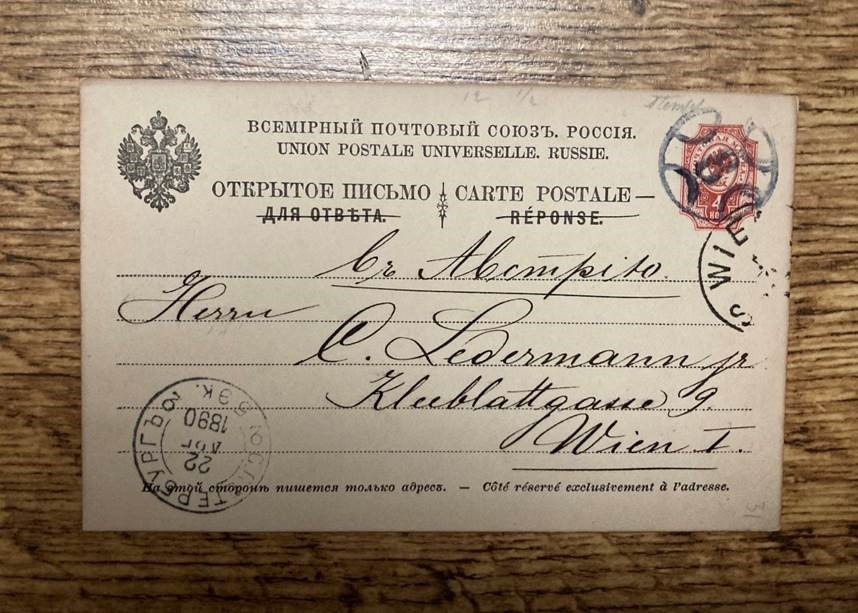
The first postcards, like this rather impressive Russian example, were prepaid cards where one wrote the address on one side and the message on the other. If you can read pre revolutionary Russian text, you’ll see that while the French reads Carte Postale – post card – the Russian reads Открытое Писъмо – open letter, which basically is what a postcard was

Picture postcards as we knew them, didn’t really appear to some time around 1900 when the various postal administrations agreed to accept divided back cards with a picture on one side and with the address and message written on the back, with the address in the right-hand half and the message on the left.

clip_image003

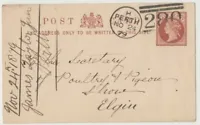
When first introduced in Britain in 1870 at a cost of ½d – half an old penny and half the price of the penny post for a letter they proved amazingly successful with thirty seven million being sent in the first year they were on sale, more than one for everyone living in Britain at the time.

It can be hard to get a handle on the cost in real terms due to inflation and the change in incomes and living standards but using the Bank of England’s inflation calculator you end up with the cost being roughly 20p ($A0.37), which compares quite well with the current UK price of 75p ($A1.40) for an economy (second class) letter

clip_image005

(The Bank of England’s inflation calculator assumes you convert your price to British post 1971 decimal currency. As there were 240 pre decimal pennies to the pound, there were 480 half pennies, making the half penny worth around £0.002 in post 1971 currency).

Mostly, postcard seem to have been used in much the same way we use text an whatsapp messages today – as a way of sending short simple messages or confirming meetings or travel arrangements. I did a very rough scan of vintage postcards for sale on ebay and etsy, and while some had longer messages on the back, most have pretty short messages.

I thought we might see some examples with messages written in code or in Ancient Greek or Latin, to stop the servants reading the message, but no.

In fact one postcard collector who had come across an example in code says that it’s the only example he’s come across in twenty years of collecting. There are a few examples out there, as well as ones in which the text has been obfuscated, such as by using mirror writing.

Basically, it looks like people mostly wrote postcards in clear text. That’s not to say that the messages were not sometimes used to confirm assignations and the like, but that they looked innocuous.

To explain consider the following made up example

Dearest Dottie,

Are you able to meet for tea on Sunday? I’ll be coming on the Norwich train

Albert

Seemingly innocent, except for the word Norwich – which was used by British squaddies during World War II, and possibly earlier, as an acronym for ‘knickers off ready when I come home’ and was commonly used in telegrams to let wives and girlfriends know that they had some unexpected leave. Telegrams cost a shilling (5p) for the first few words so brevity and acronyms were required.

So, returning to our nineteenth century courting couple, they may well have used some private words to communicate something more private given that postcards were open media.

But did they? Possibly they did, or as always in such matters probably some did, some didn’t, and one should always be careful not to read too much into a message, after all Albert might have genuinely caught the Norwich train …

Posted in Uncategorized | 3 Comments

Codes, the Crimean war, and a hint of incest

Today’s been wet.

Too wet for a walk or gardening, and of course a bike ride is out of the question for a day or two until a replacement tyre arrives in the mail.

So, I’ve been off down an internet rabbit hole.

At the moment my bedtime reading is ‘A Bitter Remedy’ by Alis Hawkins.

Set in late Victorian Oxford, it’s an absorbing mystery novel, and for me, all the better for involving nineteenth century patent medicines, not to mention a walk on part for Charles Dodgson, aka Lewis Carroll and a little bit of cryptography.

I admit I’m a sucker for well written mysteries, but this is a fascinating one.

And I learned something I did not know.

In the story there’s a throw away line that Charles Babbage had cracked the Russian codes during the Crimean war. Well, I had to check that out.

The story’s a little more complicated.

In 1845, Babbage realised that Vignère ciphers could be cracked mathematically, but did nothing with the idea until, in 1852, John Thwaites, a Bristol dentist, claimed to have produced a new secure cipher

clip_image002

Babbage cracked it and showed that it was really just a variation on the Vignère cipher.

However, credit for breaking the Vignère cipher is usually given to Friedrich Kasiski, an officer in the Prussian army, who published a method of cracking Vignère ciphers some twenty years later.

The reason why Babbage’s discovery was not publicised was that the Russians were using Vignère ciphers to encode diplomatic telegrams in the run up to the Crimean war. At the time all telegrams were sent over the public network by clerks in telegraph offices, who typed, and sometimes retyped the text along the way as a sort of human signal repeater, meaning that if a telegram was to be kept confidential it needed to be encoded prior to being sent.

Vignère ciphers were though to be uncrackable, or so the Russians thought. Babbage’s discovery meant that the British could, with some effort, and a lot of paper and pencil, read the Russian official telegrams. And of course, having cracked the Russian code, the British could crack any similar code.

Given the sensitivity of this information, Babbage’s role was downplayed and he never really received credit for his role in breaking the Russian codes until the 1980’s.

These codes had a surprising longevity, being in use as late as the Korean war.

Sir Francis Beaufort, the manager of the Royal Navy’s hydrographic service and the officer responsible for training Robert FitzRoy, later commander of the Beagle during Darwin’s voyage and the inventor of the Beaufort scale, was a friend of Babbage and developed his own variation on the Vignère cipher which was later used in the US Army Hagelin encoding machine, very broadly the US equivalent of the German Enigma machine.

Encoding machines were needed to encrypt messages as morse code radio transmission could of course be listen in to by anyone with a suitable radio receiver.

Beaufort would have understood the need for encrypting communications, as he had worked with his brother in law to install a semaphore telegraph in Ireland during the Napoleonic wars to warn of a repeat of the French invasion of the west of Ireland in 1798.

On a more human note, Beaufort also used a simpler code to encrypt some of his private papers, including his diaries. When his diaries were decoded they revealed that after the death of his first wife he had had an incestuous affair with his sister Harriet. Both were in their fifties at the time, and the affair continued until he later married Honora Edgeworth, his brother in law’s daughter, in 1838, which I suppose was one way of keeping it all in the family.

Harriet, sometimes known as Henrietta, is today principally remembered as botanist.

Posted in Uncategorized | 1 Comment

Digital and retro photography crossover

While we were down in Apollo Bay last week, I didn’t bother taking any of my film cameras, instead taking my old Fuji digitsl SLR and my little Canon iXus – the Fuji is bit heavy to carry around all the time, so I often just take the little iXus with me as lightweight alternative.

What was noticeable though was that despite only a very slight experimentation with film cameras the week before I felt I was more disciplined in composing the shot rather than simply relying on editing tools to fix things up afterwards.

There’s clearly a role for both but I found it interesting that only after 20 minutes playing with film cameras I’d started to sharpen my technique and be more considered about composition …

Posted in Uncategorized | Leave a comment

Retro photography – just do it

Almost a year ago I blogged about how I was going to go play with my old film cameras.

Well, like the grand old duke of York, I marched them up to the top of the hill, then marched them down again. I bought some fresh film, even bought an extra camera through ebay (a totally mechanical Balda Baldessa from the 1950’s), and then did nothing.

Not quite true. I put some film in my old Olympus Trip and may old Vivitar SLR, but I didn’t, like, actually do anything as radical as take a picture.

Well there was an article on the ABC at the weekend (another one) on how film was making a comeback. Incidentally, this isn’t just hype, the price of working retro cameras on ebay has been steadily climbing, and the last time I was in the big Camera Warehouse in Albury they were stocking film and advertising they could process it for you.

So, yesterday, I took my old Olympus Trip down to Chiltern with me, and after my day’s documentation I stopped off at the railway station.

Chiltern railway station is unmanned these days and fairly quiet allowing me to geek about. I’d timed my visit to coincide with the arrival of a train, but the train was late, meaning I had the station more or less to myself.

I realised that I’d forgotten to set the film speed, and I couldn’t remember what film I’d loaded, so I took a guess at 100ASA and set the camera to that.

I took some fairly crappy shots of the old station building – probably badly composed and amateurish, but actually I found the experience useful to bring back old skills – like you do need to use the viewfinder, you do need to line up and compose your shot, and the time to wind on set up the next shot is more, much more, than with digital.

All in all, I’ve probably taken around ten fairly poor shots, but I’ll go back in a few days, and try and do it in a more composed manner.

I’m not going to try my own processing and scanning this early in the exercise, I’ll let the photo lab process and scan the negatives for me. I’ve already played with Gimp enough to work out how to both convert a negative image to positive and play with light and contrast, so we might be in with a chance, plus I might learn something …

Posted in Uncategorized | 2 Comments

Life experience and documentation

Down at Dow’s, quite often I come across things to do with photography.

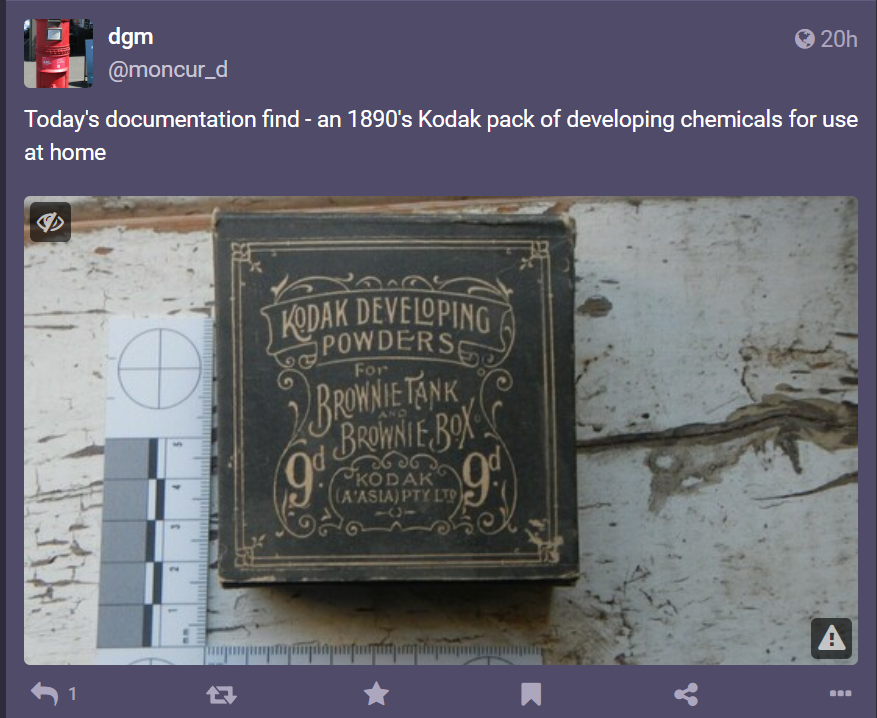
Not just film packets, which you’d expect, but items such as contact print frames, developing trays, and even some very old photographic developing powders

clip_image002

I’ve even found an old 35mm film camera in a drawer which might have belonged to one of the pharmacists or an assistant.

clip_image004

We can date it to the 1950’s or just possibly the early 1960’s as Neoca went bankrupt and disappeared in 1960.

In fact there’s enough photographic bits and pieces shoved in drawers to suggest that someone working at the pharmacy was an amateur photographer who was interested enough in photography to do their own developing and printing – normally a chemist offering a film processing service would send customers’ exposed films off to a big commercial specialist processing facility, such as Kodak’s lab in Burnley.

And this was how most people had their films processed and printed.

However, especially for black and white photography, the whole developing and printing process was quite open. It was easy enough to process your own films and make your own prints. Colour processing was rather more complicated, and while doable at home, you needed more in the way of specialist equipment and a dedicated lab space.
In comparison, black and white processing was simple enough to do at home, and there was enough tolerance in the process to allow a bit of inaccuracy. You could buy home use developers and fixers over the counter, and all you then needed was a measuring cylinder or two, a stopwatch, and a developing tank, plus a change bag – basically an opaque bag in which one opened the film cassette and spooled the film into the developing tank spool, and then closed up the light proof tank.

You then followed the bouncing ball, adding chemicals in the correct order and fifteen minutes or so later you had a set of negatives.

How do I know this?

Because I’ve been there.

As a teenager in the early seventies, I became interested in the social history of trains. Still am, truth be told.

And around where I lived, there were quite a few abandoned train lines and railway stations and I used to ride my bicycle out to them to photograph and document them using my trusty Regula Sprint camera.

Some of the pictures I took, I took on colour slide film, and that was too complicated to process at home, and anyway most of the over the counter brands included the cost of processing in the price.

But I also took a lot of black and white photographs, most of which have sadly disappeared.

By the time I’m writing about colour photography had become the norm, but the equipment to do home black and white developing and printing was readily available second hand, and most good camera shops would sell you the processing chemicals, making doing it yourself a very cost effective proposition.

And that’s exactly what I did. I acquired the equipment, including an enlarger to blow up images to a larger and more usable size, taught myself how to process and print black and white photographs, and even rolled my own film cassettes using bulk black and white film from eastern Europe and recycled empty film cassettes – again some of the more specialist camera shops would happily sell you a bag of empty cassettes for something fairly nominal – I think they sort of assumed that you’d come back and buy chemicals and photographic paper from them, and perhaps eventually a more expensive camera.

And then, of course, life changed and I no longer had time to do my own developing and printing, and by the time I might have had the leisure to start over, photography was going digital.

Since the I’ve dabbled in retro photography, but to be honest, it’s only been dabbling.

But strangely, while documenting at Dow’s I’ve found what could be described as irrelevant knowledge useful.

After all no one under the age of forty probably remembers pre digital photography, and amateur developing and printing was always very much a minority sport – the people who did it were either oddballs like me, art students who did it as part of their course, and some old school press photographers, meaning the knowledge was probably not that widely spread to start with.

And suddenly, years later, being able to recognise the equipment, knowing about film brands and film sizes, has suddenly been very helpful in identifying and documenting items.

Posted in Uncategorized | 1 Comment

Makhorka

makhorka

A few days ago I was idly browsing instagram (my instagram feed is full of posts from various archive services) when I came across the item above.

It had been misclassified as a packet loose tea – when it in fact was a packet of loose rough cut cigarette tobacco or makhorka (Махорка).

There’s also a bit of a give away in that the labelling includes the word табакъ (tabak or tobacco). We can also confidently date the packet to a date before 1918 as the word табакъ includes a hard sign character (ъ), something that was done away with in the 1918 spelling reforms

Makhorka is made from the dried leaves of Nicotiana rustica – a different species of tobacco from the one used in the west.

Nicotinia rusticana  grows freely over most of Russia, meaning that it for the peasants it was essentially free as it could be grown behind the chicken coop in the back yard.

It also has great cultural significance – it was issued to the Red Army during the second world war, and Russian novels are full of descriptions of peasants hand rolling cigarettes made of newspaper and makhorka and held together with a bit of spit.

Okay, so I know something that the person who catalogued the packet didn’t. That’s not a crime, and I’m painfully aware from my work cataloguing Dows Pharmacy just how easy it is to misclassify objects. In fact I’ve gone back on several occasions and corrected entries in the light of new knowledge.

And equally, I’ve been very dependent on the work of others who have traced and documented objects for much of my documentation work. Standing on the shoulders of giants etc.

And, to be fair the archive site, responded when I told them and said they would check it out – perfectly fair – they don’t know me from Adam and I could have been talking out of my bottom for all they know.

However I think what this little story does show is the power of opening up one’s collection online and allowing comments, which indirectly may help improve the quality of the archive.

Yes, it’s only a minor correction but it is a correction …

Posted in Uncategorized | Leave a comment

Pubs with tile exteriors

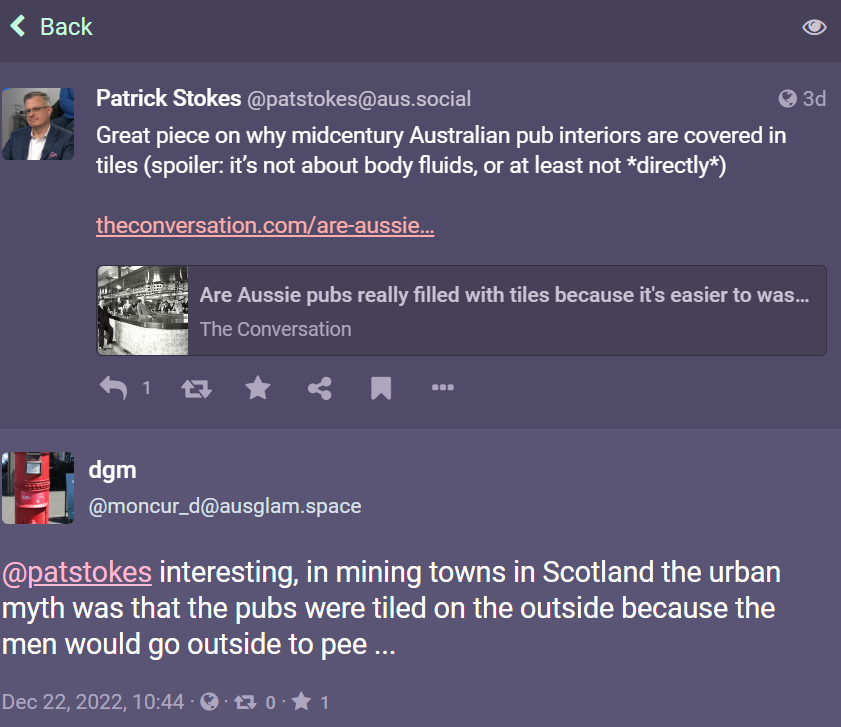
Recently I posted the following on Mastodon

Screenshot 2022-12-25 125925

in response to a post about a recent article on why some Aussie pubs have tiled interiors

The urban myth is of course that during the time of the six o’clock swill beer was spilt, bodily fluids released, and tiling pubs made them easier to hose out.

I’ve also heard a hybrid version where pubs in mining towns in NSW and WA had tiled counters because the miners would drink thenselves into oblivion, and piss themselves when they slid down the bar and fell over.

Not true.
And not true in Scotland either.
In Scotland, the main reason for pubs acquiring ceramic tiles on the outside was to make them stand out among the general greyness of the typical late Victorian street scene – no publican would invest in brightly coloured (and expensive) tiles for his clientele to wee against.

Most tiled exteriors post date the 1880’s when glazed tiles became easier to produce in mass quantities – for much the same reason early London Underground station (remember the system started in the 1860’s and the Central Line mostly dates to the 1880’s) have red tiled exteriors to make them stand out in an otherwise grey streetscape …

Posted in Uncategorized | Leave a comment

An Arabian Baboon

I follow quite a number of blogs, including the University of St Andrews Special Collections blog which deals with the rarer early printed books in their collection.

Every year in the run up to Christmas they do a series of Christmas themed posts based on the collection. One year it might be early photographs of winter in St Andrews, another it might be medieval music. This year it’s based around the Yule Days, a versions of the more common 12 days of Christmas, first published in 1847.

The published poem is in English, not Scots, but includes words such as papingo – the early modern Scots word for a parrot, suggesting there might once have been a version in Scots.

However, if there was a Scots original it’s been lost to us.

One of the more striking lines is

Screenshot 2022-12-22 164639

which of course begs the question of how a baboon got to Scotland.

Well, nowadays baboons are not known on the Arabian peninsula, but they are known on the opposite coast in what is now Eritrea and Somaliland, lying on the major medieval spice trading route to and from India and Sri Lanka. (Arab traders would take advantage of the monsoons to sail to and from India via the Horn of Africa or Aden, and then return to sell their spices in Alexandria, where they were sold to Venetian or earlier, Byzantine traders. The Spice Market in Istanbul is still sometimes called the Egyptian Bazaar.)

So, even though baboons are pesky vicious and smelly, it would be possible for a few to have reached Scotland on the back of the trade in spices and eastern exotica, just as cockatoos reached renaissance Italy as curiosities, just as 3000 years earlier, a langur may have reached Knossos.

It’s interesting that studies of baboons mummified by the ancient Egyptians suggest that they were captured in the Horn of Africa region, leading to the suggestion that it was the semi-mythical Land of Punt.

Likewise, there is some evidence that the semi-mythical Ophir referred to in the Bible was also in the same area.

So perhaps John Masefield was more right than he realised, and trading ships, if not exactly quinquiremes of Nineveh carried apes and peacocks back to Palestine …

Posted in Uncategorized | Leave a comment

Of letterpress and sellotape

I’ve been puzzling over the labels on a lot of old bottles, mostly of aromatic oils, I’ve been documenting down at Chiltern.

clip_image002

I was assuming that because some of the bottles looked to be nineteenth century (the glass had a slightly greenish tinge, and there were inclusions in the glass) that the letterpress labels used by Rocke Tompsitt dated from the Victorian era.

However, as I found out, that’s not the case – the same labels were used by Rocke Tompsitt on their trade packaging until the 1940’s at least.

Some of the older looking bottles do have deposit stickers such as this one

clip_image004

Which seem only to occur on older bottles.

Clearly, some of the bottles are old and some are less so. But also note the use of sticky tape to secure the labels. There are also a number of old bottles (judging by the glass quality) that have simple typescript labels secured by sticky tape

clip_image006

Sticky tape was first produced in America branded as Scotch Tape by the 3M corporation in 1930. Sellotape, it’s British competitor didn’t appear until 1937, so we can say that these typescript labels date from the 1930’s, even if the bottles are older.

So, I’m guessing there was a lot of reuse and refilling of bottles, sometimes with the same contents as before, and sometimes with new and different content.

This is nicely confirmed by a large glass bottle, clearly dating from the nineteenth century with a typescript label

clip_image008

But which is embossed on the rear “ B. Eugene, Hairdresser, 201 Punt Road, Richmond

clip_image010

I was initially unable to find any evidence of a B. Eugene at 201 Punt Road, but a B. Eugene, Hairdresser and Wigmaker was advertising in the Age in the 1880’s as having premises at 96 Elizabeth Street, and a little more digging found her trading from 201 Punt Road in 1912, meaning we could tentatively date the bottle to 1900 ±20.

Posted in Uncategorized | 1 Comment

Using Notable for family history research

A few weeks ago I wrote about using a Linux based laptop for research and documentation.

At the time I suggested that you could use a local install of Notable to keep work in progress notes – I suggested Notable as it keeps notes as a series of Markdown files, making it easy to extract notes later and add them to something else. Notable is available not only for Linux, but also for Windows and the Mac.

So, today I thought I would experiment on using Notable for some family history research and I used the Windows version for this little experiment.

I’d previously used Notable when putting together some notes on the Yelverton case, but not for actual note taking while researching something.

I chose to research a man called John Stiven Moncur. He was born in Dundee in 1830 and died in Pavlovsk, near St Petersburg in 1910, with is profession being given as an engineer. He would have been 80 when he died, so I assume he was retired.

Interestingly, his address was given in the records of British nationals who died abroad as 74 Kalashnikov Quay in St Petersburg.

Kalashnikov Quay was named for the nineteenth century Kalashnikov family of corn merchants, and was renamed Sinopskaya Embankment in 1953.

If you use Google Street view there’s still a nice nineteenth century house at 74 Sinopskaya, so even if he was living in an apartment in the building he must have been reasonably well off.

clip_image002

He was born to Charles Moncur and Isabella Coupar (married women in Scotland did not change their names on marriage in the 1800’s) in Dundee on April 4 1830

clip_image004

Charles and Isabella had married in Tealing in 1814. I can’t say that definitively that Charles was related to my family but there were a number of us in the Tealing area in the early 1800s, so there’s a reasonable probability he’s related to an ancestor of mine.

Charles was quite easy to find and was born in 1784 meaning he’d have been thirty when he married.

Isabella was a bit more difficult to trace. No Isabella Coupar was born in the forty years before the date of their marriage. Isobels and Isabels yes, but no Isabellas.

Isabella died in 1850 and her age was given as 65 suggesting she was born in 1784 or 1785, and there is exactly one Isobel Coupar born in 1784, so I’m guessing Isobel preferred to be Isabella.

Charles and Isabella had a daughter, Marion, who was born in 1817, when both Charles and Isabella would have been 32 or 33. They don’t appear to have had any other children other than John.

Given that John was born in 1830, Isabella would have been 45 when he was born, which is quite old.

I did wonder if John was actually Marion’s illegitimate child, but at 13 or 14 years old she seems a little young to be a mother, even though at that time in Scotland girls could legally be married at 12. 12 was also the age of consent in Scotland at the time, so I guess it’s not impossible.

It’s also probably unknowable.

I havn’t been able to trace John Stiven Moncur – certainly he appears in the 1841 and 1851 censuses as living in Dundee but after that nothing until his probate notice.

clip_image006

I’m assuming he married given that he has beneficiary named Charles Moncur who was probably his son, but I’ve been unable to trace a marriage record

Using Notable, I found it was quick and simple to transcribe my notes

working notes 20221113

and attach screenshots and document images

So I think it might actually be a workable solution for work in progress notes.

If I’ve whetted your appetite for more information on the internals of Notable, I’ve written a more technical post over on one of my other blogs

Posted in Uncategorized | Leave a comment