Nellie Bly as an inspiration …

Last night, J and I started watching the David Tennant version of ‘Around the World in Eighty Days’.

It’s a complete romp, and very enjoyable for that, ideal Sunday night viewing.

It’s been years since I read the book, but I don’t really remember Passepartout’s ethnicity, or that there was a female journalist called Abigail Fix-Fortescue involved, but it doesn’t matter, it’s 45 minutes of well made fun.

The Abigail Fix-Fortescue character is clearly inspired by the exploits of Nellie Bly and  Elizabeth Bisland both of whom competed in 1889 to beat Phileas Fogg’s fictional record, however while both Nellie Bly and Elizabeth Bisland were American, the Abigail Fix-Fortescue character is clearly English.

J had never heard of Nellie Bly, and while I told Nellie’s story the discussion moved onto Louisa M. Allcott and the fictional Harriet Stackpole in Henry James’ Portrait of a Lady.

In England in the 1880’s the idea of a female journalist, especially an adventurous female journalist would be almost impossible to imagine, but clearly not so in America.

Why so?

My guess, and it is only a guess, is that the number of middle class men died in the American Civil War was sufficient to allow women to fill some of the roles formerly dominated by name, mucj as happened in Britain after the First World War.

It’s an interesting idea and certainly the trope of the determined female reporter seems to go back further in the USA than the UK …

Posted in Uncategorized | Leave a comment

Arsenic and old books

A few days ago I retweeted the following from the Yorkshire Post

Strangely, I was not surprised. The mid Victorian period really was peak arsenic. It was everywhere, in patent medicines such as Fowler’ Solution, and doubtless many others. It featured in murders, most prominently in the Madeleine Smith case, where Madeleine was put on trial for murdering her boyfriend, who was blackmailing her over her remarkably explicit letters describing their sexual encounters.

Madeleine was accused or murdering him by putting arsenic in his cocoa. (I suspect that if it wasn’t for the sexual component the murder of Emile l’Angelier would not have achieved the notoriety it did.)

There was also the case of the arctic explorer Charles Francis Hall who died mysteriously. Hall was treating himself with a patent medicine for a stomach ailment when he died.

His body was exhumed a century after his death and his fingernails sampled for arsenic. It was found that he had a high concentration of arsenic in his body, suggesting that he died of the effects of arsenic poisoning.

We don’t know the patent medicine Hall was using, or if it contained arsenic. Shortly before his death Hall complained that his coffee was too sweet (arsenic reportedly has a sweet taste). Given that he was not well liked by his men there is a lingering suspicion they may have added a little extra arsenic to his diet to help him along.

Arsenic was readily available and, while there were some attempts made to keep records, it was easy to obtain covertly. There are numerous cases of wives in mid-Victorian times poisoning their abusive husbands – in a society without divorce and where men controlled a wife’s assets – it could well be better to be grieving widow than a battered and beaten wife.

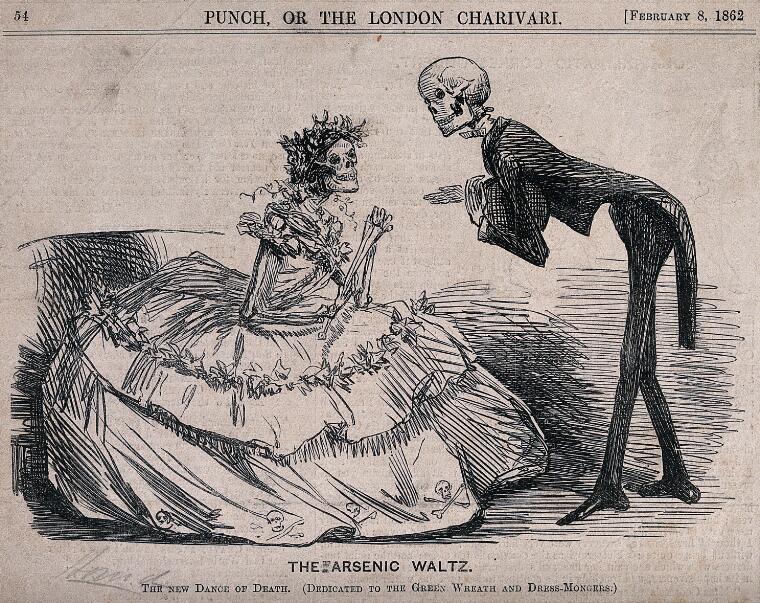
© Punch and the Estate of John Tenniel

Arsenic really was everywhere in the nineteenth century, in artist’s paint, in dyes, in wallpaper, in textiles

It’s been suggested that the green arsenic based dye in Napoleon’s wallpaper in St Helena had a part to play in his demise.

William Morris used arsenic based dyes extensively in his wallpaper designs, something that may have inadvertently hastened the end of some of the Victorian middle class. Morris did not believe that his arsenic based wallpapers were toxic and argued that the arsenic based inks gave a better colour, and did not remove the arsenic based inks from his wallpapers until 1880. (It’s one of the happenstances of history that a few years after her trial, Madeleine Smith married George Wardle, William Morris’s workshop manager).

Likewise, arsenic based dyes were used to dye textiles giving dresses and other garments a deep and shimmering green, even if their use may have hastened the wearer’s demise, so it’s not really surprising that arsenic based dyes have turned up in book covers.

In fact, given how common the use of arsenic dyes was in the mid nineteenth century it would be surprising if it didn’t turn up in old books.

The Winterthur Museum in Delaware has been running a project to investigate the use of arsenic in old book bindings, and has produced not only a guide to handling possible arsenical books, but also a list of the books they’ve identified.

Personally, given how common arsenic inks and dyes were, I’d treat any book published before 1900 with suspicion – while the dyes had more or less dropped out of common use by 1880 it’s probably a good idea to give oneself a margin of error, just as one would if handling wallpaper or textiles from the period – it’s safer to assume arsenical than not.

So, that old family bible, botany guide or Walter Scott novel with a green binding should be treated with suspicion – you never know what secrets it could be hiding …

Posted in Uncategorized | Leave a comment

Reverse N’s

I was looking at the Facebook paleography group recently and came across the following post

Now I’ve seen the reverse N before in old grave markers in country areas in Scotland.

If you look at the inscription you can see that the letters are roughly spaced out, slightly uneven and not quite the same size.

I’d guess that the inscription was written out in chalk and then carved with a chisel – hence the thickening of the curves on the C’s and D’s.

The person who did the carving may not have been the person who wrote out the original inscription – in times of shaky literacy it could be that the carver may have been illiterate, or effectively so and unsure of his letters.

Be that as it may, it doesn’t explain the reverse N – if the inscription was written out in chalk on the stone for him to follow it’s the fault of the inscription writer, or if he copied it himself from a slip of paper it’s likely he copied the mistake (or if the inscription was written cursively made an error converting from cursive to capital letters).

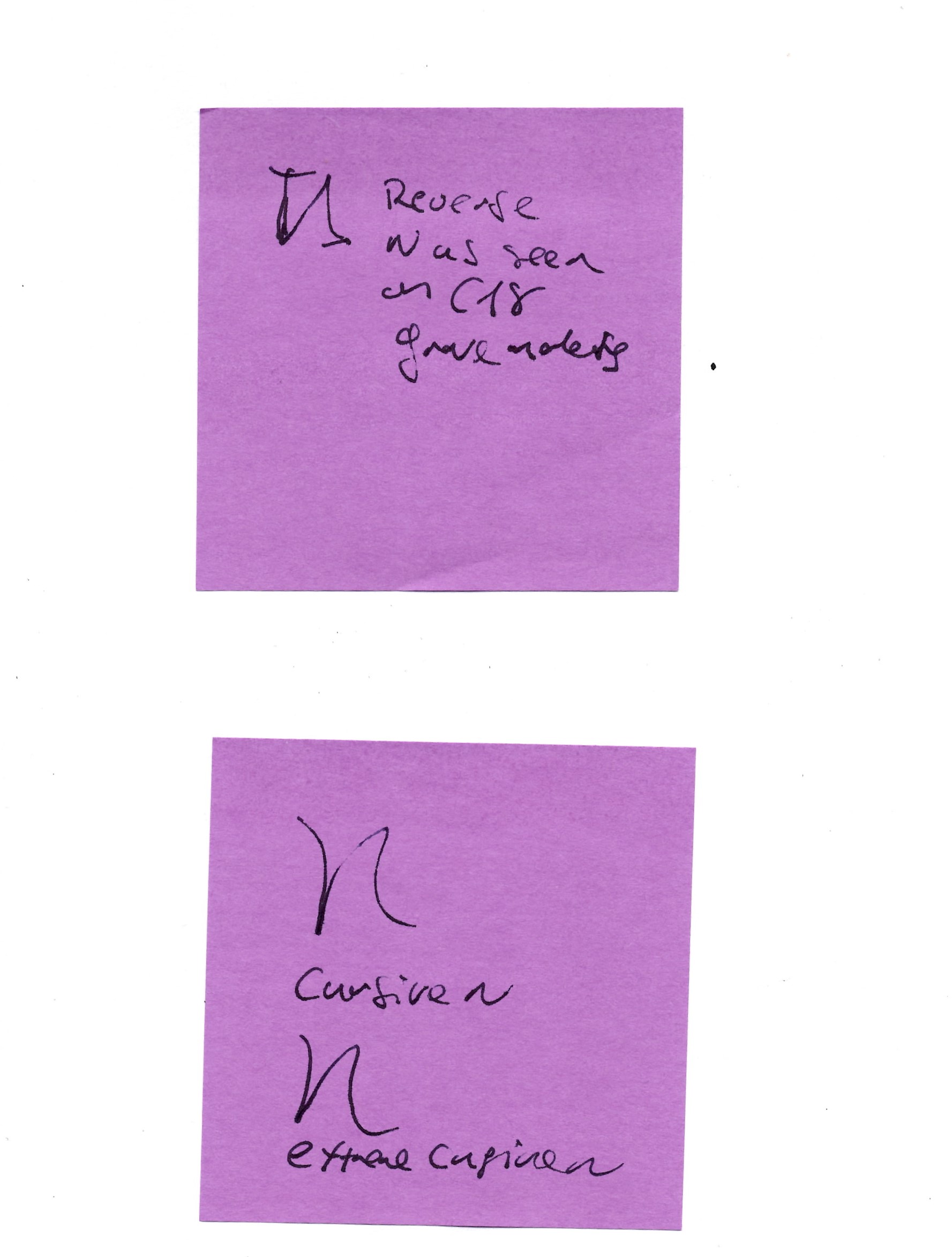
This is what I call the Deborah effect after a former girlfriend in my youth. The upper purple square shows a rough copy of a carved reverse N. If you look at the bottom square you will see two cursive N’s.

The upper one is the way we were taught to write in school with the curve starting half to two thirds up the vertical, and the bottom is my approximation of Deborah’s cursive capital N with the loop of the N starting from the bottom of the vertical stroke. Square it and straighten it up and you get a reverse N.

As can be seen from the Eassie Kirk session minutes from 1805 a lot of people who wrote professionally, such as the Kirk Session secretary formed their N’s correctly, in this case by an upstroke, followed by a downstroke and second upstroke.

Bit less literate people?

I don’t have any examples, but I’m guessing that people who didn’t write all the time, and when they wrote on rough paper ended up doing something like the Deborah N to avoid scratching, blotting or tearing the paper as you can see in this fragment of an 1815 list of books available to the servants at Dyffryn in Wales

who ever wrote the list almost made a reverse N by forming a loop at the bottom of the N to avoid going back over the ink and risk making a blot …

Posted in Uncategorized | Leave a comment

Rereading Len Deighton

Recently I reread a couple of early Len Deighton novels – the Ipcress File and Funeral in Berlin – which I ‘d picked up cheaply online.

I always thought that Len Deighton was underrated as teller of spy stories as his novels captured the snobbishness and genteel poverty of post war England and the creeping sense of paranoia of the Cold war.

It’s a world of Darjeeling tea, shillings for the gas, a world where everyone smokes, and where crossing into East Germany was not quite the dystopian nightmare it later became.

A different world.

A world where there was a Soviet Union, a Yugoslavia, a Czechoslovakia, and of course a GDR.

I am too young to remember those times but I do remember the shabbiness of Britain in the seventies, of sitting idly looking out of the window in an upstairs seminar room at Uni watching air force Lightnings scream into the sky across the bay.

We always thought they were rehearsing for Armageddon, and perhaps they were.

Most times though we didn’t think about these things and tried to ignore the paranoid rhetoric of both the east and the west.

To be fair there wasn’t much during the seventies. Détente, and the understanding of mutually assured destruction, not to mention the more immediate pressures of an economy that no longer delivered produced an atmosphere of general gloom.

It was the rise of right wing hawks at the end of the seventies that was both frightening and ridiculous.

Thatcher on a tank was ridiculous, the old grey men on the Kremlin terrifying waxworks, and one wondered about a US president who had difficulty remembering his lines.

But Len Deighton’s early novels provide a picture of peculiarly English ambiguity. Things are understood.

One of course would never have milk in Darjeeling, just as sometimes there has to be some distasteful business, and one has to deal with people whom one might not care to have afternoon tea with.

And with this ambiguity comes deniability and ruthlessness. And afterwards one goes back to one’s shabby flat, listens to Elgar or perhaps an interesting talk on the radio, and of course another cup of Darjeeling. After all nothing much has happened.

They are most definitely books of their time, and unconsciously they capture the spirit of the time.

Britain, impoverished by the costs of the second world war and without an empire is a failing state, like an old uncle who still has a tuxedo in his wardrobe, but in reality is living on his old age pension and for whom a glass of cheap red and a lasagne with salad in an Italian café is a treat to be looked forward to.

The people who inhabit that world, or at least the world that Deighton describes, aspire to be middle or upper middle class, still worry about what school someone went to, and believe in keeping up appearances, despite the shabbiness of the world around them.

What Deighton’s books don’t describe is the working class condemned to blue collar jobs in grey factories making things badly and going home to poor quality housing for egg and chips on a Saturday night – when I look at photographs of late fifties and early sixties Britain I’m always struck as how absolutely impoverished the working class areas were – grim housing estates crowded buses and the rest.

No wonder so many aspired to migrate to countries such as Australia where life was sunnier and looked to be better even if it wasn’t as good as it looked in the posters outside Australia House.

A different world indeed.

Posted in Uncategorized | Leave a comment

The very odd places family history can take you …

I have an interest in Egyptology, or more importantly the impact of the re discovery of ancient Egypt on the culture of late nineteenth and early twentieth century Europe and America, from patent medicines with vaguely pharaonic packaging through buildings designed in a vaguely Egyptian style to all these crap ‘B’ grade movies and TV shows about the returning ghosts of dead Egyptians.

So naturally I was sucker for the documentary by Ella Al-Shamahi about possible toxins in the tomb of Tut-ankh-amen and how they could have caused the deaths of some of the supposed victims of “Tut’s curse”. (The documentary is actually quite sensible and can be watched via SBS on Demand if  you are interested.)

Anyway, one of the early supposed victims was George Jay Gould, the son of the US railroad baron Jay Gould.

In one of the pictures of him visiting the tomb, there is a partially cropped image of a young woman with unusually extravagant ringlets, almost dreadlocks, incredibly unusual among the rich of the gilded age.

I was so struck by the image that I tried to find it online, with complete lack of success, but from other images I’ve found online of his daughter Helen Vivien Gould with similar looking hair I’ll guess it was his daughter.

Strangely, here’s a very odd family history connection here to Helen Vivien Gould:

One of my forebears was the long term companion of Thomas Carter Allen, of whom it was alleged by his legitimate son that Thomas Carter Allen was an illegitimate descendant of Bonnie Prince Charlie.

This was of course complete bollocks, but it gained some traction as his son, John Sobieski-Stuart (as he took to calling himself) managed to single handedly instigate the great con of Tartanry.

Thomas Carter Allen himself was connected by (legitimate) marriage with the Anglo Irish aristocracy, all of whom were incredibly in bred as they tended to marry each other.

It’s a quirk of my genealogy feed that it has trouble distinguishing between formal and informal relationships, with the result that I get lots of posts about digitised records referring to members of the Anglo Irish aristocracy connected to Thomas Carter Allen’s legitimate relationship.

They’re absolutely nothing to do with me, but you do get to recognise the names if only to go ‘another bloody de la Poer descendant’ and delete it without reading.

They all seem to have been incredibly dull people and never involved in a scandalous marriage or arrested for buggering a bishop so I feel justified in ignoring them. Until now.

Helen Vivien Gould married one of the Beresfords – she got the title, and he got the money, a common enough story.

But why the connection to Tut-ankh-amen?

It turns out that Helen Miller Gould, George Jay Gould’s sister was fascinated by ancient Egypt and assembled a large collection or artefacts, most of which she donated to the Metropolitan Museum in New York.

I havn’t been able to find any indication that George Jay Gould was particularly interested in Egyptology, unlike his sister.

Likewise I havn’t found any record of Helen Miller Gould visiting Egypt much after the 1880’s – did she badger her brother visit or was she travelling with her brother and insist on a visit?

At the moment I don’t know, but his sister’s fascination with things Egyptian does explain his visit to the tomb …

Posted in Uncategorized | Leave a comment

The woman in the library

While we were in the Kimberley, I read a book – The woman in the library by Sulari Gentill.

Like a lot of my recreational reading it’s a murder mystery, but this one got under my skin a bit.

Most mysteries go a little like this – a body is discovered in circumstances that suggest something untoward has happened. The competent authorities are incompetent or otherwise disinterested.

However, the lead protagonist feels there is more to the case and starts to ask questions, only to be given the brush off. They keep digging and find a greater mystery – illegal logging, an ice lab in a school, a corruption cover up.

The real trick is to set the story in an exotic location – 1980’s Moscow, nineteenth century rural Wales, a broken Aboriginal community scarred by drug abuse out in the desert, or among the hippy towns of northern NSW.

Done well these stories tell you something of the realities of life in these communities and the issues facing them.

I heard Sulari Gentill speak about her book at WinterWords, our local literary festival a few months ago, and while she was an entertaining speaker I got the feeling that even she didn’t quite get the appeal of her book.

On paper, if you simply go on the plot synopsis, it doesn’t stand out.

Like most classic mysteries, Sulari Gentill’s novel starts with the discovery of a body, or rather this time it doesn’t, it starts with a scream.

Four strangers are flung together and a fairly classic locked room mystery plays out among the middle classes of Boston. (One of the protagonists is a visiting Australian author incongruously named Winifred – personally I don’t believe that anyone in Australia has been called Winifred since Bob Menzies was in short pants)

The mystery plays out with all the various twists and turns you would expect – was Winifred’s lover the murderer, or was it a stranger, and what did the homeless man found dead by the lake know?

It’s a good story and well written, and if it had simply been a locked room mystery I would still have read it and enjoyed it, but I wouldn’t be writing about it – what makes it different from most is a second story told in a series of emails interleaved in the book about how the author is being stalked by someone allegedly helping her gather source material and how the relationship becomes more threatening.

Anyway, enough. Read it yourself – you’ll enjoy it


Posted in Uncategorized | Leave a comment

A little progress on the family history front

Off and on I’ve been puzzling over Henry Thomas Hill, who was J’s great^n grand parent who appeared with his wife Anne in Castlemaine in 1848. His history prior to then has been a puzzle to me and is hopelessly muddled due to there being another Henry Thomas Hill who was married to a lady known as Charlotte Elizabeth Salt.

Today, I did something different.

I’d been avoiding researching Anne Hill as it was such a common name, but today I bit the bullet and came up with some circumstantial evidence

ann humphries 1841 tweaked fragment

It turns out that there were not that many people called  Anne Hill who were born in 1820 (ish) and married to someone called Henry in the 1841 English census. In fact the only instance that looks a possibility is this one from the census in Walton in what is now West Yorkshire.

It’s a bit problematical – Henry should have been 30 or 31, but we actually don’t know his date of birth, the birth year of 1810 comes from the record of his death, which doesn’t record his date of birth, only his age – it’s just possible that at some point he added five years to his age ie he may not actually have been 72 when he died in 1882.

Screenshot 2022-07-28 134209

The other bit of circumstantial evidence was that an Anne Hill, accompanied by her husband, arrived into New South Wales on the Emperor in 1848, 1848 being the year they appear in Castlemaine. Unfortunately the online record for Anne Hill, which is only an index to the microfilmed records, does not list her husband’s name

This is of course complete hand waving, I might be utterly and completely wrong, but it’s worth a punt …

[Update 28 July 2022]

Well, a little more digging, and while there’s no Henry Thomas Hill taking passage on the Emperor in 1848, there’s a Thomas Hill.

Unfortunately, the records have not yet been digitised and are on microfilm, which means I can’t take this further at the moment, but circumstantially it looks likely …

Posted in Uncategorized | Leave a comment

How cemeteries end

Back at the end of June I tweeted a link to a story from South Africa about the looting of the Avalon cemetery in Soweto, and that’s certainly one view of how cemeteries end.

But there’s another one.

Australia, and other places, are full of nineteenth century cemeteries, and quite a few are effectively abandoned. For example, Carlyle Cemetery near Rutherglen is full of goldrush era graves, some of Chinese miners, but mostly of people of European heritage.

And of course, during the gold rush the population of the area was higher.

There’s a section of the cemetery that is still in use but there are a lot of nineteenth century graves which are untended and abandoned, graves to which people have no connection.

The rain comes, the wind blows, headstones topple and break, and  gradually things fade away.

One can imagine that in another hundred years or so, especially if the cemetery ceased to be maintained, that one would have an overgrown paddock with a few intact headstones and a lot of rubble, bits of broken monuments and the like.

Metal fitments, and even cast iron grave monuments would probably be stolen for recycling, and in the end it would simply be ‘lumps and bumps’ ….

Posted in Uncategorized | Leave a comment

Pennyroyal

I’ve written before about the nineteenth century use of abortifacients – in an age without reliable contraception unwanted pregnancy was a risk for women, especially unmarried women.

One of the most common remedies was pennyroyal, often sold in pill form

IMG_20220217_163338

(Incidentally I’m not advocating its use in any way – it can cause serious liver damage and people taking it can suffer serious bleeding requiring hospitalisation.)

However in the nineteenth century it was one of the few remedies that was both accessible and which had a reasonable chance of bringing about the desired outcome if taken early enough.

However, how did people access them?

Discreetly.

Obviously no one wanted to go into the local pharmacy and ask for pennyroyal pills. In a small town it would be tantamount to admitting you’d been having sex with the butcher, the baker, or the candlestick maker.

For a married woman, especially if her husband was away, supremely embarrassing. For an unmarried woman be she the village schoolmistress or a girl who helped out in the haberdasher simply impossible.

So, the answer was mail order

Screenshot 2022-06-27 102525

A search of Welsh Newspapers online Papers Past NZ and Trove here in Australia for ‘pennyroyal’ turns up numerous adverts from chemists offering to post out pennyroyal pills, as well as adverts for  apiol and steel pills as an alternative (Apiol is a distilled extract of parsley, and was also used as an abortifacient.)

Screenshot 2022-06-27 103223

(Apiol and steel pills are still available in India for those who wish to practise ayurvedic medicine, and as with pennyroyal there are potentially serious health risks associated with their use)

Screenshot 2022-06-27 103059


Posted in Uncategorized | Leave a comment

Gallowhill (or spaces matter)

Before the pandemic I’d played about with family history  on hot days in January, but it was only with the pandemic that I started to play with it seriously, and it’s brought a number of puzzles, one of which was Gallow Hill Farm.

Some of my forebears apparently lived on Gallow Hill farm in the parish of Tealing, which is not that far from Dundee. (Incidentally, Tealing was where John Glas, the founder of the Glasite sect preached – and while there’s no family history connection, the Baxters with whom Mary Shelley visited were members of the Glasite sect.)

This makes perfect sense as Tealing is the next parish going south towards Dundee from Eassie, where I’d already been able to place my ancestors around 1800.

Between Tealing and Eassie there’s a couple of hills, one of which is called Gallow Hill, so you would naturally tend to assume that the farm was somewhere on the slopes of Gallow Hill.

Well, no.

Having spent more time than I should have staring at the National Library of Scotland’s digitised maps from the early 1840’s I’ve been unable to find any trace of it, which was strange, given that people had turned up in the census as living there.

And then I had an idea, I searched for Gallowhill without the spaces  and there it was – still in the parish of Tealing but at the south end of it near Strathmartine Castle, on the outskirts of Dundee

Screenshot 2022-06-18 123647

it only appears as a named place on the 1840’s six inch map – confusingly on the 1860’s one inch map it’s not named

gallow hill above the ine

and today it seems to have disappeared into outer suburbia


gallowhill today

Still, lesson learned.

Just because the census people and the local minister put a space in the name of a farm when recording births, deaths and marriages, it doesn’t mean the original Ordnance Survey surveyors did …

Posted in Uncategorized | 1 Comment