Finding Franz Josef (or is it Joseph)

I have long been fascinated by the events of the Russian revolutions of 1917 in February and October of that year, but over the years I’ve come to realise that that the collapse of the Austro Hungrian Empire at the end of the first world war created a power vacuum in central Europe that helped events play out as they did.

Remember that in 1916 Russia had pushed back the Austro Hungarian army and throughout 1917 managed to hold the line until the army disintegrated, and by that time the Austro Hungarian forces were no longer capable of taking advantage of the chaos.

Their own army was disintegrating and it was increasingly clear that the 1867 compromise between Austria and Hungary was on borrowed time.

At the same time Kaiser Franz Josef had died on 21 November 1916 at the grand old age of 86, and had for many, been the only Kaiser they had known.

Franz Josef was Austria Hungary.

So, if I was to do some research on the period as a wet weather topic over winter the death of Franz Josef seemed as good a point to start as anywhere.

Except there was a little problem. Franz Josef was also known as Franz Joseph in English.

I first of all thought it might be possible to get away with a search for ‘Franz’ but a trial searching for ‘Franz’ in Welsh Newspapers Online for 1916 rapidly showed that there were just too many  people called ‘Franz’ in the news.

So, I turned to QueryPic to check usage in both Australia and New Zealand:

franz josef australia

and we can see that while ‘Franz Joseph’ had been more popular as a usage in the nineteenth century, by the time of World War I both usages were equally popular.

The peak for ‘Franz Josef’ around 1900 is due to Fridtjof Nansen’s landing on Franz Josef land during the Fram expedition.

franz josef nz

In New Zealand, the situation is slightly more complicated due to the Franz Josef glacier on the South Island, with later post 1920 usage favouring ‘Franz Josef’.

So any search needs to be something like

Franz AND (Josef OR Joseph)

and even when, as a test, I ran the searches for real for news of his death or funeral even the same newspaper would refer to him as Franz Joseph one day and Franz Josef the next.

However, there does look to be an explanation of sorts. Austria was at war with France and Britain (and by extension Canada, Australia and New Zealand) which meant that the only English speaking correspondents in Vienna were American and of course were subject to censorship by the Austrian authorities.

News was restricted – its not for nothing that Ernesta Bullitt’s diary of her travels in Germany and Austria in the summer of 1916 was entitled An Uncensored Diary from the Central Empires.

And in an attempt to avoid censorship it looks as if the major source of news about what was going on in Austria Hungary in Welsh, Australian and New Zealand newspapers was syndicated reports from news agencies in Zurich and Amsterdam (both Switzerland and the Netherlands were neutral during world war one), and quite a few of these reports preferred Josef rather than Joseph.

Only when the reports were rewritten or compiled into a longer news article was Josef replaced with Joseph, and then not always or even consistently…


Posted in Uncategorized | Leave a comment

Paper Diaries in 2022 …

I recently replied to a tweet from @wmarybeard about diaries and the demise of the Cambridge University diary.

And that got me thinking about paper diaries and why we use them.

All my professional life I’ve used a diary to keep appointments, manage meetings, projects and the like. And strangely, I still use a paper based one, and have done ever since the mid nineteen eighties.

The university where I first had a permanent job used to issue these academic year diaries to staff that let you plan meetings and schedule appointments, all within the then standard three term framework.

Sometime in the late nineties they stopped issuing them and I moved to using a Filofax, which in those days had an option for a generic English university diary (three terms, October to June, and a three month long vacation.)

That worked well enough for two or three years, but once online calendars arrived sometime around 2000 I needed something that synced and that I could carry round in my pocket.

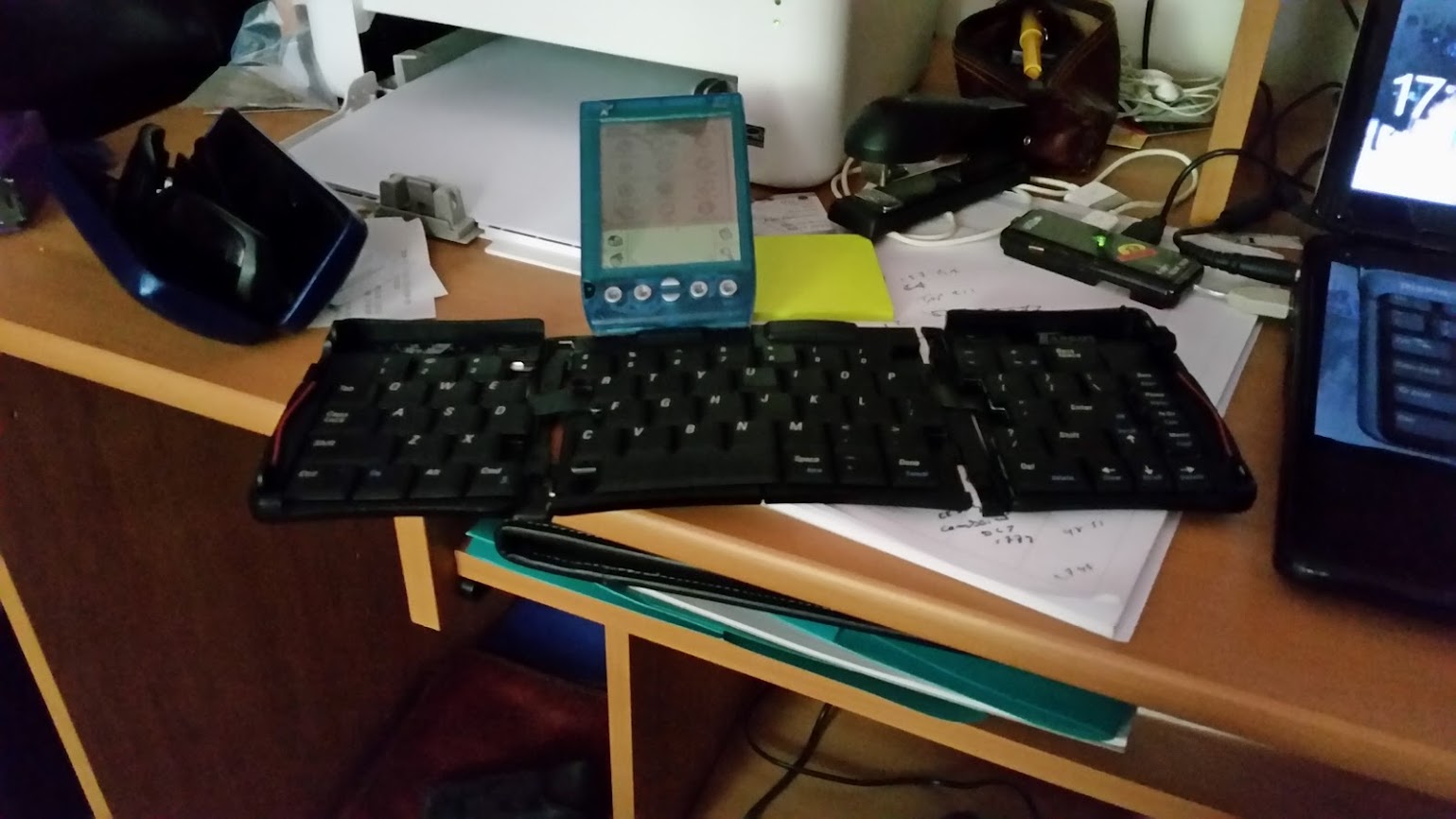
In these pre smartphone days the answer was a Palm Pilot – I still have both of mine, including an optional keyboard for those of us for whom character recognition never quite worked – a device that synced your calendar, let you draft emails and notes offline which you could then sync when you got home. In its time a truly wonderful device.

But I had a problem. Sometimes I would work for people other than my main employer, and I needed to keep records.

I discovered these Leuchterm project management diaries – the page on the left showing the week, and the page on the right for notes.

And they were ideal. Appointments and meetings in the diary pages, notes and expenses on the note pages – use different colours for different project, and you were organised.

Helpfully the notebook was A5, which meant that opened out it was an A4 landscape page which could be scanned and filed online, which meant compiling activity reports and the like a doddle, not to mention expenses and travel claims.

When I retired I thought I’d stop needing to do this, and even if I still needed a paper diary a cheap $10 generic one would do.

Not a bit of it. I ended up volunteering to catalogue the contents of Dow’s Pharmacy for the NTAV, which again meant recording activity, not to mention all the shuffling and planning that goes into daily life.

The only major change is a change from Leuchturm to Moleskine for planning diaries – the former have proved just too difficult to get during the pandemic with disruptions to the supply chain, so its been Moleskine for the past couple of years.

So, while they’re not as full as they once were, diaries still provide a record keeping function to show what was done when and where.

Now, I am not a luddite. I use Google Calendar extensively, not to mention tools like Boomerang and Microsoft To-Do to manage reminders and tasks, but none of them truly provide a record keeping function, something that is absurdly easy with a paper diary …

Posted in Uncategorized | Leave a comment

So how expensive did train travel use to be?

Following on from my post yesterday on how trains services in country Victoria are actually better than they were in 1880 and 1905, I thought I’d look at the comparative costs.

Both the 1905 Bradshaw and 1880 Victorian Railways helpfully list the price of a first class single (in shillings and pennies) to Melbourne from Beechworth:

1880 28s6d
1905 33s1d

Written out in pounds, shillings, and pence format, 28s6d is £1:8:6 and 33s1d is £1:13:1.

The Reserve Bank of Australia have an inflation calculator allowing you to work out what a pre-decimal sum of money would be in today’s dollars. The sum needs to be entered as pounds, shillings, and pence (being old enough to have learned how to calculate money in pre-decimal days helps) we get the following result

So we can say that in 1905 a first class single would have cost around $260 in today’s money.

Working out the 1880 costs is a little more complex.

The RBA calculator only goes back to Federation in 1901.

Prior to Federation, Australia, or rather the six colonies that were to become the Commonwealth of Australia used British money (and British coins – this is why our 10c and 20c coins are still the same size as the pre decimal British 1s and 2s coins).

So, making the assumption that a pound in London in 1880 had the same purchasing power as a pound in Melbourne we can use a British inflation calculator

Just to make things fun, this calculator wanted the amount entered as if it was in post 1971 decimal currency, so £1:8:6 is £1.43 rounding to the nearest penny.

We of course don’t use pounds any more so the second fudge is to convert the amount in British pounds to Australian dollars using an online converter

which gives us a cost of $312.29.

So what does the equivalent journey cost today?

Or a rather more modest $48.

1880$312.29
1905$261.76
2022$48

So, we can say that train travel in country Victoria in 2022 is considerably cheaper than it was either in 1905 or 1880.

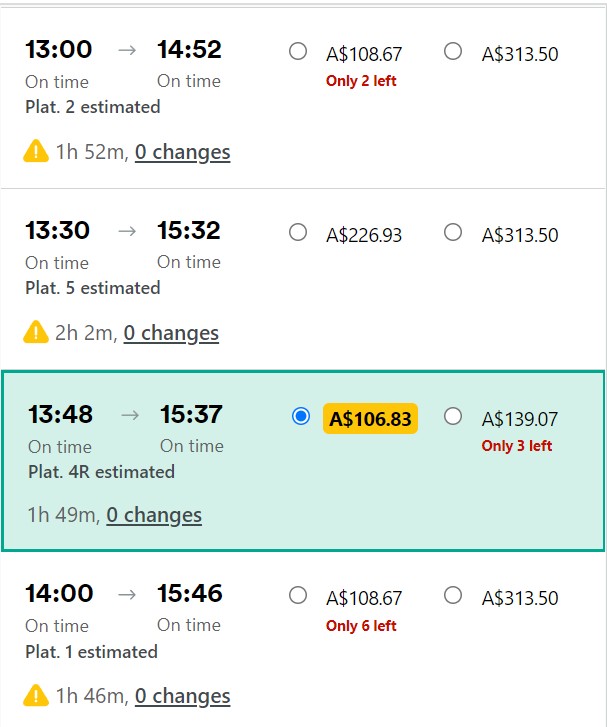
The distance from Beechworth to Melbourne is a little under 300km. Just for fun I used an English train booking website to see how much the same journey (say from London to York) would cost

The website helpfully calculated the fare in Australian Dollars for me so we can see that a LNER economy ticket is on average roughly twice a V/Line first class ticket for the same distance, and that in most cases a first class ticket is more like the 1905 cost of a first class ticket on V/Line’s predecessor, Victorian Railways.

Posted in Uncategorized | Leave a comment

Train services in country Victoria

There’s an unspoken assumption that country trains have become less frequent and fewer over the years.

In one sense they have with the closure of branch lines, but actually, they seem to be no less frequent than they once were.

When I was writing about my ride out to Baarmutha earlier this week I happened across a 1905 Bradshaw’s, and the first thing that strikes you is how few trains there were

bradshaw 1905

By 1905 the gold was running out and Beechworth had begun to fade from being one of the most important towns in north east Victoria to a sleepy country town,

But things were not much better twenty five years earlier in 1880, five years after the railway came to Beechworth when it was a place of some importance

vr 1880

Basically, two trains a day was your lot.

Nowadays, despite having to catch a V/Line coach for the leg to Wangaratta we have three services to Melbourne.

(Actually we have more – there’s a mid morning coach that goes all the way  to Seymour to connect with a train from Shepparton to the city, and while no one admits to this, if you can get someone to drive you to Wangaratta – there’s no convenient V/Line bus – you can catch the late afternoon New South Wales Trainlink  Sydney Melbourne train. V/Line used to list the NSW train on their timetables but now ignore its existence.)

So, we actually have more (and faster) trains than we did at the start of the twentieth century.

It is actually possible to go to the city and back in a day (we’ve done it) even though it makes for a very long day…

Posted in Uncategorized | 1 Comment

John Kirk, photographer

john kirk

John Kirk is famous for many reasons. For being Livingstone’s deputy, for being instrumental in ending the slave trade in Zanzibar.

But in 1854, he was none of these things. He was a newly qualified doctor who volunteered for the Crimean war. He already had some expertise in photography

john kirk arbirlot

and as a doctor, he naturally had access to chemicals, and  began to document what he saw. Unlike Roger Fenton, he was not an official photographer, but an amateur.

Doubtless he did photographs of his compatriots but the main interest in his photographs is what he photographed for his own use

930175855_6d49beb28d_b

The hospital and army camp, the prefabricated hospital buildings

930175365_661a872c85_b

and the inside of the wards

931023218_e68d550258_b

Kirk wasn’t the only unofficial photographer – there was James Robertson and Felice Beato, and doubtless others whose work has not survived – early photographs were incredibly fragile – but Kirk’s photographs are incredibly valuable as he used photography to document the medical facilities in the Crimea.

Posted in Uncategorized | Leave a comment

Retro photography

I’ve always been interested in photography – ever since I was given a box brownie when I was round about eight.

The ultimate point and shoot – 127 format film, and 8 shots a roll. You rapidly learned to compose your shots and be careful with them. (Well as much as an eight year old who wanted to take photos of trains and historic sites could)

Later on, as a teenager, I graduated to 35mm photography, at first with a basic point and shoot that only allowed some fairly simple control over the image focus, exposure time  image depth.

Enough to learn.

And around the same time, I started processing and printing my own pictures, not to mention rolling my own 35mm cassettes from bulk film.

All black and white of course. Colour processing required better equipment than I could afford, and a proper photo lab, but at the same time it was possible (and I did) to turn a bathroom into a temporary film lab for black and white developing and printing.

From there it was a journey to a proper SLR and a lot of colour slide photography. While there were nice lightweight Japanese cameras around, as a poor student I couldn’t afford them, so I was stuck with heavy, totally mechanical, Soviet and East  German cameras.

I kept my photo lab gear for years, only ditching it when I moved permanently to Australia. At the same time, I was finding that simple cameras like the Pentax Espio – all electronic, all automatic did an excellent job of everyday photography, even to the extent that I almost abandoned my SLR for day to day photography.

Though I didn’t recognise it at the time, cameras like the Espio represented the last gasp of film – as easy to use as one of today’s small digital cameras, they used film to get the image quality as hi resolution CCD’s were still expensive.

(I still have my old Espio – and it powers up and works, but to be honest my Canon Ixus does a better job.)

And then, some time around 2005, film just disappeared.

Processing labs just went, film was no longer available, and you could no longer buy the chemicals for home processing, and it’s been digital all the way since.

Until recently.

Every few years I’ve looked at my film cameras gathering dust and wondered if I could play about with wet film photography for old times’ sake.

And every time I’ve looked it’s been too difficult – too difficult to get hold of fresh film, way too difficult to get hold of processing chemicals, and if you wanted your film processed in a lab, no chance outside of Sydney or Melbourne.

This time, when I looked at the possibilities I forund there’s a retro photography scene developing which means that you can once again buy black and white film, processing chemicals, and even a small home processing lab in a box.

There’s no need for an enlarger, I have a film scanner and obviously the way to go would be to scan the images and then play with them with some image processing software like Gimp.

So, I’ve decided to jump back in.

I’ve still got an old totally mechanical Praktica SLR which still seems to work, so I guess the next thing to do is get some film and do some simple performance testing to make sure everything works as it should.

I’ve looked at buying a better camera, but old Japanese cameras in working order command a high price from collectors, and sometimes the electronics in early cameras can fail.

Prakticas have the advantages of being almost totally mechanical and reasonably well made. There’s also quite a few around, so if I needed a replacement, it wouldn’t be that expensive to pick one up via auction sites like ebay. And of course the same goes for peripherals like extra lenses, lens hoods, filters and the like.

I do have some old film sitting around, but it’s all about twenty years old, and while black and white film is fairly stable, it can degrade, so it probably makes sense to use some new film for performance testing.

There are also now some small mail order processing labs, so I don’t need to invest in the whole home film processing thing until I see how I go with my return to nineteen eighties technology …

Posted in Uncategorized | 2 Comments

Thomas Skidmore and Sons, Wolverhampton

I had been to get my flu shot at the local pharmacy, and as is usual these days they asked me to wait for fifteen minutes to make sure I didn’t have a bad reaction.

The waiting area obviously doubled up as an office for the duty pharmacist but was quite nicely organised with some comfortable chairs,  a computer playing a live stream of one of the ABC channels and soothing music on Spotify.

However the thing that caught my eye was the rather impressive nineteenth century safe still in use. I could see that it wasn’t a Thomas Perry safe like the one we have in Dow’s, but one by a different Black Country manufacturer.

I realised however that scrabbling round on the floor in a pharmacy waiting room was probably not on, so I contented myself with grabbing a quick picture of the makers plate:

Like the safe at Dow’s, it was an impressive wood effect steel safe.

Wear on the makers’ plate made it a little difficult to read but after a little bit of image massaging I came up with the following:

Which proudly reads

Thomas Skidmore • Bilston Road Wolverhampton

Nonconduction Fire and Thiefproof Safemakers

which is a claim that reeks of nineteenth century self assurance.

A little googling showed that Thomas Skidmore safes were as well known in the nineteenth century competing with Thomas Perry to supply Post Offices and bank branches throughout the British Empire.

While Thomas Skidmore went out of business in the 1920s, their safes are still well regarded, and a scan of various auction sites shows them continuing to command high prices – around £2000 (say a little under A$4000) for a good example in working order.

The pharmacy in Beechworth is in an old nineteenth century building. What I don’t know is how long a pharmacy has been on the site, but it’s probably a guess that the safe has been in use for as long as the business has been on site, if not longer.

Posted in Uncategorized | Leave a comment

White Lead and Elizabeth I of England

Yesterday, I posted the following tweet,  really because of my work documenting Dow’s Pharmacy and my interest in the Madeleine Smith trial

clip_image002

The podcast is about the work of Fiona MacNeill, a toxicologist at McMaster in Canada. She’s actually well known for her work on lead poisoning and if you google her you’ll turn up a number of scholarly articles and a couple of videos about her work.

Basically there were two forms of white lead make up in use between the sixteenth centuries – Ceruse and Venetian Ceruse.

By looking at early apothecary’s recipe books they were able to recreate the two forms of the cosmetic.

Ceruse is basically white lead ground up in pig fat or some other greasy vehicle make a paste which was then applied to the skin. While white lead is undoubtedly highly toxic, the skin forms an effective barrier against it, meaning that if the paste was only applied to unbroken skin, and no one licked either the area the paste was applied to, or the brush used for application, occasional use probably wouldn’t cause you serious harm.

Venetian ceruse was made differently and was essentially a mixture of vinegar, water and white lead, meaning that it was slightly acidic, and being acidic, removed the natural oils in the skin and allowed the white lead to penetrate into the subcutaeneous layer, which is most definitely not a good thing.

They found this out by painting samples on pig skin (pig skin is a good analogue for human skin) and studying the amount of penetration into the skin.

It is said that Elizabeth I of England used Ceruse, in part to hide skin blemishes caused by smallpox.

Actors playing Elizabeth often use a fairly grotesque white make up containing Titanium Dioxide. While there are concerns about titanium dioxide in cosmetics, it is certainly less toxic than white lead.

However, when Fiona MacNeill compared ceruse with a titanium dioxide based stage makeup, the ceruse came out with a warmer and more natural hue, meaning that Elizabeth did not look like a painted grotesque, but rather more like the historian Lucy Worsley dressed as Elizabeth I in this image from the BBC:

clip_image004

Which rather changes our image of Elizabeth, perhaps a little more natural looking.

However, Elizabeth is also reputed to have used arsenic based cosmetics to get rid of blemishes, perhaps caused by smallpox, perhaps caused by her used of Ceruse, which probably would not have improved her overall health …

Posted in Uncategorized | Leave a comment

Of rats, mice, and New Zealand

A few days ago I tweeted a link to a blogpost from Te Papa about nineteenth century mice.

Essentially, and I recommend reading the post yourself, they sequenced DNA from mouse and rat remains from early nineteenth century archaeological deposits in Sydney and compared them with the genotypes of the mouse and rat population in both the North and South Island in New Zealand.

They found that in the North Island population the genotype resembled that of the nineteenth century Sydney rodent population.

European mice and rats are of course introduced species in both Australia and New Zealand.

The Sydney population probably derived from those that arrived on convict ships post 1788.

Sydney, in the early part of the nineteenth century was not just a convict settlement, but a base for whalers and sealers, as well as the informal trade with New Zealand.

New Zealand was not formally organised as a British colony until 1841 (with a short period in 1840 when it was governed by Britain as part of New South Wales), but prior to then there was some settlement by missionaries, not to mention trade in guns, rum and tobacco (all the delights of civilisation) with the Maori, principally in the North Island.

The North Island being warmer, supported a larger population.

So, not surprising. Most trade and contact would be through Sydney, so that would be how the mice and rats would have come, and might even have been introduced by a possible ancestor of mine.

If there are still extant rat populations on some of the remoter Antarctic and sub Antarctic islands, it might be worth repeating the experiment comparing these populations with the nineteenth century Sydney population – for, as James Clark Ross describes in his Voyage to the Southern Seas, there were numerous informal whaling stations on these islands.

So far, so good.

But it gets better, when they analysed the population on the South Island, they found that, rather than being related to the Sydney population, they contained genetic markers linking them to a rat population in China.

Not what you would have expected. Given that before the 1860s gold rush in the South Island, many of the European population were graziers and farmers who migrated from Scotland, one might have expected traces of Scottish ancestry in the rodent population, as well as Sydney, but not China.

It could be due to trade, but what was the trade in?

The Maori population of the South Island was comparatively small and agricultural. Other than greenstone, I can’t imagine anything that the Chinese would have wanted to trade for.

It’s possible that the rats arrived with Chinese goldminers in the 1860’s and outbred the small local population and effectively masked their genetic signature.

Conversely, I guess the reverse could have happened in the North Island, if there were Chinese traders, they could have introduced a small population of rodents which was subsequently outbred by the arrivals from Sydney.

Posted in Uncategorized | Leave a comment

Bile Beans

For seventeen or so years of my life, I lived in York, in England, and one of the local landmarks was the Bile Beans sign on the side of a building in Lord mayor’s walk, just outside of the city walls.

Bile beans were a laxative cure first marketed in the 1890s, and allegedly based on exotic herbs known only to Aboriginal Australians.

Complete rubbish. Analyses have suggested that they were based on nothing more than rhubarb, cascara, licorice and menthol, products used in most 19th century over the counter laxatives.

However, imagine my delight, when doing some documentation down at Dow’s pharmacy in Chiltern, I came across an original pack of Bile Beans

complete with the contents still in the bottle

Posted in Uncategorized | 1 Comment