Foxes in Victoria

I’ve previously written about urban foxes in Canberra, and it comes as no surprise to find that foxes (both urban and rural) are pretty common in Victoria.

Las week when we were driving from Daylesford to Queenscliff we were treated to the quite magnificent sight of a dog fox in top condition running across a paddock outside of Trentham.

One of these moments that makes you sad that such animals are serious pests, but then, if I had some chooks, I’d probably feel very different …

Posted in Uncategorized | Tagged | Leave a comment

Driving to Daylesford

A long and unseasonably warm drive down the freeway to Victoria.

We started just after seven and broke for a coffee at the bakery in Holbrook sometime after 10.30. The drive down had been uneventful though a dry yellowing autumn landscape and afterwards we pressed on to Benalla where we had a picnic lunch in the Botanic gardens next the art gallery. It had been forecast rain but it was unseasonbly warm and dry reaching 28C in the afternoon. Just after we turned off the freeway, somewhere short of Woodend the heavens opened and the temperature dropped ten degrees in as many minutes. Then we drove on across country Victoria, which has a rolling hilly landscape and small fields and coppices that gives it a looks of a half-remembered England, through towns with very English sounding names and streets of nineteenth century wooden houses to the little village of Musk, where we had rented a cottage for a few days.

Musk consists of a row of houses and a store by a creek, and lies about 5km outside of Daylesford, which was a nineteenth century spa town and resort for the well to do of Melbourne in summer to avoid the heat. A bit like an Australian Llandrindod Wells.

Daylesford’s origins were a littel more prosaic, it started as a gold mining settlement called Wombat and was laid out as ‘proper’ town by the colonial surveyor’s office in the late 1850‘s, at which point the surveyor decided to rename it Daylesford after a village in Devon as he thought Wombat did not have the right tone.

The gold of course ran out, but not before they built a railway line to it, and some local entrepreneurs started promoting it, and its quite foul tasting mineral waters as a spa cum summer resort.

These days, and the railway, are now gone but the town still has an air of faded gentility and some quite nice nineteenth century shop buildngs in the main street. Nowadays it promotes itself as a weekend destination for Melbourne and trades more than a little on its Victorian past, but that does mean a plethora of places to stay and some more than half decent restaurants and cafes.

The whole central highlands area of Victoria is pretty nice, quaint, englishy without the pompousness of England, and with old empty gold towns like Maldon left to dream of the good times before the gold ran out and now just a dream of wrought iron and period features, including a nice selection of colonial period mail boxes.

In the course of our few days there we basically just drove about, went for a few gentle walks, took photgraphs of unspoiled nineteenth century architecture, read and unwound.

Again, we were, by accident rather than design, off the net for a few days. While most places had decent 3G mobile network connections, the quaint, japanese style cedar built cottage we were staying in did not – it was in a hollow, and while you could get a network connection or make a phone call that was all and they would drop out unexpectedly.

Still, that was to the good and we were free of technology and the world, in fact we were amazingly ignorant of the world over these few days – while there was tv in the cottage we were usually out at dinner when the main evening news was on, and we didn’t bother with newspapers, and of course surfing the web for news sites was out of the question.

We did have an ulterior motive in visiting Daylesford for a few days. As I’ve mentioned before, we’re beginning to think about retirement and, Daylesford, or more particularly these old nineteenth centrury gold towns in the region are eminently affordable for us, a bit warmer than Canberra but cold enough to have temperate seasons, and, because Victoria still has a rural train network, somewhere where going to a big city for the day is easy and saves the hassle of driving (and parking).

After Daylesford we went to see family in Mornington on the peninsula. Rather than drive down through Melbourne and pay tollway fees to drive through the city – paying fifteen bucks for the privlege of sitting in a traffic jam on an urban tollway has never been my idea of fun we drove to Queenscliff (it did have a final ‘e’ in the nineteenth century but it got lost along the way) south of Geelong, and got the ferry to Sorrento across the mouth of the bay.

Queenscliff is a small pleasant town with a massive post office building dating from the late nineteenth century when the government obviously thoght the town was need of the stamp of authority. The ferry was, compared to the Kangaroo island ferry last year, a model of efficiency, and while driving, and sitting in traffic jams, would have been cheaper it was definitely a much more pleasant experience.

Mornington was Mornington, where we did Mornington things, such as brunch in Docs an italian cafe cum restauant cum providore, talked, barbecued and reconnected. After that it was the long drive home via Bruthen and the famous Bruthen pie shop.

A busy but fun week …

Posted in Uncategorized | Leave a comment

Padaek, garum and nam pla

One of the infuriating things about the Romans is that they didn’t do documentation, or if they did, an early medieval monk didn’t find it titillating enough, and used it to light the fire or worse. In very crude terms that’s why we know rude stories about Theodora and geese, and actually don’t know about fish sauce.

Yes we do know the Romans liked fish sauce, that they called it garum, or sometimes liquamen, and that sometimes over the thousand years of fish sauce consumption they seemed to be synonyms and sometimes they referred to different things. We don’t really understand the distinction, or why it changed, or indeed exactly what went into each.

Just like in Laos. What in English we call ‘fish sauce’ can refer to a number of possibilities. Basically,  there’s two sorts of fish sauce, a thin brown one that’s identical with nam pla, which you can buy in any Vietnamese or Thai supermarket, and Padeak, a thick gloppy fish sauce made of fermented pickled fish and which often has chunks of fish in it. Not surprisingly, across the border in the Lanna lands of north east Thailand they make something similar called pla ra. Pla ra is smelly but loved. It’s also been used in political protests to make stink bombs to throw at politicians, but that’s a different story. As far as I know, the Romans did not make a habit of throwing garum at opposition politicians.

My guess, and it is only a guess, is that liquamen was like nam pla. Yes they probably tasted a bit different and were used differently, but basically a thin sauce added for flavour during cooking.

Garum was probably more like pla ra, a spicy addition added to the meal to give you that spicy fish taste with that extra protein from the chunks of pickled fish.

Or of course I could be totally wrong – if you want a different take check out ‘Pass the Garum‘ …

Posted in Uncategorized | Tagged , , , | Leave a comment

Orwell and Pyongyang

Orwellian.

Anyone watching the pictures from North Korea must be immediately reminded of George Orwell’s 1984, with the chanting hate sessions and the screaming rhetoric.

Orwell is of course for ever linked with 1984 and Animal Farm, both of which were written in the aftermath of the second world war, the Hitler Stalin pact and how after the German invasion of Russia Stalin became ‘kindly Uncle Joe’ only to be demonised again after the Soviet takeover of Eastern Europe with its ethnic cleansing, electoral manipulations and half truths.

Orwell of course had seen the same duplicity in Barcelona with the suppression of the POUM – an event captured in Homage to Catalonia and one that seems to have marked the end of his idealism – and in his work for the wartime British overseas radio service where he saw the inside of news management and manipulation.

Orwell died in 1950, before the rise of mega corporations and their manipulation of governments and the populace through their ownership of the media, which has created their own world, the time when governments and elections can be bought, and as in Chile in 1973, changed, if its not to the investor’s liking. He also did not leave to see the death of Stalin and his denounciation, the cultural revolution in China or the bloody insanity of Kampuchea. Or indeed Saddam’s translation from a bulwark against the Ayatollahs to a member of the axis of evil. Cynicism and lies everywhere.

Orwell’s books and his reputation rest on the fact that both Animal Farm and 1984 struck a chord in a post war world where people were weary of lies and deceit and could see that things could be manipulated.

Orwellian has come to be a term to describe any manipulative quasi socialist totalitarian state where people are told what to believe and external demonised forces are used to explain failure of the regime.

A society in which no one is honourable. Surviving trumps being honourable. A society built on lies and half truths.

Orwell provided a mirror for his times. A picture of what we might become, not what we are. We should remember that

Posted in Uncategorized | Tagged , , | Leave a comment

Proudlock and QueryPic

Following my playing with QueryPic and the Lincoln assasination I thought I’d have a quick experiment to see how the Proudlock murder case was reported.

I’d originally thought about a ‘compare and contrast’ with Welsh Papers online but their corpus ends in 1910 and the murder trial took place in 1911, so that kind of died a death.

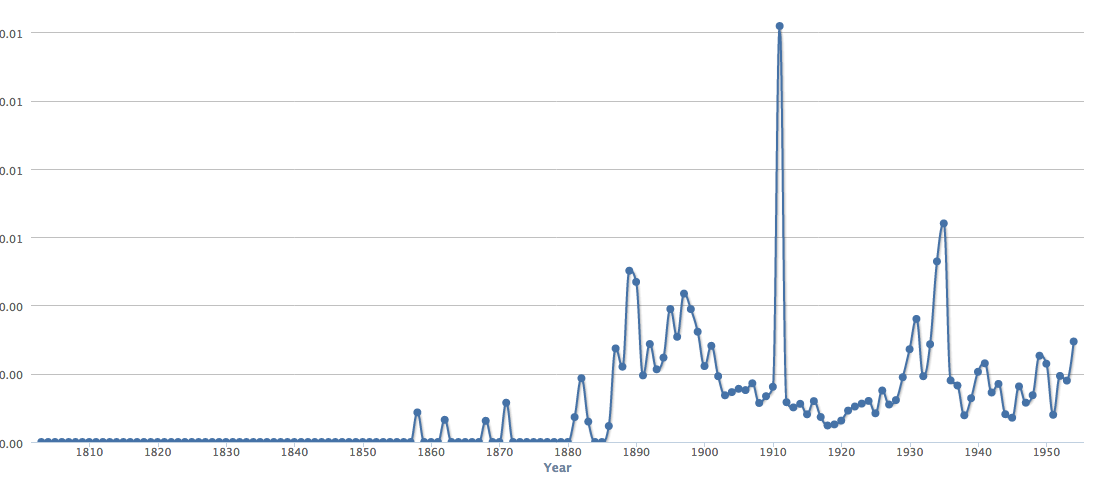
However playing with QueryPic gives a nice tight peak in 1911:

Image

and in fact there are slightly under 170 mentions, for example this report from the SMH.

The tightness and height of the peak shows that clearly the trial was a major sensation.

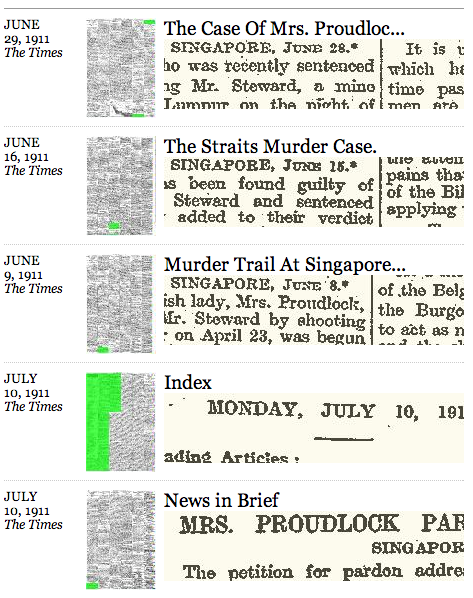
The other thing it shows is how quickly news was spread – searching the London Times archive gives five equally tightly grouped results:

Image

in other words, news was now spread as quickly to Australia as it was to England. Singapore of course lay on the major telegraph route between the UK and Australia, so this is hardly surprising but quite a nice little demonstration of the speed of the spread of the news in both directions ….

Posted in Uncategorized | Tagged , , , | Leave a comment

Newspaper logos and the British Empire

Newspaper brands and logos are much of a muchness, although you can pick out some memes – like the use of an Olde English style font for a bit of gravitas as seen in ‘proper papers’  like the SMH, Canberra Times, London Daily Telegraph, NYT and others too numerous to mention.

Interestingly even newspapers such as the Bangkok Post and the Siberian Times, designed to service a small expatriate community are devotees of the Olde English design  for their logo

But there’s another logo meme out there – the crest and text meme as shown in the London Times and London Observer, not to mention the London Sunday Times.

The same basic design crops up in the Press in Christchurch, The Age in Melbourne and in the Times of India, and The Hindu. From my admittedly very unscientific skimming of US newspaper websites it doesn’t seem to show up on any US newspaper logos.

So, guessing that the basic design was a British Empire thing, with newspapers. most of whom were nineteenth century foundations, consciously modelling their appearance on the London Times to give themselves gravitas with the assumption that a good many of their readers would be familiar with the UK original.

The logo similarity is quite a stunning effect – more than once I’ve had to look twice to convince myself that the Sunday Age is indeed the Sunday Age and not a weekly edition of the Times that somehow found its way into Hughes bakery.

So, like red post boxes, the ghost of the British Empire lives on …

Posted in Uncategorized | Leave a comment

Using Welsh Papers online ..

Inspired by my various experiments with Trove and QueryPic and following on from Jim Mussell and Bob Nicholson’s posts about the new Welsh newspapers online site, I thought I’d give it a go with my favourite topics of the moment, the CSS Alabama and the surrender of the CSS Shenandoah.

As you might expect, both topics generated a fair amount of coverage and were obviously topics of interest at the time.

However, I found myself comparing the site in usability and usefulness to Trove. The Welsh site is of course a beta and consequently some features may not be as functional as they might.

Like Trove it displays the scanned article and the OCR’d text in a fairly standard three pane interface.

Missing is the ability to download the article in either a PDF or as a JPEG, something which should be relatively easy to provide given that the images are almost certainly held as TIFFs. This would also be useful should the Welsh National Library ever want to follow the NLA and start a crowdsourced OCR correction project – it’s simply easier to work from a printed page.

PDF download also provides a simple way of getting content into Evernote for later annotation.

The OCR’ing of the articles appears to be an ondemand process and sometimes it took several sets of double clicks to produce the text. In general the OCR’s text seems to be more accurate that that in Trove, but that could just be an artefact of the half dozen articles I chose.

The only practical way I found to get material into Evernote was to laboriously cut and paste the material from the webpage into Libre Office, change the font from very pale grey to something useful, top and tail the document with the source and date, and then email the pdf to Evernote.

Yes, it works, but it’s certainly not fluid.

There are other things as well – the navigation widget does not let you scroll left right making the hunting for and onscreen reading of text at the highest resolution an interesting experience.

That said it’s a beta, and it certainly has a lot of potential.

Given the power of QueryPic to find material, it would be great if they also provided an api to allow third party search tools access their resources.

Posted in Uncategorized | Leave a comment

How the news came from Galle

Happenstance is a wonderful thing.

I was helping J out yesterday by googling for some nineteenth century sources about early steamship travel to Australia when I came across this study (DOI 10.2104.ha070006) which confirms what I had suspected from my earlier posts on the Lincoln Assassination and the first internet about Australia’s connection with the rest of the world.

The author looked at reports of the Franco Prussian war in the Australian press of the time and the effects of ‘bunching’ caused by the overseas news arriving in distinct lumps, and also how Australian east coast newspapers had special correspondents placed at Albany to meet the mail steamers and work through the mail to create summaries to be telegraphed as soon as the connecting South Australian mail boat reached Adelaide.

The other thing that struck me about the study was how simple my lightweight study had been to carry out, compared to pre-digital days (less than a decade ago) when the author must have had to spend a considerable amount of time in newspaper archives rather than a  couple of lunchtimes playing with QueryPic …

Posted in Uncategorized | 4 Comments

Building the first internet

The telegraph network was the first internet, enabling a step change in the speed of communication and the spread of news.

The telegraph was seen by the British as something to hold the empire together, especially as after the 1857 conflict in India.

During the conflict the telegraph came into its own relaying military information much as it did during the American civil war, but it’s clear from reading the histories of the conflict that the local British command was very much on their own. No one in Britain really knew what was happening as reports had to travel by ship to the nearest terminus to be telegraphed on, and the nearest terminus was Suez, so even though the telegraph networks built in India were used by the British to their advantage they were still disconnected from the government in London.

Any news was at least two or three weeks old by the time it got to London.

The obvious thing would be to build a link – but interestingly, as this newspaper report from the Hobart Mercury in 1863 shows the building of a link was neither particularly rapid or problem free.

From and Australian point of view the timing is interesting – the route across Australia had been surveyed and already the Netherlands was building a link from Jakarta (then known as Batavia) to Singapore. It’s clear that from the article that the building of the link to India was seen as important to Australia’s integration into the modern world.

Australia was still dependent on surface mail until the early 1870’s and even then everything more than the headlines would still have come via sea. When you look at the newspapers of the time and the information sent by ‘electric telegraph’  a lot of it is commercial information – wheat and wool prices in London and New York for example – information that crucial to trade.

So as well as quickening the spread of news the telegraph had a role in increasing the pace of business and in tying Australia into the global economy …

Posted in Uncategorized | 2 Comments

Querypic, commerce raiders, and the American civil war at sea

Playing with querypic can be addictive, as I did when trying to work out how quickly the news of Abraham Lincoln’s assasination spread to Australia, or more accurately the happenstance element of the other things that you find along the way is incredibly addictive, such as this apology for delayed mail at a time when the mail steamers brought the news from overseas:

The detention of the mails this month arose from the incompetency of the Peninsular and Orient steamers to keep to the contract times. The rate of speed from Suez to Galle and King George’s Sound only averaged seven and a half knots per hour. Througout the average speed ofAustralian Steam Navigation Company’s mail steamer was ten and a half knots in unfavourable weather.

Amusement aside, the thing that looking at these old newspapers gives you is the realisation of the extent to which the American civil war was a worldwide sensation with regular reports from the battlefield. This was very much a reported war.

The war is usually represented in history books as an almost exclusively land based war, but reading these reports, it rapidly becomes clear that there was a substantial naval conflict with what the Confederacy styled commerce raiders and other privateers and worse preying on Union shipping. Much in the way that German auxiliary cruisers such as the Kormoran preyed on allied shipping during world war II.

The 1860’s was a time of change in shipping – steamships or sail assisted steamships were becoming the norm. The great shipping lines of the latter half of the nineteenth century were not yet in operation, and a lot of cargo was still carried on sailing ships – after all if the cargo was not time critical sail would do, and on the right route at the right time of year sail could still beat steam.


The other thing to realise is the importance of whaling. Whales provided the oil for oil lamps, making the supply of oil critical in a time when most lighting outside of towns and cities was in from oil lamps. Disrupting whaling would disrupt the supply of lighting oil and hence rural life and industry.

Whaling ships would sail from New England in pursuit of whales – for oil, for baleen. The whalers would sail down to the Southern Ocean or round the Cape of Good Hope up to San Francisco and then up into the sea of Okhotsk.

San Francisco was a small wild whaling port at the time, and because of the lack of an overland route from the east coast almost as isolated as the colonial cities of Australia or New Zealand. Other towns on the west coast of America such as Portland and Seattle were not much more than logging camps and trading posts, meaning much of what went on in the northern Pacific was out of sight from news corrspondents.

And where the whalers went the Confederate privateers pursued them.

The Confederate navy was not based on the American mainland but unofficially and de facto in Liverpool, which was one of the largest ports in England at the time and the main import route for cotton from the southern states to the Lancashire cotton industry. The cotton industry was of critical importance to the south as their main export and earner of foreign currency. The Union however successfully blockaded the Confederate ports, and while some ships did run the blockade the trade was effectively strangled by the blockade.


Unsurprisingly when the southern blockade runners tried to get their cargo out it was to Liverpool, meaning that the Confederate government had a semi official office in the town, and gradually the role of this office changed from organising cotton shipments to acquiring ships, or having ships built and then moved to a friendly port to be commissioned and armed as confederate navy vessels.

Britain, shall we say, while officially neutral had an extremely lax interpretation of neutrality with shipyards in Liverpool and on the Clyde building blockade runners and later commerce raiders for the South.

These commerce raiders were front page news around the world. One of the privateers the Alabama, distinguished herself by sinking a Union vessel in sight of the shore off Cape Town, again something that was front page news at the time. The Alabama then ran for Cherbourg and was sunk nine miles off Cherbourg by a Union vesssel, the Kearsarge.

News of civil war naval engagement in the English Channel was a major sensation in both London and Australia, with graphic accounts of the conflict being published in the press.

Another privateer, the Florida was lying in Brest at the time, and when explosions were heard off of Jersey in fog a few days after the Alabama’s sinking it was assumed wrongly that the Kearsarge had found another victim. In fact neither the Kearsarge or its sister ship found the Florida.

The last of these privateers, the Shenandoah didn’t surrender until November 1865, more than six months after the end of the war, and then it was to a British naval vessel, the captain probably guessing that the British would be more acommodating than the Union navy.

To emphasise the global nature of the conflict, the Shenandoah had previously put in to Melbourne for repairs, something that was a major sensation for the newspapers in Victoria at the time, and consequently her surrender half a world away was most definitely newsworthy.

As well as giving a sense of the history, following the stories through shows how the news was relayed by the first news agencies, picking up and relaying stories from the English press to newspapers in Australia and New Zealand, and shows how the advent of the mail steamer and the telegraph meant that life in Australia ceased to be ‘life on Mars’ but life on somewhere connected to and engaged with the rest of planet Earth.

Posted in Uncategorized | 2 Comments