Yala
After Mirissa, it was on to Yala, in the far south east of the island. Yala is pretty much nothing, an epanse of scrubby forest, but it is a massive nature reserve, and the last place you can see, or hope to see leopards, in Sri Lanka.
And seeing leopards was what we were about.
Basically you have to book onto a trip on a jeep with a driver and a guide.Getting a jeep (actually a Tata pickup with at least one bald tyre) and a driver and a guide to ourselves was ony a few dollars morethan going with a larger party.
You then set off bouncing around the reserve along dirt tracks. Obviously, they don’t let you walk round the reserve on your own or get out of the jeep.
Our guide turned out to be really knowledgeable and had previously worked on a loris conservation project on the Horton Plains, and was an accomplished wildlife photographer, which meant we saw everything, including a leopard, twice. Our driver was pretty damn good as well, both at spotting animals, backing up and creeping his freewheeling vehicle along to give us a better view.
Once, a female crossing a track ahead and the second time a big male who looked rather pissed off with the whole business. You could imagine it thinking ‘just get out of the jeep and you’re dinner’.
That was day one. We’d signed up for two days wildlife spotting, and our sightings turned out to be beginners luck. Day two, we saw things, but no leopards. (Actually not strictly true, our guide spotted one asleep in a tree and got a good long distance shot of him, but with even with field glasses he was pretty indistinct)
Day two was however enlivened by the surprise appearance of a snake.
We were having lunch in our hotel before going out on one of the jeep trips. Leopards, being cats, are pretty crepuscular, and basically like to doze through the hotter part of the day, only being active in the morning or the evening, meaning there’s not that much doing around lunchtime.
Our hotel was a fairly standard tourist hotel, although they did warn you about crocodiles hauling out of the estuary next to the swimming pool. They said they’d never had one in the pool, but let’s just say never is a long time. There were certainly some pretty impressive crocs in the estuary.
The hotel consisted of a group of cabins round a central complex with pool, bar, restaurant etc. At night they advised you not to go walking on your own due to wild elephants and suggested you ask for a guide to walk you to your cabin. Should you go on your own they suggested that you take a torch, to throw at the elephant, with the aim of distracting it long enough for you to make your escape.
Being on the edge of the Yala national park it was fairly wild.
So, back to the story. We were sitting in the bar having lime sodas and something to eat when this beautiful thin iridescent blue snake appeared out of some vegetation and slid across the floor of the bar.
This, not unnaturally caused a degree of disturbance, the snake took fright, and climbed up inside wickerwork of a cane table, where it refused to come out, though it did occasionally poke its head out.
The bar staff, who you would think would be pretty blase about such happenings were as excited and fascinated as anyone by this and all came one by one to look at it.
The consensus was that the snake was not harmful, and they gingerly moved the table out of the bar area and left the snake to make its escape in its own time.
Nuwara Eliya, trains, and Fawlty Towers
From Yala, we went on to Nuwara Eliya, an old British hill station in the mountains. We could have gone direct but instead we hired a minivan to take us to Ella, where, if we could get seats in the observation car, we would get the train to Nuwara Eliya (actually Nanu Oya, Nuwara Eliya is nine or ten kilometres away on the other side of the valley.
The drive to Ella was interesting and scenic, and we got there so early the previous train, a nice modern blue Chinese made one, was going through. This occupied the whole station staff, including the station master who had a slightly comic opera white uniform like a nineteenth century naval officer, so we had to wait outside while they dealt with the train and the half dozen passengers.
We waited in the yard while all this took place, but eventually they opened the ticket office, which looked like it hadn’t been updated since the British left, although it did have an elderly Dell computer in the corner.
Booking tickets involved a long drawn out conversation
me: Two first class observation car tickets for Nanu Oya please
    Clerk: two?
Me: Yes
Station master shuffles off to computer, logs in to what looks to be an online booking system and fiddles about for some minutes, and then comes back.
Clerk: Colombo ?
    me: no, Nanu Oya
Clerk: Today ?
    Me: yes, next train, please
Shuffles off, more buggering about and eventually he returns
Clerk: OK, you can go
    me:how much?
Clerk: Rs2000/-
At this stage you would think that was the end of it, but no, he wanders off again and communes again with Sri Lankan Railways intranet. However at the end of it an elderly dot matrix printer burbles into life and he returns with a train ticket – or more accurately a printout – Sri Lankan railways evidently don’t use pasteboard tickets, but instead something that looks very much like an e-ticket.
The whole transaction takes about ten minutes. The moral being that if you want to do this, book your ticket at a quiet time the day before.
Ella station itself looked like a nineteen fifties English country station, or perhaps more accurately like a tv representation of such a station. Certainly it was out of the same playbook, quiet, sleepy and very pleasant. Even though we were up in the hills it was warm and sunny like a spring day at home.
Along with other people we waited, and talked to a tea planter who liked trains and had come to see the train. He gently corrected me when I called the 5’6″ gauge ‘Indian Gauge’ – here it was most definitely Sri Lankan Gauge.
We heard the train long before it arrived as it hooted up the curves. It consisted of an elderly disel locomotive, some older passenger cars, and the fabled observation car.
This turned out to look like something the British had left behind. It possibly wasn’t, but it looked it. Varnished wood panelling to be sure but the seats were tatty and inexpertly patched, the observation windows at the rear were cracked and had crazing from stone chips and some of the other windows were held together by sticky tape and optimism. Some didn’t open, some were jammed permanently open.
Ours opened, but the horizontal frame was rotten, and parted company with one of the verticals when we opened it.
Still, we were rolling, and the view was superb over tea plantations and people picking tea. The stations we rolled through in the main looked like old English country stations, even down to the lavatories – quaintly still labelled ‘For Gentlemen’. All in all pleasantly bucolic.
And then we went over the watershed, and the day changed. A cold wind began to blow and it began to rain, first as light showers and then more and more. It began to feel cold and the landscape (and the railway line) started to look like an overdone version of the West Highland line in Scotland.
At Ambewela the train stopped. First to let the up train past, which consisted of older passenger cars and then for another forty minutes while it awaited a second up train – this time one of the nice new Chinese ones.
I managed to hold the window together so we could close it. Fortunately we’d packed jumpers in our grab bag and had chosen to wear long pants rather than shorts so we were somewhat warm – the railway people were wearing woolly hats and padded anoraks, and it was distinctly chilly.
Eventually we started rolling again, and rattled into Nanu Oya an hour late. By this time it was raining steadily.
We’d planned to get the train onwards on the Sunday to Kandy. Probably if I’d had my wits about me I should have tried to book this at Ella. Here the booking clerk pointedly ignored me and counted his takings. Eventually he relented and asked me what I wanted.
He told me to go to the other window and asked me again what I wanted.
two first class to Kandy on Sunday
after a bit of to and fro to confirm that I really wanted the morning train on Sunday he consulted his computer.
Clerk: All full
    me: second class ?
Clerk: only one
At this point J had found a minvan to take us to our hotel and the driver came to help. Fortunately he had better English than the booking clerk, and definitely speeded up the process.
After a short exchange in Sinhala, the conclusion was that I should buy two third class seats to get onto the upgrade waitlist – at Rs800/- it was cheap enough to give to some other traveller or even throw away if there was no upgrade available.
When we got to the minivan the driver gave me his card and offered to drive us to Kandy for Rs8000/- on Sunday if we couldn’t get first class tickets. By the time we’d got to Nuwara Eliya we’d decided to take him up on his offer given it would cost us at least what we’d spent on the third class reservations to get a van back to the train station, not to mention the hassle of having to get people to phone and sort out if upgrades were available.
The moral of the story is to book your trains in advance, which given the lack of an online booking service, can be a big ask. That, and always have a plan B.
Nuwara Eliya
Nuwara Eliya means City of light – well it was misnamed it should have been called City of Rain – the wind howled and the rain descended in Biblical volumes during our stay.
This would not have mattered if it wasn’t for the fact we were staying at Fawlty Towers. It was supposed to be a boutique hotel in an old colonial bungalow with roaring woodfires an the like.
Certainly the location looked very English – Nuwara Eliya claims to be a colonial hill station, and while it was that once, now, in reality it’s a slightly scruffy Sri Lankan town with concrete shops and a few colonial relics.
That said, the area of the town where the bungalow was located did look a bit like a half remembered dream of home counties england.
When we got there, there was no one home, except for one houseboy who had no idea we were coming and who had never seen a booking docket. He also couldn’t speak English, other than a few words, which didn’t help. After our driver explained the way of the world to him, he grudgingly let us in.
It was cold, damp, no roaring wood fires to be seen, the only heating a distinctly arthritic fan heater and there was no hot water.
Eventually the rest of the staff returned from the supermarket, including the manager, who managed to get the hot water going again.
He apologised for the lack of fires, saying he had tried to buy wood but it was all wet. I bit my tongue and resisted saying something sarcastic about woodsheds and getting supplies laid in in the dry season.
That night we ate in the hotel. Dinner, while good was a chilly experience, but the staff did give us hot water bottles, with slightly incongorous Peter Rabbit covers.
The next day was no better, but we caught a tuk tuk down into the town to walk about, take photographs of colonial heritage, and generally explore.
It was too wet and horrible for that. We did visit the park, but were forced to retreat under the bandstand with stray dogs and canoodling teenagers (the park did have a stern warning that visitors were to ‘behave decently‘) from the rain.
Another time, another day it might have been good, but we had a damp and cold experience and after lunch in a bakery retreated to the hotel to read and write.
Everything, including the towels was damp due to the rain and cold, so we asked for new towels which resulted in the following dialog:
J:  I don’t mind if you don't clean the room, but could we have some fresh towels?
H: There are no towels.
J: But we are the only guests, you must have some more.
H: Towels are all wet madam
J: Aren't there any dry ones at all?- that means you only have 3 towels.
H: No madam, towels are all wet.
As if to prove a point the guy came back with a neatly folded pile of sodden towels.
That evening we thought we’d treat ourselves and eat at the Grand Hotel, one of the big old colonial hotels. The Grand had started life as the British Governor’s summer residence in the middle of the nineteenth century, but at some point the Governor acquired a new summer residence, which is still occasionally used by the president of Sri Lanka, and the Grand Hotel was born
It really was an immense old colonial relic, with waiters everywhere – going to the toilet was an experience where the attendant turned the tap on for you when you washed your hands, handed you soap and a towel, and turned the tap off.
(Shades of the time a few years ago we went to the best hotel in Tiznit in Morocco. principly because they served wine with dinner, and the toilet attendant insisted on flushing the toilet for you and then expected a tip – at least in Sri Lanka they didn’t want a tip – or flush the toilet.)
We felt a little underdressed even in our ‘smart’ clothes, but actually we shouldn’t have worried – the hotel was full of guests from the gulf states, most of whom were dressed in an approximation of ‘western casual, some more successfully than others, plus the occasional shiny middle eastern suit.
However, we didn’t eat at the Grand – they provided a fairly boring western style menu (Oxtail soup, roast beef with vegetables, etc) that they’d probably been serving since 1920. Instead, after a couple of shockingly expensive whiskies (Rs2000/- for two J&B’s) we went to the Grand Indian an Indian restaurant run by the hotel.
Inside it could have been in Wigan. Actually it couldn’t, due to the presence of jolly Arab families, the women still in burkahs, but all sitting together, talking, taking pictures of each other, but in style it could be an Indian restaurant in England, even down to the food.
Actually, the food was better than that, all freshly prepared and cooked to order.
After that it was back to the hotel and then onto Kandy the next day.
Kandy
The drive down to Kandy was interesting – past roadside stalls selling cool climate vegetables and flower sellers (Nuwara Eliya is famed for its flowers and european vegetables – being comparatively cool and wet the grow well there) with spectacular rain soaked views of waterfalls and valleys.
It never really stopped raining all the way down, and was still wet in Kandy. We stayed the the Queen’s Hotel, a charming old colonial relic directly opposite the Temple of the Tooth and on the lake.
The Queen’s has a magnificent period diing room with exposed steel beams and big old fans just like you see in pictures of the British Raj in India, and big echoing corridors. Definitely charming, even if the hot water is sometimes a bit erratic.
That afternoon it finally stopped raining and we went for a walk to stretch our legs. We first of all waled up to St Paul’s church, the old anglican church, built in colonial times provocatively close to the Temple of the Tooth.
The church was tatty in a very Anglican way, but did have some very good Victorian stained glass.
The verger very proudly invited us in and told us that they still got over 200 people to the main service on a Sunday.
Looking at the list of Vicars, it was interesting to see how the names changed – up to and just after independence they were very English names, and then, through the sixties and the seventies they became solidly Sri Lankan.
Rather than visit the Temple of the Tooth, which was crowded with pilgrims attending puja we contented ourselves with looking through the bars of the compound at the ceremony.
We then walked on to visit the old British Garrison cemetery and discovered round the back of the compound there was a pilgrims entrance with flower sellers and the like and we lucked out by arriving just as the dancers came out of their dressing room and waled over and into the compound.
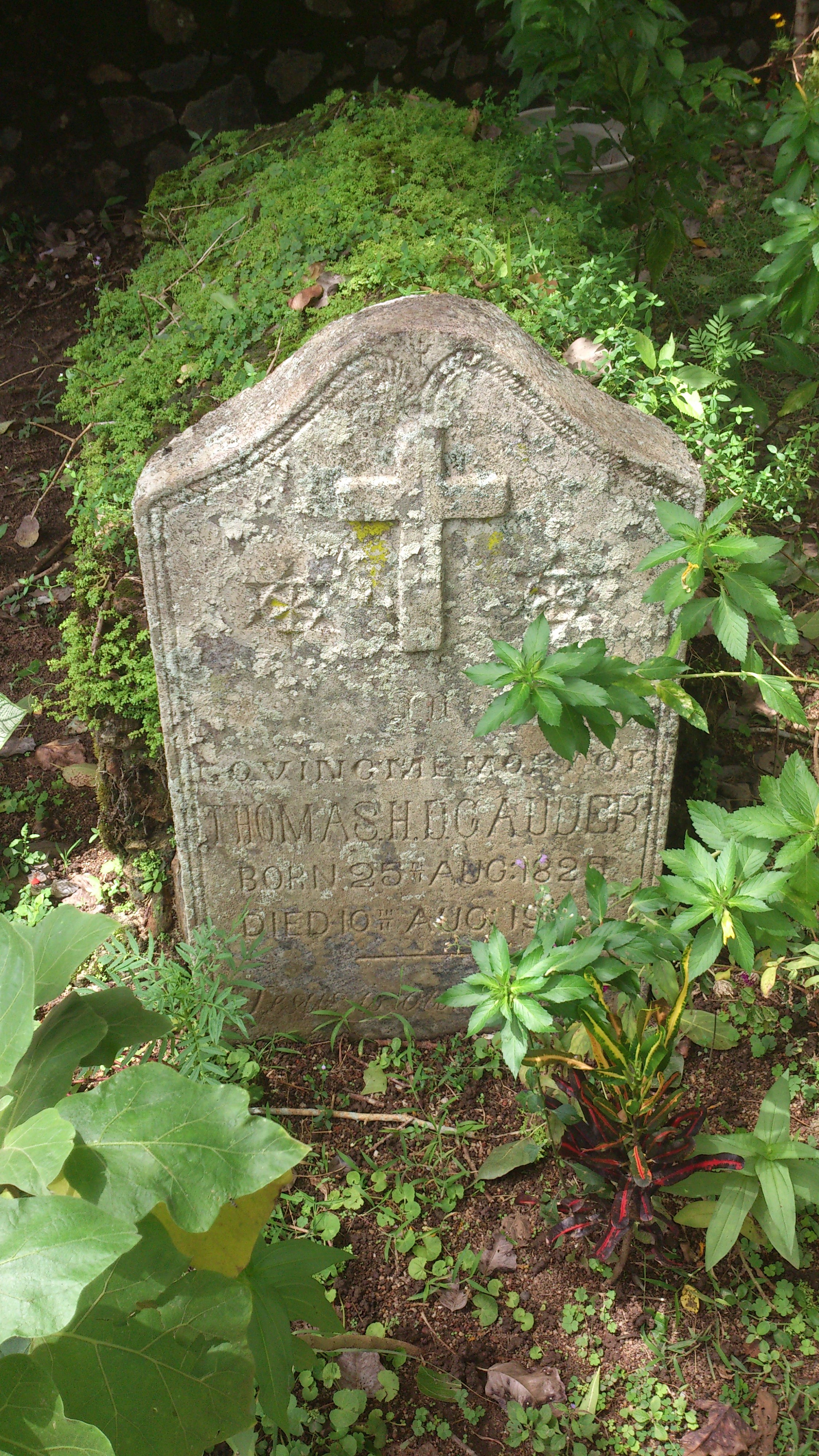
We then walked up the hill to the old Garrison cemetery, now looked after by a local historical association. Inside the cemetery there were several soldiers letting off strings of firecrackers in an effort to scare off the resident langurs.
The monkeys totally ignored the fire crackers and got on with being aggressive squawking monkeys. To be fair, they were aggressive to each other, not to us.
The caretaker was a nice old man who told us all about the graves and the restoration project, including the fact that the first person who was buried there had fought at Waterloo. (Actually, it’s not as insane as it sounds – Waterloo was fought in 1815, and the British took over the Kingdom of Kandy, the last remaining independent kingdom in 1814. Lachlan Macquarie, later governor of New South Wales, served there with the 73rd Perthshire regiment which had a globe trotting career. In fact one of the things that is quite fascinating about the history of the British Empire is the way that people popped up in quite unexpected places.)
The heavens then opened again. We’d intended to go and see the Kandyan dancers that evening but it was just too bloody wet. Instead we ate a very odd Chinese meal in the hotel Chinese restaurant.
The next day the sun came out and we visited the temple of the tooth, which is quite magnificent, but, not being practicing Buddhists, totally incomprehensible.
However we paid our respects to the monks and left an offering as requested.
After lunch – in the Olde Empire – a very traditional Sri Lankan curry house across the square from the hotel – we were then off to our next destination.

 stuff 'n other stuff